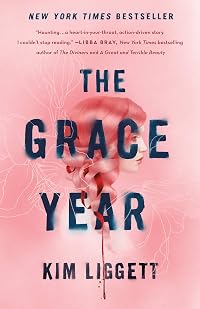
The Grace Year
by Kim Liggett
On This Page
Description
Tierney James, sixteen, struggles to endure the year in which she and other young women are banished to the wild until, purified, the survivors are allowed to return home and marry.Tags
Recommendations








Member Reviews
Rare is the book that actually merits a comparison to The Handmaid's Tale.
(Full disclosure: I received a free e-ARC for review through NetGalley. Trigger warning for misogyny, homophobia, violence - including rape - and suicide.)
“In the county, everything they take away from us is a tiny death. But not here . . .” She spreads her arms out, taking in a deep breath. “The grace year is ours. This is the one place we can be free. There’s no more tempering our feelings, no more swallowing our pride. Here we can be whatever we want. And if we let it all out,” she says, her eyes welling up, her features softening, “we won’t have to feel those things anymore. We won’t have to feel at all.”
###
“In the county, there’s nothing show more more dangerous than a woman who speaks her mind. That’s what happened to Eve, you know, why we were cast out from heaven. We’re dangerous creatures. Full of devil charms. If given the opportunity, we will use our magic to lure men to sin, to evil, to destruction.” My eyes are getting heavy, too heavy to roll in a dramatic fashion. “That’s why they send us here.”
“To rid yourself of your magic,” he says.
“No,” I whisper as I drift off to sleep. “To break us.”
###
I've started and stopped, cut and pasted this review so many times over the last few weeks that I've lost count. The truth is that The Grace Year left me speechless and, as with all of my favorite books, I'm afraid that nothing I might write will do it justice. This is the kind of book that merits a twenty-page thesis, not a 500-word review. (Though, let's be honest, precious few of my reviews clock in at less than 1,000 words.)
You can gather the basics from the synopsis. Our protagonist, sixteen-year-old Tierney James, lives in a culture that hates and fears women. It's believed that young women possess a powerful, dark magic; paradoxically, they're also considered men's inferiors. For the good of society, young women are banished from Garner County for the entirety of their sixteenth year.
The goal during the "Grace Year" is twofold: to purge the magic from their bodies so that they can return home pure and ready to be married - and to return home, period. Their wild and wicked magic; the harsh wilderness; and the poachers who aim to kill them and sell their bewitched body parts on the black market: all stand between the girls and survival.
The Grace Year follows Tierney and her cohorts as they claw, fight, manipulate, and straight up slay their way through 365 days of exile. Along the way, Tierney calls on her specialized knowledge - her dad is a doctor who always wanted a son, and thus "spoiled" his middle daughter by teaching her useful life skills - to try and change the system from the inside. She dreams of a young woman who carries within her the spark of revolution. She can only hope that her visions are more prophecy, less the random firing of neurons.
The story is told in four main parts, each corresponding to one season in Tierney's Grace Year: autumn, winter, spring, and summer. There aren't chapters to divvy things up further (at least there wasn't in the ARC), which makes each section feel L-O-N-G (in a good way!). Whereas some reviewers complained about this format, I loved it: it gives the readers a sense of the slow passage of time as the Grace Year girls experience it, the weight of days differentiated from one another only by violence and death.
Usually I scoff when books are blurbed as "The Handmaid's Tale meets XYZ," but I think the comparison is more than warranted here: The Grace Year is The Handmaid's Tale meets Lord of the Flies, with a dash of The Hunger Games meets Bridezillas for extra-crunchy complexity. There's so much to unpack and dissect here.
In The Grace Year, Kim Liggett has created a semi-fictional world that could exist at (nearly) any time or place in history. The lack of modern technology - there are references to lithographs and gas lamps, and a distinct absence of electronics - hints at the past. Perhaps Garner County is an isolated community in 1800s America? Yet, without a detailed backstory of how Tierney's community came to be, she and her ilk could just as easily live in some future dystopia, a society rebuilt from the ashes of a pandemic or world war. Or they could inhabit another 'verse altogether. I love that the setting is open to interpretation, because it prevents us from dismissing Garner County as something from our past: a result of primitive and outdated beliefs that we have since moved beyond.
News flash: misogyny and homophobia (and racism, classism, ableism, etc.) are still alive and well. Just read the damn news, mkay.
Again just from the synopsis, it's glaringly obvious that Tierney's is a strictly religious and patriarchal society marked by rigid gender roles...but this summary hardly does it justice. Think: the fictional Gilead in The Handmaid's Tale. Or Women Talking, inspired by the very real mass rapes that took place in Manitoba County, a Bolivian Mennonite settlement.
In Garner County, women face myriad restrictions, including but not limited to the following:
- Women are branded with their father's sigil at birth. They are quite literally owned by their fathers, until the time they are bartered and traded to would-be husbands. Needless to say, they have no say in who they marry.
- Young women who go unclaimed have three options open to them: they can become maids, field laborers, or prostitutes in the outskirts.
- Married women are required to perform their "wifely duties": “Legs spread, arms flat, eyes to God.” In other words, wives are raped on the regular.
- Though it's not stated outright, it's safe to assume that birth control and contraception are outlawed, at least for married women. (Married) women are not allowed to determine how many children they bear, if any.
- It's considered blasphemous to pray for a baby girl (because we're worthless, see?).
- Women are only schooled until the age of ten.
- "All the women in Garner County have to wear their hair the same way, pulled back from the face, plaited down the back. In doing so, the men believe, the women won’t be able to hide anything from them—a snide expression, a wandering eye, or a flash of magic. White ribbons for the young girls, red for the grace year girls, and black for the wives. Innocence. Blood. Death."
- "We’re forbidden from cutting our own hair, but if a husband sees fit, he can punish his wife by cutting off her braid."
- "We’re not allowed to pray in silence, for fear that we’ll use it to hide our magic."
- "The women of the county aren’t allowed to hum—the men think it’s a way we can hide magic spells."
- Adult women cannot wear hoods or other protection against the elements: "After their grace year, their faces needed to be free and clear to make sure they weren’t hiding their magic. The wives scarcely went outdoors during those months."
- "In the county, bathing with flowers is a sin, a perversion, punishable by whip."
- "The women aren’t allowed to own pets in the county. We are the pets."
- "The women aren’t allowed to congregate outside of sanctioned holidays."
- If a girl does not return from the Grace year - either alive or in bottles - her female family members will be punished by banishment.
Some of these rules are universal to what you'd expect to see in a religious patriarchy: anything to keep women voiceless, segregated, and compliant. In a word, powerless. Others feel like loving throwbacks to The Handmaid's Tale: for example, the scene where Tierney defiantly bathes with a flower brings to mind Offred, secreting away a pat of butter to moisturize her dry and purely functional (to Gilead) body.
One detail that jumps out at me is how the girls and women are pitted against each other, so that they exist in a perpetual state of competition rather than cooperation. Similar to what you'd see in FLDS communities, there's a sizable gender imbalance in Garner County; created not by casting young men out, as is the polygamous Mormon way, but by drafting lower-class men as Guards, denying them wives, and then castrating them to prevent unauthorized pregnancies. (This is one obvious deviation from The Handmaid's Tale, where lower-class men like Nick are at least allowed the hope that they may one day merit a Wife.)
Thus, there are more eligible wives than husbands - and as the position of wife is the "best" a young woman of Garner County can hope for (the gilded cage), women are pitted against each other. As if this isn't offensive enough, the veil ceremony takes place immediately before the potential brides leave for their Grace Year. Picture it: you're a scared sixteen-year-old girl who was just sentenced to a life of hard field labor; the only thing standing between an early, sun-baked death and a relatively cushy life as a wife and mother is a scrap of fabric. You're alone and unsupervised, for the first time in your life; your body coursing with magic. What now?
Garner County has effectively incentivized murder - hence The Hunger Games meets Bridezillas. Not that state-sanctioned murder should come as a surprise: the death penalty is alive and well. See also: the poachers. In truth, not all of the Grace Year girls are meant to return home: not when they are sent into the wilderness with inadequate housing and provisions, and certainly not when they state sanctions poaching. Women are nothing if not expendable.
Magic is also a common theme but, as Tierney so astutely observes, men only seem to discover evidence of magic when it is convenient for them: "Like when Mrs. Pinter’s husband died, Mr. Coffey suddenly accused his wife of twenty-five years of secretly harboring her magic and levitating in her sleep. Mrs. Coffey was as meek and mild as they come—hardly the levitating sort—but she was cast out. No questions asked. And surprise, surprise, Mr. Coffey married Mrs. Pinter the following day."
Women are so thoroughly indoctrinated that they question themselves whenever they have an impertinent thought or experience a flash of anger: "And I wonder if this is the magic taking over. Is this how it starts—the slip of the tongue? A loss of respect? Is this how I become a monster the men whisper of? I turn and run up the stairs before I do something I regret."
Spoiler alert: magic isn't real. Or perhaps it would be more accurate to say that magic, as it's defined in Garner County, is not mysterious or supernatural in nature. Rather, magic is code for women's anger. Magic is when a women speaks her mind and demands equal treatment. Magic is women working together to overthrow the patriarchy and create a new, more equitable society in which they are valued and respected. Magic is a tiny red flower. Magic is revolution.
(Here, I'm reminded of another book: Rage Becomes Her: The Power of Women’s Anger by Soraya Chemaly:
"Ask yourself, why would a society deny girls and women, from cradle to grave, the right to feel, express, and leverage anger and be respected when we do? Anger has a bad rap, but it is actually one of the most hopeful and forward thinking of all of our emotions. It begets transformation, manifesting our passion and keeping us invested in the world. It is a rational and emotional response to trespass, violation, and moral disorder. It bridges the divide between what 'is' and what 'ought' to be, between a difficult past and an improved possibility. Anger warns us viscerally of violation, threat, and insult. By effectively severing anger from 'good womanhood,' we choose to sever girls and women from the emotion that best protects us against danger and injustice.")
It's no wonder the men fear it.
Of course, not everyone is hip to the true nature of women's magic, and it's enthralling to see how this plays out in the little community formed by the Grace Year girls. I love how Liggett devises a very reasonable, if not mundane, explanation for the manifestation of the girls' magical powers. And the power dynamics that arise out of this are pretty shrewd and insightful, with plenty of real-world consequences. This is how cult leaders are made. Or 45th presidents.
There's so much more I want to rave about: The way that Liggett uses Hans to eviscerate the Nice Guy (tm) trope. The kinship between women and animals, and the vegan feminist ethic that might arise from recognizing and honoring our similarities. The sheer, raw power (might I say "magic"?) of sisterhood. The seed of revolution that blossoms here.
The Grace Year may not take place in 2019 America, yet its lessons are painfully relevant today.
My only complaint - and it is not a minor one - is the complete absence of race from the narrative. Only a few of the girls are described in great physical detail; those that are all appear to be white. Do no women of color live in Garner County? If not, why not? Perhaps darker skinned women do exist, but simply are not valued as Wives in this white nationalist patriarchy. If this is the case, we'd expect to find them laboring in the fields, serving the white nuclear families, and bearing the brunt of toxic masculinity as sex workers in the outskirts. As with The Handmaid's Tale, this is an egregiously weak spot in an otherwise powerful and engaging story.
http://www.easyvegan.info/2019/10/04/the-grace-year-by-kim-liggett/ show less
(Full disclosure: I received a free e-ARC for review through NetGalley. Trigger warning for misogyny, homophobia, violence - including rape - and suicide.)
“In the county, everything they take away from us is a tiny death. But not here . . .” She spreads her arms out, taking in a deep breath. “The grace year is ours. This is the one place we can be free. There’s no more tempering our feelings, no more swallowing our pride. Here we can be whatever we want. And if we let it all out,” she says, her eyes welling up, her features softening, “we won’t have to feel those things anymore. We won’t have to feel at all.”
###
“In the county, there’s nothing show more more dangerous than a woman who speaks her mind. That’s what happened to Eve, you know, why we were cast out from heaven. We’re dangerous creatures. Full of devil charms. If given the opportunity, we will use our magic to lure men to sin, to evil, to destruction.” My eyes are getting heavy, too heavy to roll in a dramatic fashion. “That’s why they send us here.”
“To rid yourself of your magic,” he says.
“No,” I whisper as I drift off to sleep. “To break us.”
###
I've started and stopped, cut and pasted this review so many times over the last few weeks that I've lost count. The truth is that The Grace Year left me speechless and, as with all of my favorite books, I'm afraid that nothing I might write will do it justice. This is the kind of book that merits a twenty-page thesis, not a 500-word review. (Though, let's be honest, precious few of my reviews clock in at less than 1,000 words.)
You can gather the basics from the synopsis. Our protagonist, sixteen-year-old Tierney James, lives in a culture that hates and fears women. It's believed that young women possess a powerful, dark magic; paradoxically, they're also considered men's inferiors. For the good of society, young women are banished from Garner County for the entirety of their sixteenth year.
The goal during the "Grace Year" is twofold: to purge the magic from their bodies so that they can return home pure and ready to be married - and to return home, period. Their wild and wicked magic; the harsh wilderness; and the poachers who aim to kill them and sell their bewitched body parts on the black market: all stand between the girls and survival.
The Grace Year follows Tierney and her cohorts as they claw, fight, manipulate, and straight up slay their way through 365 days of exile. Along the way, Tierney calls on her specialized knowledge - her dad is a doctor who always wanted a son, and thus "spoiled" his middle daughter by teaching her useful life skills - to try and change the system from the inside. She dreams of a young woman who carries within her the spark of revolution. She can only hope that her visions are more prophecy, less the random firing of neurons.
The story is told in four main parts, each corresponding to one season in Tierney's Grace Year: autumn, winter, spring, and summer. There aren't chapters to divvy things up further (at least there wasn't in the ARC), which makes each section feel L-O-N-G (in a good way!). Whereas some reviewers complained about this format, I loved it: it gives the readers a sense of the slow passage of time as the Grace Year girls experience it, the weight of days differentiated from one another only by violence and death.
Usually I scoff when books are blurbed as "The Handmaid's Tale meets XYZ," but I think the comparison is more than warranted here: The Grace Year is The Handmaid's Tale meets Lord of the Flies, with a dash of The Hunger Games meets Bridezillas for extra-crunchy complexity. There's so much to unpack and dissect here.
In The Grace Year, Kim Liggett has created a semi-fictional world that could exist at (nearly) any time or place in history. The lack of modern technology - there are references to lithographs and gas lamps, and a distinct absence of electronics - hints at the past. Perhaps Garner County is an isolated community in 1800s America? Yet, without a detailed backstory of how Tierney's community came to be, she and her ilk could just as easily live in some future dystopia, a society rebuilt from the ashes of a pandemic or world war. Or they could inhabit another 'verse altogether. I love that the setting is open to interpretation, because it prevents us from dismissing Garner County as something from our past: a result of primitive and outdated beliefs that we have since moved beyond.
News flash: misogyny and homophobia (and racism, classism, ableism, etc.) are still alive and well. Just read the damn news, mkay.
Again just from the synopsis, it's glaringly obvious that Tierney's is a strictly religious and patriarchal society marked by rigid gender roles...but this summary hardly does it justice. Think: the fictional Gilead in The Handmaid's Tale. Or Women Talking, inspired by the very real mass rapes that took place in Manitoba County, a Bolivian Mennonite settlement.
In Garner County, women face myriad restrictions, including but not limited to the following:
- Women are branded with their father's sigil at birth. They are quite literally owned by their fathers, until the time they are bartered and traded to would-be husbands. Needless to say, they have no say in who they marry.
- Young women who go unclaimed have three options open to them: they can become maids, field laborers, or prostitutes in the outskirts.
- Married women are required to perform their "wifely duties": “Legs spread, arms flat, eyes to God.” In other words, wives are raped on the regular.
- Though it's not stated outright, it's safe to assume that birth control and contraception are outlawed, at least for married women. (Married) women are not allowed to determine how many children they bear, if any.
- It's considered blasphemous to pray for a baby girl (because we're worthless, see?).
- Women are only schooled until the age of ten.
- "All the women in Garner County have to wear their hair the same way, pulled back from the face, plaited down the back. In doing so, the men believe, the women won’t be able to hide anything from them—a snide expression, a wandering eye, or a flash of magic. White ribbons for the young girls, red for the grace year girls, and black for the wives. Innocence. Blood. Death."
- "We’re forbidden from cutting our own hair, but if a husband sees fit, he can punish his wife by cutting off her braid."
- "We’re not allowed to pray in silence, for fear that we’ll use it to hide our magic."
- "The women of the county aren’t allowed to hum—the men think it’s a way we can hide magic spells."
- Adult women cannot wear hoods or other protection against the elements: "After their grace year, their faces needed to be free and clear to make sure they weren’t hiding their magic. The wives scarcely went outdoors during those months."
- "In the county, bathing with flowers is a sin, a perversion, punishable by whip."
- "The women aren’t allowed to own pets in the county. We are the pets."
- "The women aren’t allowed to congregate outside of sanctioned holidays."
- If a girl does not return from the Grace year - either alive or in bottles - her female family members will be punished by banishment.
Some of these rules are universal to what you'd expect to see in a religious patriarchy: anything to keep women voiceless, segregated, and compliant. In a word, powerless. Others feel like loving throwbacks to The Handmaid's Tale: for example, the scene where Tierney defiantly bathes with a flower brings to mind Offred, secreting away a pat of butter to moisturize her dry and purely functional (to Gilead) body.
One detail that jumps out at me is how the girls and women are pitted against each other, so that they exist in a perpetual state of competition rather than cooperation. Similar to what you'd see in FLDS communities, there's a sizable gender imbalance in Garner County; created not by casting young men out, as is the polygamous Mormon way, but by drafting lower-class men as Guards, denying them wives, and then castrating them to prevent unauthorized pregnancies. (This is one obvious deviation from The Handmaid's Tale, where lower-class men like Nick are at least allowed the hope that they may one day merit a Wife.)
Thus, there are more eligible wives than husbands - and as the position of wife is the "best" a young woman of Garner County can hope for (the gilded cage), women are pitted against each other. As if this isn't offensive enough, the veil ceremony takes place immediately before the potential brides leave for their Grace Year. Picture it: you're a scared sixteen-year-old girl who was just sentenced to a life of hard field labor; the only thing standing between an early, sun-baked death and a relatively cushy life as a wife and mother is a scrap of fabric. You're alone and unsupervised, for the first time in your life; your body coursing with magic. What now?
Garner County has effectively incentivized murder - hence The Hunger Games meets Bridezillas. Not that state-sanctioned murder should come as a surprise: the death penalty is alive and well. See also: the poachers. In truth, not all of the Grace Year girls are meant to return home: not when they are sent into the wilderness with inadequate housing and provisions, and certainly not when they state sanctions poaching. Women are nothing if not expendable.
Magic is also a common theme but, as Tierney so astutely observes, men only seem to discover evidence of magic when it is convenient for them: "Like when Mrs. Pinter’s husband died, Mr. Coffey suddenly accused his wife of twenty-five years of secretly harboring her magic and levitating in her sleep. Mrs. Coffey was as meek and mild as they come—hardly the levitating sort—but she was cast out. No questions asked. And surprise, surprise, Mr. Coffey married Mrs. Pinter the following day."
Women are so thoroughly indoctrinated that they question themselves whenever they have an impertinent thought or experience a flash of anger: "And I wonder if this is the magic taking over. Is this how it starts—the slip of the tongue? A loss of respect? Is this how I become a monster the men whisper of? I turn and run up the stairs before I do something I regret."
Spoiler alert: magic isn't real. Or perhaps it would be more accurate to say that magic, as it's defined in Garner County, is not mysterious or supernatural in nature. Rather, magic is code for women's anger. Magic is when a women speaks her mind and demands equal treatment. Magic is women working together to overthrow the patriarchy and create a new, more equitable society in which they are valued and respected. Magic is a tiny red flower. Magic is revolution.
(Here, I'm reminded of another book: Rage Becomes Her: The Power of Women’s Anger by Soraya Chemaly:
"Ask yourself, why would a society deny girls and women, from cradle to grave, the right to feel, express, and leverage anger and be respected when we do? Anger has a bad rap, but it is actually one of the most hopeful and forward thinking of all of our emotions. It begets transformation, manifesting our passion and keeping us invested in the world. It is a rational and emotional response to trespass, violation, and moral disorder. It bridges the divide between what 'is' and what 'ought' to be, between a difficult past and an improved possibility. Anger warns us viscerally of violation, threat, and insult. By effectively severing anger from 'good womanhood,' we choose to sever girls and women from the emotion that best protects us against danger and injustice.")
It's no wonder the men fear it.
Of course, not everyone is hip to the true nature of women's magic, and it's enthralling to see how this plays out in the little community formed by the Grace Year girls. I love how Liggett devises a very reasonable, if not mundane, explanation for the manifestation of the girls' magical powers. And the power dynamics that arise out of this are pretty shrewd and insightful, with plenty of real-world consequences. This is how cult leaders are made. Or 45th presidents.
There's so much more I want to rave about: The way that Liggett uses Hans to eviscerate the Nice Guy (tm) trope. The kinship between women and animals, and the vegan feminist ethic that might arise from recognizing and honoring our similarities. The sheer, raw power (might I say "magic"?) of sisterhood. The seed of revolution that blossoms here.
The Grace Year may not take place in 2019 America, yet its lessons are painfully relevant today.
My only complaint - and it is not a minor one - is the complete absence of race from the narrative. Only a few of the girls are described in great physical detail; those that are all appear to be white. Do no women of color live in Garner County? If not, why not? Perhaps darker skinned women do exist, but simply are not valued as Wives in this white nationalist patriarchy. If this is the case, we'd expect to find them laboring in the fields, serving the white nuclear families, and bearing the brunt of toxic masculinity as sex workers in the outskirts. As with The Handmaid's Tale, this is an egregiously weak spot in an otherwise powerful and engaging story.
http://www.easyvegan.info/2019/10/04/the-grace-year-by-kim-liggett/ show less
A stark and brutal story of love, violence and hope, The Grace Year is a dystopian story set in a patriarchy that is intent on crushing feminine strength, individuality and freedom. Girls are brought up being told that they have the power to lure grown men and to drive other women mad with jealousy. At the age of sixteen, they are banished for a year and told to release their magic into the wild so that they can return purified and ready for marriage. But many of these girls do not make it home alive from their Grace Year. The woods into which they are sent are full of poachers, who hunt the girls with the purpose of killing, skinning and cutting up their bodies to be sold on the black market.
Rebellious sixteen year old Tierney leaves show more for her grace year hoping that she can help all the girls learn how to survive. She dreams of creating a better life for all of them, but she soon comes to realize that it is not just the wild animals and poachers that she must fear as a strange madness descends upon the girls and paranoia, superstition and mistrust prevail.
The Grace Year reads like a blend of The Handmaid’s Tale and Lord of the Flies. Be warned that physical brutality is in the forefront along with some horror elements and a harrowing story of survival. I listened to an audio version of the story as read by Emily Shaffer who did an adequate job. Although I did feel that parts of the book were over-done, the author didn’t shrink away from showing the dark side of this frightening world. show less
Rebellious sixteen year old Tierney leaves show more for her grace year hoping that she can help all the girls learn how to survive. She dreams of creating a better life for all of them, but she soon comes to realize that it is not just the wild animals and poachers that she must fear as a strange madness descends upon the girls and paranoia, superstition and mistrust prevail.
The Grace Year reads like a blend of The Handmaid’s Tale and Lord of the Flies. Be warned that physical brutality is in the forefront along with some horror elements and a harrowing story of survival. I listened to an audio version of the story as read by Emily Shaffer who did an adequate job. Although I did feel that parts of the book were over-done, the author didn’t shrink away from showing the dark side of this frightening world. show less
"In the county, there’s nothing more dangerous than a woman who speaks her mind..."
The Grace Year is everything I wanted from a YA Dystopian. The story was gripping and while I was listening to the audiobook and not reading a physical copy, I found it difficult to press pause and take out the headphones. The audio was fantastic and by far one of the best audiobooks I've listened to lately. The story played a huge part in that, of course. But the narrator also did a spectacular job voicing the characters, especially the nuances between Tierney, Kiersten and Gertie, and really made me feel immersed in the story.
The details regarding the Grace Year are kept a secret to all in the county. Similar to Fight Club, the number one rule is, "we show more don't talk about the Grace Year." Which serves to keep a shroud of mystery wrapped around the entire rite of passage until the girls reach their own personal Grace Year. However, they quickly begin to discover what the year is about, and while I won't spoil it here, I really enjoyed discovering it right along with them rather than from an omniscient narrator with heaps of background information.
My second favorite thing about the book was how the author handled the twists. I won't go into more detail, but Kim did a fantastic job giving the reader just enough information to just begin to suspect a few things... and I'll stop there letting you read the book for the rest.
It's difficult to describe how I felt reading the book without taking away your own experience. But suffice it to say that I still have goosebumps when I think about this story and all the amazing things the author made me feel.
I will definitely be purchasing a physical copy when the book is released and rereading it again soon. And it will always hold a special spot on my shelf right next to The Giver.
I received an advanced copy of this book in exchange for an honest review. However, all thoughts and opinions are completely my own. show less
The Grace Year is everything I wanted from a YA Dystopian. The story was gripping and while I was listening to the audiobook and not reading a physical copy, I found it difficult to press pause and take out the headphones. The audio was fantastic and by far one of the best audiobooks I've listened to lately. The story played a huge part in that, of course. But the narrator also did a spectacular job voicing the characters, especially the nuances between Tierney, Kiersten and Gertie, and really made me feel immersed in the story.
The details regarding the Grace Year are kept a secret to all in the county. Similar to Fight Club, the number one rule is, "we show more don't talk about the Grace Year." Which serves to keep a shroud of mystery wrapped around the entire rite of passage until the girls reach their own personal Grace Year. However, they quickly begin to discover what the year is about, and while I won't spoil it here, I really enjoyed discovering it right along with them rather than from an omniscient narrator with heaps of background information.
My second favorite thing about the book was how the author handled the twists. I won't go into more detail, but Kim did a fantastic job giving the reader just enough information to just begin to suspect a few things... and I'll stop there letting you read the book for the rest.
It's difficult to describe how I felt reading the book without taking away your own experience. But suffice it to say that I still have goosebumps when I think about this story and all the amazing things the author made me feel.
I will definitely be purchasing a physical copy when the book is released and rereading it again soon. And it will always hold a special spot on my shelf right next to The Giver.
I received an advanced copy of this book in exchange for an honest review. However, all thoughts and opinions are completely my own. show less
When I first started to read this book I tried my best to categorize it by things that have come before (think "Handmaid's Tale" meets "Hunger Games" meets "Mean Girls."). It drew me in because it became its own book because the main character, Tierney, was so interesting to me.
On the surface, it is about the "grace year" - every year, all the 16 year-old girls in the village are sent away. The "lucky ones" that return are an absolute mess. What happened to them? Prior to leaving, the "lucky ones" are presented with veils by their new husbands (husbands they are given to by their fathers). During the grace year, they can be hunted down by poachers. The women are sent away to this ordeal to rid them of their magic and allow the survivors show more to return to the village where they no longer represent a threat.
This book is about a lot more than surviving the grace year. It has a lot of say about society's fear and control or women, how society sets up women to destroy each other to the benefit of men, and how women continue to survive despite this and find ways to support one another and challenge the system. show less
On the surface, it is about the "grace year" - every year, all the 16 year-old girls in the village are sent away. The "lucky ones" that return are an absolute mess. What happened to them? Prior to leaving, the "lucky ones" are presented with veils by their new husbands (husbands they are given to by their fathers). During the grace year, they can be hunted down by poachers. The women are sent away to this ordeal to rid them of their magic and allow the survivors show more to return to the village where they no longer represent a threat.
This book is about a lot more than surviving the grace year. It has a lot of say about society's fear and control or women, how society sets up women to destroy each other to the benefit of men, and how women continue to survive despite this and find ways to support one another and challenge the system. show less
One of the best books I've read this year.
A dystopian novel that manages to be both a deeply thought-through vivisection of what patriarchies do to women to keep them powerless and an action-packed, character-driven thriller filled with intense emotions.
'The Grace Year' is a high impact 'I have to tell EVERYONE to read this' book. You don't just read 'The Grace Year', you experience it and the experience changes you and you want to talk about it but the only people who will get what you're saying are the ones who've read the book. So feel free to stop here, read 'The Grace Year', give yourself a day or two to recover and then come back and read the rest of the review.
The opening of the 'The Grace Year' is irresistible:
'No one speaks of show more The Grace Year. It's forbidden. We're told we have the power to lure grown men from their beds, make boys lose their minds and make the wives mad with jealousy. They believe our very skin emits a powerful aphrodisiac, the potent essence of youth, of a girl on the edge of womanhood. That's why we're banished for our sixteenth year, to release our magic into the wild before we are allowed to return to civilisation.
But I don't feel powerful. I don't feel magical.
Speaking of The Grace Year is forbidden but it hasn't stopped me from searching for clues. A slip of the tongue between lovers in the meadow. A frightening bedtime story that doesn't feel like a story at all. Knowing glances nestled in the frosty hollows between pleasantries of the women at the market.
But they give away nothing.
The truth about The Grace Year, what happens during that shadow year, is hidden away in the tiny slivers of filament hovering around them when they think no-one's watching. But I'm always watching. The slip of a shawl, scarred shoulders bared under a harvest moon, haunted fingertips skimming the pond watching the ripples fade to black, their eyes a million miles away. In wonderment? In horror?
I used to think that was my magic, having the power to see things others couldn't, things they didn't even want to admit to themselves. but all you have to do is open your eyes. My eyes are wide open.'
This is an invitation to all of us to open our eyes and see the things we don't want to admit to.
This opening left me really wanting to know what The Grace Year was and why it is and if she survives it. I loved the intimate, introspective tone of the Tierney, the narrator. She sounds like someone I'd like to get to know, and of course, I'm intrigued by the content which suggests a thriller and not just ideological symbolism.
As soon as I started reading the main body of the text, the tone changed, becoming more personal, more focused on threat and response and much more emotionally intense.
The first half of the book, which does the initial world-building and describes the first few months the girls spend in their Grace Year was so thick with fear, rage, spite and betrayal that it was emotionally exhausting to read. The patriarchal cage these women are raised in is wrought in a fine filigree of taboos, violence, public shame and private unvoiced rage but it's as nothing compared to what the women are willing to do to each other when they're alone in their Grace Year.
'The Grace Year' is wonderfully written but I found myself reading it in shorter slices than usual because I find the tension hard to take. Kim Liggett is superb at creating a sense of a growing, unnamed but unavoidable dread.
You know that many of the girls on the Grace Year are doomed. You may even be able to guess at the form that the doom will take but that misses the point. That suggests that rationality and analysis and pragmatic compromise could hold the doom back but, as you share the world the girls live in, you know that isn't true because that kind of thinking doesn't take magic into account.
The girls have been raised to believe that they will come into their magic at sixteen and that the purpose of the Grace Year is to purge that magic, so they're waiting for it, hoping for it and fearing it at the same time.
One of the ways that Kim Liggett makes the tension and the dread so palpable, so hard to bear, is that she focuses on the power of belief. Magic is always based on belief. Faith has power at least in as far as those who have it see the world differently, act differently and judge themselves and others differently.
When the belief is in something benign - treat others as you would want to be treated- all life is precious - then the consequences are more likely to be benign (although the 'all life is precious' can still lead to bombing abortion clinics and 'treat others as you'd like to be treated' can still sustain a regime of unrecognised privilege and make us blind to difference).
When the belief is based on the release of a wildness that needs to be purged and that cannot be controlled then the consequence is likely to be violence, the unleashing of hate and fear and the abrogation of individual and collective responsibility. You know that, when the magic ebbs, all that will be left are shame, guilt and stubborn denial.
Kim Liggett never articulates this. There are no long passages of ethical discussion. She's the ultimate in 'show, don't tell' and what she's showing feels so real that it's very hard to watch.
In the second half of the book, Kim Leggit changes the pace. I won't share the plot details except to say that what happens next goes beyond and comparison to 'The Handmaid's Tale' and 'Lord Of The Flies' (Ligett has quotations from both prefacing the book) and goes back to the idea of Tierney having her eyes wide open. What she sees over the remainder of her Grace Year changes everything: what she wants, how she sees the other girls and fuels her rage at and contempt for the men who placed them all in this situation.
The ending is... well, I was on the edge of my seat, desperate to know what the ending was. The short answer is 'very satisfactory'. It has the punch of a thriller with a brilliant denouement but it also has a deeper level of thought that gives an insight into how women, stripped of overt power, will still work together to nurture hope and find limited freedom through subversion.
Nothing is simple in 'The Grace Year'. It's not painted in primary colours. It's immersive and complex and feels very very real.
I listened to the audiobook version and was deeply impressed by Emily Shaffer's narration. She took Kim Liggett's text and delivered the emotion, the drama and the nuanced thought perfectly. Click on the SoundCloud link below to hear a sample.
And after that, go read the book and then tell everyone about it. show less
A dystopian novel that manages to be both a deeply thought-through vivisection of what patriarchies do to women to keep them powerless and an action-packed, character-driven thriller filled with intense emotions.
'The Grace Year' is a high impact 'I have to tell EVERYONE to read this' book. You don't just read 'The Grace Year', you experience it and the experience changes you and you want to talk about it but the only people who will get what you're saying are the ones who've read the book. So feel free to stop here, read 'The Grace Year', give yourself a day or two to recover and then come back and read the rest of the review.
The opening of the 'The Grace Year' is irresistible:
'No one speaks of show more The Grace Year. It's forbidden. We're told we have the power to lure grown men from their beds, make boys lose their minds and make the wives mad with jealousy. They believe our very skin emits a powerful aphrodisiac, the potent essence of youth, of a girl on the edge of womanhood. That's why we're banished for our sixteenth year, to release our magic into the wild before we are allowed to return to civilisation.
But I don't feel powerful. I don't feel magical.
Speaking of The Grace Year is forbidden but it hasn't stopped me from searching for clues. A slip of the tongue between lovers in the meadow. A frightening bedtime story that doesn't feel like a story at all. Knowing glances nestled in the frosty hollows between pleasantries of the women at the market.
But they give away nothing.
The truth about The Grace Year, what happens during that shadow year, is hidden away in the tiny slivers of filament hovering around them when they think no-one's watching. But I'm always watching. The slip of a shawl, scarred shoulders bared under a harvest moon, haunted fingertips skimming the pond watching the ripples fade to black, their eyes a million miles away. In wonderment? In horror?
I used to think that was my magic, having the power to see things others couldn't, things they didn't even want to admit to themselves. but all you have to do is open your eyes. My eyes are wide open.'
This is an invitation to all of us to open our eyes and see the things we don't want to admit to.
This opening left me really wanting to know what The Grace Year was and why it is and if she survives it. I loved the intimate, introspective tone of the Tierney, the narrator. She sounds like someone I'd like to get to know, and of course, I'm intrigued by the content which suggests a thriller and not just ideological symbolism.
As soon as I started reading the main body of the text, the tone changed, becoming more personal, more focused on threat and response and much more emotionally intense.
The first half of the book, which does the initial world-building and describes the first few months the girls spend in their Grace Year was so thick with fear, rage, spite and betrayal that it was emotionally exhausting to read. The patriarchal cage these women are raised in is wrought in a fine filigree of taboos, violence, public shame and private unvoiced rage but it's as nothing compared to what the women are willing to do to each other when they're alone in their Grace Year.
'The Grace Year' is wonderfully written but I found myself reading it in shorter slices than usual because I find the tension hard to take. Kim Liggett is superb at creating a sense of a growing, unnamed but unavoidable dread.
You know that many of the girls on the Grace Year are doomed. You may even be able to guess at the form that the doom will take but that misses the point. That suggests that rationality and analysis and pragmatic compromise could hold the doom back but, as you share the world the girls live in, you know that isn't true because that kind of thinking doesn't take magic into account.
The girls have been raised to believe that they will come into their magic at sixteen and that the purpose of the Grace Year is to purge that magic, so they're waiting for it, hoping for it and fearing it at the same time.
One of the ways that Kim Liggett makes the tension and the dread so palpable, so hard to bear, is that she focuses on the power of belief. Magic is always based on belief. Faith has power at least in as far as those who have it see the world differently, act differently and judge themselves and others differently.
When the belief is in something benign - treat others as you would want to be treated- all life is precious - then the consequences are more likely to be benign (although the 'all life is precious' can still lead to bombing abortion clinics and 'treat others as you'd like to be treated' can still sustain a regime of unrecognised privilege and make us blind to difference).
When the belief is based on the release of a wildness that needs to be purged and that cannot be controlled then the consequence is likely to be violence, the unleashing of hate and fear and the abrogation of individual and collective responsibility. You know that, when the magic ebbs, all that will be left are shame, guilt and stubborn denial.
Kim Liggett never articulates this. There are no long passages of ethical discussion. She's the ultimate in 'show, don't tell' and what she's showing feels so real that it's very hard to watch.
In the second half of the book, Kim Leggit changes the pace. I won't share the plot details except to say that what happens next goes beyond and comparison to 'The Handmaid's Tale' and 'Lord Of The Flies' (Ligett has quotations from both prefacing the book) and goes back to the idea of Tierney having her eyes wide open. What she sees over the remainder of her Grace Year changes everything: what she wants, how she sees the other girls and fuels her rage at and contempt for the men who placed them all in this situation.
The ending is... well, I was on the edge of my seat, desperate to know what the ending was. The short answer is 'very satisfactory'. It has the punch of a thriller with a brilliant denouement but it also has a deeper level of thought that gives an insight into how women, stripped of overt power, will still work together to nurture hope and find limited freedom through subversion.
Nothing is simple in 'The Grace Year'. It's not painted in primary colours. It's immersive and complex and feels very very real.
I listened to the audiobook version and was deeply impressed by Emily Shaffer's narration. She took Kim Liggett's text and delivered the emotion, the drama and the nuanced thought perfectly. Click on the SoundCloud link below to hear a sample.
And after that, go read the book and then tell everyone about it. show less
They believe our very skin emits a powerful aphrodisiac, the potent essence of youth, of a girl on the edge of womanhood. That’s why we’re banished for our sixteenth year, to release our magic into the wild before we’re allowed to return to civilization.
I read this for the Dystopian Hellscape Halloween Bingo square and with a sort of The Handmaid's Tale formatted society, it definitely fit. The vast majority of this story was a girl Lord of the Flies with some Crucible. I have read all three stories this was clearly inspired by and, well, I hate to be that person but they did it better.
There’s no freedom in comfort. They’re padded shackles, to be sure, but shackles nonetheless.
This is tagged as YA, which because of our main show more character's age, 16, sure, but adults would have no problem enjoying. It's all told from first person perspective by Tierney, a girl who is about to be sent into the woods with other sixteen year old girls for their “Grace Year”. When a girl comes into her magic, the author is obviously talking about menstruation, the men fear their power so they have to spend that year in the woods to burn it off. The messaging is pretty clear with men fearing women's “power” and so forth.
I want to believe we can be different, but when I look around the church, at the women comparing the length of their braids, reveling in another woman’s punishment, scheming and clawing for every inch of position, I can’t help thinking the men might be right. Maybe we’re incapable of more. Maybe without the confines placed upon us, we’d rip each other to shreds, like a pack of outskirt dogs.
I wasn't really feeling the first half because I was ready for some woman power, working together to smash the patriarchy. To me, it felt like Tierney had a case of “not like other girls” and whenever she needed help, it was men who came to her rescue. The Crucible-ness, along with Lord of the Flies, really comes into play when the girls are alone and lead by the lead mean girl, Kiersten, who is mad at Tierney for “stealing” the boy she wanted for a husband, they dissolve into hysteria and attacks. The vast majority of this was “look how mean girls/women can be to each other and they are the true perpetrators! ”. Not really what I was personally looking for.
“[...]I mean … who doesn’t want to feel powerful? Who doesn’t want to feel like they’re in control for once in their lives? Because without it, what would we be?”
The second half brings in a romance, severely underdeveloped, between Tierney and Ryker, a poacher who, you guessed it, rescued her. The last 30-20% also brings in some quiet defiance and finally some of that women's strength I was looking for, but coming so late, it ends up feeling brushed over and, underdeveloped. A lot was underdeveloped for me, but as this is categorized as YA, maybe I was looking for some context and layers that were purposefully glazed over. The first person pov also isn't a personal favorite of mine, as I like to be in different characters' heads.
The world-building was there microscopically, as in seen only from Tierney's view and while I thought the rules of the land were laid out nicely, there was a lot not conveyed, was this some kind of M. Night Shyamalan's The Village happening with the mystery of over the hills? This was just ok for me but if you haven't read The Handmaid's Tale, Lord of the Flies, or The Crucible, your mileage would definitely vary. I wish the ending reveals of women fighting back would have been the focus more than the fighting between the girls. Some good highlighting of how power structures work to keep certain people down and women's resolve. show less
I read this for the Dystopian Hellscape Halloween Bingo square and with a sort of The Handmaid's Tale formatted society, it definitely fit. The vast majority of this story was a girl Lord of the Flies with some Crucible. I have read all three stories this was clearly inspired by and, well, I hate to be that person but they did it better.
There’s no freedom in comfort. They’re padded shackles, to be sure, but shackles nonetheless.
This is tagged as YA, which because of our main show more character's age, 16, sure, but adults would have no problem enjoying. It's all told from first person perspective by Tierney, a girl who is about to be sent into the woods with other sixteen year old girls for their “Grace Year”. When a girl comes into her magic, the author is obviously talking about menstruation, the men fear their power so they have to spend that year in the woods to burn it off. The messaging is pretty clear with men fearing women's “power” and so forth.
I want to believe we can be different, but when I look around the church, at the women comparing the length of their braids, reveling in another woman’s punishment, scheming and clawing for every inch of position, I can’t help thinking the men might be right. Maybe we’re incapable of more. Maybe without the confines placed upon us, we’d rip each other to shreds, like a pack of outskirt dogs.
I wasn't really feeling the first half because I was ready for some woman power, working together to smash the patriarchy. To me, it felt like Tierney had a case of “not like other girls” and whenever she needed help, it was men who came to her rescue. The Crucible-ness, along with Lord of the Flies, really comes into play when the girls are alone and lead by the lead mean girl, Kiersten, who is mad at Tierney for “stealing” the boy she wanted for a husband, they dissolve into hysteria and attacks. The vast majority of this was “look how mean girls/women can be to each other and they are the true perpetrators! ”. Not really what I was personally looking for.
“[...]I mean … who doesn’t want to feel powerful? Who doesn’t want to feel like they’re in control for once in their lives? Because without it, what would we be?”
The second half brings in a romance, severely underdeveloped, between Tierney and Ryker, a poacher who, you guessed it, rescued her. The last 30-20% also brings in some quiet defiance and finally some of that women's strength I was looking for, but coming so late, it ends up feeling brushed over and, underdeveloped. A lot was underdeveloped for me, but as this is categorized as YA, maybe I was looking for some context and layers that were purposefully glazed over. The first person pov also isn't a personal favorite of mine, as I like to be in different characters' heads.
The world-building was there microscopically, as in seen only from Tierney's view and while I thought the rules of the land were laid out nicely, there was a lot not conveyed, was this some kind of M. Night Shyamalan's The Village happening with the mystery of over the hills? This was just ok for me but if you haven't read The Handmaid's Tale, Lord of the Flies, or The Crucible, your mileage would definitely vary. I wish the ending reveals of women fighting back would have been the focus more than the fighting between the girls. Some good highlighting of how power structures work to keep certain people down and women's resolve. show less
I read this much faster than I expected to when I picked it up. The writing sucked me in from the very beginning, and I found myself invested in the world and story really quickly. I also found the ending extremely satisfying, and I think the many of the comparisons between this book and others like The Lord of the Flies, The Handmaid's Tale, Hatchet, and fairy tales are fairly apt. That said, I feel like the story dragged a fair bit in the middle, and I definitely found myself skimming at times. I think teen readers might be more invested in the survival-ish parts of the story than I was, so that's probably not a big problem while recommending.
I don't think I'll bring this on middle school visits because it deals with themes, from show more abuse to bullying to sexual assault to pregnancy, that are fairly mature. For me, I don't think I could say I really enjoyed this book, but I did find it a compelling read, and I would definitely recommend it for readers who want something that blends a fiercely independent and opinionated protagonist with a survival story, a mystery thriller, and a story about girls thrown together in a society that wants them punished just for existing. It actually reminded me of reading Margaret Atwood's Oryx and Crake, because it's a story that my mind keeps going over and over, but I also don't really like the story, if that makes sense. Well, aside from some snippets at the very ending which I REALLY liked. Fine, okay. My feelings are complicated.
This is a mixed bag of a review, so to sum up I'll pull something from the book. There's a quote near the end (not spoilery!) that I felt encompasses so much of what teen girls can go through and that spoke to me on a visceral level. I'll put it behind a spoiler cut, but it doesn't reference anything specific from the story: "We hurt each other because it's the only way we're permitted to show our anger. When our choices are taken from us, the fire builds within. Sometimes I feel like we might burn down the world to cindery bits, with our love, our rage, and everything in between." show less
I don't think I'll bring this on middle school visits because it deals with themes, from show more abuse to bullying to sexual assault to pregnancy, that are fairly mature. For me, I don't think I could say I really enjoyed this book, but I did find it a compelling read, and I would definitely recommend it for readers who want something that blends a fiercely independent and opinionated protagonist with a survival story, a mystery thriller, and a story about girls thrown together in a society that wants them punished just for existing. It actually reminded me of reading Margaret Atwood's Oryx and Crake, because it's a story that my mind keeps going over and over, but I also don't really like the story, if that makes sense. Well, aside from some snippets at the very ending which I REALLY liked. Fine, okay. My feelings are complicated.
This is a mixed bag of a review, so to sum up I'll pull something from the book. There's a quote near the end (not spoilery!) that I felt encompasses so much of what teen girls can go through and that spoke to me on a visceral level. I'll put it behind a spoiler cut, but it doesn't reference anything specific from the story:
Members
- Recently Added By
Lists

Favorite Science Fiction by Women Authors
737 works; 202 members

Books Read in 2019
4,052 works; 110 members

Top Five Books of 2019
387 works; 111 members

Top Five Books of 2020
982 works; 350 members

Books Read in 2025
4,091 works; 97 members
Author Information

5+ Works 2,391 Members
Some Editions
Awards and Honors
Awards
Distinctions
Notable Lists
Common Knowledge
- Canonical title
- The Grace Year
- Original title
- The grace year
- Original publication date
- 2019-10-08
- People/Characters
- Tierney James; Michael Welk; Gertrude Fenton; Tommy Pearson; Geezer Fallow; Kiersten (show all 9); Hans; Ryker; Anders
- Important places
- Garner County
- Epigraph
- A rat in a maze is free to go anywhere,
as long as it stays inside the maze.
—MARGARET ATWOOD,
THE HANDMAID'S TALE
Maybe there is a beast … maybe
it's only us.
—WILLIAM GOLDING,
LORD OF THE FLIES - Dedication
- For the daughters of the world, and those who revere them.
- First words
- No one speaks of the grace year.
- Quotations
- The open water, the breeze, the unobstructed sun glaring down on us—it feels like freedom, but we know it's a lie. This is how they break us. They take everything away, our very dignity, and anything we get in return feels ... (show all)like a gift.
We hurt each other because it's the only way we're permitted to show our anger. When our choices are taken from us, the fire builds within. Sometimes I feel like we might burn down the world to cindery bits, with our love, ou... (show all)r rage, and everything in between.
The things we do to girls. Whether we put them on pedestals only to tear them down, or use them for parts and holes, we're all complicit in this. But everything touches everything else, and I have to believe that some good wi... (show all)ll come out of all this destruction. - Last words
- (Click to show. Warning: May contain spoilers.)Holding my ground, I wait to see if he'll take me in his arms or simply pass right through me.
- Publisher's editor
- Goodman, Sara
- Blurbers
- Ahmed, Samira; Bray, Libba; Link, Kelly; Tahir, Sabaa; Warga, Jasmine
- Original language
- English
Classifications
Statistics
- Members
- 1,960
- Popularity
- 10,815
- Reviews
- 120
- Rating
- (3.93)
- Languages
- 10 — Dutch, English, Finnish, French, German, Italian, Portuguese, Spanish, Swedish, Turkish
- Media
- Paper, Audiobook, Ebook
- ISBNs
- 35
- ASINs
- 9