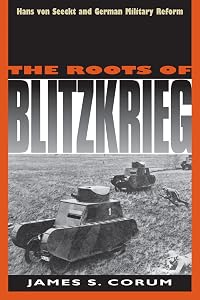
The Roots of Blitzkrieg: Hans von Seeckt and German Military Reform
by James S. Corum
Modern War Studies (1994)
On This Page
Description
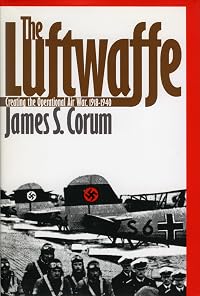
Following Germany's defeat in World War I, the Germans signed the Versailles Treaty, superficially agreeing to limit their war powers. The Allies envisioned the future German army as a lightly armed border guard and international security force. The Germans had other plans. As early as 1919, James Corum contends, the tactical foundations were being laid for the Nazi Blitzkrieg. Between 1919 and 1933, German military leaders created and nurtured the Reichswehr, a new military organization show more built on the wreckage of the old Imperial Army. It was not being groomed for policing purposes. Focusing on Hans von Seeckt, General Staff Chief and Army Commander, Corum traces the crucial transformations in German military tactical doctrine, organization, and training that laid the foundations for fighting Germany's future wars. In doing so, he restores balance to prior assessment of von Seeckt's influence and demonstrates how the general, along with a few other "visionary" officers--including armor tactician Ernst Volckheim and air tactician Helmut Wilberg--collaborated to develop the core doctrine for what became the Blitzkrieg. The concepts of mobile war so essential to Germany's strength in World War II, Corum shows, were in place well before the tools became available. As an unforeseen consequence of the Versailles Treaty, the Germans were not saddled with a stockpile of outdated equipment as the Allies were. This, ironically, resulted in an advantage for the Germans, who were able to create doctrine first and design equipment to match it. show lessTags
Recommendations























Member Reviews
In this very interesting book, we are given example of what happens when (a) war does not end in a proper way - conditions will come up, that will just enable resumption of war under other means - and (b) when you get right people in right time on the right place.
Related to (a), as much Versailles' treaty was basically just a trigger for new war, nothing was learned after WW2. Same as at the end of WW1, Germany was just used as a bulwark against USSR (this time instead of Freikorps' Iron Division fighting in Baltics, Allies basically reactivated Wehrmacht under the most weird white propaganda ever). Everything was silenced (btw denazification as a term popular today, for which everybody is saying, oh what does this mean - check the show more Nueremberg Trials, this was a thing then but because of Red Menace, they went silent about it and never pursued it to the end, giving rise to scandal later when history of people running West Germany became known) and even more deadly ideology (when compared to Kaiser in WW1) was allowed to thrive and live. Because, hey, enemy of my enemy ..... you get the gist, right?
That being said, this book is more about the post-WW1 German Army goal to make sure that Reichswehr (Weimar era German Army) does not end up forgotten and basically erased from the history.
Although some political elements do come up, overall Reichswehr's political aims are not central point (although they are mentioned as king-makers in the background, basically parallel power structure) and I understand that would muddle the water considerably, and make the book stray into potentially troublesome waters.
This book is about organizational nature of Germans, especially in military affairs. It is about how far-thinking and patriotic officer corps, led by van Seeckt, laid the way, doctrinal but also organizational and in the end physical (including industrial aspect and international relations) to make sure that Germany, when Allies control mechanisms are brought down, can again take its place on the international stage and have powerful army to back any political decision German government makes.
It is fascinating to read about people learning on their mistakes, collating all of the data and feedback from infantry, artillery to motorized forces and air service, and preparing the ground for advancement. If Germans had to have small army they decided it would be very professional army, highly trained, technologically knowledgeable, adaptable and able to expand very quickly as needed. At the tip of the spear was Truppenamt, renamed German General Staff - professional officer corps that worked tirelessly to make sure troops get proper training, equipment and mindset for the conflicts to come. it is exquisite to read about the way air force was built and organized, or how mock-up tanks were used to make sure that troops get accustomed to work with the armor even before the armor forces were actually fully operational.
Even on international stage, Reichswehr managed to make deals with Soviets and use Soviet territory to conduct trainings and technical development they could not do on their own land. Military industry spread across the world where it developed many vehicle and weapon prototypes (Sweden for example being crucial for development of tanks and weapons such as famous German 88mm gun). This was not something to be done immediately, but over the years. Imagine having politicians or leaders of any nation in Europe's west thinking this much ahead - a decade? No way, political managers cannot even think 4 years ahead.
I mean when one looks at all of this, full militarization of Germany way ahead of Nazi party takeover, it is obvious that powder keg would be put on fire no matter what by the end of 1930's. It is very interesting how Germans viewed Poles and Czechs as very aggressive neighbors - they were expecting conflict with them at any time. At the same time French were tolerated, not the least because territory they were trying to occupy did not interest Germany that much at the time - definitely not as much as territory of old Prussia.
By finely manipulating the Army, Nazi party managed to overtake it completely, instilling the political and ideological vigor and make Army part of the Nazi machine. Everything that was started to enable Germany to stand on its own after humiliation is over, just made sure that this entire fine tuned mechanism ended up completely under Nazi control. And this is greatest defeat of Reichswehr and van Seeckt's goals. Instead of being force to unite Germany, Reichswehr became the ideologically-fueled Nazi tool with major role to play in overtaking the whole of Europe and Asia. Truly sad, but then what is army for than for fighting wars, if it is not keen on finding targets on its own, ambitious politicians will always find ways to utilize it.
Fantastic book on how to approach very complex task of rebuilding of army. Highly recommended to anyone interested in the turbulent interwar period, magnificent technological advances and their military applications.
Highly, highly recommended. show less
Related to (a), as much Versailles' treaty was basically just a trigger for new war, nothing was learned after WW2. Same as at the end of WW1, Germany was just used as a bulwark against USSR (this time instead of Freikorps' Iron Division fighting in Baltics, Allies basically reactivated Wehrmacht under the most weird white propaganda ever). Everything was silenced (btw denazification as a term popular today, for which everybody is saying, oh what does this mean - check the show more Nueremberg Trials, this was a thing then but because of Red Menace, they went silent about it and never pursued it to the end, giving rise to scandal later when history of people running West Germany became known) and even more deadly ideology (when compared to Kaiser in WW1) was allowed to thrive and live. Because, hey, enemy of my enemy ..... you get the gist, right?
That being said, this book is more about the post-WW1 German Army goal to make sure that Reichswehr (Weimar era German Army) does not end up forgotten and basically erased from the history.
Although some political elements do come up, overall Reichswehr's political aims are not central point (although they are mentioned as king-makers in the background, basically parallel power structure) and I understand that would muddle the water considerably, and make the book stray into potentially troublesome waters.
This book is about organizational nature of Germans, especially in military affairs. It is about how far-thinking and patriotic officer corps, led by van Seeckt, laid the way, doctrinal but also organizational and in the end physical (including industrial aspect and international relations) to make sure that Germany, when Allies control mechanisms are brought down, can again take its place on the international stage and have powerful army to back any political decision German government makes.
It is fascinating to read about people learning on their mistakes, collating all of the data and feedback from infantry, artillery to motorized forces and air service, and preparing the ground for advancement. If Germans had to have small army they decided it would be very professional army, highly trained, technologically knowledgeable, adaptable and able to expand very quickly as needed. At the tip of the spear was Truppenamt, renamed German General Staff - professional officer corps that worked tirelessly to make sure troops get proper training, equipment and mindset for the conflicts to come. it is exquisite to read about the way air force was built and organized, or how mock-up tanks were used to make sure that troops get accustomed to work with the armor even before the armor forces were actually fully operational.
Even on international stage, Reichswehr managed to make deals with Soviets and use Soviet territory to conduct trainings and technical development they could not do on their own land. Military industry spread across the world where it developed many vehicle and weapon prototypes (Sweden for example being crucial for development of tanks and weapons such as famous German 88mm gun). This was not something to be done immediately, but over the years. Imagine having politicians or leaders of any nation in Europe's west thinking this much ahead - a decade? No way, political managers cannot even think 4 years ahead.
I mean when one looks at all of this, full militarization of Germany way ahead of Nazi party takeover, it is obvious that powder keg would be put on fire no matter what by the end of 1930's. It is very interesting how Germans viewed Poles and Czechs as very aggressive neighbors - they were expecting conflict with them at any time. At the same time French were tolerated, not the least because territory they were trying to occupy did not interest Germany that much at the time - definitely not as much as territory of old Prussia.
By finely manipulating the Army, Nazi party managed to overtake it completely, instilling the political and ideological vigor and make Army part of the Nazi machine. Everything that was started to enable Germany to stand on its own after humiliation is over, just made sure that this entire fine tuned mechanism ended up completely under Nazi control. And this is greatest defeat of Reichswehr and van Seeckt's goals. Instead of being force to unite Germany, Reichswehr became the ideologically-fueled Nazi tool with major role to play in overtaking the whole of Europe and Asia. Truly sad, but then what is army for than for fighting wars, if it is not keen on finding targets on its own, ambitious politicians will always find ways to utilize it.
Fantastic book on how to approach very complex task of rebuilding of army. Highly recommended to anyone interested in the turbulent interwar period, magnificent technological advances and their military applications.
Highly, highly recommended. show less
Ratings
Members
- Recently Added By
Lists

All Things Germany
321 works; 4 members
Author Information
17+ Works 424 Members
James S. Corum, currently with the U.S. Army Command and General Staff College at Fort Leavenworth, previously taught at the U.S. Air Force's School of Advanced Airpower Studies.
Series

Common Knowledge
- People/Characters
- Hans von Seeckt
- Important places
- Germany
- Important events
- World War II (1939 | 1945)
- Original language
- English
Classifications
- Genres
- Nonfiction, History, General Nonfiction
- DDC/MDS
- 355.02 — Society, government, & culture Public administration & military science The Military - Land, Air & Sea / Warfare War
- LCC
- UA710 .C67 — Military Science Armies: Organization, distribution, military situation Armies: Organization, distribution, military situation By region or country
- BISAC
Statistics
- Members
- 84
- Popularity
- 380,501
- Reviews
- 1
- Rating
- (4.25)
- Languages
- English
- Media
- Paper
- ISBNs
- 2
- ASINs
- 2