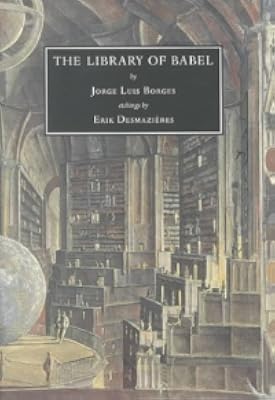
The Library of Babel [short story]
by Jorge Luis Borges
On This Page
Description
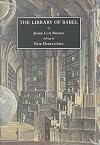
"Not many living artists would be sufficiently brave or inspired to attempt reflecting in art what Borges constructs in words. But the detailed, evocative etchings by Erik Desmazieres provide a perfect counterpoint to the visionary prose. Like Borges, Desmazieres has created his own universe, his own definition of the meaning, topography and geography of the Library of Babel. Printed together, with the etchings reproduced in fine-line duotone, text and art unite to present an artist's book show more that belongs in the circle of Borges's sacrosanct Crimson Hexagon - "books smaller than natural books, books omnipotent, illustrated, and magical.""--BOOK JACKET.Title Summary field provided by Blackwell North America, Inc. All Rights Reserved show lessTags
Recommendations


















Member Reviews
Just finished my re-read. Borges' stories are always very cerebral. The idea or mindgame at the center of many of these stories is more important than traditional things like emotional engagement or characters.
The mindgame at the center of this particular story has to do with the infinite combinations of alphabetical letters and symbols.
Each book has 410 pages x 40 lines per page x 80 symbols per line = 1,312,000 symbols/book. If the alphabet has only 25 symbols in it, to have a separate book with every possible combination of letters, you would need to have 1,312,000 taken to the 25th power books! But if you had this insane number of books, that would represent every possible book that anyone could ever write. So somewhere in that show more 8,878,628,324,041,671,119,727,680,877,641,900,000,000,000,000,000,000,000,000,000,000,000,000,000,000,000,000,000,000,000,000,000,000,000,000,000,000,000,000,000,000,000,000,000,000,000,000,000,000,000,000,000,000,000,000,000,000,000,000,000,000,000,000,000,000,000 books in this fictional library would exist the first portion of the Bible, the first portion of every one of Shakespeare's plays, every book of scientific, religious, and artistic invention but all of them generated by purely random accident! Unfortunately, with that many books, there would be no hope of finding anything useful. You'd be more likely to win countless lotteries in a row than you would to find that one randomly generated King James Bible in such a gigantic number of random books, even searching an entire lifetime!
It's pretty wacky, and it does boggle my mind. The idea that all human knowledge could exist and yet be completely out of any practical reach.
But what does all of this mean beyond the mindgame? I'm not sure. There's some fairly deep considerations of human behavior here in the story though. These are a few random thoughts that occurred to me:
1.
If people know that solutions already exist somewhere out there, what does that do to their own motivation to their own sense of invention or creativity?
"The certitude that everything has been written negates us or turns us into phantoms. I know of districts in which the young men prostrate themselves before books and kiss their pages in a barbarous manner, but they do not know how to decipher a single letter."
It reminds me of the part in Foundation where the decadent representative of the empire laughs upon the idea of conducting actual archeological digs, since he feels all the knowledge has already been gathered in books. Science without experiment or yearning for advancement stultifies.
Of course, nowadays, I'd say the bigger danger is that people no longer have the ability to believe in any basic facts rather than the problem of taking too many things for granted. But still, it's a persistent human danger, to lose that yearning to engage directly and to lose curiosity about the world.
2.
Another thought I had is about the arbitrariness of language. By mutual consent, we agree socially on the meaning of different sounds and we agree on what they mean. Someone long ago decided "house" meant a house, and we all agree that's what it means, but going back to the first languages of the first people, maybe the word "giraffe" could have been assigned to that meaning, or any word really. I remember reading something along those lines in C.G. Jung's Dreams way back when I was in college and it blew my mind. I was talking to a professor of mine, and he said, oh yeah, that's just semiotics. Whatever. I still think it's pretty mindblowing. Communication is pretty much a miracle if you think about it deeply.
3.
One last thing that struck me: I love the part where he yearns for some justification of the library. By his own admission, the library itself is just a big random construction, like something spewed out by a supercomputer combining math sets. But he still yearns for it to have some kind of meaning.
"I pray to the unknown gods that a man--just one, even though it were thousands of years ago!--may have examined and read it . . . Let heaven exist, though my place be in hell. Let me be outraged and annihilated, but for one instant, in one being, let Your enormous Library be justified."
I don't know anything about Borges' religious beliefs or lack thereof, but this feels a little to me like a crying out of someone without faith for there to be at least some kind of meaning. If the world wasn't created by any divine being and just blinked into existence out of some random happenstance, the world would be like one of these books, just a randomly generated coincidence. And some people do believe that in a sense--within the universe, each planet has the capacity for life, and the arrangement of factors that happen to exist on a planet (the elements, the proximity to a sun, etc) sometimes cause life to form. In that world view, the universe is a lot like this giant expansion of books. But for Borges, even in knowledge of that randomness, there's still a deep human yearning for some meaning to justify it. There are many ways of creating meaning of course.
But this one part was the only thing that affected me emotionally in the "story." Those lines moved me; the speaker's desperation for meaning and yet his inability to be sure of any meaning feels almost unbearably sad. show less
The mindgame at the center of this particular story has to do with the infinite combinations of alphabetical letters and symbols.
Each book has 410 pages x 40 lines per page x 80 symbols per line = 1,312,000 symbols/book. If the alphabet has only 25 symbols in it, to have a separate book with every possible combination of letters, you would need to have 1,312,000 taken to the 25th power books! But if you had this insane number of books, that would represent every possible book that anyone could ever write. So somewhere in that show more 8,878,628,324,041,671,119,727,680,877,641,900,000,000,000,000,000,000,000,000,000,000,000,000,000,000,000,000,000,000,000,000,000,000,000,000,000,000,000,000,000,000,000,000,000,000,000,000,000,000,000,000,000,000,000,000,000,000,000,000,000,000,000,000,000,000,000 books in this fictional library would exist the first portion of the Bible, the first portion of every one of Shakespeare's plays, every book of scientific, religious, and artistic invention but all of them generated by purely random accident! Unfortunately, with that many books, there would be no hope of finding anything useful. You'd be more likely to win countless lotteries in a row than you would to find that one randomly generated King James Bible in such a gigantic number of random books, even searching an entire lifetime!
It's pretty wacky, and it does boggle my mind. The idea that all human knowledge could exist and yet be completely out of any practical reach.
But what does all of this mean beyond the mindgame? I'm not sure. There's some fairly deep considerations of human behavior here in the story though. These are a few random thoughts that occurred to me:
1.
If people know that solutions already exist somewhere out there, what does that do to their own motivation to their own sense of invention or creativity?
"The certitude that everything has been written negates us or turns us into phantoms. I know of districts in which the young men prostrate themselves before books and kiss their pages in a barbarous manner, but they do not know how to decipher a single letter."
It reminds me of the part in Foundation where the decadent representative of the empire laughs upon the idea of conducting actual archeological digs, since he feels all the knowledge has already been gathered in books. Science without experiment or yearning for advancement stultifies.
Of course, nowadays, I'd say the bigger danger is that people no longer have the ability to believe in any basic facts rather than the problem of taking too many things for granted. But still, it's a persistent human danger, to lose that yearning to engage directly and to lose curiosity about the world.
2.
Another thought I had is about the arbitrariness of language. By mutual consent, we agree socially on the meaning of different sounds and we agree on what they mean. Someone long ago decided "house" meant a house, and we all agree that's what it means, but going back to the first languages of the first people, maybe the word "giraffe" could have been assigned to that meaning, or any word really. I remember reading something along those lines in C.G. Jung's Dreams way back when I was in college and it blew my mind. I was talking to a professor of mine, and he said, oh yeah, that's just semiotics. Whatever. I still think it's pretty mindblowing. Communication is pretty much a miracle if you think about it deeply.
3.
One last thing that struck me: I love the part where he yearns for some justification of the library. By his own admission, the library itself is just a big random construction, like something spewed out by a supercomputer combining math sets. But he still yearns for it to have some kind of meaning.
"I pray to the unknown gods that a man--just one, even though it were thousands of years ago!--may have examined and read it . . . Let heaven exist, though my place be in hell. Let me be outraged and annihilated, but for one instant, in one being, let Your enormous Library be justified."
I don't know anything about Borges' religious beliefs or lack thereof, but this feels a little to me like a crying out of someone without faith for there to be at least some kind of meaning. If the world wasn't created by any divine being and just blinked into existence out of some random happenstance, the world would be like one of these books, just a randomly generated coincidence. And some people do believe that in a sense--within the universe, each planet has the capacity for life, and the arrangement of factors that happen to exist on a planet (the elements, the proximity to a sun, etc) sometimes cause life to form. In that world view, the universe is a lot like this giant expansion of books. But for Borges, even in knowledge of that randomness, there's still a deep human yearning for some meaning to justify it. There are many ways of creating meaning of course.
But this one part was the only thing that affected me emotionally in the "story." Those lines moved me; the speaker's desperation for meaning and yet his inability to be sure of any meaning feels almost unbearably sad. show less
There's literally a whole other book been written on the mathematics of this story alone, and there's also (of course) the matter of a certain elephant in the room--which is to say an infinite number of elephants on an infinite number of typewriters . . . . So I'll limit myself to the allegorical interpretation that leaps out at me: This is a fable of the tension at the centre of meaningmaking, the perpetual singularity of turning data into information. How do we deal with this endless shrieking imperative? What do we do when we realize our library is infinite? (And it's important to remember that that doesn't make it total. There are an infinite number of numbers between one and ten but none of them is eleven; a book can be any book, show more and it can be a book about staircases or about the impossibility of a book being like a staircase or a refutation of said impossibility or a book structured like a staircase, but it can't be a staircase. [Wait, is that even true? What about a book printed on a staircase? What about a staircase made of stacks of books?]
What we do first is we retreat into cabalism, the search for absolute essence in words. We say "it may be impossible to know what these books mean. We may never know if that is Moby-Dick or Go Dog Go written in some infinitely intricate code. BUT what we can do is understand the patterns here--the intrinsic nature of the words,the metameaning of their place in the alphabet and position on the page and adding them all uppp . . . ." We can defer that way, like believing that the word "gold" contains some essential information about the thing gold. And we can make meaning. But we'll be wrong.
Or we can defer the other way, say "hey, we're no primitive cabalists. What is the essence of being? Following Descartes, ratiocination. What is the essence of language? Self-evidently, to communicate the ideas that we each develop independently through sense-experience. What is the essence of the library? It is the depository of our knowledge. Where do we draw that knowledge from? From the library. Where do we put it? In the library. What do we communicate with? (Language.) Where do we learn that language? In the library. What possibly can be the nature of the library, when we are deriving it from itself to construct it anew?" And we languish, and we try to posit some state of library outside the Library. And it's meaningful, but wrong.
And then we regroup, a little bit chilly and with an ominous thoat-tickle, a little bit scared. But we say "We see that pure reason puts the cart before the horse. We have tape recorders and comparative etymology and the enigma machine and the smartest minds in the business, God damn it, and we're not going to get all superstitious about numinous meanings and the Crimson Hexagon and the god-man who read all the books. No, we are going to st down, study this stuff, find the patterns and draw the conclusions. But AS SOON AS we do that--as soon as we move just from describing what we see to making generalizations or being heuristic or categorical--we're mythmaking, meaningmaking, again. And we're wrong.
And so we turn to representation, and we write this story. And we turn to figuration, and start talking about the library like it's a library, when we know it's something else entirely. And we turn to the internet and deconstruct each other's ideas about what the library is, with sniping. And millennial cults and book-burners appear, and the blood-dimmed tide swells and recedes. That's where the Babel comes in.
This is nothing less than a recapitulation of the entirety of Western thought, and the impossibility of keeping up the balance of imagination, deduction and induction that allows us to make any sense of the world, and the ultimate inadequacy of all assumption, description, perception, interaction with it. As soon as we let go of falsity we are paralyzed, because the truth is too big to be borne.As soon as we let go of the belief in truth we are paralyzed--paralyzed by fear. show less
What we do first is we retreat into cabalism, the search for absolute essence in words. We say "it may be impossible to know what these books mean. We may never know if that is Moby-Dick or Go Dog Go written in some infinitely intricate code. BUT what we can do is understand the patterns here--the intrinsic nature of the words,the metameaning of their place in the alphabet and position on the page and adding them all uppp . . . ." We can defer that way, like believing that the word "gold" contains some essential information about the thing gold. And we can make meaning. But we'll be wrong.
Or we can defer the other way, say "hey, we're no primitive cabalists. What is the essence of being? Following Descartes, ratiocination. What is the essence of language? Self-evidently, to communicate the ideas that we each develop independently through sense-experience. What is the essence of the library? It is the depository of our knowledge. Where do we draw that knowledge from? From the library. Where do we put it? In the library. What do we communicate with? (Language.) Where do we learn that language? In the library. What possibly can be the nature of the library, when we are deriving it from itself to construct it anew?" And we languish, and we try to posit some state of library outside the Library. And it's meaningful, but wrong.
And then we regroup, a little bit chilly and with an ominous thoat-tickle, a little bit scared. But we say "We see that pure reason puts the cart before the horse. We have tape recorders and comparative etymology and the enigma machine and the smartest minds in the business, God damn it, and we're not going to get all superstitious about numinous meanings and the Crimson Hexagon and the god-man who read all the books. No, we are going to st down, study this stuff, find the patterns and draw the conclusions. But AS SOON AS we do that--as soon as we move just from describing what we see to making generalizations or being heuristic or categorical--we're mythmaking, meaningmaking, again. And we're wrong.
And so we turn to representation, and we write this story. And we turn to figuration, and start talking about the library like it's a library, when we know it's something else entirely. And we turn to the internet and deconstruct each other's ideas about what the library is, with sniping. And millennial cults and book-burners appear, and the blood-dimmed tide swells and recedes. That's where the Babel comes in.
This is nothing less than a recapitulation of the entirety of Western thought, and the impossibility of keeping up the balance of imagination, deduction and induction that allows us to make any sense of the world, and the ultimate inadequacy of all assumption, description, perception, interaction with it. As soon as we let go of falsity we are paralyzed, because the truth is too big to be borne.As soon as we let go of the belief in truth we are paralyzed--paralyzed by fear. show less
What can one say about the Library of Babel? For me, it's like an ancient scripture: strange musings from the unknown where truth can be found if one delves deep enough. Perhaps the best review I can give is to reveal the fact that I borrowed this book and now I can't bear to return it. That hasn't happened in years.
I have always enjoyed Borges because its clear he understood the Gnostics and makes reference to them in his stories. Is the universe itself a type of library? Cosmologists and other scientists now claim that information itself cannot be destroyed. It must be stored somewhere; is that somewhere a Universe built like a tesseract which contains all data for all time. Borges seemed to believe this was the case, and I agree with him.
“For a book to exist, it is sufficient that it is possible. Only the impossible is excluded.”
Paradoxes abound in this allegory that has aspects of The Blind Watchmaker, especially DNA, and also the Infinite Monkey Theorem.
I have the Collected Fictions (with copious translator's notes), but am splitting my review of that into its components, in publication order: Collected Fictions - all reviews. This is one of the the longer stories in The Garden of Forking Paths, published in 1941.
The universe is an infinite Library. Maybe the universe is the internet? But Borges’ library is more beautiful: an endless series of connecting, identical, hexagons, and it has - and will - exist for eternity.
Each vestibule has “a mirror which show more faithfully duplicates appearances”, leading men to infer that the Library is not infinite, otherwise “what need would there be for that illusory replication?”
But it is infinite: the books contain “all that is able to be expressed, in every language”, composed of the same alphabetic elements, and each is unique. But are uniqueness and infinity contradictory?
Most of the books are indecipherable, and “trying to find sense in books” is “a vain and superstitious habit”, likened to palmistry and numerology. Surely that doesn’t apply to this, or does it? (Recursion, again.)
“You who read me – are you certain you understand my language?”
“Man, the imperfect librarian, may be the work of chance or malevolent demiurges; the universe… can only be the work of a god.” That’s “a god”, not “God”.
Who or what made me? Am I real, or just making marks on one of an infinite number of pages that may never be read?
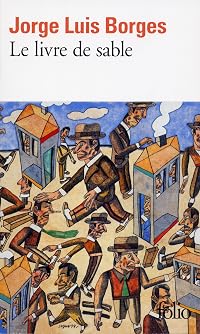
These ideas of infinity are explored and elaborated on in “Undr” and The Mirror and the Mask, which throw minimalism into the mix. More specifically, the story of The Book of Sand is like the Library of Babel in miniature: a single, infinite book. They are all in The Book of Sand. show less
Paradoxes abound in this allegory that has aspects of The Blind Watchmaker, especially DNA, and also the Infinite Monkey Theorem.
I have the Collected Fictions (with copious translator's notes), but am splitting my review of that into its components, in publication order: Collected Fictions - all reviews. This is one of the the longer stories in The Garden of Forking Paths, published in 1941.
The universe is an infinite Library. Maybe the universe is the internet? But Borges’ library is more beautiful: an endless series of connecting, identical, hexagons, and it has - and will - exist for eternity.
Each vestibule has “a mirror which show more faithfully duplicates appearances”, leading men to infer that the Library is not infinite, otherwise “what need would there be for that illusory replication?”
But it is infinite: the books contain “all that is able to be expressed, in every language”, composed of the same alphabetic elements, and each is unique. But are uniqueness and infinity contradictory?
Most of the books are indecipherable, and “trying to find sense in books” is “a vain and superstitious habit”, likened to palmistry and numerology. Surely that doesn’t apply to this, or does it? (Recursion, again.)
“You who read me – are you certain you understand my language?”
“Man, the imperfect librarian, may be the work of chance or malevolent demiurges; the universe… can only be the work of a god.” That’s “a god”, not “God”.
Who or what made me? Am I real, or just making marks on one of an infinite number of pages that may never be read?
These ideas of infinity are explored and elaborated on in “Undr” and The Mirror and the Mask, which throw minimalism into the mix. More specifically, the story of The Book of Sand is like the Library of Babel in miniature: a single, infinite book. They are all in The Book of Sand. show less
A fine collection of some of Borges' short stories, The Library of Babel has been a fun read with a lot of intertextuality. Some of the selected stories stand tall against the others - the highs of the book/the editor's selections much outweigh the lows, however.
I recently read A Short Stay in Hell by Steven L. Peck which was inspired by this short story. While that book didn't do much for me, I was intrigued enough by the concept to see how it originated.
I confess, I also find this work disappointing, as it seems more like a theoretical exercise than a story. Borges noodles around for a little bit in a cold and distant manner, then stops.
Not much here for me.
I confess, I also find this work disappointing, as it seems more like a theoretical exercise than a story. Borges noodles around for a little bit in a cold and distant manner, then stops.
Not much here for me.
Members
- Recently Added By
Lists

Essential Reading for Continuing Professional Development
11 works; 5 members

Authors from Argentina
5 works; 1 member

Fiction: Classics, Literary, Short Stories
85 works; 1 member

Favourite Short Stories
22 works; 2 members

Books Read in College
80 works; 5 members

Linguistics in Science Fiction
27 works; 4 members

Reading LIst
648 works; 1 member
Author Information

865+ Works 58,741 Members
Born in Buenos Aires, Argentina, in 1899, Jorge Borges was educated by an English governess and later studied in Europe. He returned to Buenos Aires in 1921, where he helped to found several avant-garde literary periodicals. In 1955, after the fall of Juan Peron, whom he vigorously opposed, he was appointed director of the Argentine National show more Library. With Samuel Beckett he was awarded the $10,000 International Publishers Prize in 1961, which helped to establish him as one of the most prominent writers in the world. Borges regularly taught and lectured throughout the United States and Europe. His ideas have been a profound influence on writers throughout the Western world and on the most recent developments in literary and critical theory. A prolific writer of essays, short stories, and plays, Borges's concerns are perhaps clearest in his stories. He regarded people's endeavors to understand an incomprehensible world as fiction; hence, his fiction is metaphysical and based on what he called an esthetics of the intellect. Some critics have called him a mystic of the intellect. Dreamtigers (1960) is considered a masterpiece. A central image in Borges's work is the labyrinth, a mental and poetic construct, that he considered a universe in miniature, which human beings build and therefore believe they control but which nevertheless traps them. In spite of Borges's belief that people cannot understand the chaotic world, he continually attempted to do so in his writing. Much of his work deals with people's efforts to find the center of the labyrinth, symbolic of achieving understanding of their place in a mysterious universe. In such later works as The Gold of the Tigers, Borges wrote of his lifelong descent into blindness and how it affected his perceptions of the world and himself as a writer. Borges died in Geneva in 1986. (Bowker Author Biography) show less
Some Editions
Awards and Honors
Notable Lists
Series
Belongs to Publisher Series
Work Relationships
Is contained in
Common Knowledge
- Canonical title
- The Library of Babel [short story]
- Original title
- La biblioteca de Babel
- Original publication date
- 1941
- Epigraph*
- By this art you may contemplate the variation of the 23 letters ...
The Anatomy of Melancholy, part 2, sect. II, mem. IV. - First words
- The universe (which others call the Library) is composed of an indefinite and perhaps infinite number of hexagonal galleries, with vast air shafts between, surrounded by very low railings.
- Quotations
- When I am dead, compassionate hands will throw me over the railing; my tomb will be the unfathomable air, my body will sink for ages, and will decay and dissolve in the wind engendered by my fall, which shall be infinite.
There was no personal problem, no world problem, whose eloquent solution did not exist - somewhere in some hexagon... The universe suddenly became congruent with the unlimited width and breadth of humankind's hope. - Last words
- (Click to show. Warning: May contain spoilers.)My solitude is cheered by that elegant hope.
- Original language
- Spanish
- Disambiguation notice*
- This is a short story. Do NOT combine with any collections.
*Some information comes from Common Knowledge in other languages. Click "Edit" for more information.
Classifications
- Genres
- Fiction and Literature, General Fiction, Fantasy
- DDC/MDS
- 868.6209 — Literature & rhetoric Spanish Literature Spanish miscellaneous writings 20th Century 1900-1945
- LCC
- PQ7797 .B635 .B5213 — Language and Literature French, Italian, Spanish and Portuguese literatures Spanish literature Provincial, local, colonial, etc. Spanish America
- BISAC
Statistics
- Members
- 653
- Popularity
- 44,256
- Reviews
- 13
- Rating
- (4.22)
- Languages
- Armenian, Dutch, English, German
- Media
- Paper, Audiobook
- ISBNs
- 6
- ASINs
- 2