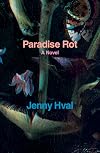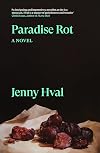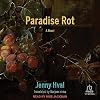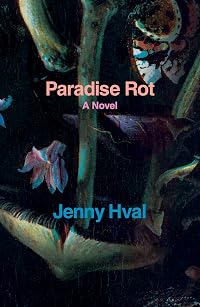
Paradise Rot: A Novel
by Jenny Hval
On This Page
Description
A lyrical debut novel from a musician and artist renowned for her sharp sexual and political imagery Jo is in a strange new country for university and having a more peculiar time than most. In a house with no walls, shared with a woman who has no boundaries, she finds her strange home coming to life in unimaginable ways. Jo's sensitivity and all her senses become increasingly heightened and fraught, as the lines between bodies and plants, dreaming and wakefulness, blur and mesh. This debut show more novel from critically acclaimed artist and musician Jenny Hval presents a heady and hyper-sensual portrayal of sexual awakening and queer desire. show lessTags
Recommendations











Member Reviews
Can't tell if this book gave me a headache or the poison Sydney air.
It's short but real fucken dense like the knot in your shoelaces in the morning when you're running late for work.
There's a lot of piss imagery. Like, literal urine. Is it like a stand-in or a metaphor or something for the taboo of homosexuality? My dumb ass doesn't know. But there's lots of it.
There's something deeply uncomfortable about how this is written that I can't figure out either, not just because of the pee pee stuff, nor the explicitly uncomfortable stuff that occurs within it. I felt unsettled on the first page and never got settled by the time it was through. It's to its benefit though I think, with Jo being rightly uncomfortable the whole goddamn time show more about everything.
I think if I was a lesbian or gay then more of these cryptic little pieces would click. But I'm also probably writing this review too soon without letting it all rattle around in my head for long enough.
It's weird and skin-crawly and head-hurty and you'll blast through it a couple hours. show less
It's short but real fucken dense like the knot in your shoelaces in the morning when you're running late for work.
There's a lot of piss imagery. Like, literal urine. Is it like a stand-in or a metaphor or something for the taboo of homosexuality? My dumb ass doesn't know. But there's lots of it.
There's something deeply uncomfortable about how this is written that I can't figure out either, not just because of the pee pee stuff, nor the explicitly uncomfortable stuff that occurs within it. I felt unsettled on the first page and never got settled by the time it was through. It's to its benefit though I think, with Jo being rightly uncomfortable the whole goddamn time show more about everything.
I think if I was a lesbian or gay then more of these cryptic little pieces would click. But I'm also probably writing this review too soon without letting it all rattle around in my head for long enough.
It's weird and skin-crawly and head-hurty and you'll blast through it a couple hours. show less
In Paradise Rot, Jo, a young Norwegian woman, has arrived in the English town of Aybourne to attend college and study biology. She has no place to live and initially stays in a hostel before securing a room in an apartment located in a converted brewery. Her roommate in the brewery apartment is Carral, who works as an office temp and has a degree in English Literature but reads trashy romance novels. From the outset, Jo’s narration emphasizes her physical surroundings, the fleshly textures of the food she eats and the people around her: “The food in the breakfast hall was slippery and fluid.” And, “The foreign students too were smooth and gleaming.” Jo’s “room” does not afford much in the way of privacy because show more Carral’s apartment is divided only by flimsy partitions that don’t reach the ceiling. Thus, noises of all sorts, from pages being turned to sounds of a more intimate nature, reverberate throughout the apartment. As the days pass, Jo’s experience of the space in which she resides becomes dominated by biological processes. Jo’s narrative details bodily secretions, such as urine and blood. Carral brings home a load of apples—far too many for the two of them to eat—which begin to spoil, and which saturate the apartment with the stench of decay even after the rotting fruit is consigned to the compost. When humidity levels rise and fog embraces the town, the apartment grows soggy, moss appears on the walls and between the floorboards, and mushrooms sprout in the bathroom. The two women grow together and seem to merge, sharing thoughts and sensations. Carral comes to Jo’s bed. And near the end of the book, when Carral takes a sip of hot tea, Jo can feel the liquid sear the roof of her mouth. In Paradise Rot, the symbolism is clear, but Aybourne is no Eden, and Jo’s escape from the brewery is more salvation than banishment. This is a novel that spins an elusive flesh and blood tale of bodies stewing in their own juices. It’s as if we’re observing specimens under a microscope, cells clinging to one another, consuming each other. The world of Jenny Hval’s first novel (originally published in 2009) is familiar but alien and hints at something unsavory just below the surface, but well out of sight. Paradise Rot does not divulge its secrets. But it does leave an imprint on the reader that is not quick to fade. show less
I found [b:Paradise Rot|39216527|Paradise Rot|Jenny Hval|https://i.gr-assets.com/images/S/compressed.photo.goodreads.com/books/1596041196l/39216527._SY75_.jpg|7163943] on the horror fiction shelf of the library and don't understand why it was shelved there. The plot is that a Norwegian student named Jo comes to England to study biology and moves into a flatshare with weird vibes. I found it strange and unsettling, but not frightening. The aim does not seem be scaring the reader, unless you have a phobia of damp and mould. Who in the UK has not lived in a shitty rental home where mushrooms grew indoors; it's happened to me twice. The elements that are weirder for Jo are her flatmate having no boundaries and the flat no sound insulation. show more Her narrative is visceral, atmospheric, and often sexual. There's a thread of queer awakening running through the book, although this is somewhat abstract. I liked the writing/translation style and found some of the imagery arresting. [b:Paradise Rot|39216527|Paradise Rot|Jenny Hval|https://i.gr-assets.com/images/S/compressed.photo.goodreads.com/books/1596041196l/39216527._SY75_.jpg|7163943] is a distinctive and claustrophobic novella that seeks to make terrible student accommodation compellingly sensual, with some success. show less
Paradise Rot follows Jo, a Norwegian foreign exchange student in Great Britain, as she finds a place to live and makes friends at her new school. The apartment she ends up living in has very thin walls, and her new roommate quickly becomes very close to her.
It is definitely a book that is not for everyone. Jenny Hval uses the culture shock of being a foreign exchange student and combines it with living in a strange apartment, where senses are heightened and foods rot, to create a feeling of disillusionment. This disillusionment is used to show the disconnect that can come during a queer or sexual awakening. Throughout the novella, she feels more connected with her surroundings and herself, hence the reader becoming more comfortable show more reading the story. The way description is used throughout curates this feeling perfectly and brings the reader on the same self-discovery journey as Jo.
Because of the seemingly adverse way she uses descriptions, I was able to connect with the story in a way I didn't think I would. I ended up quite enjoying it, and think Hval achieved perfectly what she set out to accomplish. show less
It is definitely a book that is not for everyone. Jenny Hval uses the culture shock of being a foreign exchange student and combines it with living in a strange apartment, where senses are heightened and foods rot, to create a feeling of disillusionment. This disillusionment is used to show the disconnect that can come during a queer or sexual awakening. Throughout the novella, she feels more connected with her surroundings and herself, hence the reader becoming more comfortable show more reading the story. The way description is used throughout curates this feeling perfectly and brings the reader on the same self-discovery journey as Jo.
Because of the seemingly adverse way she uses descriptions, I was able to connect with the story in a way I didn't think I would. I ended up quite enjoying it, and think Hval achieved perfectly what she set out to accomplish. show less
A creepy and psychedelic novel that is slender and powerful. It's as if the process of decomposition was distilled into book form. The rhythm of the text was hypnotic, enough so that I was drawn deeper and deeper into the world, even as it became increasingly disturbing. After I reached the half-way point, I was pretty much powerless to stop reading until the book was over. This is how a surreal novel should be written, without a wasted phrase.
Norwegian college girl Jo arrives in Australia to spend a year studying. Looking for a place to live, she comes across Carral’s ad for shared space in a “converted” brewery. I have quotes around ‘converted’ because it’s not really made fit for human dwelling. There are few walls put in. The bathroom is on the ground floor, and it has no ceiling- awkward when you consider that the place is two or three stories tall. Everything is just a jumble of coming apart steel. It smells of its former life, as well as of urine. Urine is a theme in this story; it comes up with discomforting frequency. But Jo settles in. Carral brings home a huge number of apples, which they can’t eat fast enough, and so start to rot all over the show more brewery. Slowly, a relationship develops between Jo and Carral. Mushrooms appear on the bathroom wall. The apples mark the fall of this smelly Garden of Eden.
This story has the feel of a horror novel without ever quite going there. I kept expecting the mushrooms to start growing on Jo or something. I found it extremely creepy, especially how Carral descends into a sort of human rot. I wasn’t sure if some of the descriptions were actually happening, or hallucinations brought on by how gross the brewery was. It’s totally surreal, rather like Lovecraft brought into the modern age. Three stars. show less
This story has the feel of a horror novel without ever quite going there. I kept expecting the mushrooms to start growing on Jo or something. I found it extremely creepy, especially how Carral descends into a sort of human rot. I wasn’t sure if some of the descriptions were actually happening, or hallucinations brought on by how gross the brewery was. It’s totally surreal, rather like Lovecraft brought into the modern age. Three stars. show less
Paradise Rot is the story of Jo, a shy Norwegian girl, newly arrived in Australia to study biology at university. She shares an apartment in a converted brewery with Carral, a peculiar and mysterious woman working as an office temp.
One day Carral brings home a large bag of overripe apples that have been discarded by a local grocery store and, as they slowly rot, the apartment morphs into a surreal terrarium of humidity and fungal growth. Even though Jo is intensely drawn to Carral, she drifts into a half-hearted affair with Pym, a male neighbor, until Carral becomes inexplicably ill, forcing Jo to acknowledge her attraction so she can devote herself to her care.
This is sort of a contemporary re-telling of the Garden of Eden/Fall of Man show more story – Carral bringing Jo the apples as a prelude to her sexual awakening and, as the apples decompose, the apartment’s transformation into a corrupted, rotten garden. And, while author Jenny Hval would surely take issue with this comparison, her novel seems to share some DNA with Darren Aronofsky’s art house horror film, “Mother!” Firstly, despite the fact that nothing overtly horrific happens, this has the vaguely menacing feel of a classic gothic horror novel. Plus, like “Mother,” its can also be interpreted as a cautionary environmental fable, with the brewery apartment playing the role of a festering paradise run amok with Carral, as Mother Earth, withering away from illness and neglect.
This short, cerebral novel is short on plot, but long on atmosphere. It left me thinking many days after I’d finished it. show less
One day Carral brings home a large bag of overripe apples that have been discarded by a local grocery store and, as they slowly rot, the apartment morphs into a surreal terrarium of humidity and fungal growth. Even though Jo is intensely drawn to Carral, she drifts into a half-hearted affair with Pym, a male neighbor, until Carral becomes inexplicably ill, forcing Jo to acknowledge her attraction so she can devote herself to her care.
This is sort of a contemporary re-telling of the Garden of Eden/Fall of Man show more story – Carral bringing Jo the apples as a prelude to her sexual awakening and, as the apples decompose, the apartment’s transformation into a corrupted, rotten garden. And, while author Jenny Hval would surely take issue with this comparison, her novel seems to share some DNA with Darren Aronofsky’s art house horror film, “Mother!” Firstly, despite the fact that nothing overtly horrific happens, this has the vaguely menacing feel of a classic gothic horror novel. Plus, like “Mother,” its can also be interpreted as a cautionary environmental fable, with the brewery apartment playing the role of a festering paradise run amok with Carral, as Mother Earth, withering away from illness and neglect.
This short, cerebral novel is short on plot, but long on atmosphere. It left me thinking many days after I’d finished it. show less
Members
- Recently Added By
Lists

Sapph-Lit
78 works; 4 members
Author Information

11+ Works 908 Members
Some Editions
Common Knowledge
- Original publication date
- 2009
- Original language
- Norwegian
Classifications
- Genres
- Fiction and Literature, General Fiction, Horror
- DDC/MDS
- 839.823 — Literature & rhetoric German & related literatures Other Germanic literatures Danish and Norwegian literatures Norwegian literature Norwegian Bokmål fiction
- LCC
- PT8952.18 .V35 — Language and Literature German, Dutch and Scandinavian literatures Norwegian literature Individual authors or works 2001-
- BISAC
Statistics
- Members
- 601
- Popularity
- 48,776
- Reviews
- 15
- Rating
- (3.57)
- Languages
- English, Norwegian (Bokmål)
- Media
- Paper, Audiobook, Ebook
- ISBNs
- 7
- ASINs
- 3