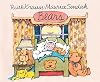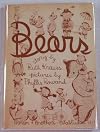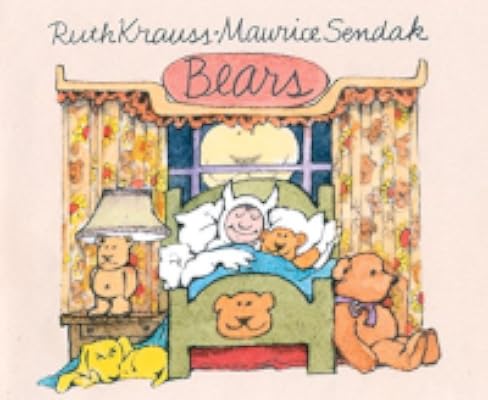
Bears
by Ruth Krauss
On This Page
Description
Captioned drawings depict bears in some unusual places and poses.Tags
Recommendations









Member Reviews
Sendak's art drives the picture book. It is delightful to see how full of life his drawings were, and seeing "Max" outside of Where the Wild Things Are is a treat. Ruth Krauss cleverly writes with such limited vocabulary, which makes this read ideal for younger readers.
Bears are everywhere. They are on the stairs, in the living room, in the tub, and some are giving strange stares. The little boy cannot avoid bears because everywhere he goes there is a bear. Bears are at the train station, streets, and in his room. The boy decides to go to sleep and this allows the bears to be everywhere. The book shows how overwhelming a situation could be in life.
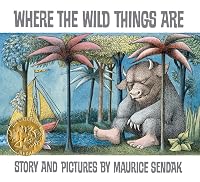
First off, I think we should be a little worried that the boy from “Where the Wild Things Are” is hanging his bears, but other than that, this is a simple story. The story is 5 decades older than this version with Sendak’s illustrations, and I see why he chose to do them. The illustrations are wonderful, and take the reader back to the world of Wild things.
Bears was a book about bears literally everywhere and their actions. Every word at the end of each sentence rhymed with Bears. It was actually cool and a really quick read.
This is a retelling/reanimation of Ruth Krauss's 1948 Bears. Sendak adds some subplots, a dog, and... Max, the hero of Where the Wild Things are.
A clever story, Sendak at his mischievious best.
A clever story, Sendak at his mischievious best.
Something about this edition, as illustrated by Sendak, just went sour for me. I love Krauss, I love much of Sendak, I've loved their other collaborations - but not this one, sorry. I would like to try to find the original edition, though, the one with simpler pictures.
Super simple-read with a chant from kids-Bears Bears Bears Bears
Members
- Recently Added By
Author Information

51+ Works 11,882 Members
Ruth Krauss was born on July 25, 1901 in Baltimore, Maryland. She attended the Peabody Institute of Music. She received a Bachelor of Arts degree from the Parsons School of Fine and Applied Art and studied anthropology at Columbia University. In 1941, she married David Johnson Leisk, who wrote and illustrated children's books as Crockett Johnson. show more They occasionally worked together. Her first book, A Good Man and His Good Wife, was published in 1944. She was credited as being one of the first authors to use minimal text, concentrating on precise language and working closely with an illustrator. She wrote more than 30 children's books during her lifetime including The Carrot Seed, I Can Fly, and A Hole Is to Dig: A First Book of First Definitions. She received the Caldecott Medal for The Happy Day in 1950 and A Very Special House in 1954. She also wrote verse plays and poetry for adults. She died on July 10, 1993 at the age of 91. (Bowker Author Biography) show less
All Editions
Awards and Honors
Common Knowledge
- Original publication date
- 1948
- First words
- Bears
- Last words
- (Click to show. Warning: May contain spoilers.)every wheres
Classifications
Statistics
- Members
- 516
- Popularity
- 57,948
- Reviews
- 15
- Rating
- (3.40)
- Languages
- Catalan, English, Portuguese, Spanish
- Media
- Paper, Ebook
- ISBNs
- 18
- ASINs
- 9