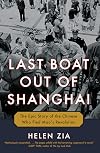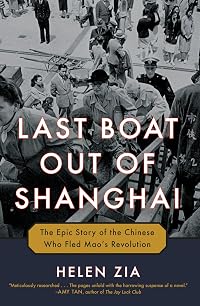
Last Boat Out of Shanghai: The Epic Story of the Chinese Who Fled Mao's Revolution
by Helen Zia
On This Page
Description
"The dramatic, real-life stories of four young people caught up in the mass exodus of Shanghai in the wake of China's 1949 Communist Revolution--a precursor to the struggles faced by emigrants today. Shanghai has historically been China's jewel, its richest, most modern and westernized city. The bustling metropolis was home to sophisticated intellectuals, entrepreneurs, and a thriving middle class when Mao's proletarian revolution emerged victorious from the long civil war. Terrified of the show more horrors the Communists would wreak upon their lives, citizens of Shanghai who could afford to fled in every direction. Seventy years later, the last generation to fully recall this massive exodus have opened the story to Chinese American journalist Helen Zia, who interviewed hundreds of exiles about their journey through one of the most tumultuous events of the twentieth century. From these moving accounts, Zia weaves the story of four young Shanghai residents who wrestled with the decision to abandon everything for an uncertain life as refugees in Hong Kong, Taiwan, and the U.S. Young Benny, who as a teenager became the unwilling heir to his father's dark wartime legacy, must choose between escaping Hong Kong or navigating the intricacies of a newly Communist China. The resolute Annuo, forced to flee her home with her father, a defeated Nationalist official, becomes an unwelcome young exile in Taiwan. The financially strapped Ho fights deportation in order to continue his studies in the U.S. while his family struggles at home. And Bing, given away by her poor parents, faces the prospect of a new life among strangers in America" -- show lessTags
Recommendations





Member Reviews
Helen Zia's 'Last Boat Out of Shanghai' is a beautifully-told story of four individuals from China before, during, and after the Communists came to power. As the book's title portends, these individuals are faced with the daunting and often almost-impossible decision of whether or not to leave their homeland as Mao Zedong's Communists romp towards Shanghai.
This book was really a pleasure to read, and the impressive average rating here on Goodreads (4.47/5.0, as of this typing) is well-deserved. While it is non-fiction, the author weaves together these inspiring, heart-wrenching, and immersive stories from the four main characters and their families & friends to make this something I had trouble putting down, even at 1am, knowing full show more well it was a work night. It's a testament to the magnitude of what these people, among millions of other Shanghai residents and broader Chinese people, had to endure, but also a testament to the skill of the author. She crafts these stories in a way that is lucid, flowing, and just made for a really fascinating book.
I particularly appreciated two themes within the book. Helen Zia makes sure to illustrate the main characters' experiences prior to the Communist takeover of Shanghai so that it captures imperial Japan rule in the late 1930s into the early 1940s. Where many books about China in this 1940s time period focus (understandably) on what's happening between the Communists and Nationalists, Zia deliberately paints vivid pictures of Japan occupation. Some parts of that timeframe in this book are difficult to read because of their graphic nature, however, it is up to us as people to understand these atrocities as they happened and ensure they never happen again. You should make an effort to read these harrowing sections if you're able.
Second, I learned quite a bit about how exactly the Nationalists fell to the Communists. My education thus far from the American school system impressed on me that the Nationalists almost beat down the Communists entirely, Mao then regrouped with a hardcore group in the mountains of China, and this band of fierce-fighting peasants won primarily on their guerilla warfare tactics and rural support. The author here shows another dimension by way of the four main characters' experiences, with vivid recounts of extensive corruption and seriously questionable governmental choices by Chiang Kai-Shek and his Nationalist administration. It's now clear that more credit must be given to the Nationalists' ineptitude, corruption, and mistreatment of the population as additional reasons the Communists were able to claim victory. Sections of this book covering the tail end of Japanese occupation through Communist victory provide glaring examples of key missteps by the Nationalists which, at best, hurt their chances to win; at worst, prevented any possibility of victory in the first place.
This was an expertly crafted book and was a pleasure to read. The material was engaging, informative, and coherent, and the author clearly has a skill for bringing true stories to life without embellishing or otherwise artificially altering them. Five stars for a real must-read book. show less
This book was really a pleasure to read, and the impressive average rating here on Goodreads (4.47/5.0, as of this typing) is well-deserved. While it is non-fiction, the author weaves together these inspiring, heart-wrenching, and immersive stories from the four main characters and their families & friends to make this something I had trouble putting down, even at 1am, knowing full show more well it was a work night. It's a testament to the magnitude of what these people, among millions of other Shanghai residents and broader Chinese people, had to endure, but also a testament to the skill of the author. She crafts these stories in a way that is lucid, flowing, and just made for a really fascinating book.
I particularly appreciated two themes within the book. Helen Zia makes sure to illustrate the main characters' experiences prior to the Communist takeover of Shanghai so that it captures imperial Japan rule in the late 1930s into the early 1940s. Where many books about China in this 1940s time period focus (understandably) on what's happening between the Communists and Nationalists, Zia deliberately paints vivid pictures of Japan occupation. Some parts of that timeframe in this book are difficult to read because of their graphic nature, however, it is up to us as people to understand these atrocities as they happened and ensure they never happen again. You should make an effort to read these harrowing sections if you're able.
Second, I learned quite a bit about how exactly the Nationalists fell to the Communists. My education thus far from the American school system impressed on me that the Nationalists almost beat down the Communists entirely, Mao then regrouped with a hardcore group in the mountains of China, and this band of fierce-fighting peasants won primarily on their guerilla warfare tactics and rural support. The author here shows another dimension by way of the four main characters' experiences, with vivid recounts of extensive corruption and seriously questionable governmental choices by Chiang Kai-Shek and his Nationalist administration. It's now clear that more credit must be given to the Nationalists' ineptitude, corruption, and mistreatment of the population as additional reasons the Communists were able to claim victory. Sections of this book covering the tail end of Japanese occupation through Communist victory provide glaring examples of key missteps by the Nationalists which, at best, hurt their chances to win; at worst, prevented any possibility of victory in the first place.
This was an expertly crafted book and was a pleasure to read. The material was engaging, informative, and coherent, and the author clearly has a skill for bringing true stories to life without embellishing or otherwise artificially altering them. Five stars for a real must-read book. show less
This book is stunning, and is yet another I will likely send to my dad to read, as it combines his interest in military history but also our shared fascination with the history of the Chinese diaspora. To listen to an interview with the author, check out this live episode of They Call Us Bruce.
I was initially surprised to find that it was a narrative read, following four individuals from childhood through their diaspora adventures. Even more surprising, these are *true* narratives, collected over many interviews through the course of 12 years (in addition to over one hundred interviews with other Shanghainese immigrants). Nonfiction can get very dry, citing reports and contemporary news articles without personifying things, but this show more was a gripping tale. My family are Taishanese folks, but the stories here are adjacent to my family's, with an uncle remembering Japanese atrocities in the ancestral village during WWII, and his wife being a refugee yet also a "sophisticated city girl" to his self-described "country bumpkin".
Last Boat Out of Shanghai covers the mostly untold story of the exodus of millions out of Shanghai around the Communist takeover of the city in 1949. Zia mentions the perception that the people who fled Mao's revolution were the landowners, the bourgeosie, the rich and intellectual, but the Japanese occupation and the following civil war disrupted life for all classes. Annuo and Bing's stories consistently are about staving off poverty (both girls also leave and return to Shanghai various times during this period too), Benny goes from a spoiled son of a corrupt police official to struggling to find a way to finish his education, while Ho is trapped in limbo, a student overseas trying to figure out if he should go home to find his family or find a way to stay in a country that doesn't want him.
Though a historical, biographical narrative, it's not hard to draw comparisons to modern day discussions about refugees displaced on the globe. Zia digs in her acknowledgements that even at the height of Cold War and McCarthyism paranoia, the US government didn't want to separate parents from their children. The stress of having enough money to enter another country, having the right papers, making sure your family is all covered (or do you divide members in case the safe haven't isn't that safe?) are still questions people need to consider when thinking about fleeing home. show less
I was initially surprised to find that it was a narrative read, following four individuals from childhood through their diaspora adventures. Even more surprising, these are *true* narratives, collected over many interviews through the course of 12 years (in addition to over one hundred interviews with other Shanghainese immigrants). Nonfiction can get very dry, citing reports and contemporary news articles without personifying things, but this show more was a gripping tale. My family are Taishanese folks, but the stories here are adjacent to my family's, with an uncle remembering Japanese atrocities in the ancestral village during WWII, and his wife being a refugee yet also a "sophisticated city girl" to his self-described "country bumpkin".
Last Boat Out of Shanghai covers the mostly untold story of the exodus of millions out of Shanghai around the Communist takeover of the city in 1949. Zia mentions the perception that the people who fled Mao's revolution were the landowners, the bourgeosie, the rich and intellectual, but the Japanese occupation and the following civil war disrupted life for all classes. Annuo and Bing's stories consistently are about staving off poverty (both girls also leave and return to Shanghai various times during this period too), Benny goes from a spoiled son of a corrupt police official to struggling to find a way to finish his education, while Ho is trapped in limbo, a student overseas trying to figure out if he should go home to find his family or find a way to stay in a country that doesn't want him.
Though a historical, biographical narrative, it's not hard to draw comparisons to modern day discussions about refugees displaced on the globe. Zia digs in her acknowledgements that even at the height of Cold War and McCarthyism paranoia, the US government didn't want to separate parents from their children. The stress of having enough money to enter another country, having the right papers, making sure your family is all covered (or do you divide members in case the safe haven't isn't that safe?) are still questions people need to consider when thinking about fleeing home. show less
narrative nonfiction following four individuals through the turbulent time of 1937-1948 Shanghai (and sometimes nearby towns along the Yangtze R.) as power changed hands over and again -- the student son of a landowner (Ho Chow); the wealthy son of a high-level puppet policeman under Japanese control (Benny Pan); the adopted daughter given up by her rural family and taken in by city socialites (Bing Woo); and a daughter of a Nationalist officer (Annua Liu). The focus is specific to Shanghai rather than mainland China overall, as the city generally had operated in a uniquely separate bubble, but also follows each person's travels into the 1950s (New York City, Taiwan, Ann Arbor, Hong Kong, Nanjing, etc.) and though my ancestors did not show more pass through most of those places I still found it very interesting to see all the things that could happen to a person during this time period, depending on (or regardless of) where your allegiances may appear to lie.
Very readable and extensively researched--any work done in researching this period is necessarily meticulous, and the author has done her job well. show less
Very readable and extensively researched--any work done in researching this period is necessarily meticulous, and the author has done her job well. show less
This was an interesting read about Shanghai, Taiwan, Hong Kong, etc during and after WW2. It focuses on a few different people's lives and how they were affected, but they are partly symbolic for a large number of people.
Shanghai was probably the most (only?) modern city in China before the Japanese took over. It was like the roaring 20s there. Actually, I guess it pretty much was the roaring 20s. Lots of rich people going out dancing and drinking, and a lot of Westerners living in their own sections.
The Japanese didn't mess around with them too much, especially not the Europeans, but it was still pretty bad for the common Chinese there. It actually seemed to get worse when the Japanese lost, and the Nationalists took over with the show more Communist invaders getting closer. The Nationalists were pretty worn out when they arrived after fighting the Japanese, and they took over whatever houses they wanted. They punished a lot of Chinese who had suffered under Japanese rule for cooperating with the Japanese when all they were doing was trying to keep out of trouble and stay alive.
Then, as the Communists got closer, the Nationalist leaders started abandoning the city for Taiwan while urging the army to fight to the end. They never had a chance, and the Communists took over, and of course, punished the poor Chinese for cooperating with the Nationalists. As the Communists invaded, a lot of citizens managed to escape to Taiwan or Hong Kong, often with very little to their name. They didn't want to live in Taiwan, which they considered too backward, or Hong Kong, which was remote with nothing to do. But they couldn't stay in Shanghai which was being continuously bombed by the Nationalists in Taiwan, and they were afraid of the Communists. Plus, they thought it would only be for a short time. Unfortunately, the US didn't want to continue to support them.
Once in Taiwan, a lot of them were suspected of being Communist supporters. And there weren't enough jobs or housing, so life was really bad. Some moved on to Hong Kong, which wasn't much better, and some managed to get to the US for college. But of course, the US had Joe McCarthy looking for communists everywhere, especially in the Chinese immigrants, and the US citizens didn't think very highly of any Asians after the war against Japan. They didn't really know the difference between Japanese, Chinese, or Korean.
It was a pretty sad story most of the time. It's interesting to learn about how hard it was to leave their country and come here with nothing, and makes me think about the current immigrants from countries that are run by dictators, etc, who come here and are discriminated against, can't get jobs, etc. A lot of these Chinese were very educated and smart, yet the Communists thought they and other educated people were evil rich people who stole from the common workers, so they were punished, often harshly. It was a really stupid thing from them to do, but hard-core ideologies often don't act in their own self-interests. show less
Shanghai was probably the most (only?) modern city in China before the Japanese took over. It was like the roaring 20s there. Actually, I guess it pretty much was the roaring 20s. Lots of rich people going out dancing and drinking, and a lot of Westerners living in their own sections.
The Japanese didn't mess around with them too much, especially not the Europeans, but it was still pretty bad for the common Chinese there. It actually seemed to get worse when the Japanese lost, and the Nationalists took over with the show more Communist invaders getting closer. The Nationalists were pretty worn out when they arrived after fighting the Japanese, and they took over whatever houses they wanted. They punished a lot of Chinese who had suffered under Japanese rule for cooperating with the Japanese when all they were doing was trying to keep out of trouble and stay alive.
Then, as the Communists got closer, the Nationalist leaders started abandoning the city for Taiwan while urging the army to fight to the end. They never had a chance, and the Communists took over, and of course, punished the poor Chinese for cooperating with the Nationalists. As the Communists invaded, a lot of citizens managed to escape to Taiwan or Hong Kong, often with very little to their name. They didn't want to live in Taiwan, which they considered too backward, or Hong Kong, which was remote with nothing to do. But they couldn't stay in Shanghai which was being continuously bombed by the Nationalists in Taiwan, and they were afraid of the Communists. Plus, they thought it would only be for a short time. Unfortunately, the US didn't want to continue to support them.
Once in Taiwan, a lot of them were suspected of being Communist supporters. And there weren't enough jobs or housing, so life was really bad. Some moved on to Hong Kong, which wasn't much better, and some managed to get to the US for college. But of course, the US had Joe McCarthy looking for communists everywhere, especially in the Chinese immigrants, and the US citizens didn't think very highly of any Asians after the war against Japan. They didn't really know the difference between Japanese, Chinese, or Korean.
It was a pretty sad story most of the time. It's interesting to learn about how hard it was to leave their country and come here with nothing, and makes me think about the current immigrants from countries that are run by dictators, etc, who come here and are discriminated against, can't get jobs, etc. A lot of these Chinese were very educated and smart, yet the Communists thought they and other educated people were evil rich people who stole from the common workers, so they were punished, often harshly. It was a really stupid thing from them to do, but hard-core ideologies often don't act in their own self-interests. show less
The Goodreads summary of this book says it follows the lives of four young people fleeing the 1949 Communist takeover of China. It is that but their story actually begins with the Japanese invasion of China, which predates US involvement in WWII, continuing all the way to very recent times. You may think you know their story, I'll bet you don't.
Helen Zia describes the interesting often sad tales of each of the four individuals in her book, each worthy of a separate book themselves. But more than simply tell you about someone else's life she tells you what it means to you.
This isn't about Chinese and China, it is about you, me, and everyone in the world regardless of our nationality, politics, religious beliefs, or where we live.
Helen Zia describes the interesting often sad tales of each of the four individuals in her book, each worthy of a separate book themselves. But more than simply tell you about someone else's life she tells you what it means to you.
This isn't about Chinese and China, it is about you, me, and everyone in the world regardless of our nationality, politics, religious beliefs, or where we live.
Excellent account of individuals caught up in the tumultous events of Shanghai during the 20th century. The book does not present a comprehensive overview of the Sino-Japanese War, World War II, or the Chinese Revolution, but it brings these events to life for thse familiar with them.
This review was written for LibraryThing Member Giveaways.
This historical biography is most likely of interest to those unfamiliar with the transition in China to Mao's revolution and the massive effort of many Chineses to flee the country. It is well-written and informative, if not great reading.
Members
- Recently Added By
Lists

History: Asia
103 works; 1 member

China / Hong Kong / Taiwan
25 works; 1 member
Author Information
6+ Works 695 Members
Helen Zia, a graduate of Princeton University's first co-educational class, is an award-winning journalist who has covered Asian American communities & political movements for twenty years. She lives in the San Francisco Bay Area. (Bowker Author Biography)
Some Editions
Awards and Honors
Common Knowledge
- People/Characters
- Mao Zedong; Chiang Kai-shek; Ho Chow; Hosun Chow; Wanyu Chow; Annuo Annabel Liu (show all 16); Charley Liu; Li-Ning Liu; Shanying Dai Liu; Yongchio Liu; Benny Yongyi Pan; Annie Pan; Cecilia Pan; Pan Zhijie (C.C. Pan, Pan Da); Bing Wu; Betty Huiling Wu
- Important places
- Shanghai, China; China
- Important events
- Chinese Revolution of 1949; Battle of Shanghai (1937); Nanjing Massacre; Japanese surrender after World War II (1945)
- Epigraph
- Running away is one of our nation's characteristics. We are very good at it. The best strategy for getting out of a bad situation is to run away. It may be the only way you can save yourself. If you don't follow this rule, yo... (show all)u end up suffering.
The two character "tao nan" mean running away from difficulty." When transposed, it is "nan tao" and means difficult to run away from." Looking back at those who tried to run away by plane or train or ship, many ended up getting killed in accidents. It was indeed difficult for them to run away. -Except translated from Lun Yu [The Analects Fortnightly], China's Leading Literary Magazine, in its "Special Issue on Running Away," March 16, 1949 - Dedication
- To all refugees from crises amok;
To the compassionate who strive
Toward a world where no one must flee to survive;
To the memory of my mother, who inspired this book. - First words
- Bing sat straight up in the pedicab, gripping the hard seat as the driver cursed and spat. She watched with alarm as his feet, clad in sandals cut from old tires, seemed to slow to a snail's pace just when she most needed spe... (show all)ed. This stylish-looking young woman had imagined that her last hours in Shanghai would be spent waving farewell from a ship's deck to envious onlookers below as a river breeze gently lifted her dark hair, just as she'd seen in the movies. After all, she was about to leave China's biggest, most glamorous, and most notorious city. Shanghai had been Bing's home since she had arrived following the Japanese invasion nearly twelve years earlier, as a frightened girl of nine. But now, with the imminent threat of a violent Communist revolution, she was running away again, along with half the city's population, it seemed. -Prologue, Shanghai, May 4, 1949
- Quotations
- Well-to-do Shanghai schoolboys had no fears of conscription at a time when country boys their age, lacking strings to pull or money to hire surrogates, were dying at a shocking rate, with hundreds of thousands sometimes kille... (show all)d in a single battle. (78)
In 1940, a hundred yuan could buy a pig; in 1943, a chicken; in 1945, a fish, while in 1946, it would buy only an egg. By 1947, it couldn't even fetch a pack of matches. (175)
The Americans began to reshape Shanghai. Even the simple act of crossing the street required greater care. For a hundred years, Shanghai had observed the British left-sided traffic flow. Now American GIs were powering through... (show all) Shanghai streets in their fast jeeps and trucks--on the wrong side of the road. Newspapers, freed from Japan's censorship, earnestly reported the details of accidents and deaths caused by American soldiers, to the great consternation of Shanghai's locals. But the Americans won the right-of-way. On January 1, 1946, all traffic in the city was ordered to switch to the right-hand side of the road--a change that many predicted would shut down the city. The process intrigued Ho, especially when Shanghai adjusted without a hitch. The British Empire's influence on the city was waning fast. (170) - Blurbers
- See, Lisa; Tan, Amy; Bradley, James; Jen, Gish; Dong, Stella; Chang, Gordon H
- Canonical DDC/MDS
- 951.04
- Canonical LCC
- DS777.Z53
Classifications
Statistics
- Members
- 334
- Popularity
- 94,934
- Reviews
- 8
- Rating
- (4.19)
- Languages
- English
- Media
- Paper, Audiobook, Ebook
- ISBNs
- 8
- ASINs
- 3