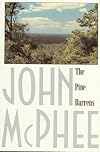
The Pine Barrens
by John McPhee
On This Page
Description
Most people think of New Jersey as a suburban-industrial corridor that runs between New York and Philadelphia. Yet in the low center of the state is a near wilderness, larger than most national parks, which has been known since the seventeenth century as the Pine Barrens. The term refers to the predominant trees in the vast forests that cover the area and to the quality of the soils below, which are too sandy and acid to be good for farming. On all sides, however, developments of one kind or show more another have gradually moved in, so that now the central and integral forest is reduced to about a thousand square miles. Although New Jersey has the heaviest population density of any state, huge segments of the Pine Barrens remain uninhabited. The few people who dwell inthe region, the "Pineys," are little known and often misunderstood. Here McPhee uses his uncanny skills as a journalist to explore the history of the region and describe the people--and their distinctive folklore--who call it home. show lessTags
Recommendations









































Member Recommendations

Member Reviews
A fascinating, if dated, look at the history and ecology of the natural wonder that is the Pine Barrens of Southern New Jersey. When this book was originally published in 1967, the Barrens were threatened by encroaching development, urban sprawl and by plans for a massive jetport which was envisioned to ease the congestion of the Philadelphia and New York airports. McPhee held out little hope for the long-term survival of this wilderness, which was home to diverse plant and animal life, some of it unique to that ecosystem (like the pygmy pine forests in which the trees grow no taller than 4 feet), and under which is an acquifer containing 17 trillion gallons of the purest water to be found in the U.S. His book, although reprinted quite show more recently, does not contain updated information on the creation of the Pinelands National Reserve (1978) or the International Biosphere Reserve (1988), whereby development has been curtailed and strictly controlled. Still, the natural history in The Pine Barrens is absorbing, and the writing is somewhat reminiscent of Annie Dillard's Pilgrim at Tinker's Creek. 4 stars. Could have had 5 if it had been brought up to date with an afterword or some such show less
McPhee explores the natural history and culture of New Jersey’s Pine Barrens in this book developed from articles originally published in The New Yorker. Although the Pine Barrens is not geographically in Appalachia, its local culture seems very familiar to this southern Appalachian native. I was drawn to this book when I learned through family history research that a many-times great-uncle and cousins operated the Batsto Furnace from the late eighteenth century to the mid-nineteenth century. Batsto gets a couple page mention in this book.
The New York Times revisited the Pine Barrens in a 1985 article, speaking to the son of McPhee’s local guide, Fred Brown. In the twenty years between McPhee’s book and the NYT article, tourists show more and industry discovered the Pine Barrens. Did the attention from McPhee’s book hasten the inevitable “wheels of progress”? show less
The New York Times revisited the Pine Barrens in a 1985 article, speaking to the son of McPhee’s local guide, Fred Brown. In the twenty years between McPhee’s book and the NYT article, tourists show more and industry discovered the Pine Barrens. Did the attention from McPhee’s book hasten the inevitable “wheels of progress”? show less
Published in 1967. John McPhee visits, interviews and documents the people and disappearing culture of the Pine Barrens that cover a large portion of southern New Jersey. There, people made a living from the land, doing seasonal work; farming, making charcoal, iron, hunting and other endeavors. Some worked in nearby towns and cities.
The vast area is a natural wonderland adjacent to some of the most populated areas on the Eastern Seaboard. The area supported blueberry and cranberry crops. Pickers were bussed in from Philadelphia in some cases. The barrens are susceptible to fire. “It is because of fire that pines are dominant in the Pine Barrens.” “Eighty-four different kinds of birds breed in the Pine Barrens, not to mention the show more ones that make stopovers there.” “The beavers are big and surprisingly fierce.”
Development has been attempted. “Over the years, more than a million people have bought or otherwise acquired lots in the Pine Barrens on which no houses have ever been built.” A “Supersonic Jetport” where supersonic jets would land “ninety minutes after leaving Paris” was envisioned around the time McPhee was researching the book. It seems funny now.
The legend of the Jersey Devil originated in the pines.
This is John McPhee’s typical mix of interesting people well observed, intensive research and telling detail combined to make an informative and entertaining book.
As a footnote, the Pinelands National Reserve was established in 1978 to protect and preserve the ecology of 1.1 million acres of the barrens. This book likely contributed to that effort. show less
The vast area is a natural wonderland adjacent to some of the most populated areas on the Eastern Seaboard. The area supported blueberry and cranberry crops. Pickers were bussed in from Philadelphia in some cases. The barrens are susceptible to fire. “It is because of fire that pines are dominant in the Pine Barrens.” “Eighty-four different kinds of birds breed in the Pine Barrens, not to mention the show more ones that make stopovers there.” “The beavers are big and surprisingly fierce.”
Development has been attempted. “Over the years, more than a million people have bought or otherwise acquired lots in the Pine Barrens on which no houses have ever been built.” A “Supersonic Jetport” where supersonic jets would land “ninety minutes after leaving Paris” was envisioned around the time McPhee was researching the book. It seems funny now.
The legend of the Jersey Devil originated in the pines.
This is John McPhee’s typical mix of interesting people well observed, intensive research and telling detail combined to make an informative and entertaining book.
As a footnote, the Pinelands National Reserve was established in 1978 to protect and preserve the ecology of 1.1 million acres of the barrens. This book likely contributed to that effort. show less
I've been slowly working my through John McPhee's books ever since reading his wonderful book "Oranges" many, many years ago. I still tell people stuff I learned about citrus fruit since reading that book more than a decade ago, now I can further annoy people with facts about a New Jersey region I'd never heard of before.
In "The Pine Barrens," McPhee travels around the woodsy area of New Jersey, which apparently has a sort of backwoods reputation, and tells the stories of the interesting characters he runs into, as well as the region's history.
The book is very readable and very entertaining -- very glad I picked this one up.
In "The Pine Barrens," McPhee travels around the woodsy area of New Jersey, which apparently has a sort of backwoods reputation, and tells the stories of the interesting characters he runs into, as well as the region's history.
The book is very readable and very entertaining -- very glad I picked this one up.
I grew up in New Jersey and we often drove through the "Jersey Pines" on the way to the shore for a day at the ocean beaches. However, I never heard the term "Pine Barrens" until I encountered this gem of a book.
Among other topics, McPhee details the industry which utilized "bog iron" to provide military equipment such as cannons and cannonballs during the American Revolution and the War of 1812. He tells us of the origins of the New Jersey Devil, sort of an East coast version of Sasquatch in spirit if not in detail.
Among other topics, McPhee details the industry which utilized "bog iron" to provide military equipment such as cannons and cannonballs during the American Revolution and the War of 1812. He tells us of the origins of the New Jersey Devil, sort of an East coast version of Sasquatch in spirit if not in detail.
What a wonderful book. Thoughful description of a part of New Jersey I never knew existed (or rather I had heard mentioned but had no idea what it was). Very reminiscent of "The Spirit of the Mountains" in its treatment of a land and people outside the mainstream. And like "Maryland: A Middle Temperment," I wish there was an update (this book dates to 1968) to know what has happened to the land...
I didn’t really even know the Pine Barrens existed. This was a book that, incidentally, made me realize again how big the US is and how many places exist, big places, that I know little about.
I enjoyed McPhee’s treatment of this area, even if it is now 50 years old. How this unique place came to be and how it continued, mostly undeveloped, is remarkable. The unique ecosystems that exists here was fascinating to read about. I really enjoyed this book.
I enjoyed McPhee’s treatment of this area, even if it is now 50 years old. How this unique place came to be and how it continued, mostly undeveloped, is remarkable. The unique ecosystems that exists here was fascinating to read about. I really enjoyed this book.
Members
- Recently Added By
Lists

Top Five Books of 2018
802 works; 265 members

Recommend the 20 best books you've read in the last five years
2,168 works; 606 members

Firewatch reading list
14 works; 1 member

Books Read in 2016
4,666 works; 197 members

Books Read in 2020
4,379 works; 123 members
Author Information

59+ Works 21,095 Members
McPhee was born in Princeton, New Jersey, and educated at Princeton University and Cambridge University. His writing career began at Time magazine and led to his long association with the New Yorker, where he has been a staff writer since 1965. That same year he published his first book, A Sense of Where You Are, with FSG, and soon followed with show more The Headmaster (1966), Oranges (1967), The Pine Barrens (1968), A Roomful of Hovings and Other Profiles (collection, 1969), The Crofter and the Laird (1969), Levels of the Game (1970), Encounters with the Archdruid (1972), The Deltoid Pumpkin Seed (1973), The Curve of Binding Energy (1974), Pieces of the Frame (collection, 1975), and The Survival of the Bark Canoe (1975). Both Encounters with the Archdruid and The Curve of Binding Energy were nominated for National Book Awards in the category of science Since 1977, the year in which McPhee received the Award in Literature from the American Academy of Arts and Letters and The John McPhee Reader and the bestselling Coming into the Country appeared in print, Farrar, Straus and Giroux has published Giving Good Weight (collection, 1979), Basin and Range (1981), In Suspect Terrain (1983), La Place de la Concorde Suisse (1984), Table of Contents (collection, 1985), Rising from the Plains (1986), Heirs of General Practice (in a paperback edition, 1986), The Control of Nature (1989), Looking for a Ship (1990), Assembling California (1993), The Ransom of Russian Art (1994), The Second John McPhee Reader (1996), and Irons in the Fire (1997). Annals of the Former World was published in 1998 and was awarded the Pulitzer Prize in 1999. McPhee has taught at Princeton as Ferris Professor since 1975. (Bowker Author Biography) show less
Some Editions
Awards and Honors
Notable Lists
Work Relationships
Common Knowledge
- Canonical title
- The Pine Barrens
- Original publication date
- 1968
- Important places
- Pine Barrens, New Jersey, USA
- Dedication
- For Pryde
and for her father
Charles Mitchell Brown - First words
- From the fire tower on Bear Swamp Hill, in Washington Township, Burlington County, New Jersey, the view usually extends about twelve miles.
- Last words
- (Click to show. Warning: May contain spoilers.)At the rate of a few hundred yards, or even a mile or so each year, the perimeter of the pines contracts.
- Original language
- English
- Disambiguation notice
- First published in: The New Yorker (1967)
Classifications
Statistics
- Members
- 932
- Popularity
- 28,458
- Reviews
- 19
- Rating
- (4.09)
- Languages
- English
- Media
- Paper, Audiobook, Ebook
- ISBNs
- 14
- ASINs
- 10