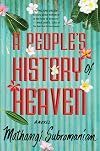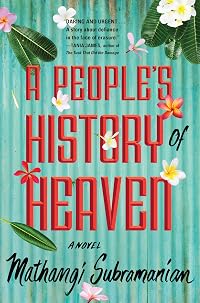
A People's History of Heaven
by Mathangi Subramanian
On This Page
Description
"In Bangalore, India, five young women fight to save their homes, which are really only shacks and lean-tos, in a slum named "Heaven," which the city wants to bulldoze in order to accommodate its growing tech industry"--Tags
Recommendations












Member Reviews
A People's History of Heaven is about friendship and loyalty. Set in a Bangalore slum nicknamed "Heaven" that's about to be bulldozed, the story moves back and forth in time to tell the stories of a group of teenage girls and their mothers and grandmothers. For generations, the women of Heaven have survived and thrived because they have worked together, supported each other, and formed a large, extended family.
The story is told from the point of view of the teenage girls, but no one girl is identified as the narrator: "There are five of us girls: Deepa, Banu, Padma, Rukshana, and Joy. Born the same year in the same slum. In the same class at school." Each girl's story is told in the third person by a first-person plural, omniscient, show more unidentified "we," the group as a whole. It's a unique way to emphasize the importance of the group's identity to their survival, and I loved it.
I was less in love with the author's tendency to use incomplete sentences as a narrative device. She does it a lot and it makes the whole book sound breathy and rushed, as if we were catching snatches of narration here and there instead of reading the story whole. It would work if it were used more sparingly, but so much of the narration is just strings of incomplete phrases that it starts to feel repetitive and irritating.
Regardless, A People's History is a wonderful book that will make you want to hug your friends and maybe even your mom. show less
The story is told from the point of view of the teenage girls, but no one girl is identified as the narrator: "There are five of us girls: Deepa, Banu, Padma, Rukshana, and Joy. Born the same year in the same slum. In the same class at school." Each girl's story is told in the third person by a first-person plural, omniscient, show more unidentified "we," the group as a whole. It's a unique way to emphasize the importance of the group's identity to their survival, and I loved it.
I was less in love with the author's tendency to use incomplete sentences as a narrative device. She does it a lot and it makes the whole book sound breathy and rushed, as if we were catching snatches of narration here and there instead of reading the story whole. It would work if it were used more sparingly, but so much of the narration is just strings of incomplete phrases that it starts to feel repetitive and irritating.
Regardless, A People's History is a wonderful book that will make you want to hug your friends and maybe even your mom. show less
I so enjoy when a story drags me to where they want me to be as these five fearsome girls sneak their way into your heart. Raised in a Bangalore slum, each character gets to provide their backstory that centers around lives defined around by femaleness and class structure as they fight for their future, adventures, and just to be. The unnamed first person plural narrative voice showcases the ingenuity and solidarity of the characters in the unconditional acceptance of each other and each just want to live their best life.
This lithe tale while explore our humanity is as profound as it is entertaining.
Female power shines brightly.
This lithe tale while explore our humanity is as profound as it is entertaining.
Female power shines brightly.
I read this one because the author did an event at my local bookstore (she was lovely!) and I was happy to support her and the store. I did not have the opportunity to read the book before the event so couldn’t ask questions but I did enjoy the discussion between her and the Indian women in attendance who talked a lot about the disparities between girls and boys in Indian culture and how it’s been changing over their lifetimes. They also shed light on Hijra people in India which I’d never heard of before and they play a small role in this story.
But: Back to the book!
It took me a little while to get a handle on all of the characters and to learn why each one was special but by the end I certainly did care about all of their show more fates. It’s almost impossible for me to really understand the situation they are in and how their lives can be so different from mine where even basic elementary school education is a luxury and they have parents who can’t read or write and they live in a slum that could be bulldozed at any moment.
The more I think about it, the more I’m realizing how much I liked this book. show less
But: Back to the book!
It took me a little while to get a handle on all of the characters and to learn why each one was special but by the end I certainly did care about all of their show more fates. It’s almost impossible for me to really understand the situation they are in and how their lives can be so different from mine where even basic elementary school education is a luxury and they have parents who can’t read or write and they live in a slum that could be bulldozed at any moment.
The more I think about it, the more I’m realizing how much I liked this book. show less
I started this book a bit confused and had a hard time getting into it because if my unfamiliarity with the characters’ names. I found myself continuously going back to the front of the book to see who was who and see who was the current speaker. However, that quickly fell away as I grew able to identify the girls/women and their relatives.
Before long i was captured and found that I cared about these girls and their welfare and the outcome of their stories.
A very enjoyable read.
Before long i was captured and found that I cared about these girls and their welfare and the outcome of their stories.
A very enjoyable read.
It was a great read about young women growing up in an oppressed society. In many ways they are very much like young women everywhere and in other ways unique in their strength and resilience. I highly recommend this one.
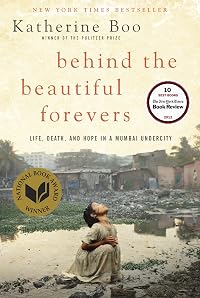
The story was interesting but I did not like her writing. Every object had a synonym, analogy or overly descriptive. Keeping track of the 5 girls and their mothers was daunting. Very similar to "A Beautiful Forever".
Ratings
Members
- Recently Added By
Lists

History: Asia
103 works; 1 member

Books Read in 2019
4,052 works; 110 members
Author Information
10+ Works 222 Members
Awards and Honors
Common Knowledge
- Original publication date
- 2019
- Blurbers
- James, Tania; Abel, Heather; Hajratwala, Minal
- Original language
- English
Classifications
Statistics
- Members
- 168
- Popularity
- 195,340
- Reviews
- 6
- Rating
- (3.97)
- Languages
- English
- Media
- Paper, Audiobook, Ebook
- ISBNs
- 9
- ASINs
- 2