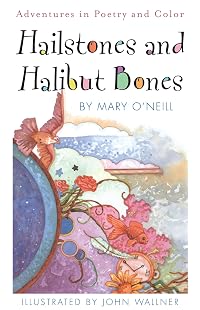
Hailstones and Halibut Bones: Adventures in Poetry and Color
by Mary Le Duc O'Neill
On This Page
Description
Twelve poems reflect the author's feelings about various colors.Tags
Recommendations



Member Reviews
It all begins with a strange coin on a sun-warmed sidewalk.
Jane finds the coin, and becasue she and her sblings are having the worst, most dreadfully boring summer ever, she idly wishes something exciting would happen.
And something does: Her wish is granted.
Or not quite. Only half of her wish comes true.
It turns out the coin grants wishes--but only by half, so that you must wish for twice as much as you want.
Wishing for two times some things is a cinch, but other doubled wishes only cause twice as much trouble. What is half of twice a talking cat? Or to be half-again twice not-here? And how do you double your most heartfelt wish, the one you care about so much it has to be perfect?
Jane finds the coin, and becasue she and her sblings are having the worst, most dreadfully boring summer ever, she idly wishes something exciting would happen.
And something does: Her wish is granted.
Or not quite. Only half of her wish comes true.
It turns out the coin grants wishes--but only by half, so that you must wish for twice as much as you want.
Wishing for two times some things is a cinch, but other doubled wishes only cause twice as much trouble. What is half of twice a talking cat? Or to be half-again twice not-here? And how do you double your most heartfelt wish, the one you care about so much it has to be perfect?
“Black is a feeling / Hard to explain / Like suffering but / Without the pain.” I saw this line of poetry referenced on the Internet somewhere and knew I had to check out this book! O’Neill gives each color of the rainbow (plus a few extras) its own attention in poetry that is humorous and insightful. Color is of course a visual charactertistic, but it’s so much more. I loved exploring all the emotional and sensory experiences we associate with color, and this book gave me a desire to consider how I would personally describe each color.
Content consideration: includes a reference to Indians as “things that are red” with an illustration of a Native American statue.
Content consideration: includes a reference to Indians as “things that are red” with an illustration of a Native American statue.
“Black is a feeling / Hard to explain / Like suffering but / Without the pain.” I saw this line of poetry referenced on the Internet somewhere and knew I had to check out this book! O’Neill gives each color of the rainbow (plus a few extras) its own attention in poetry that is humorous and insightful. Color is of course a visual charactertistic, but it’s so much more. I loved exploring all the emotional and sensory experiences we associate with color, and this book gave me a desire to consider how I would personally describe each color.
Content consideration: includes a reference to Indians as “things that are red” with an illustration of a Native American statue.
Content consideration: includes a reference to Indians as “things that are red” with an illustration of a Native American statue.
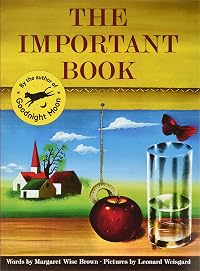
I was given the Wallner edition.. The pictures are lovely. But I can't rate the book. It reminds me of [b:The Important Book|216330|The Important Book|Margaret Wise Brown|https://i.gr-assets.com/images/S/compressed.photo.goodreads.com/books/1388197290l/216330._SX50_.jpg|2216644] by [a:Margaret Wise Brown|18479|Margaret Wise Brown|https://images.gr-assets.com/authors/1208465845p2/18479.jpg]. I should love both of them, but I actually despise them. Why?
Because they *decree.* "Content is gray, and sleepiness, too." Says who!? *I* say sleepiness is a warm brown, tbh. ... So, ok, yes, both books could be used in a classroom to inspire creative writing. Fine. Teach thus: "In Brown's opinion... in O'Neill's opinion... How do you feel about show more these colors, these things?"
But still. If the full book is shared before the students start to write, I'm concerned that their own creativity would be stifled. I *know* mine is. Any attempt I would make now would certainly be only a reaction, a response, nothing fresh or creative.
And also, many children encountering it don't even have that guidance. They're definitely reading it as Established Wisdom. And I honestly don't think either Brown or O'Neill intended that. So, too bad, sorry, but: Fail. show less
Because they *decree.* "Content is gray, and sleepiness, too." Says who!? *I* say sleepiness is a warm brown, tbh. ... So, ok, yes, both books could be used in a classroom to inspire creative writing. Fine. Teach thus: "In Brown's opinion... in O'Neill's opinion... How do you feel about show more these colors, these things?"
But still. If the full book is shared before the students start to write, I'm concerned that their own creativity would be stifled. I *know* mine is. Any attempt I would make now would certainly be only a reaction, a response, nothing fresh or creative.
And also, many children encountering it don't even have that guidance. They're definitely reading it as Established Wisdom. And I honestly don't think either Brown or O'Neill intended that. So, too bad, sorry, but: Fail. show less
This is a wonderful anthology of poems about colors. The author brings colors to life by describing to the reader how colors make her feel and what they remind her of. She personifies the colors by giving them humanistic attributes like green being greedy. She also tells how the colors sound, look like, smell and taste like.
I love this book because it invokes all the senses. You can actually hear smell and taste the different colors as she describes them.
One extension idea I would use in the classroom would be to give each student a card with the name of a color on it and ask them to tell the class what that color sounds, smells, tastes, looks, and feels like to them. I cold also have them use the same cards and point to things around show more the room that are the same color to show them how color is an intricate part of our world and our everyday life and how the vision impared cannot see the colors and so we must find other ways to describe to them the colors we get to see everyday. show less
I love this book because it invokes all the senses. You can actually hear smell and taste the different colors as she describes them.
One extension idea I would use in the classroom would be to give each student a card with the name of a color on it and ask them to tell the class what that color sounds, smells, tastes, looks, and feels like to them. I cold also have them use the same cards and point to things around show more the room that are the same color to show them how color is an intricate part of our world and our everyday life and how the vision impared cannot see the colors and so we must find other ways to describe to them the colors we get to see everyday. show less
This is hands down my favorite poetry book. I love the imagery and the words used to describe the 12 colors. There is also a video that can be found on United Streaming that accompanies the book. It is probably available on youtube as well. Students are inspired to create their own color poems after sharing this poetry book. I usually have them do a share, and read their poem and the others have to guess their color. There are tons of fun lessons out there surrounding this magical book.
Hailstones and Halibut Bones: Adventures in Color is a fun walk through the different colors of the universe. O’Neil begins and ends this collection of poetry with a poem that describes all colors as living entities that affect the world. Throughout the book, each poem brings it assigned color to life. You do not read about the colors, you see, hear, smell and feel them.
Even though this book is as old as I am, I think it could be considered timeless because colors, like people, do not really change. I thought it was fun to read and I caught myself saying “yes, that is the best way to describe that.” In the poems, “What is Blue?” and “What is Black?” the author’s use of figurative language reveals the true personalities show more of these colors. Both colors have preconceived notions about them, but O’Neil shows the reader there is good and bad in all.
This book would be great to use as an extension to a unit on colors. Whenever a new color was to be introduced, the teacher could read that poem.
There are several poems that offer opposites, such as “What is Blue?” After reading and discussing the poem, the students would work with opposite cards at center, pairing cards with their opposites. show less
Even though this book is as old as I am, I think it could be considered timeless because colors, like people, do not really change. I thought it was fun to read and I caught myself saying “yes, that is the best way to describe that.” In the poems, “What is Blue?” and “What is Black?” the author’s use of figurative language reveals the true personalities show more of these colors. Both colors have preconceived notions about them, but O’Neil shows the reader there is good and bad in all.
This book would be great to use as an extension to a unit on colors. Whenever a new color was to be introduced, the teacher could read that poem.
There are several poems that offer opposites, such as “What is Blue?” After reading and discussing the poem, the students would work with opposite cards at center, pairing cards with their opposites. show less
Members
- Recently Added By
Lists

Brilliant poetry collections for kids
51 works; 18 members

Honey For a Child's Heart
1,152 works; 25 members

Youth: Poetry
124 works; 1 member

Youth: Reading, Writing, Humor, Satire
63 works; 1 member

Poetry Corner
187 works; 15 members

50+ Books for a 6th Grader Who Loves to Read
53 works; 4 members

Early Picture Books
467 works; 9 members
Author Information
24 Works 1,886 Members
Some Editions
Common Knowledge
- Alternate titles
- Hailstones and Halibut Bones; Adventures in Color
- Original publication date
- 1961
- Epigraph
- Like acrobats on a high trapeze
The Colors pose and bend their knees
Twist and turn and leap and blend
Into shapes and feelings without end... - First words
- Time is purple
Just before night
When most people
Turn on the light --
But if you don't it's
A beautiful sight. - Last words
- (Click to show. Warning: May contain spoilers.)And you and you and I
Know well
Each has a taste
And each has a smell
And each has a wonderful
Story to tell....
Classifications
Statistics
- Members
- 1,475
- Popularity
- 15,872
- Reviews
- 32
- Rating
- (4.32)
- Languages
- English
- Media
- Paper
- ISBNs
- 18
- ASINs
- 14
