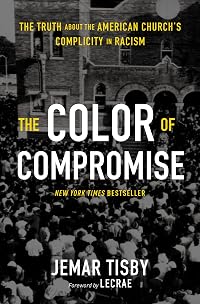
The Color of Compromise: The Truth about the American Church’s Complicity in Racism
by Jemar Tisby
On This Page
Description
An acclaimed, timely narrative of how people of faith have historically--up to the present day--worked against racial justice. And a call for urgent action by all Christians today in response. The Color of Compromise is both enlightening and compelling, telling a history we either ignore or just don't know. Equal parts painful and inspirational, it details how the American church has helped create and maintain racist ideas and practices. You will be guided in thinking through concrete show more solutions for improved race relations and a racially inclusive church. The Color of Compromise: - Takes you on a historical, sociological, and religious journey: from America's early colonial days through slavery and the Civil War C- overs the tragedy of Jim Crow laws, the victories of the Civil Rights era, and the strides of today's Black Lives Matter movement - Reveals the cultural and institutional tables we have to flip in order to bring about meaningful integration - Charts a path forward to replace established patterns and systems of complicity with bold, courageous, immediate action - Is a perfect book for pastors and other faith leaders, students, non-students, book clubs, small group studies, history lovers, and all lifelong learners The Color of Compromise is not a call to shame or a platform to blame white evangelical Christians. It is a call from a place of love and desire to fight for a more racially unified church that no longer compromises what the Bible teaches about human dignity and equality. A call that challenges black and white Christians alike to standup now and begin implementing the concrete ways Tisby outlines, all for a more equitable and inclusive environment among God's people. Starting today. show lessTags
Recommendations


Member Reviews
For context, this book stands in the stream of a personal listening campaign. Particularly as a white man, I take it as a serious responsibility to listen to the many cries of injustice coming from the American black community. I also take it as a serious responsibility to listen critically, because the truth matters. Many times, a tension develops in those of us who hear the charges of racism being spoken by those we care about, because we do not readily understand the charges themselves. It’s a serious thing to assign the label of racism, so many people like myself have a great desire to extinguish it, but we are hesitant to rush into the fight until we can grasp the nature of the charges and assess their validity.
In the context of show more this listening campaign, I can not say that The Color of Compromise answers every question, but it has certainly moved me in the right direction. As a historical overview of Christian complicity with racism, the book proceeds as one would expect from the 1600’s up through the mid-twentieth century. America has had a serious and well-documented problem with racism for a long time, and it comes as no surprise that many Christians have been a part of the problem. Even the Bible has been used to justify slavery and segregation.
The problem always comes as we move into the latter part of the twentieth century. The prevailing white sentiment is, “Yes, we acknowledge the horrible history of racism. And, we acknowledge the diminishing group of racists that still exists. But, aren’t we moving in the right direction now? Haven’t we at least fixed the system now?” The growing response today is, “No – above all, it’s the system itself that’s the problem!” Tisby acknowledges this as he writes, “Nowadays, all the American church needs to do in terms of compromise is cooperate with already established and racially unequal social systems [to maintain complicity with racism].” He also notes, “Racialization functions differently from straightforward racism… discrimination in a racialized society is increasingly covert, embedded in the normal operations of institutions, and it avoids direct racial terminology, making it invisible to most white people.” In other words, if you’re struggling to understand racial tension in today’s America, join the club!
Thankfully, Tisby specifically lists many examples of racial discrimination from the 1970’s through the 2010’s that are very helpful for pursuing the conversation further. As one would expect, they’re full of grey areas, and the reader may not agree with his assessment on all of them. However, they open the door to hear and understand from another perspective.
The book closes with a chapter of practical suggestions – where do we go from here? Again, Tisby’s suggestions are a mixed bag, but I do believe everybody can find something in the chapter to practice as we commit together to racial reconciliation. Overall, the book was a thought-provoking addition to the ongoing conversation on race in the American church. show less
In the context of show more this listening campaign, I can not say that The Color of Compromise answers every question, but it has certainly moved me in the right direction. As a historical overview of Christian complicity with racism, the book proceeds as one would expect from the 1600’s up through the mid-twentieth century. America has had a serious and well-documented problem with racism for a long time, and it comes as no surprise that many Christians have been a part of the problem. Even the Bible has been used to justify slavery and segregation.
The problem always comes as we move into the latter part of the twentieth century. The prevailing white sentiment is, “Yes, we acknowledge the horrible history of racism. And, we acknowledge the diminishing group of racists that still exists. But, aren’t we moving in the right direction now? Haven’t we at least fixed the system now?” The growing response today is, “No – above all, it’s the system itself that’s the problem!” Tisby acknowledges this as he writes, “Nowadays, all the American church needs to do in terms of compromise is cooperate with already established and racially unequal social systems [to maintain complicity with racism].” He also notes, “Racialization functions differently from straightforward racism… discrimination in a racialized society is increasingly covert, embedded in the normal operations of institutions, and it avoids direct racial terminology, making it invisible to most white people.” In other words, if you’re struggling to understand racial tension in today’s America, join the club!
Thankfully, Tisby specifically lists many examples of racial discrimination from the 1970’s through the 2010’s that are very helpful for pursuing the conversation further. As one would expect, they’re full of grey areas, and the reader may not agree with his assessment on all of them. However, they open the door to hear and understand from another perspective.
The book closes with a chapter of practical suggestions – where do we go from here? Again, Tisby’s suggestions are a mixed bag, but I do believe everybody can find something in the chapter to practice as we commit together to racial reconciliation. Overall, the book was a thought-provoking addition to the ongoing conversation on race in the American church. show less
My thanks to someone on either LibraryThing or GoodReads who recommended this as the better book than Reconstructing the Gospel on discussing Christianity, the church and racism. This had a lot of historical background information. It was better written in that it really laid out the problem from the beginnings and then came forward in time. I really appreciated the end chapters with their suggestions on how to address the problem. I'm so grateful for books that go beyond just describing a problem and offer ways to make a difference. This is one of those. Well written, though the author's narration was not the best, the material really kept my attention. This would be great to read with a group. There is so much to delve into. Very show more thoughtfully put together. show less
Introductory survey of the Christian church in America and how much white supremacy was interwoven in with theology and everyday practice. It was very well written and a solid introduction.
I think I was expecting a lot more detail and more primary sources rather than a survey which briefly covered hundreds of years. For comparison, Kendi's Stamped from the Beginning clocks in at 608 pages. I would have loved to read 600 pages from Tisby as the 250 pages we got seemed to be too little. Here's to another Tisby history book!
The later chapters have a more recent context so it was easier to access and I especially appreciate how he contrasted Billy Graham and Martin Luther King, Jr. as it is stark how differently the white Christian show more response was to Black suffering during the civil rights movement.
A good conversation starter and a great jumping off point into deeper research. show less
I think I was expecting a lot more detail and more primary sources rather than a survey which briefly covered hundreds of years. For comparison, Kendi's Stamped from the Beginning clocks in at 608 pages. I would have loved to read 600 pages from Tisby as the 250 pages we got seemed to be too little. Here's to another Tisby history book!
The later chapters have a more recent context so it was easier to access and I especially appreciate how he contrasted Billy Graham and Martin Luther King, Jr. as it is stark how differently the white Christian show more response was to Black suffering during the civil rights movement.
A good conversation starter and a great jumping off point into deeper research. show less
The Color of Compromise is a historical survey focusing on the ways American Christianity has been complicit in enslavement and racism throughout the history of the United States, from colonization to the present. I found it to be a heavy read, but a necessary one.
One of the most compelling arguments Tisby presents throughout the book centers around the notion that white American Christianity has consistently focused on individual conversion at the expense of systemic change. He does an excellent job of tracing this theme from the First and Second Great Awakenings through to today. He scrutinizes oft revered American religious figures such as Jonathan Edwards and George Whitefield, and exposes the ways in which they enabled slavery- show more Tisby pulls no punches in discussing Jim Crow era racial terror, and furthermore, considers the insidious ways racism still permeates society today.
The book was well-researched, well-presented, and I greatly appreciated Tisby's final chapter containing concrete suggestions about how Christians can work to combat racism today.
This is a sobering read, but one I highly recommend. Those of us who are part of the many, many Christian denominations and communities that have played a role in oppressing Black Americans- overtly and through silence in the face of injustice- need to read this book. show less
One of the most compelling arguments Tisby presents throughout the book centers around the notion that white American Christianity has consistently focused on individual conversion at the expense of systemic change. He does an excellent job of tracing this theme from the First and Second Great Awakenings through to today. He scrutinizes oft revered American religious figures such as Jonathan Edwards and George Whitefield, and exposes the ways in which they enabled slavery- show more Tisby pulls no punches in discussing Jim Crow era racial terror, and furthermore, considers the insidious ways racism still permeates society today.
The book was well-researched, well-presented, and I greatly appreciated Tisby's final chapter containing concrete suggestions about how Christians can work to combat racism today.
This is a sobering read, but one I highly recommend. Those of us who are part of the many, many Christian denominations and communities that have played a role in oppressing Black Americans- overtly and through silence in the face of injustice- need to read this book. show less
I read this book not long after I had finished Wilkerson's The Warmth of Other Suns, a book I am convinced should be read by everyone in America with the same dedication that they would read The Federalist Papers or biographies of presidents, or, I don't know, "Greatest Generation" stories maybe. So it was with Wilkerson's wide-scale view of the causes and effects of the seventy-year Black migration out of the South and into the North and West that I picked up Tisby's book, which is a historical survey of the American Christian Church's complicity in perpetuating systemic racism. As I made my way through the book, scenes from Warmth would come back to me, like I was listening to a conversation between the two books, so well did they show more mesh and overlap.
All of which is to say I think the stellar research and evidence presented in Warmth informs and validates the perspective and conclusions of much of The Color of Compromise.
Tisby, first of all, is a faithful and deeply passionate Christian. He wants to heal his church from the disease of its racist past and present:
Tisby gives two cooperating definitions of racism:
1) Racism is a system of oppression based on race (Beverly Daniel Tatum)
2) racism is prejudice plus power
In other words, prejudice becomes racism when it imposes itself on other people. And complicity "isn't a matter of melanin, it's a matter of power." With those working definitions at hand, Tisby takes a tour through the history of the church in America, wherever it intersects with the fate of the Black people that were enslaved and brought here. It is a historical survey of complicity, that he attempts to elucidate and bring into awful context.
As a historical survey, I found the latter half of the book, which looks at Jim Crow and our contemporary equivalents, more interesting and immediate than the former, which gives an overview of the adoption, justification, and defense of slavery. None of his examples are new or given original interpretations: Christian justifications for slavery based on things like "there is slavery in the Bible" or "it's the curse of Ham" would sound silly if they weren't used to such devestating effect. But we are (I hope) past using Biblical justifications for bigotry.
What I found more interesting about the first part of the book is Tisby's insistence that every historical moment where the fate of Black people were decided was a matter of deliberate choice: The Virginia Assembly in 1667 could have chosen that conferring baptism renders a person free (since it was a tenet of Christianity at the time that one Christian could not enslave another, this was a hot button issue), but they didn't. The writers of the Constitution could have chosen to recognize Blacks as people, but they didn't. The more entrenched slavery became and the more integrated into the economy, the more effort white people put into regulating and justifying it. And in fact, Christian missionary types (I did NOT know that John Newton, who wrote Amazing Grace, was originally a slave ship captain) went to great lengths to assure plantation owners that baptising their work force into Christianity would not mean they had to be emancipated, even if they had souls to be saved. That sort of thing resulted in what can only be called a very twisted concept of Christiany that still infects the Church today.
It is interesting to read Tisby's contention that there was a choice at these various historical moments, because the general take by historians is that there was not. Anyone who reads any -- and I do mean ANY -- of the more popular and well-respected histories of the founding of the United States invariably runs into the hard fact that antislavery clauses were excised from the Declaration of Independence, and the even harder brick wall that is the presence of the three-fifths clause of the Constitution. That the phrase "We believe that all men are created equal" is possibly the most hypocritical line ever written given the circumstances. They are mentioned, and usually justified as regrettably "necessary" for the survival of the nascent country, but quickly passed over in favor of continuing the story of the great white men and events that resulted in The United States of America. Historians shy away from the dreadful irony that their new land of Life, Liberty, and the Pursuit of Happiness actually depended on enslaving people, treating slavery as an historical artifact of the past. The average American historian talks about the pragmatism of the founding fathers, but Tisby insists -- rightly -- that it was also a deliberate, conscious, and therefore EVIL choice, the results of which we have never stopped feeling.
The other thing I found interesting in the first part of the book was Tisby's analysis of how The Great Awakening, with its emphasis on conversion and the individual's relationship with God, became the de facto theological justification for preserving a racial caste system. He covers a number of early influential church leaders and movements -- George Whitfield, Jonathan Edwards, The Baptist General Committee of Virginia -- once again insisting that wherever racist justifications were made or racist policies adopted, it was a matter of conscious and deliberate choice. But it is in the rise of Evangelism during the Second Great Awakening in Antebellum era that he concentrates most of his attention.
The logic seems to go something like this: Christ will return after an extended period of peace and justice to his Benevolent Empire. This empire can only happen through social reform, which can only happen when the people in the society convert and accept Jesus as their Savior. That is, once a person believes in Jesus Christ, they will naturally work for justice. Therefore, the more conversions, the more just the society.
As a result, American Christian churches were more interested in individual conversions than in social policies or reform, while their newly converted congregants now felt that being saved, they acted for the good by default. It's a bit of circular magical thinking that is at the foundation of many conservative Christians inability to see or comprehend systemic racism. A society is simply a collection of individual good and bad works.
In fact, I'd say the whole latter half of the book is the author's attempt to convince his readers that there is such a thing as systemic racism.
To that end there is an extensive discussion of Jim Crow and its not-just Southern presence. For example, in talking about segregation, he talks about the practice of redlining, and the long term effects it has had on neighborhoods and communities. And when it comes to the Civil Rights Era, his focus is on moderate white Christian churches and leaders, and how their lack of active support for anti-segregation was in fact complicity in a racist society. His poster boy for this is Rev. Billy Graham, who is famous for removing the ropes that divided Black and white worshippers in his own congregation, but who generally avoided situations that would require to take a stand that would alienate his own white followers. "I believe the heart of the problem of race is in loving our neighbor" Tisby quotes him after Brown vs. Board of Education. Its the kind of statement this is true, but leaves responsiblity for social justice to the individual, and doesn't call for any collective action -- a direct descendant of the Evangelism of the 19th century. On the contrary, the same arguments that were once used to justify slavery began to be trotted out by white evangelicals in support of segregation: the evangelical is not primarily a reformer, but a spreader of the Good News. It is not for the Church to force people together who don't want to be. Tisby also suggests that it was Graham and church leaders like him, that did as much as any politician to cement the association of civil rights activism with communism, entangling the two such that they are still conflated today, thus allowing Christians to behave in racist ways under the very accomodating umbrella of anti-communist sentiment.
There is, in fact, an extensive comparison between Rev. Billy Graham and Rev. Martin Luther King, Jr. in their approach to civil rights activism. The former, like many white moderate religious leaders, against the "lawlessenss" that even King's nonviolent marches and demonstrations represented, while they remained largely silent about the lynchings and extracurricular violence visited on Black bodies.
The last few chapters of The Color of Compromise attempts to address the racialized society we live in -- a society where overt racist acts, like lynching, are illegal or unacceptable, but covert racist actions and policies are in full force. "Racialized society" here being defined as Michael Emerson and Christian Smith do in their book Divided by Faith: "wherein race matters profoundly for defferences in life experiences, life opportunites, and social relationships."
That is, American white conservative Christians hold a set of beliefs that make them complicit in the racism of such a society. One example he gives is the idea of "accountable individualism" which holds that "individuals exist independent of structures and institutions, have free will, are acccountable for their own actions," and thus not significantly influenced or controlled by social systems. This is at the heart of the conservative insistence that to focus on racist social structures is to deny Black people their own ability to be responsible for themselves.
Tisby also looks at the conservative resistance to the Black Lives Matter movement, which seems to be a sort of muddled response to 1) the fact that BLM does not identify as a faith-based movement, and advocates for gay, queer, and transgender rights and 2) their conviction that the apparently endless accounts of Black people killed by police are first and foremost isolated incidents, not the result of any unstated policy on the part of law enforcement across the country.
And of course Tisby sees Christian conservative and evangelical support of Donald Trump as a kind of nadir of the faith: "Christian complicity with racism looks different than complicity with racism in the past," he writes. "It looks like Christians responding to "black lives matter" with the phrase "all lives matter". It looks like Christians consistently supporting a president whose racism has been on display for decades. It looks like Christians telling black people and their allies that their attemps to bring up racial concerns are 'divisive.'"
The Color of Compromise is a long, long, litany of the sins of the American Christian Church, written by a person of deep faith who hasn't lost it. His last chapter of "things you can do" (diversify your friends, read, join social justice organizations, vote) is not very original nor at this point even very radical. "Take down Confederate Monuments" is one suggestion, so Tisby must be gratified at the news today. "Learn from the Black Church" is another, more useful recommendation for re-interpreting or rethinking a theology which has been used in the service of such pernicious causes. The most radical suggestion in the chapter is "The R-Word" -- reparations. But Tisby has only vague ideas about how to address such a thing.
But despite the general "we can do better" message at the end of the book, the emotional weight of The Color of Compromise is its long, terrible list of examples of the racist acts and compromises of the church. The "confession," as he calls it. Not being a person of faith myself, it is a little hard for me to assess how likely this book is to make anyone re-assess their faith, much less change their mind about something like Black Lives Matter. But what does come through is that the book was written from a place of love, not enmity. That this isn't an attack on Christian faith, but a lament for what it has become, a plea for it to return to what it truly means to be a Christian. In the first chapter of the book, Tisby has a section called "Why The Color of Compromise May be Hard to Read." It is a list of all the usual objections and rejections people make against the idea of systemic racism: that it is "too liberal", or reduces Black people to a victim mentality, or that the examples in the book don't represent the "real" church. I don't know if a reader with any or all of those objections will have changed their mind by the end of the book, but I hope so. show less
All of which is to say I think the stellar research and evidence presented in Warmth informs and validates the perspective and conclusions of much of The Color of Compromise.
Tisby, first of all, is a faithful and deeply passionate Christian. He wants to heal his church from the disease of its racist past and present:
"History and Scripture teaches us that there can be no reconciliation without repentance. There can be no repentance without confession. And there can be no confession without truth. The Color of Compromise is about telling the truth so that reconciliation--robust, consistent, honest reconciliation--might occur across racial lines. Yet all too often Christians, and Americans in general, try to circumvent the truth-telling process in their haste to arrive at reconciliation. This book tells the truth about racism in the American church in order to facilitate authentic human solidarity."
Tisby gives two cooperating definitions of racism:
1) Racism is a system of oppression based on race (Beverly Daniel Tatum)
2) racism is prejudice plus power
In other words, prejudice becomes racism when it imposes itself on other people. And complicity "isn't a matter of melanin, it's a matter of power." With those working definitions at hand, Tisby takes a tour through the history of the church in America, wherever it intersects with the fate of the Black people that were enslaved and brought here. It is a historical survey of complicity, that he attempts to elucidate and bring into awful context.
As a historical survey, I found the latter half of the book, which looks at Jim Crow and our contemporary equivalents, more interesting and immediate than the former, which gives an overview of the adoption, justification, and defense of slavery. None of his examples are new or given original interpretations: Christian justifications for slavery based on things like "there is slavery in the Bible" or "it's the curse of Ham" would sound silly if they weren't used to such devestating effect. But we are (I hope) past using Biblical justifications for bigotry.
What I found more interesting about the first part of the book is Tisby's insistence that every historical moment where the fate of Black people were decided was a matter of deliberate choice: The Virginia Assembly in 1667 could have chosen that conferring baptism renders a person free (since it was a tenet of Christianity at the time that one Christian could not enslave another, this was a hot button issue), but they didn't. The writers of the Constitution could have chosen to recognize Blacks as people, but they didn't. The more entrenched slavery became and the more integrated into the economy, the more effort white people put into regulating and justifying it. And in fact, Christian missionary types (I did NOT know that John Newton, who wrote Amazing Grace, was originally a slave ship captain) went to great lengths to assure plantation owners that baptising their work force into Christianity would not mean they had to be emancipated, even if they had souls to be saved. That sort of thing resulted in what can only be called a very twisted concept of Christiany that still infects the Church today.
It is interesting to read Tisby's contention that there was a choice at these various historical moments, because the general take by historians is that there was not. Anyone who reads any -- and I do mean ANY -- of the more popular and well-respected histories of the founding of the United States invariably runs into the hard fact that antislavery clauses were excised from the Declaration of Independence, and the even harder brick wall that is the presence of the three-fifths clause of the Constitution. That the phrase "We believe that all men are created equal" is possibly the most hypocritical line ever written given the circumstances. They are mentioned, and usually justified as regrettably "necessary" for the survival of the nascent country, but quickly passed over in favor of continuing the story of the great white men and events that resulted in The United States of America. Historians shy away from the dreadful irony that their new land of Life, Liberty, and the Pursuit of Happiness actually depended on enslaving people, treating slavery as an historical artifact of the past. The average American historian talks about the pragmatism of the founding fathers, but Tisby insists -- rightly -- that it was also a deliberate, conscious, and therefore EVIL choice, the results of which we have never stopped feeling.
The other thing I found interesting in the first part of the book was Tisby's analysis of how The Great Awakening, with its emphasis on conversion and the individual's relationship with God, became the de facto theological justification for preserving a racial caste system. He covers a number of early influential church leaders and movements -- George Whitfield, Jonathan Edwards, The Baptist General Committee of Virginia -- once again insisting that wherever racist justifications were made or racist policies adopted, it was a matter of conscious and deliberate choice. But it is in the rise of Evangelism during the Second Great Awakening in Antebellum era that he concentrates most of his attention.
The logic seems to go something like this: Christ will return after an extended period of peace and justice to his Benevolent Empire. This empire can only happen through social reform, which can only happen when the people in the society convert and accept Jesus as their Savior. That is, once a person believes in Jesus Christ, they will naturally work for justice. Therefore, the more conversions, the more just the society.
As a result, American Christian churches were more interested in individual conversions than in social policies or reform, while their newly converted congregants now felt that being saved, they acted for the good by default. It's a bit of circular magical thinking that is at the foundation of many conservative Christians inability to see or comprehend systemic racism. A society is simply a collection of individual good and bad works.
In fact, I'd say the whole latter half of the book is the author's attempt to convince his readers that there is such a thing as systemic racism.
To that end there is an extensive discussion of Jim Crow and its not-just Southern presence. For example, in talking about segregation, he talks about the practice of redlining, and the long term effects it has had on neighborhoods and communities. And when it comes to the Civil Rights Era, his focus is on moderate white Christian churches and leaders, and how their lack of active support for anti-segregation was in fact complicity in a racist society. His poster boy for this is Rev. Billy Graham, who is famous for removing the ropes that divided Black and white worshippers in his own congregation, but who generally avoided situations that would require to take a stand that would alienate his own white followers. "I believe the heart of the problem of race is in loving our neighbor" Tisby quotes him after Brown vs. Board of Education. Its the kind of statement this is true, but leaves responsiblity for social justice to the individual, and doesn't call for any collective action -- a direct descendant of the Evangelism of the 19th century. On the contrary, the same arguments that were once used to justify slavery began to be trotted out by white evangelicals in support of segregation: the evangelical is not primarily a reformer, but a spreader of the Good News. It is not for the Church to force people together who don't want to be. Tisby also suggests that it was Graham and church leaders like him, that did as much as any politician to cement the association of civil rights activism with communism, entangling the two such that they are still conflated today, thus allowing Christians to behave in racist ways under the very accomodating umbrella of anti-communist sentiment.
There is, in fact, an extensive comparison between Rev. Billy Graham and Rev. Martin Luther King, Jr. in their approach to civil rights activism. The former, like many white moderate religious leaders, against the "lawlessenss" that even King's nonviolent marches and demonstrations represented, while they remained largely silent about the lynchings and extracurricular violence visited on Black bodies.
The last few chapters of The Color of Compromise attempts to address the racialized society we live in -- a society where overt racist acts, like lynching, are illegal or unacceptable, but covert racist actions and policies are in full force. "Racialized society" here being defined as Michael Emerson and Christian Smith do in their book Divided by Faith: "wherein race matters profoundly for defferences in life experiences, life opportunites, and social relationships."
That is, American white conservative Christians hold a set of beliefs that make them complicit in the racism of such a society. One example he gives is the idea of "accountable individualism" which holds that "individuals exist independent of structures and institutions, have free will, are acccountable for their own actions," and thus not significantly influenced or controlled by social systems. This is at the heart of the conservative insistence that to focus on racist social structures is to deny Black people their own ability to be responsible for themselves.
Tisby also looks at the conservative resistance to the Black Lives Matter movement, which seems to be a sort of muddled response to 1) the fact that BLM does not identify as a faith-based movement, and advocates for gay, queer, and transgender rights and 2) their conviction that the apparently endless accounts of Black people killed by police are first and foremost isolated incidents, not the result of any unstated policy on the part of law enforcement across the country.
And of course Tisby sees Christian conservative and evangelical support of Donald Trump as a kind of nadir of the faith: "Christian complicity with racism looks different than complicity with racism in the past," he writes. "It looks like Christians responding to "black lives matter" with the phrase "all lives matter". It looks like Christians consistently supporting a president whose racism has been on display for decades. It looks like Christians telling black people and their allies that their attemps to bring up racial concerns are 'divisive.'"
The Color of Compromise is a long, long, litany of the sins of the American Christian Church, written by a person of deep faith who hasn't lost it. His last chapter of "things you can do" (diversify your friends, read, join social justice organizations, vote) is not very original nor at this point even very radical. "Take down Confederate Monuments" is one suggestion, so Tisby must be gratified at the news today. "Learn from the Black Church" is another, more useful recommendation for re-interpreting or rethinking a theology which has been used in the service of such pernicious causes. The most radical suggestion in the chapter is "The R-Word" -- reparations. But Tisby has only vague ideas about how to address such a thing.
But despite the general "we can do better" message at the end of the book, the emotional weight of The Color of Compromise is its long, terrible list of examples of the racist acts and compromises of the church. The "confession," as he calls it. Not being a person of faith myself, it is a little hard for me to assess how likely this book is to make anyone re-assess their faith, much less change their mind about something like Black Lives Matter. But what does come through is that the book was written from a place of love, not enmity. That this isn't an attack on Christian faith, but a lament for what it has become, a plea for it to return to what it truly means to be a Christian. In the first chapter of the book, Tisby has a section called "Why The Color of Compromise May be Hard to Read." It is a list of all the usual objections and rejections people make against the idea of systemic racism: that it is "too liberal", or reduces Black people to a victim mentality, or that the examples in the book don't represent the "real" church. I don't know if a reader with any or all of those objections will have changed their mind by the end of the book, but I hope so. show less
A rehearsal of American history focusing primarily on the willingness of professing Christians to compromise Biblical standards and allow for the perpetuation of horrific treatment of black people in the name of compromise to various forces and powers.
The author recognizes that many works have been written on American history and the treatment of black people in slavery, under Jim Crow, and to the modern day. He will provide the basic outline of events and explains how it happened that black people were brought over as slaves to the US, how the slave system was justified, the Civil War and Reconstruction and the rise of Jim Crow in the South, the racism of the North, the move toward civil rights, and the rise of the Religious Right. At show more each moment, however, he pauses to consider how America could have taken different routes, and how Christians could have made conscientious stands in conviction based on Biblical principles, but instead elected to capitulate to economic concerns, accepting and perpetuating claims of racial supremacy, and generally proving unwilling to stand up against the culture of dehumanization, terrorism, and violence which black people have suffered for generations. He also does well at showing how racism remains in America in various ways, and the associations between the rise of the Religious Right and the attempt to uphold the last vestiges of segregation.
It's uncomfortable reading for white Christians to see so many aspects of their spiritual heritage discussed as ways in which the system of slavery and dehumanization of black people was justified, particularly the declaration that the church has its realm and thus nothing to say in terms of social issues of the day.
Highly recommended for all Christians to consider. show less
The author recognizes that many works have been written on American history and the treatment of black people in slavery, under Jim Crow, and to the modern day. He will provide the basic outline of events and explains how it happened that black people were brought over as slaves to the US, how the slave system was justified, the Civil War and Reconstruction and the rise of Jim Crow in the South, the racism of the North, the move toward civil rights, and the rise of the Religious Right. At show more each moment, however, he pauses to consider how America could have taken different routes, and how Christians could have made conscientious stands in conviction based on Biblical principles, but instead elected to capitulate to economic concerns, accepting and perpetuating claims of racial supremacy, and generally proving unwilling to stand up against the culture of dehumanization, terrorism, and violence which black people have suffered for generations. He also does well at showing how racism remains in America in various ways, and the associations between the rise of the Religious Right and the attempt to uphold the last vestiges of segregation.
It's uncomfortable reading for white Christians to see so many aspects of their spiritual heritage discussed as ways in which the system of slavery and dehumanization of black people was justified, particularly the declaration that the church has its realm and thus nothing to say in terms of social issues of the day.
Highly recommended for all Christians to consider. show less
Disclosure: I got an advanced copy
Sometimes truth causes an 'Amen' and sometimes an ''Ouch'. This was the later. Painful at times.
But it was a needed testimony in my life. A testimony to what the Church has done wrong or missed. All in the hopes of a change much needed. So much history unfolded that challenged my limited previous understanding.
I understand that the much of the church has a "want to" problem not a "how too" problem regarding racism. This book not only unfolds history to help stir up a "want to
but also has quite a few suggestions on what to do about racism.
It covers a timeline from Colonial times to the present and from Southern area to Northern.
Racism extends from the Colonial to the present...from the South to the show more North.
From Chapter 1:
"This book says, "Don't look away." Don't look away from Christians using the Bible to justify the inferiority of African people.
Don't look away from the political cowardice Christians displayed when-they could have changed the laws of the land.
Don't look away from the nation's bloodiest war, which was fought over the issue of human bondage, and the many Christians who risked their lives to preserve it.
Don't look away from members in good standing in Christian congregations donning the white hoods of the Ku Klux Klan and terrorizing black citizens.
Don't look away from the horror of the American church when it Comes to race."
This book is a call. Understand the past. And walk forward to the courageous Christianity that the author sets forth and leave behind the compromised Christianity of the past.
Amen show less
Sometimes truth causes an 'Amen' and sometimes an ''Ouch'. This was the later. Painful at times.
But it was a needed testimony in my life. A testimony to what the Church has done wrong or missed. All in the hopes of a change much needed. So much history unfolded that challenged my limited previous understanding.
I understand that the much of the church has a "want to" problem not a "how too" problem regarding racism. This book not only unfolds history to help stir up a "want to
but also has quite a few suggestions on what to do about racism.
It covers a timeline from Colonial times to the present and from Southern area to Northern.
Racism extends from the Colonial to the present...from the South to the show more North.
From Chapter 1:
"This book says, "Don't look away." Don't look away from Christians using the Bible to justify the inferiority of African people.
Don't look away from the political cowardice Christians displayed when-they could have changed the laws of the land.
Don't look away from the nation's bloodiest war, which was fought over the issue of human bondage, and the many Christians who risked their lives to preserve it.
Don't look away from members in good standing in Christian congregations donning the white hoods of the Ku Klux Klan and terrorizing black citizens.
Don't look away from the horror of the American church when it Comes to race."
This book is a call. Understand the past. And walk forward to the courageous Christianity that the author sets forth and leave behind the compromised Christianity of the past.
Amen show less
Members
- Recently Added By
Lists

US White Christian Nationalism
24 works; 1 member
Author Information
13+ Works 1,358 Members
Jemar Tisby (BA, University of Notre Dame; MDiv, Reformed Theological Seminary) is president of The Witness: A Black Christian Collective where he writes about race, religion, politics, and culture. He is also cohost of the Pass The Mic podcast. He speaks nationwide at conferences, and his writing has been featured by the New York Times, the show more Atlantic, and CNN. Jemar is a PhD candidate in history at the University of Mississippi, focusing on race, religion, and social movements in the twentieth century. show less
Awards and Honors
Common Knowledge
- Original publication date
- 2019-01-22
Classifications
- Genres
- Religion & Spirituality, History, Nonfiction, General Nonfiction
- DDC/MDS
- 305.800973 — Society, government, & culture Social sciences, sociology & anthropology Social group - Age, Gender, Ethnicity Ethnic and national groups standard subdivisions / Ethnic and national groups with ethnic origins from more than one continent, of European descent standard subdivisions Biography And History North America United States
- LCC
- E185.615 .T595 — History of the United States United States
- BISAC
Statistics
- Members
- 877
- Popularity
- 30,930
- Reviews
- 11
- Rating
- (4.35)
- Languages
- English
- Media
- Paper, Audiobook, Ebook
- ISBNs
- 9
- UPCs
- 3
- ASINs
- 4