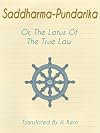
Saddharma-Pundarika or The Lotus of the True Law
by H. Kern
On This Page
Description
"The Saddharma-Pu??ar?ka (The Lotus of the True Law), one of the Mahayana sutras, is perhaps the single most important Mahayana Buddhist work. Composed originally in India, some sections written as early as the beginning of the Christian era, the Lotus is held in enormous esteem by the Northern schools of Buddhism and by Chinese and Japanese Buddhists, particularly Tendai and later developments. Described as "the most eminent" of all the sutras, "the crown jewel" in which "all Buddha-laws show more are succinctly taught," the Lotus is a keystone in the education of every serious Buddhist. This sutra is essentially a collection of responses, explanations, ex cathedra lectures, and the like, bearing chiefly upon metaphysical issues: the nature of Buddhahood, the concept of nirvana, the Bodhisattva ideal, the rewards of the faithful, and other theoretical matters, that have become essential dogma in all Buddhist schools that have since arisen. A transfiguration of the traditional Buddha-situation is presented: the historical Buddha, the Tathagata or Sakyamuni, is seen in his eternal, supernatural aspect; he sits surrounded by an array of gods, arahats, demons, bodhisattvas, gandharvas, monks and nuns--all eager to hear the infinitely wise utterances of the Great Teacher. The revelations are made sometimes by Sakyamuni, addressing his historical sangha, including Ananda, Sariputra, Kasyapa, et al., and at other times by the Buddhas of the past and the future, Manjusri and Maitreya. This edition contains the complete translation of the Lotus, rendered from Sanskrit by Professor Kern. He has also written a critical introduction to the work and has clarified and supplemented the text by means of numerous footnotes."--Publisher's description. show lessTags
Recommendations





















Member Reviews
Dutch scholar Hendrik Kern offers a rare translation of the Lotus Sutra directly from the Sanskrit. Rather than starting from the Chinese of Kumarajiva, Kern worked principally from a manuscript written on palm leaves in Nepal in 1039. The original was part of the collection of Dr. Daniel Wright at the University Library of Cambridge, England. In the present edition, Sanskrit terms are set with modern diacritical marks.
Members
- Recently Added By
Author Information
7 Works 131 Members
Awards and Honors
Notable Lists
Series
Belongs to Publisher Series
Classifications
Statistics
- Members
- 112
- Popularity
- 289,267
- Reviews
- 1
- Languages
- English
- Media
- Paper, Audiobook, Ebook
- ISBNs
- 17
- ASINs
- 10