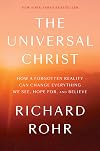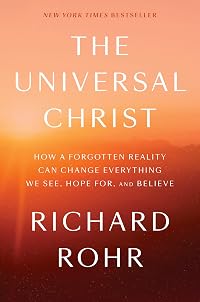
The Universal Christ: How a Forgotten Reality Can Change Everything We See, Hope For, and Believe
by Richard Rohr
On This Page
Description
"From one of the world's most influential spiritual thinkers, along-awaited book exploring what it means that Jesus was called "Christ," and how this forgotten truth can transform everything we see, hope for, and believe. In his decades as a globally recognized teacher, Richard Rohr has helped millions realize what is at stake in matters of faith and spirituality. Yet Rohr has never written on the most perennially talked about topic in Christianity: Jesus. Most know who Jesus was, but who show more was Christ? Is the word simply Jesus's last name? Too often, Rohr writes, our understandings have been limited by culture, religious squabbling, and the human tendency to put ourselves at the center. Drawing on scripture, history, and spiritual practice, Rohr articulates a transformative view of Jesus Christ as a portrait of God's constant, unfolding work in the world. "God loves things by becoming them," he writes, and Jesus's life was meant to declare that humanity has never been separate from God--except by its own negative choice. When we recover this fundamental truth, faith becomes less about proving Jesus was God, and more about learning to recognize the Creator's presence all around us, and in everyone we meet. Thought-provoking, practical, and full of deep hope and vision, The Universal Christ is a landmark book from one of our most beloved spiritual writers, and an invitation to contemplate how God liberates and loves all that is"-- show lessTags
Recommendations








Member Reviews
Rohr writes insightfully and with a deep faith drawing on his Franciscan heritage as well as a myriad of mystics down through the centuries and even some modern theologians as well. But while Rohr is a Catholic priest in the Franciscan order this book is by no means only for Catholics. His insights cut across denominational lines and speak to us more abut following Christ than any one practice of religion. The book is easily accessible to the lay reader but is also engaging enough for the theologian or pastor/priest. Calling on the contemplative tradition from which he springs he outlines the deepest understandings of living as a person of faith in the modern world. Yet this is not a book for those who are well versed in mysticism and show more contemplation but a practical discussion of the depths of the Christian experience - emphasis on experience. We must experience Christ to be able to share the experience of Christ. This is a powerful read for any Christian and for many it could very well change the way they see faith and life and the Christ we all proclaim. show less
I really, really want Richard Rohr to be right in the end about much of his theology. I would prove suspicious of those who wouldn’t.
But I don’t know whether I can go there or not.
Richard Rohr is quite famous as a contemplative mystic. He has had much to do with the resurgence of the contemplative prayer movement and his affirmation of the Enneagram has meant much for its advancement.
In The Universal Christ: How a Forgotten Reality Can Change Everything We See, Hope For, and Believe (galley received as part of early review program, but full book read), Rohr sets out his perspective on life and faith in terms of God as having revealed Himself in Christ.
At no point does Rohr explicitly contradict orthodox Trinitarianism, but he show more encourages envisioning a contrast between Jesus the person and Christ as the Reality of God manifest all around the universe.
In Christ God becomes part of the creation and endures it; in Christ God is risen from the dead, and the hope of life can endure.
Through this lens the author explores the story of Jesus and the work of God in His creation. It will seem very baffling and uncomfortable for those very much wedded to the text of the Scriptures in concrete, fixed ways. At the same time, it proves challenging to say the author has completely abandoned the witness of God in Christ.
He does advocate for a form of panentheism and very much has universalist sympathies; there are good reasons to be skeptical of these positions, but I’ve always been sympathetic to universalism. I’d like for it to be true. I would like to see ultimate redemption for everyone and all things in the end so that God can be “all in all.”
But what I might want, and what might make for a good theological story, is not necessarily exactly how things will work out, or truly well reflects what God has made known in Christ according to the witness of Scripture.
The author’s goal is for everyone to focus more on how they might experience something of God in Christ in the creation around them and in people made in His image. It’s a laudable goal. And the whole work is worth reading and considering even if you, like me, cannot “go there” in all or even many respects of what he has to say. His perspective is worth considering to broaden your horizons and imaginary about what God is accomplishing in Christ. show less
But I don’t know whether I can go there or not.
Richard Rohr is quite famous as a contemplative mystic. He has had much to do with the resurgence of the contemplative prayer movement and his affirmation of the Enneagram has meant much for its advancement.
In The Universal Christ: How a Forgotten Reality Can Change Everything We See, Hope For, and Believe (galley received as part of early review program, but full book read), Rohr sets out his perspective on life and faith in terms of God as having revealed Himself in Christ.
At no point does Rohr explicitly contradict orthodox Trinitarianism, but he show more encourages envisioning a contrast between Jesus the person and Christ as the Reality of God manifest all around the universe.
In Christ God becomes part of the creation and endures it; in Christ God is risen from the dead, and the hope of life can endure.
Through this lens the author explores the story of Jesus and the work of God in His creation. It will seem very baffling and uncomfortable for those very much wedded to the text of the Scriptures in concrete, fixed ways. At the same time, it proves challenging to say the author has completely abandoned the witness of God in Christ.
He does advocate for a form of panentheism and very much has universalist sympathies; there are good reasons to be skeptical of these positions, but I’ve always been sympathetic to universalism. I’d like for it to be true. I would like to see ultimate redemption for everyone and all things in the end so that God can be “all in all.”
But what I might want, and what might make for a good theological story, is not necessarily exactly how things will work out, or truly well reflects what God has made known in Christ according to the witness of Scripture.
The author’s goal is for everyone to focus more on how they might experience something of God in Christ in the creation around them and in people made in His image. It’s a laudable goal. And the whole work is worth reading and considering even if you, like me, cannot “go there” in all or even many respects of what he has to say. His perspective is worth considering to broaden your horizons and imaginary about what God is accomplishing in Christ. show less
Richard's voice companioned me through the spring and summer. A few pages each morning gave me plenty to think about — the process often rearranging my ideas and nudging by beliefs in unexpected ways.
The chapter challenging and examining the long-time notion of necessary violence is worth the price of the book.
I'm still getting my head around a number of concepts, but even when I don't fully understand the perspective offered, I feel invited to sit with it and give it space for consideration. Ample hope for my heart as well as a workout for my mind.
I'll be re-reading this book, I'm sure.
The chapter challenging and examining the long-time notion of necessary violence is worth the price of the book.
I'm still getting my head around a number of concepts, but even when I don't fully understand the perspective offered, I feel invited to sit with it and give it space for consideration. Ample hope for my heart as well as a workout for my mind.
I'll be re-reading this book, I'm sure.
REFLECTION & REVIEW:
SUMMARY: The Universal Christ proposes a model of Christianity that is much more in alignment with what many would call natural theology, rather than revealed theology, which is the traditional theological framework that is believed by most Christians today. Rohr does this by positing that creation was the first revelation, or first scripture, before we ever received revelation from the prophets or canonized scripture. This theological view allows for science and rational thought to be wholeheartedly integrated into Christianity, and in some ways, is more authoritative than scripture or tradition. He states that Christ is in all things, and therefore everything should be viewed as having the divine presence. One is show more encouraged to embrace the uncertainty that happens when science, philosophy, society, morality, religion, tradition, the bible, and/or any other source of knowledge or wisdom interact with one another. He advocates that one should take up one’s cross, and wrestle with God through uncertainty and embrace the divine in all the ways that divinity and spirituality can manifest. In some Christian traditions, uncertainty can be referred to as mystery. Rohr asks the reader to not be so absolute with their theological positions and trust that Christ is working in all things, in all peoples, in all ways. Rohr encourages his audience to embrace one's own personal relationship with Christ, and trust that others also have a relationship with Christ, whether or not they are Christian. This is because Rohr believes that Christ is imbued in all things, making Christ the universal and foundational essence of all that exists.
I read this book with the wonderful Eden Penny. A close friend of Nicole and I. She is on an extended trip out of the United States, and posted a picture of the books she will be reading on her trip, of which the Universal Christ was in her cohort of books. I asked her if she wanted a book buddy as she travels, and we decided to read the Universal Christ together, and share our thoughts over text as we read it.
Much of this reflection is just a copy/paste of my side of the discussion, with slight edits to make my thoughts more cohesive in a non-discussion format.
Introduction Chapter Title: Before we Begin
"Everywhere—Christ
Realization of oneness
Reverence Every kind of life has meaning
Every life has an influence on every other kind of life"
Ch. Title: Before We Begin, Pg. 11
"We gradually limited the Divine Presence to the single body of Jesus, when perhaps it is as ubiquitous as light itself—and uncircumscribable by human boundaries."Ch. Title: Before we Begin, Pg. 12
"What if Christ is a name for the transcendent within every ‘thing’ in the universe? What if Christ is a name for the immense spaciousness of all true Love? What if Christ refers to an infinite horizon that pulls us from within and pulls us forward too? What if Christ is another name for everything—in its fullness?" Introduction Ch. Pg. 12
“Your religion is not the church you belong to, but the cosmos you live inside of." Introduction Ch. Pg. 13
"A cosmic notion of the Christ competes with and excludes no one, but includes everyone and everything" Introduction Ch. Pg. 13
"Christ is everywhere. In Him every kind of life has a meaning and a solid connection." Introduction Ch. Pg. 14
This book outlines a spirituality that is similar to my own, it just uses christian metaphysical frameworks, language, and evidence, while I operate out of materialist/naturalist metaphysical frameworks. Christianity is a philosophical position that I no longer work out of, but I will take what I can, where I can, if that helps explain my positions to Christians. (I am coming back after I have read the book to comment on this. Once I realized that this book is a work of natural theology, and not revealed theology, I am much more comfortable saying that this book is essentially my own spirituality because both the author and I are viewing things through a materialist/naturalist perspective, even though I define myself as an agnostic atheist.)
Chapter 1
"if you believe Jesus’s main purpose is to provide a means of personal, individual salvation, it is all too easy to think that he doesn’t have anything to do with human history—with war or injustice, or destruction of nature, or anything that contradicts our egos’ desires or our cultural biases. We ended up spreading our national cultures under the rubric of Jesus, instead of a universally liberating message under the name of Christ." Ch. 1, Pg. 23
I love everything that this book proposes, even when I put myself into a Christian point of view and state of mind, I also find myself seeing the logic, but all I can feel is dread. It seems like any conversation I would have with a Christian about the metaphysical reframing of Christian narratives that this book tries to put forward, would be like arguing with a brick, who is incapable of following logic or empathy in any consistent fashion, parroting positions of rigid rhetoric from a talking head, instead of revelations from their own personal philosophy and revelations from the personal relationship with Christ they hold so dear. Christians who scream at you to be humble, but are terrified of the humility of not being important or living a life without meaning. They spend all their days dreaming of heaven, but fear death more than those who they say and know they are doomed to hell. Who cannot weather an existential crisis without contemplating some form of self-destruction, or handle their cognitive dissonance by justifying and doubling down on hateful rhetoric, instead of just simply realizing that being wrong on a single point does not always make the whole castle fall. Who only see dialogue as a competition that must be won, and a tool for evangelism or to further their political agenda, instead of a partnership to explore different perspectives together.
"May it not be too late, and may the unnecessary gap between practical seeing (science) and holistic seeing (religion) be fully overcome. They still need each other." Ch. 1, Pg. 23
The metaphysical reframing that Christ is not just present in saved believers but also present in humanity at large, and even present in creation itself definitely should make a believer reorient their thoughts and practice to be compassionate towards all things, due to its inherent divinity. I feel like this is often missed in the teachings of protestant evangelical Christianity. Who is so focused on evangelism, that being in the in-group, and being invited into the in-group is an ends, and not a means, and is more important than the whole reason why the group was established in the first place. From my understanding, the great commission is not the ends of Christianity. The ends of Christianity as I understand it, is this: To love God, and love your neighbor as you would love yourself. But protestant Christians practice their faith as if the great commission is the exclusive and only ends of Christianity, and not a single means, out of many means, of Christian practice. Which is, to show the love of God toward God, oneself, and one’s neighbor.
If one fully commits to Jesus’ amendment to the Jewish Shema, to Love God, and love one’s neighbor as one would love oneself, and the Golden rule preached on the Sermon on the Mount, to treat others as you one would like to be treated, as the ultimate cause of Christianity, makes Christianity an inherently political religion. A religion that pursues the welfare, flourishing, and willing the good, of one’s neighbor, as much as one pursues the welfare and flourishing of oneself, whether or not one’s neighbor, or oneself is a Christian, or in orthodox belief. Love in this sense, is a force of liberation. The better one is able to love one’s neighbor, the better one is able to love oneself or love God, or any variation of what I just stated. Love as liberation makes the tools of love context dependent. For some, the most freeing and loving thing we could do, is love in a social sense, (which is how we traditionally think of love), where inclusivity, acceptance, emotional openness, physical closeness, and sometimes even romantic pursuit, and sexual intimacy, is what is the most loving for oneself, or one’s neighbor. But that is not all that love entails. In many cases, love entails mutual aid, and anarchist economics, where one unconditionally distributes or receives access, time, knowledge, labor, capital, property, or any other resource, in the most loving and liberating ways possible. At certain moments in history, the most loving thing one can do is pursue power, in order to free oneself and free one’s neighbor from the prison of material circumstances, and this is often done collectively with the combined power of both oneself and one’s neighbor.
From my perspective, I see the evangelical, non-denominational, protestant traditions of Christianity as not being in alignment with this understanding of Jesus’ teachings, even though they themselves often teach it. They only practice this view of love if you hold their same beliefs and practice or you can directly benefit them. This is perfectly fine, if they also do not actively participate in gatekeeping resources, imprisoning and limiting the freedoms of those who do not believe or practice as they do. They make an allowance for hurting others or working with those who hurt others, if it directly benefits themself or their Christian community, or see teaching against sin, preventing sin, or avoiding sin as justified grounds to cause harm. My understanding of ‘neighbor’ does not mean ‘my neighbor who is Christian’. In my understanding, it can mean anyone who is in my vicinity, but I personally expand this definition of ‘neighbor’ to mean ‘anyone who is not myself’. I hold this view because I find it to be the most charitable definition, that leads to less gatekeeping, and has the lowest probability of causing harm.
Ch. 2
"As long as we keep God imprisoned in a retributive frame instead of a restorative frame, we really have no substantial good news; it is neither good nor new, but the same old tired story line of history. We pull God down to our level. Faith at its essential core is accepting that you are accepted!" Ch. 2, Pg. 32
As an Atheist, I am with the author on his views about God and Justice being linked. I may use different language or evidence, and have a very different view of metaphysics, but I am in agreement and specifically it seems to me that the 'Soul', crux, or thrust of most religions is a view of justice that is restorative or rehabilitative, and seeks to be in some sort of symbiosis and unity with the surrounding culture and natural world, rather than the more common retributive view of justice that focuses on punishment and revenge as methods used to correct an injustice or sin.
"The sacramental principle is this: Begin with a concrete moment of encounter, based in this physical world, and the soul universalizes from there, so that what is true here becomes true everywhere else too. And so the spiritual journey proceeds with ever-greater circles of inclusion into the One Holy Mystery! But it always starts with what many wisely call the “scandal of the particular.” It is there that we must surrender, even if the object itself seems more than a bit unworthy of our awe, trust, or surrender." Ch. 2, Pg. 34
I saw this and my philosophy brain started churning because this seems to be a very similar way of moral reasoning to Kant's Categorical Imperative. In Wikipedia it is synthesized as "Act only according to that maxim whereby you can at the same time will that it should become a universal law." So I just more or less wanted to point it out. In doing some basic reading on Wikipedia and Stanford Encyclopedia of Philosophy, if there is a difference, it is that Kant focuses on a methodology for understanding universal morals in an A Priori fashion, and Rohr uses an A Posteriori methodology. I haven't read Kant, I just had to learn about him in school, so I could be misunderstanding what I am reading on the internet. In my understanding of A Priori, it just means before an event, experience or stimulus, and A Posteriori means after an event, experience or stimulus.
Ch. 3
"Presence is never self-generated, but always a gift from another, and faith is always relational at the core. Divine seeing cannot be done alone, but only as one consciousness interfaces with another, and the two parties volley back and forth, meeting subject to subject. Presence must be offered and given, evoked and received. It can happen in a physical gesture, a quiet word or smile, a meal shared with someone we care for, where we are suddenly enlivened by a force larger than the two of us. It is so important to taste, touch, and trust such moments. Words and complex rituals almost get in the way at this point. All you can really do is return such presence with your own presence. Nothing to believe here at all. Just learn to trust and draw forth your own deepest experience..." Ch. 3, Pg. 54
A great example of the state mind one shoots for when pursuing a dialogue, and what looking at life through a dialectical lens looks like. In my readings of Plato, I have been thinking and reflecting a lot on dialectics. I have been thinking a lot about the origins of the United States and being founded upon principles of cultural and religious unity through pluralism contrasted with today's America being so focused on unity through division. I have been thinking a lot about my own childhood with family dynamics based on power and control. I have been thinking about the nature of being and existence, and the epistemology of what it means for everything to be an individual with a perspective. I have been thinking about black and white thinking vs shades of grey. I have been thinking about positions of certainty and positions of uncertainty. I have been thinking about the nature of subjective truth and objective truth, and I think this language of "subject to subject" synthesizes and gives me language to clarify my thinking as I find myself developing a personal philosophy of dialogue. In my understanding, a subject is something that is fluid, amorphous, in motion or in action. And an object is something that is solid, can be manipulated or contorted, and acted upon or against. You could use language like means and ends, but I don't know if that quite fits, even though it looks similar enough. I believe a way to avoid black and white thinking is to approach everyone and everything in life as if they are a subject first, and then move them to a position of an object as you gain context and understanding. To add to this, when you move someone to a position of an object, I think it is in parts and by degrees. This is not a binary thing, but a qualitative view where a single part of someone becomes objective for a time, and is available to be acted upon, before moving back into some level of subjectivity. I think we are in a culture that assumes objectivity too eagerly. We incorrectly assume an object first relationship to what it means to be human and you may never be moved to the position of a subject where you are humanized and given permission to have fluid perspective that shifts and changes as you experience the course of life, and are affected by the material conditions of your reality. All things are in conversation with each other. Everything is a dialogue that responds to one another through various means. All of reality is in constant communication with one another. This to me seems clear, I just don't necessarily prescribe to certain metaphysics prescribed to this fact, like the metaphysics of a creator God that Rohr and Christianity prescribes, but the wrestling and dialogue with these metaphysics has provided useful language which is beneficial for all.
Ch. 4
"God did not just start talking to us with the Bible or the church or the prophets. Do we really think that God had nothing at all to say for 13.7 billion years, and started speaking only in the latest nanosecond of geological time? Did all history prior to our sacred texts provide no basis for truth or authority? Of course not. The radiance of the Divine Presence has been glowing and expanding since the beginning of time, before there were any human eyes to see or know about it." Ch. 4, Pg 57-58
"But in the mid-nineteenth century, grasping for the certitude and authority the church was quickly losing in the face of rationalism and scientism, Catholics declared the Pope to be “infallible,” and Evangelicals decided the Bible was “inerrant,” despite the fact that we had gotten along for most of eighteen hundred years without either belief. In fact, these claims would have seemed idolatrous to most early Christians." Ch. 4, Pg. 58
"The theology of mistrust and suspicion has manifested itself in all kinds of misguided notions: a world always in competition with itself; a mechanical and magical understanding of baptism; fiery notions of hell; systems of rewards and punishments, shaming and exclusion of all wounded individuals (variously defined in each century); beliefs in the superiority of skin color, ethnicity, or nation." Ch. 4, Pg. 62
"I have never met a truly compassionate or loving human being who did not have a foundational and even deep trust in the inherent goodness of human nature." Ch. 4, Pg. 63
"If our postmodern world seems highly subject to cynicism, skepticism, and what it does not believe in, if we now live in a post-truth America, then we ‘believers’ must take at least partial responsibility for aiming our culture in this sad direction. The best criticism of the bad is still the practice of the better." Ch. 4, Pg. 67
Okay, here are my thoughts. I feel like Original Sin is probably the hardest for theology bros to deconstruct. I think they are more likely to admit its faults in a conversation, but have cognitive dissonance with their actions and internal negative self talk, and don't make the connection that information should transform your actions...which is why 'formation' is in 'information' I liked when the author was talking about a way you can practice his "original goodness" theology by essentially slowing down and smelling the roses. I think that is highly practical and the practice makes sense in theory as to how it would take hold cognitively. This chapter is pretty much the chapter telling you to go outside and touch grass. My own position on this matter of the evil or goodness of all things is more of a neutral position, where I don't think anything has any inherent moral value, but I generally recognize that to think of anyone or anything as evil essentially only leads to evil. In response to this, I find it is best to purposely believe in the charitability, and goodness of all people and all things, and am very careful to label anyone or anything as evil.
"Only the dead Nazi can be trusted to leave the innocent unharmed." - Lyudmila Pavlichenko
Even when it comes to people justifying that we should dehumanize Nazi's as a means to kill or treat them like animals for the injustices they did, as was done in WW2, I struggle with personally endorsing that line of thinking, even though Nazi's have more than likely passed a psychological threshold that is almost impossible to come back from. My thoughts on this matter is that if we allow ourselves to dehumanize those who dehumanize us, it guarantees that their evil gets passed on and survives through us. The issue is what do you then do to Nazi's, and I don't feel like I have a good answer or solution, because traditional re-education and rehabilitation most likely won't work. And throwing them all together in prison just guarantees trouble, and allows ample opportunities for them to organize behind bars as gang members behind bars already do, and inmates often call prison, "the college of crime"
Another thing that I think Original Sin leads to, is that if you believe the world is inherently evil, it can lead you not to take action when terrible things are happening, because it feels like there is no point, and your progress will be erased. I think this line of thought gets even worse if your theology puts a strong emphasis on the afterlife, and heaven and hell. It wouldn't surprise me if Rohr addresses the afterlife at some point later in the book, and try to get the reader to shift their theology to a ‘heaven is here and in the afterlife, and the Kingdom of God is here and in the afterlife’ theology, where there is an emphasis on saying that it is up to Christians to live out and make 'heaven' exist. Instead of just using the theology of heaven and the afterlife as an excuse to not get involved and not try to improve the conditions of the reality we already live in.
Ch. 5
Rohr continues to touch on his 'subject to subject' framework briefly
Love his thoughts on waking up to love and growth does demand change. But this change is not something that can be enforced. This waking up just requires deep discernment, which maps onto my experience of waking up to empathy as a way of understanding.
Also love the quote "God is not in competition with reality, but in full cooperation with it" Ch. 5, Pg 74
It reminds me of my Philosophy Professor, Dr. Gallegos, at Friends University who talked about his attraction to Christianity is because he understands it as the religion that is focused on becoming the most human, and encouraging our human behaviors, rather than restricting human behavior.
It also reminds me of when I preached for an internship at a Baptist Church, and I remember trying to convey something very similar. That an academic and intellectual understanding of the Bible and Christianity is not competing with secular reality. If anything, it is just a set of tools for discernment to take you deeper in your faith, and get rid of problematic beliefs.
Ch. 7
"There is no such thing as a nonpolitical Christianity. To refuse to critique the system or the status quo is to fully support it—which is a political act well disguised." Ch. 7, Pg 90
"When Jesus first announced “change your mind,” he immediately challenged his apostles to leave both their jobs and their families (see Mark 1:20, Matthew 4:22). The change of mind had immediate and major social implications, leading young Jewish men to call two solidly conservative sacred cows—occupation and family—into full question. He did not tell them to attend the synagogue more often or to believe that he was God. Have you ever noted that Jesus never once speaks glowingly of the nuclear family, careers, or jobs?" Ch. 7, Pg. 90
"To live is to change, and to be perfect is to have changed often." Ch. 7, Pg. 92
"Anything called “Good News” needs to reveal a universal pattern that can be relied upon, and not just clannish or tribal patterns that might be true on occasion." Ch. 7, Pg. 92
"The early second century Christians were already calling themselves “catholics” or “the universals.” At the front of their consciousness was a belief that God is leading all of history somewhere larger and broader and better for all of humanity." Ch. 7, Pg. 92
Ch. 8
I liked his thoughts on orthopraxy being more important than orthodoxy, and this is similar to where I have landed, even as I have left the Christianity. I still value correct practice more than correct thoughts. I also think both are necessary, especially after a certain point, but one should prioritize practice, especially at the beginning. I must strongly emphasize that I hold a rationalist view that action and truth are inherently unable to be separated, where correct thought is correct action, and correct action is correct thought. But this is where protestant theology bro's will go "um actually ☝️🤓" because practice means works, and works means Catholicism, and Catholicism is bad. But when you bring up the Protestant work ethic, their brain will break, and they will make a case for special pleading, saying that spiritual work is bad, but physical work is good. You can't win or make it make sense.
Making theory, ideas, facts, and logic have a real life impact on reality was a huge paradigm shift for me. For most of my life, facts were just a party trick to gain social approval, but it never occurred to me that if a fact is true, you can test it, apply it to reality, and see whether or not the fact is true.
Ch. 16.
"The contemplative mind can see things in their depth and in their wholeness instead of just in parts. The binary mind, so good for rational thinking, finds itself totally out of its league in dealing with things like love, death, suffering, infinity, God, sexuality, or mystery in general. It just keeps limiting reality to two alternatives and thinks it is smart because it chooses one! This is no exaggeration. The two alternatives are always exclusionary, usually in an angry way: things are either totally right or totally wrong, with me or against me, male or female, Democrat or Republican, Christian or pagan, on and on and on. The binary mind provides quick security and false comfort, but never wisdom. It thinks it is smart because it counters your idea with an opposing idea. There is usually not much room for a “reconciling third.” I see this in myself almost every day." Ch. 16, Pg. 189
"Spirituality is about honoring the human journey, loving it, and living it in all its wonder and tragedy" Ch. 16, Pg. 197.
CONCLUDING THOUGHTS
I generally liked it. The last few chapters, I was rushing, or not reading as in-depth. Towards the end, I noticed Rohr doing the thing many Christians do (really what a lot of people do, it is not exclusive to Christianity.) Where Rohr becomes concerned with Christianity having ownership or credit for a particular idea, or ownership that it was Christianity that introduced certain ideas. It wasn't too bad, but it can come across as an argument from origin or a genetic fallacy, making my reception to these ideas as being a little obnoxious, and makes it harder for me to see through what is being communicated and appreciating the value of what is being stated. Most other apologists and contemporary theology is full of this type of thinking to a much more gross level. I personally am more concerned with the fact that something good and true exists, rather than who gets credit for something good and true existing. I hope that makes sense.
In reading this book, I was also simultaneously reading through Plato, and becoming familiar with the broad stroke of dialectics. In focusing on dialectics, it was to my great surprise to see dialectics all over this book, whether intentional or not, it has made me think of certain sects of Christianity, and certain Christian theologies as being inherently dialectical. What do I mean by this? I think what comes to mind the most is those who hold the view that Christianity is a relationship with God/Jesus, and not a religion, and at the same time hold the view that God, Jesus, or Christianity, is unchanging and always stays the same. Under a dialectical model, these two ideas held together, are incompatible. The very nature of a relationship is dialectical, which means change is a necessary risk one has to be open to when being in a relationship, making a non-changing God or religion incompatible with a relational view of Christ, and not the most accurate interpretation of God or Christianity. Secondly, the second idea that God or 'true christianity' is unchanging, is also inaccurate under a dialectical model. I am making the assumption here that this 'unchanging' aspect I am describing is due to a metaphysical belief that God and 'true christianity' is the most factual thing to exist, and define objective facts as having unchanging qualities. I feel safe in my assumption because most people I know who are Christians have this metaphysical definition of what an objective fact is. Under a dialectical model, any genuine interaction (a dialogue) with anything other than oneself, has a strong possibility of creating a synthesis, which is something entirely new, and justified... or even, causing yourself to be changed as a result of interacting with something other than oneself, whether or not it is an 'objective, unchanging fact' or just a malleable and inherently relational Christ. Under a dialectical model, a relational model of Christianity makes the religion something that has change inherent in its core as a result of a genuine interaction with Jesus. Most evidence that is used to imply we should go back to a 'historical Christianity' is invalid if only used exclusively for this goal of preserving and minimizing how much Christianity changes.
(WHAT) TITLE: The Universal Christ
(WHAT) SERIES:
(WHAT) Order:
(WHO) AUTHOR/EDITOR: Richard Rohr
RECORDS OF NOTE:
(WHAT) GENRE / SUBJECT: Christianity, Theology, Spirituality
(HOW) METHODS OF COMPREHENSION:
PAGES: 235
(WHERE) OWNED / PLATFORM: EPUB
EXCITEMENT: 7
RATING: 7
(WHY) HOW DID I HEAR ABOUT IT?: One of my friends is going on an extended mission trip, and posted on social media about the books that they will be reading while on their trip. I messaged them asking if they needed a book buddy, and this is the book we agreed to read together. Richard Rohr is a name I have heard tossed around in recent years. I have heard his name most often by those who focus more on the spirituality of Christianity. It has obviously found it's home in the Universalist spaces of religion, and in people interested in Christian Mysticism. For these reasons, I understand that Rohr often is mentioned in fundamentalist spaces with disdain. I understand that Rohr was a major component of the Enneagram being introduced to Christian culture as a psycho-social typological framework.
FINISHED: Yes
(WHEN) READ OVER THE COURSE OF?: 2-3 weeks
(WHEN) DATE FINISHED: Mon, Oct 21, 2025
(WHY) REASON FINISHED: Reading it with a friend, and also picking up on some of the platonic and dialectical frameworks and philosophy being used or hinted at throughout the book.
(WHY) REASON DROPPED:
EXPECTATIONS: Met
PACING FEEL: Just Right
STYLE: Contemporary
WORTH MY TIME: Yes show less
SUMMARY: The Universal Christ proposes a model of Christianity that is much more in alignment with what many would call natural theology, rather than revealed theology, which is the traditional theological framework that is believed by most Christians today. Rohr does this by positing that creation was the first revelation, or first scripture, before we ever received revelation from the prophets or canonized scripture. This theological view allows for science and rational thought to be wholeheartedly integrated into Christianity, and in some ways, is more authoritative than scripture or tradition. He states that Christ is in all things, and therefore everything should be viewed as having the divine presence. One is show more encouraged to embrace the uncertainty that happens when science, philosophy, society, morality, religion, tradition, the bible, and/or any other source of knowledge or wisdom interact with one another. He advocates that one should take up one’s cross, and wrestle with God through uncertainty and embrace the divine in all the ways that divinity and spirituality can manifest. In some Christian traditions, uncertainty can be referred to as mystery. Rohr asks the reader to not be so absolute with their theological positions and trust that Christ is working in all things, in all peoples, in all ways. Rohr encourages his audience to embrace one's own personal relationship with Christ, and trust that others also have a relationship with Christ, whether or not they are Christian. This is because Rohr believes that Christ is imbued in all things, making Christ the universal and foundational essence of all that exists.
I read this book with the wonderful Eden Penny. A close friend of Nicole and I. She is on an extended trip out of the United States, and posted a picture of the books she will be reading on her trip, of which the Universal Christ was in her cohort of books. I asked her if she wanted a book buddy as she travels, and we decided to read the Universal Christ together, and share our thoughts over text as we read it.
Much of this reflection is just a copy/paste of my side of the discussion, with slight edits to make my thoughts more cohesive in a non-discussion format.
Introduction Chapter Title: Before we Begin
"Everywhere—Christ
Realization of oneness
Reverence Every kind of life has meaning
Every life has an influence on every other kind of life"
Ch. Title: Before We Begin, Pg. 11
"We gradually limited the Divine Presence to the single body of Jesus, when perhaps it is as ubiquitous as light itself—and uncircumscribable by human boundaries."Ch. Title: Before we Begin, Pg. 12
"What if Christ is a name for the transcendent within every ‘thing’ in the universe? What if Christ is a name for the immense spaciousness of all true Love? What if Christ refers to an infinite horizon that pulls us from within and pulls us forward too? What if Christ is another name for everything—in its fullness?" Introduction Ch. Pg. 12
“Your religion is not the church you belong to, but the cosmos you live inside of." Introduction Ch. Pg. 13
"A cosmic notion of the Christ competes with and excludes no one, but includes everyone and everything" Introduction Ch. Pg. 13
"Christ is everywhere. In Him every kind of life has a meaning and a solid connection." Introduction Ch. Pg. 14
This book outlines a spirituality that is similar to my own, it just uses christian metaphysical frameworks, language, and evidence, while I operate out of materialist/naturalist metaphysical frameworks. Christianity is a philosophical position that I no longer work out of, but I will take what I can, where I can, if that helps explain my positions to Christians. (I am coming back after I have read the book to comment on this. Once I realized that this book is a work of natural theology, and not revealed theology, I am much more comfortable saying that this book is essentially my own spirituality because both the author and I are viewing things through a materialist/naturalist perspective, even though I define myself as an agnostic atheist.)
Chapter 1
"if you believe Jesus’s main purpose is to provide a means of personal, individual salvation, it is all too easy to think that he doesn’t have anything to do with human history—with war or injustice, or destruction of nature, or anything that contradicts our egos’ desires or our cultural biases. We ended up spreading our national cultures under the rubric of Jesus, instead of a universally liberating message under the name of Christ." Ch. 1, Pg. 23
I love everything that this book proposes, even when I put myself into a Christian point of view and state of mind, I also find myself seeing the logic, but all I can feel is dread. It seems like any conversation I would have with a Christian about the metaphysical reframing of Christian narratives that this book tries to put forward, would be like arguing with a brick, who is incapable of following logic or empathy in any consistent fashion, parroting positions of rigid rhetoric from a talking head, instead of revelations from their own personal philosophy and revelations from the personal relationship with Christ they hold so dear. Christians who scream at you to be humble, but are terrified of the humility of not being important or living a life without meaning. They spend all their days dreaming of heaven, but fear death more than those who they say and know they are doomed to hell. Who cannot weather an existential crisis without contemplating some form of self-destruction, or handle their cognitive dissonance by justifying and doubling down on hateful rhetoric, instead of just simply realizing that being wrong on a single point does not always make the whole castle fall. Who only see dialogue as a competition that must be won, and a tool for evangelism or to further their political agenda, instead of a partnership to explore different perspectives together.
"May it not be too late, and may the unnecessary gap between practical seeing (science) and holistic seeing (religion) be fully overcome. They still need each other." Ch. 1, Pg. 23
The metaphysical reframing that Christ is not just present in saved believers but also present in humanity at large, and even present in creation itself definitely should make a believer reorient their thoughts and practice to be compassionate towards all things, due to its inherent divinity. I feel like this is often missed in the teachings of protestant evangelical Christianity. Who is so focused on evangelism, that being in the in-group, and being invited into the in-group is an ends, and not a means, and is more important than the whole reason why the group was established in the first place. From my understanding, the great commission is not the ends of Christianity. The ends of Christianity as I understand it, is this: To love God, and love your neighbor as you would love yourself. But protestant Christians practice their faith as if the great commission is the exclusive and only ends of Christianity, and not a single means, out of many means, of Christian practice. Which is, to show the love of God toward God, oneself, and one’s neighbor.
If one fully commits to Jesus’ amendment to the Jewish Shema, to Love God, and love one’s neighbor as one would love oneself, and the Golden rule preached on the Sermon on the Mount, to treat others as you one would like to be treated, as the ultimate cause of Christianity, makes Christianity an inherently political religion. A religion that pursues the welfare, flourishing, and willing the good, of one’s neighbor, as much as one pursues the welfare and flourishing of oneself, whether or not one’s neighbor, or oneself is a Christian, or in orthodox belief. Love in this sense, is a force of liberation. The better one is able to love one’s neighbor, the better one is able to love oneself or love God, or any variation of what I just stated. Love as liberation makes the tools of love context dependent. For some, the most freeing and loving thing we could do, is love in a social sense, (which is how we traditionally think of love), where inclusivity, acceptance, emotional openness, physical closeness, and sometimes even romantic pursuit, and sexual intimacy, is what is the most loving for oneself, or one’s neighbor. But that is not all that love entails. In many cases, love entails mutual aid, and anarchist economics, where one unconditionally distributes or receives access, time, knowledge, labor, capital, property, or any other resource, in the most loving and liberating ways possible. At certain moments in history, the most loving thing one can do is pursue power, in order to free oneself and free one’s neighbor from the prison of material circumstances, and this is often done collectively with the combined power of both oneself and one’s neighbor.
From my perspective, I see the evangelical, non-denominational, protestant traditions of Christianity as not being in alignment with this understanding of Jesus’ teachings, even though they themselves often teach it. They only practice this view of love if you hold their same beliefs and practice or you can directly benefit them. This is perfectly fine, if they also do not actively participate in gatekeeping resources, imprisoning and limiting the freedoms of those who do not believe or practice as they do. They make an allowance for hurting others or working with those who hurt others, if it directly benefits themself or their Christian community, or see teaching against sin, preventing sin, or avoiding sin as justified grounds to cause harm. My understanding of ‘neighbor’ does not mean ‘my neighbor who is Christian’. In my understanding, it can mean anyone who is in my vicinity, but I personally expand this definition of ‘neighbor’ to mean ‘anyone who is not myself’. I hold this view because I find it to be the most charitable definition, that leads to less gatekeeping, and has the lowest probability of causing harm.
Ch. 2
"As long as we keep God imprisoned in a retributive frame instead of a restorative frame, we really have no substantial good news; it is neither good nor new, but the same old tired story line of history. We pull God down to our level. Faith at its essential core is accepting that you are accepted!" Ch. 2, Pg. 32
As an Atheist, I am with the author on his views about God and Justice being linked. I may use different language or evidence, and have a very different view of metaphysics, but I am in agreement and specifically it seems to me that the 'Soul', crux, or thrust of most religions is a view of justice that is restorative or rehabilitative, and seeks to be in some sort of symbiosis and unity with the surrounding culture and natural world, rather than the more common retributive view of justice that focuses on punishment and revenge as methods used to correct an injustice or sin.
"The sacramental principle is this: Begin with a concrete moment of encounter, based in this physical world, and the soul universalizes from there, so that what is true here becomes true everywhere else too. And so the spiritual journey proceeds with ever-greater circles of inclusion into the One Holy Mystery! But it always starts with what many wisely call the “scandal of the particular.” It is there that we must surrender, even if the object itself seems more than a bit unworthy of our awe, trust, or surrender." Ch. 2, Pg. 34
I saw this and my philosophy brain started churning because this seems to be a very similar way of moral reasoning to Kant's Categorical Imperative. In Wikipedia it is synthesized as "Act only according to that maxim whereby you can at the same time will that it should become a universal law." So I just more or less wanted to point it out. In doing some basic reading on Wikipedia and Stanford Encyclopedia of Philosophy, if there is a difference, it is that Kant focuses on a methodology for understanding universal morals in an A Priori fashion, and Rohr uses an A Posteriori methodology. I haven't read Kant, I just had to learn about him in school, so I could be misunderstanding what I am reading on the internet. In my understanding of A Priori, it just means before an event, experience or stimulus, and A Posteriori means after an event, experience or stimulus.
Ch. 3
"Presence is never self-generated, but always a gift from another, and faith is always relational at the core. Divine seeing cannot be done alone, but only as one consciousness interfaces with another, and the two parties volley back and forth, meeting subject to subject. Presence must be offered and given, evoked and received. It can happen in a physical gesture, a quiet word or smile, a meal shared with someone we care for, where we are suddenly enlivened by a force larger than the two of us. It is so important to taste, touch, and trust such moments. Words and complex rituals almost get in the way at this point. All you can really do is return such presence with your own presence. Nothing to believe here at all. Just learn to trust and draw forth your own deepest experience..." Ch. 3, Pg. 54
A great example of the state mind one shoots for when pursuing a dialogue, and what looking at life through a dialectical lens looks like. In my readings of Plato, I have been thinking and reflecting a lot on dialectics. I have been thinking a lot about the origins of the United States and being founded upon principles of cultural and religious unity through pluralism contrasted with today's America being so focused on unity through division. I have been thinking a lot about my own childhood with family dynamics based on power and control. I have been thinking about the nature of being and existence, and the epistemology of what it means for everything to be an individual with a perspective. I have been thinking about black and white thinking vs shades of grey. I have been thinking about positions of certainty and positions of uncertainty. I have been thinking about the nature of subjective truth and objective truth, and I think this language of "subject to subject" synthesizes and gives me language to clarify my thinking as I find myself developing a personal philosophy of dialogue. In my understanding, a subject is something that is fluid, amorphous, in motion or in action. And an object is something that is solid, can be manipulated or contorted, and acted upon or against. You could use language like means and ends, but I don't know if that quite fits, even though it looks similar enough. I believe a way to avoid black and white thinking is to approach everyone and everything in life as if they are a subject first, and then move them to a position of an object as you gain context and understanding. To add to this, when you move someone to a position of an object, I think it is in parts and by degrees. This is not a binary thing, but a qualitative view where a single part of someone becomes objective for a time, and is available to be acted upon, before moving back into some level of subjectivity. I think we are in a culture that assumes objectivity too eagerly. We incorrectly assume an object first relationship to what it means to be human and you may never be moved to the position of a subject where you are humanized and given permission to have fluid perspective that shifts and changes as you experience the course of life, and are affected by the material conditions of your reality. All things are in conversation with each other. Everything is a dialogue that responds to one another through various means. All of reality is in constant communication with one another. This to me seems clear, I just don't necessarily prescribe to certain metaphysics prescribed to this fact, like the metaphysics of a creator God that Rohr and Christianity prescribes, but the wrestling and dialogue with these metaphysics has provided useful language which is beneficial for all.
Ch. 4
"God did not just start talking to us with the Bible or the church or the prophets. Do we really think that God had nothing at all to say for 13.7 billion years, and started speaking only in the latest nanosecond of geological time? Did all history prior to our sacred texts provide no basis for truth or authority? Of course not. The radiance of the Divine Presence has been glowing and expanding since the beginning of time, before there were any human eyes to see or know about it." Ch. 4, Pg 57-58
"But in the mid-nineteenth century, grasping for the certitude and authority the church was quickly losing in the face of rationalism and scientism, Catholics declared the Pope to be “infallible,” and Evangelicals decided the Bible was “inerrant,” despite the fact that we had gotten along for most of eighteen hundred years without either belief. In fact, these claims would have seemed idolatrous to most early Christians." Ch. 4, Pg. 58
"The theology of mistrust and suspicion has manifested itself in all kinds of misguided notions: a world always in competition with itself; a mechanical and magical understanding of baptism; fiery notions of hell; systems of rewards and punishments, shaming and exclusion of all wounded individuals (variously defined in each century); beliefs in the superiority of skin color, ethnicity, or nation." Ch. 4, Pg. 62
"I have never met a truly compassionate or loving human being who did not have a foundational and even deep trust in the inherent goodness of human nature." Ch. 4, Pg. 63
"If our postmodern world seems highly subject to cynicism, skepticism, and what it does not believe in, if we now live in a post-truth America, then we ‘believers’ must take at least partial responsibility for aiming our culture in this sad direction. The best criticism of the bad is still the practice of the better." Ch. 4, Pg. 67
Okay, here are my thoughts. I feel like Original Sin is probably the hardest for theology bros to deconstruct. I think they are more likely to admit its faults in a conversation, but have cognitive dissonance with their actions and internal negative self talk, and don't make the connection that information should transform your actions...which is why 'formation' is in 'information' I liked when the author was talking about a way you can practice his "original goodness" theology by essentially slowing down and smelling the roses. I think that is highly practical and the practice makes sense in theory as to how it would take hold cognitively. This chapter is pretty much the chapter telling you to go outside and touch grass. My own position on this matter of the evil or goodness of all things is more of a neutral position, where I don't think anything has any inherent moral value, but I generally recognize that to think of anyone or anything as evil essentially only leads to evil. In response to this, I find it is best to purposely believe in the charitability, and goodness of all people and all things, and am very careful to label anyone or anything as evil.
"Only the dead Nazi can be trusted to leave the innocent unharmed." - Lyudmila Pavlichenko
Even when it comes to people justifying that we should dehumanize Nazi's as a means to kill or treat them like animals for the injustices they did, as was done in WW2, I struggle with personally endorsing that line of thinking, even though Nazi's have more than likely passed a psychological threshold that is almost impossible to come back from. My thoughts on this matter is that if we allow ourselves to dehumanize those who dehumanize us, it guarantees that their evil gets passed on and survives through us. The issue is what do you then do to Nazi's, and I don't feel like I have a good answer or solution, because traditional re-education and rehabilitation most likely won't work. And throwing them all together in prison just guarantees trouble, and allows ample opportunities for them to organize behind bars as gang members behind bars already do, and inmates often call prison, "the college of crime"
Another thing that I think Original Sin leads to, is that if you believe the world is inherently evil, it can lead you not to take action when terrible things are happening, because it feels like there is no point, and your progress will be erased. I think this line of thought gets even worse if your theology puts a strong emphasis on the afterlife, and heaven and hell. It wouldn't surprise me if Rohr addresses the afterlife at some point later in the book, and try to get the reader to shift their theology to a ‘heaven is here and in the afterlife, and the Kingdom of God is here and in the afterlife’ theology, where there is an emphasis on saying that it is up to Christians to live out and make 'heaven' exist. Instead of just using the theology of heaven and the afterlife as an excuse to not get involved and not try to improve the conditions of the reality we already live in.
Ch. 5
Rohr continues to touch on his 'subject to subject' framework briefly
Love his thoughts on waking up to love and growth does demand change. But this change is not something that can be enforced. This waking up just requires deep discernment, which maps onto my experience of waking up to empathy as a way of understanding.
Also love the quote "God is not in competition with reality, but in full cooperation with it" Ch. 5, Pg 74
It reminds me of my Philosophy Professor, Dr. Gallegos, at Friends University who talked about his attraction to Christianity is because he understands it as the religion that is focused on becoming the most human, and encouraging our human behaviors, rather than restricting human behavior.
It also reminds me of when I preached for an internship at a Baptist Church, and I remember trying to convey something very similar. That an academic and intellectual understanding of the Bible and Christianity is not competing with secular reality. If anything, it is just a set of tools for discernment to take you deeper in your faith, and get rid of problematic beliefs.
Ch. 7
"There is no such thing as a nonpolitical Christianity. To refuse to critique the system or the status quo is to fully support it—which is a political act well disguised." Ch. 7, Pg 90
"When Jesus first announced “change your mind,” he immediately challenged his apostles to leave both their jobs and their families (see Mark 1:20, Matthew 4:22). The change of mind had immediate and major social implications, leading young Jewish men to call two solidly conservative sacred cows—occupation and family—into full question. He did not tell them to attend the synagogue more often or to believe that he was God. Have you ever noted that Jesus never once speaks glowingly of the nuclear family, careers, or jobs?" Ch. 7, Pg. 90
"To live is to change, and to be perfect is to have changed often." Ch. 7, Pg. 92
"Anything called “Good News” needs to reveal a universal pattern that can be relied upon, and not just clannish or tribal patterns that might be true on occasion." Ch. 7, Pg. 92
"The early second century Christians were already calling themselves “catholics” or “the universals.” At the front of their consciousness was a belief that God is leading all of history somewhere larger and broader and better for all of humanity." Ch. 7, Pg. 92
Ch. 8
I liked his thoughts on orthopraxy being more important than orthodoxy, and this is similar to where I have landed, even as I have left the Christianity. I still value correct practice more than correct thoughts. I also think both are necessary, especially after a certain point, but one should prioritize practice, especially at the beginning. I must strongly emphasize that I hold a rationalist view that action and truth are inherently unable to be separated, where correct thought is correct action, and correct action is correct thought. But this is where protestant theology bro's will go "um actually ☝️🤓" because practice means works, and works means Catholicism, and Catholicism is bad. But when you bring up the Protestant work ethic, their brain will break, and they will make a case for special pleading, saying that spiritual work is bad, but physical work is good. You can't win or make it make sense.
Making theory, ideas, facts, and logic have a real life impact on reality was a huge paradigm shift for me. For most of my life, facts were just a party trick to gain social approval, but it never occurred to me that if a fact is true, you can test it, apply it to reality, and see whether or not the fact is true.
Ch. 16.
"The contemplative mind can see things in their depth and in their wholeness instead of just in parts. The binary mind, so good for rational thinking, finds itself totally out of its league in dealing with things like love, death, suffering, infinity, God, sexuality, or mystery in general. It just keeps limiting reality to two alternatives and thinks it is smart because it chooses one! This is no exaggeration. The two alternatives are always exclusionary, usually in an angry way: things are either totally right or totally wrong, with me or against me, male or female, Democrat or Republican, Christian or pagan, on and on and on. The binary mind provides quick security and false comfort, but never wisdom. It thinks it is smart because it counters your idea with an opposing idea. There is usually not much room for a “reconciling third.” I see this in myself almost every day." Ch. 16, Pg. 189
"Spirituality is about honoring the human journey, loving it, and living it in all its wonder and tragedy" Ch. 16, Pg. 197.
CONCLUDING THOUGHTS
I generally liked it. The last few chapters, I was rushing, or not reading as in-depth. Towards the end, I noticed Rohr doing the thing many Christians do (really what a lot of people do, it is not exclusive to Christianity.) Where Rohr becomes concerned with Christianity having ownership or credit for a particular idea, or ownership that it was Christianity that introduced certain ideas. It wasn't too bad, but it can come across as an argument from origin or a genetic fallacy, making my reception to these ideas as being a little obnoxious, and makes it harder for me to see through what is being communicated and appreciating the value of what is being stated. Most other apologists and contemporary theology is full of this type of thinking to a much more gross level. I personally am more concerned with the fact that something good and true exists, rather than who gets credit for something good and true existing. I hope that makes sense.
In reading this book, I was also simultaneously reading through Plato, and becoming familiar with the broad stroke of dialectics. In focusing on dialectics, it was to my great surprise to see dialectics all over this book, whether intentional or not, it has made me think of certain sects of Christianity, and certain Christian theologies as being inherently dialectical. What do I mean by this? I think what comes to mind the most is those who hold the view that Christianity is a relationship with God/Jesus, and not a religion, and at the same time hold the view that God, Jesus, or Christianity, is unchanging and always stays the same. Under a dialectical model, these two ideas held together, are incompatible. The very nature of a relationship is dialectical, which means change is a necessary risk one has to be open to when being in a relationship, making a non-changing God or religion incompatible with a relational view of Christ, and not the most accurate interpretation of God or Christianity. Secondly, the second idea that God or 'true christianity' is unchanging, is also inaccurate under a dialectical model. I am making the assumption here that this 'unchanging' aspect I am describing is due to a metaphysical belief that God and 'true christianity' is the most factual thing to exist, and define objective facts as having unchanging qualities. I feel safe in my assumption because most people I know who are Christians have this metaphysical definition of what an objective fact is. Under a dialectical model, any genuine interaction (a dialogue) with anything other than oneself, has a strong possibility of creating a synthesis, which is something entirely new, and justified... or even, causing yourself to be changed as a result of interacting with something other than oneself, whether or not it is an 'objective, unchanging fact' or just a malleable and inherently relational Christ. Under a dialectical model, a relational model of Christianity makes the religion something that has change inherent in its core as a result of a genuine interaction with Jesus. Most evidence that is used to imply we should go back to a 'historical Christianity' is invalid if only used exclusively for this goal of preserving and minimizing how much Christianity changes.
(WHAT) TITLE: The Universal Christ
(WHAT) SERIES:
(WHAT) Order:
(WHO) AUTHOR/EDITOR: Richard Rohr
RECORDS OF NOTE:
(WHAT) GENRE / SUBJECT: Christianity, Theology, Spirituality
(HOW) METHODS OF COMPREHENSION:
PAGES: 235
(WHERE) OWNED / PLATFORM: EPUB
EXCITEMENT: 7
RATING: 7
(WHY) HOW DID I HEAR ABOUT IT?: One of my friends is going on an extended mission trip, and posted on social media about the books that they will be reading while on their trip. I messaged them asking if they needed a book buddy, and this is the book we agreed to read together. Richard Rohr is a name I have heard tossed around in recent years. I have heard his name most often by those who focus more on the spirituality of Christianity. It has obviously found it's home in the Universalist spaces of religion, and in people interested in Christian Mysticism. For these reasons, I understand that Rohr often is mentioned in fundamentalist spaces with disdain. I understand that Rohr was a major component of the Enneagram being introduced to Christian culture as a psycho-social typological framework.
FINISHED: Yes
(WHEN) READ OVER THE COURSE OF?: 2-3 weeks
(WHEN) DATE FINISHED: Mon, Oct 21, 2025
(WHY) REASON FINISHED: Reading it with a friend, and also picking up on some of the platonic and dialectical frameworks and philosophy being used or hinted at throughout the book.
(WHY) REASON DROPPED:
EXPECTATIONS: Met
PACING FEEL: Just Right
STYLE: Contemporary
WORTH MY TIME: Yes show less
When Christians claim that Jesus of Nazareth was also God, what do we mean? In The Universal Christ, Richard Rohr looks to answer that question, looking at scripture, tradition and experience to reveal the implications of that claim.
I listened to the audiobook twice, back to back, and I will likely read it again. It was and is an important book for my faith, and I hope to not only write a better review of the book, but explore some of the ideas more fully elsewhere.
I am saddened to hear Rohr has received more death threats than ever before with this book, which I have to say just made me want to read it more.
As an overview, Rohr soars among the clouds, looking mostly at the big picture of life and faith and scripture, which means he show more sometimes makes some big generalizations. He also separates Jesus and Christ in a way that still didn't quite sit right with me. Those were my two gripes, but there was much to chew on and appreciate. And -- any book written late in life by someone like Rohr (who overflows with love and joy for all!) is worth a read. show less
I listened to the audiobook twice, back to back, and I will likely read it again. It was and is an important book for my faith, and I hope to not only write a better review of the book, but explore some of the ideas more fully elsewhere.
I am saddened to hear Rohr has received more death threats than ever before with this book, which I have to say just made me want to read it more.
As an overview, Rohr soars among the clouds, looking mostly at the big picture of life and faith and scripture, which means he show more sometimes makes some big generalizations. He also separates Jesus and Christ in a way that still didn't quite sit right with me. Those were my two gripes, but there was much to chew on and appreciate. And -- any book written late in life by someone like Rohr (who overflows with love and joy for all!) is worth a read. show less
Excellent, thought-provoking and ultimately very encouraging. Rohr reminds us that 'Christ' is not Jesus' surname, but was involved in creation from the beginning - and, as such, is, in a sense, in all we see around us; not just people but animals, plants, nature in general.
I find Rohr's writing probing, yet ultimately he seems very sound. He's a deep thinker with a great deal of experience in counselling and understanding people, and if the writing is a bit heavy in places, it gave me a lot to ponder.
Recommended for anyone who is interested in Christian things or spirituality in general.
Longer review here: https://suesbookreviews.blogspot.com/2022/06/the-universal-christ-by-richard-roh...
I find Rohr's writing probing, yet ultimately he seems very sound. He's a deep thinker with a great deal of experience in counselling and understanding people, and if the writing is a bit heavy in places, it gave me a lot to ponder.
Recommended for anyone who is interested in Christian things or spirituality in general.
Longer review here: https://suesbookreviews.blogspot.com/2022/06/the-universal-christ-by-richard-roh...
Richard Rohr is very much a speaker, but his writing has improved over the years and his ideas are always challenging. I will never read "Christ" again in the same way. He has enlarged my thinking, my feeling, my very unconscious.
Members
- Recently Added By
Lists

Mike's Theology Books
74 works; 2 members
Author Information

236+ Works 12,524 Members
Richard Rohr is a globally recognized ecumenical teacher whose work is grounded in Christian mysticism, practices of contemplation and self-emptying, and compassion for the marginalized. He is a Franciscan priest of the New Mexico province and founder of the Center for Action and Contemplation in Albuquerque, where he also serves as academic dean show more of the Living School for Action and Contemplation. Fr. Richard is the author of many books, including the bestsellers Just This, What Do We Do with Evil?, The Universal Christ, and The Wisdom Pattern. show less
Common Knowledge
- Epigraph
- Recommended by Dennis R, February, 2023
Classifications
Statistics
- Members
- 749
- Popularity
- 37,594
- Reviews
- 9
- Rating
- (4.40)
- Languages
- Czech, English
- Media
- Paper, Audiobook, Ebook
- ISBNs
- 11
- ASINs
- 2