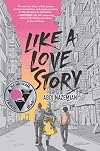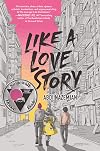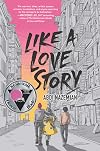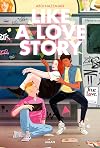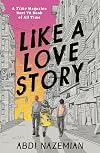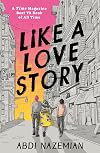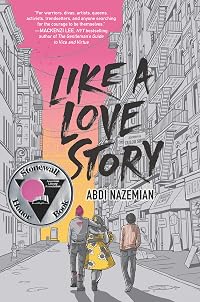
Like a Love Story
by Abdi Nazemian
On This Page
Description
It's 1989 in New York City, and for three teens, the world is changing. Reza is an Iranian boy who has just moved to the city with his mother to live with his stepfather and stepbrother. He's terrified that someone will guess the truth he can barely acknowledge about himself. Reza knows he's gay, but all he knows of gay life are the media's images of men dying of AIDS. Judy is an aspiring fashion designer who worships her uncle Stephen, a gay man with AIDS who devotes his time to activism as show more a member of ACT UP. Judy has never imagined finding romance... until she falls for Reza and they start dating. Art is Judy's best friend, their school's only out and proud teen. He'll never be who his conservative parents want him to be, so he rebels by documenting the AIDS crisis through his photographs. As Reza and Art grow closer, Reza struggles to find a way out of his deception that won't break Judy's heart -- and destroy the most meaningful friendship he's ever known. This is a bighearted, sprawling epic about friendship and love and the revolutionary act of living life to the fullest in the face of impossible odds. show lessTags
Recommendations




Member Reviews
Whew! this is a transcendent book. I haven't read anything like it for a long time. A powerful personal story embedded in a universal human tragedy.
Yes, there was a beautiful love story between two 16-year old high school seniors. But the backdrop of 1989? when AIDS was carving a path of destruction through New York's gay community was such a dramatic setting, especially with these 2 teenagers discovering their sexuality in the foreground.
I don't usually choose books about high schoolers but, wow, sometimes these books are so good - I'm thinking back to The Interestings - that they must be read.
The terrible vulnerability, anxiety, isolation and earnestness of youth is dazzling in the hands of this writer - apparently a debut author! show more Abdi Nazemian.
It's the story of Iranian immigrant loner and innocent, Reza, and rich nerdy loner gay kid, Bartholomew aka Art.
As the cover blurb says, it is about the courage to be yourself. But so much is asked of these boys! and without much help from their families. The gay community is family, to them and the countless others in the same boat.
I'm pretty sure I've heard of the ACT UP movement, but that's all. The group's activities are plot points of the novel, at least in the first half. And provide a bird's eye view of extreme heroism... I recently saw a program about the Vietnam War and the absurdly courageous early conscientious objectors among the conscripted teenagers / young adults.
It's so horrific to think of what it was to be gay as recently as the 1980s! How on earth did humanity justify treating men who loved men so callously, and women who loved women too, of course, and all the rest of the ways people loved.
The import of the book flows over into the stolen generation, the detainees on Nauru and Christmas Island, the victims of church abuse - the numerous injustices the status quo has let happen. The disregard of the sick, and there were so many sick - that's where the sinning lies.
Between 1981 and 2018, 700,000 folks died in the US of AIDS. To date, about 1.1M Americans have died from COVID. I can't grasp the scale of death.
In plenty of places people are still dying of AIDS.
Yes, this novel is a blood boiler and an ache in the heart and a triumph. show less
Yes, there was a beautiful love story between two 16-year old high school seniors. But the backdrop of 1989? when AIDS was carving a path of destruction through New York's gay community was such a dramatic setting, especially with these 2 teenagers discovering their sexuality in the foreground.
I don't usually choose books about high schoolers but, wow, sometimes these books are so good - I'm thinking back to The Interestings - that they must be read.
The terrible vulnerability, anxiety, isolation and earnestness of youth is dazzling in the hands of this writer - apparently a debut author! show more Abdi Nazemian.
It's the story of Iranian immigrant loner and innocent, Reza, and rich nerdy loner gay kid, Bartholomew aka Art.
As the cover blurb says, it is about the courage to be yourself. But so much is asked of these boys! and without much help from their families. The gay community is family, to them and the countless others in the same boat.
I'm pretty sure I've heard of the ACT UP movement, but that's all. The group's activities are plot points of the novel, at least in the first half. And provide a bird's eye view of extreme heroism... I recently saw a program about the Vietnam War and the absurdly courageous early conscientious objectors among the conscripted teenagers / young adults.
It's so horrific to think of what it was to be gay as recently as the 1980s! How on earth did humanity justify treating men who loved men so callously, and women who loved women too, of course, and all the rest of the ways people loved.
The import of the book flows over into the stolen generation, the detainees on Nauru and Christmas Island, the victims of church abuse - the numerous injustices the status quo has let happen. The disregard of the sick, and there were so many sick - that's where the sinning lies.
Between 1981 and 2018, 700,000 folks died in the US of AIDS. To date, about 1.1M Americans have died from COVID. I can't grasp the scale of death.
In plenty of places people are still dying of AIDS.
Yes, this novel is a blood boiler and an ache in the heart and a triumph. show less
I read this for review for the local high school, so it's not something I'd pick up on my own. This was fantastic though, and I can imagine it would be exactly what so many queer teens need to read during difficult high school years.
Focusing on the AIDS crisis in the late 80s/ early 90s and on coming out to yourself and others in the midst of that, this is full of tough topics. I think anyone looking to ban this for explicit content should weigh that against the empathy this will foster, but I guess if you're pro ban you're probably not big on empathy.
Focusing on the AIDS crisis in the late 80s/ early 90s and on coming out to yourself and others in the midst of that, this is full of tough topics. I think anyone looking to ban this for explicit content should weigh that against the empathy this will foster, but I guess if you're pro ban you're probably not big on empathy.
I feel so bad for rating this (super highly rated) book so low, but while the book covers a HUGE important part of lgbt history (a lot of it well researched, too), there were just so … so many things that rubbed me the wrong way while reading it. So many things were all over the place, and the characters … oh boy, those characters. I sort of liked only one of the main characters, and the other two I absolutely despised.
Content warnings:
LOTS of lgbt slurs (f slur, q slur, probably more)
as the book covers AIDS, there will be a lot about this topic, in depth
tons of homophobia
transphobia
Representation:
2 of the main characters are gay; one of them is also Iranian
the other main character is a plus-size woman
Like a Love Story takes place show more in the late 80s/early 90s in NYC, featuring Reza, a closeted gay Iranian immigrant who just moved to the US; Art, the only out and proud gay boy at school who’s also part of ACT UP; and Judy, a hopeful fashion designer and Art’s best friend (who also kind of fetishizes gay men and hates other women, but we’ll get to that later).
As these three meet, Judy and Reza start dating because Reza will do anything to convince himself he’s straight. But at the same time, Reza’s drawn inevitably towards Art, even though Art represents everything that terrifies Reza.
Okay, first of all, I’m going to cover the positives, because it’s really not a horrible book, and by far it’s not the worst one I’ve read this year.
At first glance, the story is beautiful. That cover! Beautiful. The topics covered and real life historical groups and their struggles. Beautiful, important, and great for young adults today to learn about and (as the book says at the end) Not To Forget! As the news and world today doesn’t really care about and kind of wants us to kind of sweep it under the rug. But it happened, and it’s still happening. We shouldn’t forget about these people, these activist groups, and the struggles our lgbt ancestors have gone through.
Unfortunately, the execution just didn’t match the idea. The “love triangle” of the three main characters dominated everything else. It was needlessly overdramatic (on Judy’s side) and felt unfair to Reza. The characters’ personalities, too, made it hard to enjoy the book. They were just … instantly unlikable, and never became more likable as the book progressed. While, yes, I understand some people are also not as likable as others, you need to be able to root for characters in a work of fiction. When Reza says “I hate that word [the f*g slur]”, and Art says, “Get over it. I’ve reclaimed it, and so should you,” how should we as the audience react? Like it’s funny? Like we should also have that asshole mindset?
Abdi Nazemian seems to do this a lot; kind of pushing his own opinions through the prose. Characters saying/doing wrong things is fine - as long as they’re corrected at some point during the book, or else it seems like it’s an opinion of the author (like his “get over it”, like gay people should all have reclaimed their slurs by now. Nazemian never really used “lgbt” he only used “q*eer” - even over “gay”, actually).
Art was an asshole in general, though. His pushing Rezi to have sex when Rezi wasn’t ready was really, really uncomfortable to read. Especially with the whole text shouting “gate to manhood”, “have you lost your virginity yet, however it works for you guys?”, etc., and Art going too far with Rezi telling him that he didn’t want to.
I wanted to love Judy, but she pretty much fetishized gay people and hated other women. She judged all women around her, “I didn’t know pretty women could be funny,” “I didn’t know you skinny women ate anything other than lettuce”, etc. Luckily, her opinions about other women changes, and she grows as a person in this respect, but she still fetishizes gay men: “Do you think gay people are just cooler than straight people?” “Art went to Italy and France with his parents, and he said that every man there seems gay. [...] I’d like to be in a place where all the men seem gay”, etc.
She’s also one of those allies who thinks they’re the best ally when in reality they’re just doing it for show because 1). They fetishize gay people, and 2). When Reza inevitably broke up with her (because he came out), she literally said “I hope you rot in hell”; basically what gay people are told by so many Christians, like, how is that fair? Even said in anger, it’s just not fair. Plus she was SO overdramatic and thought he betrayed her … when he really just realized he was truly gay and came out. She acted like he deceived him (typical homophobic reaction). And 3). “She [says] she’s allowed to make AIDS jokes ‘cause her uncle Stephen has AIDS and makes AIDS jokes all the time”. No. That’s not how that works.
There’s so much more I could say, but I don’t want to make this too long and be too negative. But I have to address the lack of attention to trans people, bi people, and wlw. As in, there was pretty much no mention of them. I know this is a book about AIDS and so it did and should pay the most attention to gay people, but besides the author’s note, there was literally NO mention of Marsha P. Johnson or Silvia Rivera or the trans women who were there with ACT UP in NYC in the early 90s. In fact, there was a lot of transphobia, with Art saying he wanted to have sex with “anyone with a Y chromosome”, and Stephen (a great character, actually; the best in the book!) saying “the good news is that when you’re gay, you can’t get pregnant. No babies,” etc. The book actually gave A LOT more respect to drag queens than it did trans people. I believe one line said something like ACT UP would fight with gay men, queens, and fierce feminists. Awkward that it leaves so many lgbt people out … as in everyone but gay men.
Bi people and wlw (women-loving-women) were nowhere to be found, either. The closest the text got to bi people was Judy mentioning the Kinsey scale (the Kinsey scale!! Really? Please don’t use this) to describe sexuality to Reza. But that’s definitely not a good way to describe bisexuality (aka “something in between”). Lesbians were mentioned in a spin-the-bottle game when “it was okay for girls to kiss girls, but not guys to kiss guys”. I didn’t like the insinuation that at this time it was okay to be a woman who liked women. Our struggles are and were different; it’s not okay to dismiss this (plus, it was okay for us to kiss because straight men fetishized us).
Anyway, the topic of the book, the message and story it attempted to achieve, was ambitious and beautiful, but ultimately the actual execution didn’t live up to that. I struggled through it, to be honest, but the ending and the author’s note did make me feel inspired. It’s obvious that this book is a work of love, so I’m very sorry that I didn’t like it more! show less
Content warnings:
LOTS of lgbt slurs (f slur, q slur, probably more)
as the book covers AIDS, there will be a lot about this topic, in depth
tons of homophobia
transphobia
Representation:
2 of the main characters are gay; one of them is also Iranian
the other main character is a plus-size woman
Like a Love Story takes place show more in the late 80s/early 90s in NYC, featuring Reza, a closeted gay Iranian immigrant who just moved to the US; Art, the only out and proud gay boy at school who’s also part of ACT UP; and Judy, a hopeful fashion designer and Art’s best friend (who also kind of fetishizes gay men and hates other women, but we’ll get to that later).
As these three meet, Judy and Reza start dating because Reza will do anything to convince himself he’s straight. But at the same time, Reza’s drawn inevitably towards Art, even though Art represents everything that terrifies Reza.
Okay, first of all, I’m going to cover the positives, because it’s really not a horrible book, and by far it’s not the worst one I’ve read this year.
At first glance, the story is beautiful. That cover! Beautiful. The topics covered and real life historical groups and their struggles. Beautiful, important, and great for young adults today to learn about and (as the book says at the end) Not To Forget! As the news and world today doesn’t really care about and kind of wants us to kind of sweep it under the rug. But it happened, and it’s still happening. We shouldn’t forget about these people, these activist groups, and the struggles our lgbt ancestors have gone through.
Unfortunately, the execution just didn’t match the idea. The “love triangle” of the three main characters dominated everything else. It was needlessly overdramatic (on Judy’s side) and felt unfair to Reza. The characters’ personalities, too, made it hard to enjoy the book. They were just … instantly unlikable, and never became more likable as the book progressed. While, yes, I understand some people are also not as likable as others, you need to be able to root for characters in a work of fiction. When Reza says “I hate that word [the f*g slur]”, and Art says, “Get over it. I’ve reclaimed it, and so should you,” how should we as the audience react? Like it’s funny? Like we should also have that asshole mindset?
Abdi Nazemian seems to do this a lot; kind of pushing his own opinions through the prose. Characters saying/doing wrong things is fine - as long as they’re corrected at some point during the book, or else it seems like it’s an opinion of the author (like his “get over it”, like gay people should all have reclaimed their slurs by now. Nazemian never really used “lgbt” he only used “q*eer” - even over “gay”, actually).
Art was an asshole in general, though. His pushing Rezi to have sex when Rezi wasn’t ready was really, really uncomfortable to read. Especially with the whole text shouting “gate to manhood”, “have you lost your virginity yet, however it works for you guys?”, etc., and Art going too far with Rezi telling him that he didn’t want to.
I wanted to love Judy, but she pretty much fetishized gay people and hated other women. She judged all women around her, “I didn’t know pretty women could be funny,” “I didn’t know you skinny women ate anything other than lettuce”, etc. Luckily, her opinions about other women changes, and she grows as a person in this respect, but she still fetishizes gay men: “Do you think gay people are just cooler than straight people?” “Art went to Italy and France with his parents, and he said that every man there seems gay. [...] I’d like to be in a place where all the men seem gay”, etc.
She’s also one of those allies who thinks they’re the best ally when in reality they’re just doing it for show because 1). They fetishize gay people, and 2). When Reza inevitably broke up with her (because he came out), she literally said “I hope you rot in hell”; basically what gay people are told by so many Christians, like, how is that fair? Even said in anger, it’s just not fair. Plus she was SO overdramatic and thought he betrayed her … when he really just realized he was truly gay and came out. She acted like he deceived him (typical homophobic reaction). And 3). “She [says] she’s allowed to make AIDS jokes ‘cause her uncle Stephen has AIDS and makes AIDS jokes all the time”. No. That’s not how that works.
There’s so much more I could say, but I don’t want to make this too long and be too negative. But I have to address the lack of attention to trans people, bi people, and wlw. As in, there was pretty much no mention of them. I know this is a book about AIDS and so it did and should pay the most attention to gay people, but besides the author’s note, there was literally NO mention of Marsha P. Johnson or Silvia Rivera or the trans women who were there with ACT UP in NYC in the early 90s. In fact, there was a lot of transphobia, with Art saying he wanted to have sex with “anyone with a Y chromosome”, and Stephen (a great character, actually; the best in the book!) saying “the good news is that when you’re gay, you can’t get pregnant. No babies,” etc. The book actually gave A LOT more respect to drag queens than it did trans people. I believe one line said something like ACT UP would fight with gay men, queens, and fierce feminists. Awkward that it leaves so many lgbt people out … as in everyone but gay men.
Bi people and wlw (women-loving-women) were nowhere to be found, either. The closest the text got to bi people was Judy mentioning the Kinsey scale (the Kinsey scale!! Really? Please don’t use this) to describe sexuality to Reza. But that’s definitely not a good way to describe bisexuality (aka “something in between”). Lesbians were mentioned in a spin-the-bottle game when “it was okay for girls to kiss girls, but not guys to kiss guys”. I didn’t like the insinuation that at this time it was okay to be a woman who liked women. Our struggles are and were different; it’s not okay to dismiss this (plus, it was okay for us to kiss because straight men fetishized us).
Anyway, the topic of the book, the message and story it attempted to achieve, was ambitious and beautiful, but ultimately the actual execution didn’t live up to that. I struggled through it, to be honest, but the ending and the author’s note did make me feel inspired. It’s obvious that this book is a work of love, so I’m very sorry that I didn’t like it more! show less
Like A Love Story by Abdi Nazemian takes a raw and sometimes difficult look at the heart of the AIDS crisis in the 1980s. Reza’s mother has just remarried and moved them from Toronto (and Iran before that) to New York City. Besides navigating the new school, jerky stepbrother, and other changes, Reza also thinks he may be gay. He meets best friends, Judy and Art, (who narrate different chapters of the book) and through relationships with them becomes active in AIDS protests and works to find himself. Nazemian captures teenage voices well and doesn’t shy away from honest portrayals of the early victims of AIDS and their struggles. At times some characters veer into caricature territory, and others feel very forced and plot-driven, show more but overall still an enjoyable read that depicts important pieces of our history that we don’t often see. show less
diverse teen fiction--closeted Iranian-American 17-y.o. boy meets 'out' boy and his teen girl friend (who gets teased for being fat) and her AIDS-dying uncle in 1989-90 NYC
sweet, bitter, and full of heart. I am definitely going to cry before this book ends.
I did cry, but not where I thought I would. I especially loved Uncle Stephen's study cards which explained why he thought Madonna was so bad-ass (and why you should too), and other bits of wisdom and guidance he wanted to pass on to Art and Judy, including a hilarious NOT-TO-BE-MISSED talk on proper condom storage (keep them in a cool place, and if you must carry one in your wallet, replace them regularly after each outing, even if you don't get a chance to use any).
sweet, bitter, and full of heart. I am definitely going to cry before this book ends.
I did cry, but not where I thought I would. I especially loved Uncle Stephen's study cards which explained why he thought Madonna was so bad-ass (and why you should too), and other bits of wisdom and guidance he wanted to pass on to Art and Judy, including a hilarious NOT-TO-BE-MISSED talk on proper condom storage (keep them in a cool place, and if you must carry one in your wallet, replace them regularly after each outing, even if you don't get a chance to use any).
A really wonderful, “own voices”, YA novel about gay teenage boys/men in NYC during the height of the HIV/AIDS epidemic AND the height of ACT UP activism in the late 1980s. Extra special is the fact that this story is from the perspective of an Iranian immigrant.
My only complaint is in the worshipping of Madonna I think it missed an opportunity to call out the way she has been fairly critiqued for appropriating Black gay and trans Ballroom culture in her music especially in Vogue
My only complaint is in the worshipping of Madonna I think it missed an opportunity to call out the way she has been fairly critiqued for appropriating Black gay and trans Ballroom culture in her music especially in Vogue
A teen LGBTQ love triangle, but more importantly an honest account of the fear and stigma prevalent in the early days of the AIDS epidemic in America. Also a look inside the Act Up movement who stood against the fear and demanded access to life-saving treatments. Timely for 2022, as Monkey Pox was circulating in the community and was meeting with similar fears and lack of resources. I loved Uncle Stephen’s study cards!
Members
- Recently Added By
Lists

Best Young Adult
400 works; 101 members

Youth: Sexuality & Gender
119 works; 1 member

Featured in Fat Talk by Virginia Sole-Smith
103 works; 1 member

Books recommended by Calgary Public Library staff
1,588 works; 4 members
Author Information

12+ Works 1,259 Members
Some Editions
Awards and Honors
Awards
Distinctions
Common Knowledge
- Original publication date
- 2019-06-04
- Important places
- New York, New York, USA
- Important events
- AIDS epidemic
Classifications
- Genres
- LGBTQ+, Teen, Fiction and Literature, Young Adult
- DDC/MDS
- 813.6 — Literature & rhetoric American literature in English American fiction in English 2000-
- LCC
- PZ7.1 .N378 .L — Language and Literature Fiction and juvenile belles lettres Fiction and juvenile belles lettres Juvenile belles lettres
- BISAC
Statistics
- Members
- 707
- Popularity
- 40,358
- Reviews
- 16
- Rating
- (4.07)
- Languages
- English, French, Portuguese (Portugal)
- Media
- Paper, Audiobook, Ebook
- ISBNs
- 14
- ASINs
- 3