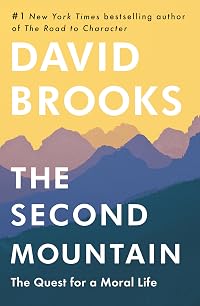
The Second Mountain: The Quest for a Moral Life
by David Brooks
On This Page
Description
#1 NEW YORK TIMES BESTSELLER • Everybody tells you to live for a cause larger than yourself, but how exactly do you do it? The author of The Road to Character explores what it takes to lead a meaningful life in a self-centered world.“Deeply moving, frequently eloquent and extraordinarily incisive.”—The Washington Post
Every so often, you meet people who radiate joy—who seem to know why they were put on this earth, who glow with a kind of inner light. Life, for these people, has show more often followed what we might think of as a two-mountain shape. They get out of school, they start a career, and they begin climbing the mountain they thought they were meant to climb. Their goals on this first mountain are the ones our culture endorses: to be a success, to make your mark, to experience personal happiness. But when they get to the top of that mountain, something happens. They look around and find the view . . . unsatisfying. They realize: This wasn’t my mountain after all. There’s another, bigger mountain out there that is actually my mountain.
And so they embark on a new journey. On the second mountain, life moves from self-centered to other-centered. They want the things that are truly worth wanting, not the things other people tell them to want. They embrace a life of interdependence, not independence. They surrender to a life of commitment.
In The Second Mountain, David Brooks explores the four commitments that define a life of meaning and purpose: to a spouse and family, to a vocation, to a philosophy or faith, and to a community. Our personal fulfillment depends on how well we choose and execute these commitments. Brooks looks at a range of people who have lived joyous, committed lives, and who have embraced the necessity and beauty of dependence. He gathers their wisdom on how to choose a partner, how to pick a vocation, how to live out a philosophy, and how we can begin to integrate our commitments into one overriding purpose.
In short, this book is meant to help us all lead more meaningful lives. But it’s also a provocative social commentary. We live in a society, Brooks argues, that celebrates freedom, that tells us to be true to ourselves, at the expense of surrendering to a cause, rooting ourselves in a neighborhood, binding ourselves to others by social solidarity and love. We have taken individualism to the extreme—and in the process we have torn the social fabric in a thousand different ways. The path to repair is through making deeper commitments. In The Second Mountain, Brooks shows what can happen when we put commitment-making at the center of our lives. show less
Tags
Recommendations



Member Reviews
Brooks is a thoughtful intellectual who has been fearless about processing the evolution of his own thinking in front of a wide audience. This volume takes the lens he often turns on politics and governing and applies it to his own progress toward a meaningful life. He questions his own assumptions as often as he questions those of others, which is a quality I find super appealing, and which I wish there was more of in our public discourse.
----UPDATE:
Well, I listened to it again, and I liked/appreciated it even more the second time, hence 5 stars. It would be a great book for high school seniors. He is asking the big questions: What is the point to life? How do we get there? What keeps us from it? His advice for considering a job/vocation, a spouse, and a faith is all fantastic. I wish I could have understood a quarter of the advice/insights when I was first making those big decisions. And, the metaphor of two mountains in life is profound. It's referenced and alluded to all over, but I don't feel like many young people hear it. At least I never did.
A few more critiques/frustrations: I did think his section on commitment to community is lacking, especially compared to his show more faith exploration in the previous section. And despite his insight into marriage, it feels like he exalts the falling-in-love experience on a precarious pedestal. How often do people really experience what he describes?
That said, a wonderful second read, one I will recommend to others.
----FIRST REVIEW:
If you were to think of life as a metaphor, climbing two mountains is pretty good. The first, according to Brooks, is that of the individual striving of self - building the necessary ego - of success and self-discovery. Our culture (in the West and particularly the US), exalts and honors those on this first mountain - movie stars, the rich, the successful. Money often follow first mountain accomplishments. But one's life, if lived well, must summit the second mountain of giving yourself away in service to others. The ego must dissolve as we move from focus on self to focus on others. The book continues to say that this second mountain experience is found not through self-discovery but making commitments: to vocation, spouse, a faith/philosophy of life, and community/neighborhood. In the final chapter - the chapter I found most compelling - is a manifesto: The Relationalist Manifesto, offered as an antidote to today's cancer - hyper-individualism. And you can read it on his website here.
This is the type of book I really appreciate, partly because of its sheer audacity and breath of vision, and that's part of the reason I didn't like it. He is asking great questions. How do we think of and live out the whole of life? What malady most ails our society? What is life's ultimate meaning? And most of all - I think the question that under-girds the entire book - How do we live well? Some would argue that the whole premise is a futile attempt, but I disagree. These are the hard, impossible-to-answer-but-so-important-we-try questions. Brooks soars at the 35,000 ft perspective on life and then zeros in on the four commitments to vocation, marriage, faith, and community, offering practical suggestion for each, to then zooms out again for his concluding manifesto.
Confession: I liked the book before reading it because the overall premise was confirmation bias… There is a time for exploration and discovery, but as we mature we (should) move toward commitment and depth, rather than breadth. Second, it comes as no surprise that Brooks is an excellent writer - clear, eloquent, and poetic at times. He provides ample wisdom to wrestle with and savor.
However, my overall gripe with the book was I felt its overall structure was choppy. The transition from the second mountain to the 4 commitments didn’t flow evenly. It felt almost like 2 books loosely connected, or maybe even 1 book with 4 longer essays. That being said, I hope to some day read it a second time. show less
Well, I listened to it again, and I liked/appreciated it even more the second time, hence 5 stars. It would be a great book for high school seniors. He is asking the big questions: What is the point to life? How do we get there? What keeps us from it? His advice for considering a job/vocation, a spouse, and a faith is all fantastic. I wish I could have understood a quarter of the advice/insights when I was first making those big decisions. And, the metaphor of two mountains in life is profound. It's referenced and alluded to all over, but I don't feel like many young people hear it. At least I never did.
A few more critiques/frustrations: I did think his section on commitment to community is lacking, especially compared to his show more faith exploration in the previous section. And despite his insight into marriage, it feels like he exalts the falling-in-love experience on a precarious pedestal. How often do people really experience what he describes?
That said, a wonderful second read, one I will recommend to others.
----FIRST REVIEW:
If you were to think of life as a metaphor, climbing two mountains is pretty good. The first, according to Brooks, is that of the individual striving of self - building the necessary ego - of success and self-discovery. Our culture (in the West and particularly the US), exalts and honors those on this first mountain - movie stars, the rich, the successful. Money often follow first mountain accomplishments. But one's life, if lived well, must summit the second mountain of giving yourself away in service to others. The ego must dissolve as we move from focus on self to focus on others. The book continues to say that this second mountain experience is found not through self-discovery but making commitments: to vocation, spouse, a faith/philosophy of life, and community/neighborhood. In the final chapter - the chapter I found most compelling - is a manifesto: The Relationalist Manifesto, offered as an antidote to today's cancer - hyper-individualism. And you can read it on his website here.
This is the type of book I really appreciate, partly because of its sheer audacity and breath of vision, and that's part of the reason I didn't like it. He is asking great questions. How do we think of and live out the whole of life? What malady most ails our society? What is life's ultimate meaning? And most of all - I think the question that under-girds the entire book - How do we live well? Some would argue that the whole premise is a futile attempt, but I disagree. These are the hard, impossible-to-answer-but-so-important-we-try questions. Brooks soars at the 35,000 ft perspective on life and then zeros in on the four commitments to vocation, marriage, faith, and community, offering practical suggestion for each, to then zooms out again for his concluding manifesto.
Confession: I liked the book before reading it because the overall premise was confirmation bias… There is a time for exploration and discovery, but as we mature we (should) move toward commitment and depth, rather than breadth. Second, it comes as no surprise that Brooks is an excellent writer - clear, eloquent, and poetic at times. He provides ample wisdom to wrestle with and savor.
However, my overall gripe with the book was I felt its overall structure was choppy. The transition from the second mountain to the 4 commitments didn’t flow evenly. It felt almost like 2 books loosely connected, or maybe even 1 book with 4 longer essays. That being said, I hope to some day read it a second time. show less
I’m a big fan of David Brooks, and that’s something since I’ve never considered myself in his political camp. He is the last of a dying breed of conservatives, pure in philosophy but forgiving socially. And I can listen to Brooks for hours, but his writing is another thing entirely. It might be that I am in my mid-70s, and I just don’t want to spend much time reinventing myself. That’s on me, not Brooks. I’ve read a couple of Brooks’ self help books, and with both I’ve ended up doing something I hardly ever do—I’ve read about a hundred pages and then skimmed the rest. I did this with “The Second Mountain” too. The book is, in a nutshell, about moving from a “me” centered society (the first mountain) to a show more “we” centered society (the second mountain). This is no small task for Brooks to take on since we have never been in a more “me” centered world, at least in this country, than we have now. The current political climate is all about getting what you can for yourself while you can. And most of our national institutions are run by conservatives, so Brooks is fighting a losing battle, I’m afraid. These conservatives aren’t his conservative, as he has stated many time over the last few years. David Brooks was never better than when he and Mark Shields provided the count-counterpoint segment of The News Hour once a week on PBS. It was discourse at its best, and its discourse that could never happen now. Both sides would be labeled wimps for not tearing each other down. And that is precisely why David Brooks’ book The Second Mountain: The Quest for a Moral Life is a really hard sell in the current political climate. show less
Summary: A book on our life journey, from the first mountain of individual achievement and success to the second mountain of rooted commitment to relationships and service.
New York Times columnist David Brooks has been on a personal journey and this book reflects that journey five years on from his earlier Road to Character in which he describes the movement from resumé virtues to the eulogy virtues that describe a life of character. In this book, Brooks develops a further dimension that his first book did not focus on, perhaps because Brooks himself was not focusing on it--that dimension of our commitments and our relationality. He continues to think about the moral life, and particularly the idea of moral ecologies, a way of being, show more believing and behaving shaped by our context. What he contends for in this book is a thicker moral ecology shaped by relational commitments rather than what he sees as the hyper-individualism of our contemporary culture.
This is where the two mountains comes in. The first mountain is the individual journey focused on self-realization, personal achievement and success. It operates in a moral ecology of self buffered from others, a focus on one's own feelings, one's own god, a privatization of meaning, a dream of freedom and a central focus on personal accomplishment.
Often it takes the experience of the value of failure, suffering, and pain to awaken us to the second mountain. Often the valley is a crisis of meaning, increasingly, it is the experience of intense loneliness. Brooks talks about the valley, and its companion, the wilderness, where we listen to our lives.
He then speaks about the second mountain, which represents the committed life. He focuses on four commitments, giving a section of several chapters to each. The four commitments he writes of are to a vocation or calling, to a marriage, to a philosophy or faith, and to a community. For each, he describes, not a moment, but a process of realization and development. He offers help in discerning a vocation, which sometimes comes down to saying "yes to every opportunity." He gives sound principles for the growth of intimacy, including whether you really enjoy talking to one another, and can envision enjoying that for a life. I love his description of marriage as "the school you build together."
His discussion of philosophy and faith is the section that seems most personal and occupies the most space. He describes his own spiritual journey both away from the mixed Jewish and Christian influences of his youth and his return, significantly through the influence of his research assistant, Anne. He writes of her:
"Anne answered each question as best she could. She never led me. She never intervened or tried to direct the process. She hung back. If I asked her a question, she would answer it, but she would never get out in front of me. She demonstrated faith by letting God be in charge. And this is a crucial lesson for anybody in the middle of any sort of intellectual or spiritual journey. Don't try to lead or influence. Let them be led by that which is summoning them" (p. 239).
So where did he end up, for those who wonder? He describes himself as "a wandering Jew and a very confused Christian, but how quick is my pace, how open are my possibilities, and how vast are my hopes." It also turns out that after several years apart, he and Anne, a Wheaton College graduate and committed Christian, married.
In his final section, he talks about commitment to community, to restoring the kind of communities where people have a sense of belonging to and being responsible to and for each other. He has critical words for programs focused on single problems rather than comprehensive approaches.
He concludes by proposing that the second mountain is the relational mountain, and offers a relationalist manifesto with enumerated points that serve to sum up the book. Everything but the kitchen sink is here, a grand sweeping vision for the second mountain life.
As I read this book, I felt both a deep resonance with much of what Brooks writes and that he was trying to do so much that I found myself wondering at times, "what kind of book is this?" I did not find that it had as coherent a structure as The Road to Character. The lengthy sections on each of the commitments, each engaging, felt like stand alone pieces, each of which could have received book length treatments. I wonder less could have been written on each commitment and more on how the four commitments cohere, if not in every life, but in healthy societies.
That said, Brooks charts the journey into the second half of life well, of the commitments to be negotiated if one is to enjoy a rich and full, and not merely successful life. That he writes so personally and openly of his own journey into both faith and love is one of the most attractive and winsome elements of this work. The challenge he offers to the hyper-individualism of our culture is one worth considering. Will we recognize that we need one another? That may be one of the critical questions of our time. show less
New York Times columnist David Brooks has been on a personal journey and this book reflects that journey five years on from his earlier Road to Character in which he describes the movement from resumé virtues to the eulogy virtues that describe a life of character. In this book, Brooks develops a further dimension that his first book did not focus on, perhaps because Brooks himself was not focusing on it--that dimension of our commitments and our relationality. He continues to think about the moral life, and particularly the idea of moral ecologies, a way of being, show more believing and behaving shaped by our context. What he contends for in this book is a thicker moral ecology shaped by relational commitments rather than what he sees as the hyper-individualism of our contemporary culture.
This is where the two mountains comes in. The first mountain is the individual journey focused on self-realization, personal achievement and success. It operates in a moral ecology of self buffered from others, a focus on one's own feelings, one's own god, a privatization of meaning, a dream of freedom and a central focus on personal accomplishment.
Often it takes the experience of the value of failure, suffering, and pain to awaken us to the second mountain. Often the valley is a crisis of meaning, increasingly, it is the experience of intense loneliness. Brooks talks about the valley, and its companion, the wilderness, where we listen to our lives.
He then speaks about the second mountain, which represents the committed life. He focuses on four commitments, giving a section of several chapters to each. The four commitments he writes of are to a vocation or calling, to a marriage, to a philosophy or faith, and to a community. For each, he describes, not a moment, but a process of realization and development. He offers help in discerning a vocation, which sometimes comes down to saying "yes to every opportunity." He gives sound principles for the growth of intimacy, including whether you really enjoy talking to one another, and can envision enjoying that for a life. I love his description of marriage as "the school you build together."
His discussion of philosophy and faith is the section that seems most personal and occupies the most space. He describes his own spiritual journey both away from the mixed Jewish and Christian influences of his youth and his return, significantly through the influence of his research assistant, Anne. He writes of her:
"Anne answered each question as best she could. She never led me. She never intervened or tried to direct the process. She hung back. If I asked her a question, she would answer it, but she would never get out in front of me. She demonstrated faith by letting God be in charge. And this is a crucial lesson for anybody in the middle of any sort of intellectual or spiritual journey. Don't try to lead or influence. Let them be led by that which is summoning them" (p. 239).
So where did he end up, for those who wonder? He describes himself as "a wandering Jew and a very confused Christian, but how quick is my pace, how open are my possibilities, and how vast are my hopes." It also turns out that after several years apart, he and Anne, a Wheaton College graduate and committed Christian, married.
In his final section, he talks about commitment to community, to restoring the kind of communities where people have a sense of belonging to and being responsible to and for each other. He has critical words for programs focused on single problems rather than comprehensive approaches.
He concludes by proposing that the second mountain is the relational mountain, and offers a relationalist manifesto with enumerated points that serve to sum up the book. Everything but the kitchen sink is here, a grand sweeping vision for the second mountain life.
As I read this book, I felt both a deep resonance with much of what Brooks writes and that he was trying to do so much that I found myself wondering at times, "what kind of book is this?" I did not find that it had as coherent a structure as The Road to Character. The lengthy sections on each of the commitments, each engaging, felt like stand alone pieces, each of which could have received book length treatments. I wonder less could have been written on each commitment and more on how the four commitments cohere, if not in every life, but in healthy societies.
That said, Brooks charts the journey into the second half of life well, of the commitments to be negotiated if one is to enjoy a rich and full, and not merely successful life. That he writes so personally and openly of his own journey into both faith and love is one of the most attractive and winsome elements of this work. The challenge he offers to the hyper-individualism of our culture is one worth considering. Will we recognize that we need one another? That may be one of the critical questions of our time. show less
In The Second Mountain, David Brooks explores the four main commitments that define a virtuous and meaningful life: to a spouse and family, to a vocation, to a philosophy or faith, and to a community.
Are you on your first or second mountain?
Is life about you - or others?
About success - or something deeper?
The world tells us that we should pursue our self-interest: career wins, high status, nice things. These are the goals of our first mountain. But at some point in our lives we might find that we're not interested in what other people tell us to want. We want the things that are truly worth wanting.
This is the second mountain.
What does it mean to look beyond yourself and find a moral cause? To forget about independence and discover show more dependence - to be utterly enmeshed in a web of warm relationships? What does it mean to value intimacy, devotion, responsibility and commitment above individual fr... show less
Are you on your first or second mountain?
Is life about you - or others?
About success - or something deeper?
The world tells us that we should pursue our self-interest: career wins, high status, nice things. These are the goals of our first mountain. But at some point in our lives we might find that we're not interested in what other people tell us to want. We want the things that are truly worth wanting.
This is the second mountain.
What does it mean to look beyond yourself and find a moral cause? To forget about independence and discover show more dependence - to be utterly enmeshed in a web of warm relationships? What does it mean to value intimacy, devotion, responsibility and commitment above individual fr... show less
Once upon a time there was a frail older man who stood at a pulpit and said, quoting a leader of old, "Give me this mountain! "
And he, in turn, was quoted by a wise, emotional ecclesiastical teacher (which is where I heard it). So when I was notified of this impending release, I was intrigued.
This is very much a superior book to his others. I have admired him for years for the depth of his thought and continue to do so. While some of his columns I can do without, this book is, in some ways, a response to Sack's The Home We Build Together and, my other fave, Lost Connections. His tackling of despair, suicide rates, the rash of mass shootings and, even less spoken of, death by loneliness is admirable and so are the book's highlights of show more those already rising within their neighborhoods to stem the negative tide caused by modern society and philosophies.
I particularly thought his blunt statements about pride and loving enemies were brilliant and fed nicely my desire to do so (Thank you, Arthur Brooks).
All in all, it has inspired me to climb my second and third and fourth mountains. To take action, to do something. show less
And he, in turn, was quoted by a wise, emotional ecclesiastical teacher (which is where I heard it). So when I was notified of this impending release, I was intrigued.
This is very much a superior book to his others. I have admired him for years for the depth of his thought and continue to do so. While some of his columns I can do without, this book is, in some ways, a response to Sack's The Home We Build Together and, my other fave, Lost Connections. His tackling of despair, suicide rates, the rash of mass shootings and, even less spoken of, death by loneliness is admirable and so are the book's highlights of show more those already rising within their neighborhoods to stem the negative tide caused by modern society and philosophies.
I particularly thought his blunt statements about pride and loving enemies were brilliant and fed nicely my desire to do so (Thank you, Arthur Brooks).
All in all, it has inspired me to climb my second and third and fourth mountains. To take action, to do something. show less
I enjoy listening to David Brooks's commentary on PBS each Friday night. His common-sense, insightful views give me hope that we can all work together as a nation and as a global society. As I read The Second Mountain, I could hear his voice, at times thoughtful, at times humorous. I didn't agree with everything he wrote, but his honest approach to living a moral life was refreshing. He didn't pretend to have all the answers and acknowledged that his journey to find fulfillment continues as he looks for opportunities to serve the larger community. Too many books on morality and faith are preachy. This one reads as the quest that it is.
I'm not sure I would have titled it as he did, though, since the "second mountain" is really the first show more of five parts in the book and there wasn't much mention of it aside from the first section and a brief appearance again at the end. I think the subtitle, The Quest for a Moral Life, would have been a more accurate description.
There were also too many different lists/types of/stages/metaphors/rationales about this or that, which made the book feel fragmented. And the 15-page "Relationalist Manifesto" at the end (consisting of six additional, lengthy lists) was too much to take in. What core message did Mr. Brooks intend for his reader?
My favorite pages were examples of others doing good and the author's personal experiences, particularly with marriage. Drawing from numerous sources and a wide variety of lives, Mr. Brooks offers simple, practical, meaningful advice we can apply today as we discover a deeper sense of joy in committing to people and ideals and causes beyond our limited selves. show less
I'm not sure I would have titled it as he did, though, since the "second mountain" is really the first show more of five parts in the book and there wasn't much mention of it aside from the first section and a brief appearance again at the end. I think the subtitle, The Quest for a Moral Life, would have been a more accurate description.
There were also too many different lists/types of/stages/metaphors/rationales about this or that, which made the book feel fragmented. And the 15-page "Relationalist Manifesto" at the end (consisting of six additional, lengthy lists) was too much to take in. What core message did Mr. Brooks intend for his reader?
My favorite pages were examples of others doing good and the author's personal experiences, particularly with marriage. Drawing from numerous sources and a wide variety of lives, Mr. Brooks offers simple, practical, meaningful advice we can apply today as we discover a deeper sense of joy in committing to people and ideals and causes beyond our limited selves. show less
Members
- Recently Added By
Author Information

11+ Works 7,859 Members
David Brooks was born in Toronto, Canada on August 11, 1961. He received a degree in history from the University of Chicago in 1983. After graduation, he worked as a police reporter for the City News Bureau. His other jobs include numerous posts at The Wall Street Journal, a senior editor at The Weekly Standard, and a contributing editor at show more Newsweek and The Atlantic Monthly. He currently is an op-ed columnist for The New York Times since 2003 and a weekly commentator on PBS NewsHour. He is the author of the several books including Bobos in Paradise: The New Upper Class and How They Got There, On Paradise Drive: How We Live Now (And Always Have) in the Future Tense, and The Social Animal: The Hidden Sources of Love, Character, and Achievement. He is also the editor of the anthology Backward and Upward: The New Conservative Writing. David Brooks made the New York Times Best Seller List with his title Social Animal: the Hidden Sources of Love, Character, and Achievement and The Road to Character. (Publisher Provided) show less
Awards and Honors
Common Knowledge
- Canonical title
- The Second Mountain: The Quest for a Moral Life
Classifications
- Genres
- Nonfiction, Philosophy, General Nonfiction, Biography & Memoir
- DDC/MDS
- 302 — Society, government, & culture Social sciences, sociology & anthropology Mass Communication & Media
- LCC
- HM1111 .B76 — Social sciences Sociology (General) Sociology Social psychology Interpersonal relations. Social behavior
- BISAC
Statistics
- Members
- 932
- Popularity
- 28,652
- Reviews
- 17
- Rating
- (3.71)
- Languages
- 8 — Chinese, Dutch, English, Italian, Korean, Portuguese (Portugal), Serbian, Spanish
- Media
- Paper, Audiobook, Ebook
- ISBNs
- 23
- ASINs
- 4