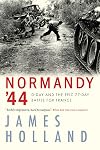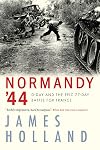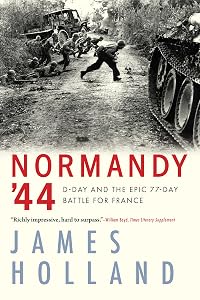
Normandy '44: D-Day and the Epic 77-Day Battle for France
by James Holland
On This Page
Description
A history of World War II's Operation Overlord, from the campaign's planning to its execution, as Allied forces battled to take France back from Germany. D-Day, June 6, 1944, and the seventy-six days of bitter fighting in Normandy that followed the Allied landing, have become the defining episode of World War II in the west-the object of books, films, television series, and documentaries. Yet as familiar as it is, as James Holland makes clear in his definitive history, many parts of the show more Overlord campaign, as it was known, are still shrouded in myth and assumed knowledge. Drawing freshly on widespread archives and on the testimonies of eye-witnesses, Holland relates the extraordinary planning that made Allied victory in France possible, indeed, the story of how hundreds of thousands of men, and mountains of materiel, were transported across the English Channel, is as dramatic a human achievement as any battlefield exploit. The brutal landings on the five beaches and subsequent battles across the plains and through the lanes and hedgerows of Normandy-a campaign that, in terms of daily casualties, was worse than any in World War I-come vividly to life in conferences where the strategic decisions of Eisenhower, Rommel, Montgomery, and other commanders were made, and through the memories of paratrooper Lieutenant Dick Winters of Easy Company, British corporal and tanker Reg Spittles, Thunderbolt pilot Archie Maltbie, German ordnance officer Hans Heinze, French resistance leader Robert Leblanc, and many others. For both sides, the challenges were enormous. The Allies confronted a disciplined German army stretched to its limit, which nonetheless caused tactics to be adjusted on the fly. Ultimately ingenuity, determination, and immense materiel strength-delivered with operational brilliance-made the difference. A stirring narrative by a pre-eminent historian, Normandy '44 offers important new perspective on one of history's most dramatic military engagements and is an invaluable addition to the literature of war. show lessTags
Recommendations


Member Reviews
Poorly edited, terrible maps, generic retelling
Edit to add my two-part Amazon review:
***
Sep 2019 This book has an interesting and welcome premise, and the bibliography is full of the latest and greatest writing on WWII and the campaign in NWE. It’s great to see hearty books still being written on this fascinating campaign.
However … the editing and proofreading is exceptionally sloppy.
For example, the caption to a photo of a group of Tiger II identifies the tanks as Panthers, while another miscounts the number of rockets being fired from a Typhoon. The maps are terrible - for example the map of the British landing beaches on p.xxii-xxiii identifies individual commandos as brigade sized units (they are battalions), and the sizing of show more units in the Canadian division is all over the place - there is a 9th Canadian Brigade located near Anisy, while just to it’s northwest is 9th Canadian Division, while to the north there are two 8th Canadian Divisions! Meanwhile, over at Merville there is battalion identified as 15 RMC … who knows what that’s supposed to be. The map showing the bombing of the beach defences (p.xiii) reverses the aerial targets - the heavy bombers actually struck Omaha, Gold, Juno and Sword, while the mediums of 9th Air Force only hit the defences at Utah.
In the timeline, on Tuesday 4th July (page 560), the “Canadian assault” of Op WINDSOR is noted as being supported by the ‘79th Armoured Brigade’ (no such unit existed). Meanwhile, on Wednesday 12 July there is the gloriously inarguable entry “Heavy fighting in Western sector.” In the appendices the organisation of a representative SS panzer division is shown in great detail (p.552-3), which is fine except that none of the ten mobile divisions the Germans employed in Normandy were organised in the same way - each one had its own quirks of organisation and equipment. So while the representative organisation shown isn’t strictly wrong, it is at least misleading in that it implies order where in fact none existed. The diagrams on pages 546-9 appear to have been wholly plagarised - without attribution - from Bouchery’s ‘The British Soldier, vol. 2’
In the text there are numerous silly errors, such as ‘Gabby’ Gabreski being noted, on p.29, as returning to the USAAF - from his stint with 315 Sqn RAF - in “early 1942”. In fact he returned a year later, in early 1943. Leigh-Mallory comes in for a good kicking, but the claim that he prevented the Spitfire being modified for long range (p.27) is both novel and seemingly unsupported. It’s an interesting claim, if true, but I suspect that the truth lies elsewhere.
That’s only the first two chapters. I believe the book would have benefited greatly from another 4-6 weeks with qualified proofreaders before it was sent to the press. As it is, the numerous errors are distracting, and call into question the conclusions that Holland is likely to draw. I want to like this book, and I deeply hope it improves.
***
Sep 2024
I wrote the above review of the first two chapters back in October 2019. Shortly after that I had to put the book down for a couple of years, and only just picked it up again several months ago. In the meantime I had stumbled across the We Have Ways podcast and then rediscovered this book on my shelves, so I got stuck into it again. A big ol’ book on Normandy! What’s not to like?!
Unfortunately, quite a lot. As I noted in my earlier review, there are numerous errors in the maps and the first chapters. That sloppiness continues throughout the rest of the book.
The maps serve as a useful metaphor for the book as a whole: there are a lot of them, and on the surface they look great. But the more you look at them, and try to use them, the worse you realise they actually are. In addition to the extensive mislabeling and misidentification of units (which is rife on every map), places referred to in the narrative are often absent from the map. For example; there is a hill which is referred to a lot at the start of the Bluecoat chapter, yet it’s missing from the Bluecoat map. The lack of terrain features on the maps is a recurrent feature; Holland likes to bang on about the importance of ‘walking the ground’, making the absence of contours, vegetation, natural obstacles, and other terrain features which dictated the course of battles highly surprising. To give one specific example; the raised railroad and embankment which bisected the Goodwood battlefield is referred to briefly in the text but completely absent from the map. Another example are the ridgelines which played such a significant role in delaying the capture of St Lo, and which were so instrumental in shaping the attacks which finally liberated that town, yet are likewise missing from these weirdly featureless maps.
Holland also seems a little confused about the nature of the ground in Normandy. For example; the village of Cagny – a central character in this description of Goodwood, and the scene of Luck’s shenanigans with the battery of 88s – is described as being “on the slopes of the Bourguebus Ridge”, instead of its actual position in the middle of the plain east of Caen.
The references section of the book is fairly hearty which, like the quantity of maps, is very encouraging - right up until the reader tries to start using them. There are a couple of interesting assertions in places which I am curious to investigate but they are unreferenced. It seems that the general scheme adopted is that only first-person accounts are footnoted, which leads to the grimly hilarious situation where the entirety of the chapter on Totalize appears to rest solely on Ken Tout’s ‘Tank!’ That is, without doubt, a fine book. However, ‘Tank!’ is also purely focused on the experiences of one man in one tank. To use that as the basis of what is supposedly an operational description of an operational battle in a book which claims to be bringing the operational level to the forefront is … curious. Holland provides negligible description of the operational level planning required to mount Totalize, with virtually nothing on the planning for the artillery which complemented the oft-told heavy bomber attacks. Instead we get dropped into the middle of a garbled retelling of Tout’s very personal narrative. This habit of relying on single sources for large chunks of the book is repeated in other places.
The final issue is Holland’s supposed aim and claim to “centre the operational layer.” Reader, the operational is not ‘centred.’ Instead the descriptions of ‘operational’ appear to describe a highly personalised and iconoclastic definition of that term; it seems that Holland believes that ‘operational’ is synonymous with ‘logistics’. It is not.
In the end the failure to properly understand, describe and centre operations is probably the biggest disappointment of Normandy ‘44. What’s left is yet another mediocre retelling of an oft-told tale, with little new to add.
*** show less
Edit to add my two-part Amazon review:
***
Sep 2019 This book has an interesting and welcome premise, and the bibliography is full of the latest and greatest writing on WWII and the campaign in NWE. It’s great to see hearty books still being written on this fascinating campaign.
However … the editing and proofreading is exceptionally sloppy.
For example, the caption to a photo of a group of Tiger II identifies the tanks as Panthers, while another miscounts the number of rockets being fired from a Typhoon. The maps are terrible - for example the map of the British landing beaches on p.xxii-xxiii identifies individual commandos as brigade sized units (they are battalions), and the sizing of show more units in the Canadian division is all over the place - there is a 9th Canadian Brigade located near Anisy, while just to it’s northwest is 9th Canadian Division, while to the north there are two 8th Canadian Divisions! Meanwhile, over at Merville there is battalion identified as 15 RMC … who knows what that’s supposed to be. The map showing the bombing of the beach defences (p.xiii) reverses the aerial targets - the heavy bombers actually struck Omaha, Gold, Juno and Sword, while the mediums of 9th Air Force only hit the defences at Utah.
In the timeline, on Tuesday 4th July (page 560), the “Canadian assault” of Op WINDSOR is noted as being supported by the ‘79th Armoured Brigade’ (no such unit existed). Meanwhile, on Wednesday 12 July there is the gloriously inarguable entry “Heavy fighting in Western sector.” In the appendices the organisation of a representative SS panzer division is shown in great detail (p.552-3), which is fine except that none of the ten mobile divisions the Germans employed in Normandy were organised in the same way - each one had its own quirks of organisation and equipment. So while the representative organisation shown isn’t strictly wrong, it is at least misleading in that it implies order where in fact none existed. The diagrams on pages 546-9 appear to have been wholly plagarised - without attribution - from Bouchery’s ‘The British Soldier, vol. 2’
In the text there are numerous silly errors, such as ‘Gabby’ Gabreski being noted, on p.29, as returning to the USAAF - from his stint with 315 Sqn RAF - in “early 1942”. In fact he returned a year later, in early 1943. Leigh-Mallory comes in for a good kicking, but the claim that he prevented the Spitfire being modified for long range (p.27) is both novel and seemingly unsupported. It’s an interesting claim, if true, but I suspect that the truth lies elsewhere.
That’s only the first two chapters. I believe the book would have benefited greatly from another 4-6 weeks with qualified proofreaders before it was sent to the press. As it is, the numerous errors are distracting, and call into question the conclusions that Holland is likely to draw. I want to like this book, and I deeply hope it improves.
***
Sep 2024
I wrote the above review of the first two chapters back in October 2019. Shortly after that I had to put the book down for a couple of years, and only just picked it up again several months ago. In the meantime I had stumbled across the We Have Ways podcast and then rediscovered this book on my shelves, so I got stuck into it again. A big ol’ book on Normandy! What’s not to like?!
Unfortunately, quite a lot. As I noted in my earlier review, there are numerous errors in the maps and the first chapters. That sloppiness continues throughout the rest of the book.
The maps serve as a useful metaphor for the book as a whole: there are a lot of them, and on the surface they look great. But the more you look at them, and try to use them, the worse you realise they actually are. In addition to the extensive mislabeling and misidentification of units (which is rife on every map), places referred to in the narrative are often absent from the map. For example; there is a hill which is referred to a lot at the start of the Bluecoat chapter, yet it’s missing from the Bluecoat map. The lack of terrain features on the maps is a recurrent feature; Holland likes to bang on about the importance of ‘walking the ground’, making the absence of contours, vegetation, natural obstacles, and other terrain features which dictated the course of battles highly surprising. To give one specific example; the raised railroad and embankment which bisected the Goodwood battlefield is referred to briefly in the text but completely absent from the map. Another example are the ridgelines which played such a significant role in delaying the capture of St Lo, and which were so instrumental in shaping the attacks which finally liberated that town, yet are likewise missing from these weirdly featureless maps.
Holland also seems a little confused about the nature of the ground in Normandy. For example; the village of Cagny – a central character in this description of Goodwood, and the scene of Luck’s shenanigans with the battery of 88s – is described as being “on the slopes of the Bourguebus Ridge”, instead of its actual position in the middle of the plain east of Caen.
The references section of the book is fairly hearty which, like the quantity of maps, is very encouraging - right up until the reader tries to start using them. There are a couple of interesting assertions in places which I am curious to investigate but they are unreferenced. It seems that the general scheme adopted is that only first-person accounts are footnoted, which leads to the grimly hilarious situation where the entirety of the chapter on Totalize appears to rest solely on Ken Tout’s ‘Tank!’ That is, without doubt, a fine book. However, ‘Tank!’ is also purely focused on the experiences of one man in one tank. To use that as the basis of what is supposedly an operational description of an operational battle in a book which claims to be bringing the operational level to the forefront is … curious. Holland provides negligible description of the operational level planning required to mount Totalize, with virtually nothing on the planning for the artillery which complemented the oft-told heavy bomber attacks. Instead we get dropped into the middle of a garbled retelling of Tout’s very personal narrative. This habit of relying on single sources for large chunks of the book is repeated in other places.
The final issue is Holland’s supposed aim and claim to “centre the operational layer.” Reader, the operational is not ‘centred.’ Instead the descriptions of ‘operational’ appear to describe a highly personalised and iconoclastic definition of that term; it seems that Holland believes that ‘operational’ is synonymous with ‘logistics’. It is not.
In the end the failure to properly understand, describe and centre operations is probably the biggest disappointment of Normandy ‘44. What’s left is yet another mediocre retelling of an oft-told tale, with little new to add.
*** show less
This large detailed account reads as well as many WW2 novels that I have read. James Holland is an excellent storyteller and his tale covers one of the largest and most complex battles of World War 2. A WW2 600+ page history that is hard to put down is indeed an outstanding accomplishment. The Big War chapter on WW2 logistics is succinct, thorough, and worth a special note.
I listened to Audible's version of James Holland's "Normandy '44: D-Day and the Epic 77-Day Battle for France." I found the story extremely interesting and very well written. The book not only addresses the strategic issues that went into executing and winning the Normandy campaign, but it also provides very detailed insight of what soldier's on the ground faced on a day-to-day basis.
On the basis of the content, I would give it five stars. However, since my review is of the Audible version, I deducted one star (with the temptation to deduct more) because of John Sackville's narration. I found that his pronunciations to be irritating. For example, he would pronounce the word "battalion" as if he were speaking French, saying it as show more "battalEEon." An instance I'm unlikely to forget is when he called the famous boxer Joe Louis "Joe Louey." This carried over to other words as well, which, with their repeated use, combined to be distracting. show less
On the basis of the content, I would give it five stars. However, since my review is of the Audible version, I deducted one star (with the temptation to deduct more) because of John Sackville's narration. I found that his pronunciations to be irritating. For example, he would pronounce the word "battalion" as if he were speaking French, saying it as show more "battalEEon." An instance I'm unlikely to forget is when he called the famous boxer Joe Louis "Joe Louey." This carried over to other words as well, which, with their repeated use, combined to be distracting. show less
This is a meticulously researched and painstakingly presented account of the 1944 Battle of Normandy, from the days leading up to the D-Day invasion to the Allied “break-out” seventy-seven days later.
Oftentimes, books that are this painstakingly researched can be a chore to read, and such is the case here. Amateur and military historians will likely eat this prose up, but the casual reader will bog down in the dense detail of which unit of which regiment, led by which officers were tasked with taking which designated crossroads or hill. The maps are of some help, but many times did not identify specific place names or locations referenced in the body of the work. Also, these maps were all bunched together in the front of the book, show more instead of located on the pages in which they were referenced. When the author disengages from the minute detail, the writing is far more entertaining and enlightening.
To sum up, this is fine piece of scholarship and excellent military history, but not necessarily what you are looking for if you are a casual reader, or reading strictly for enjoyment. My view of this work suffered from my having followed it up with Max Hastings’s treatise on Vietnam, which is equally as well researched, but presented in a form easily accessible by the reader. In my opinion, this work has a specific target audience, of which I am not necessarily a member. show less
Oftentimes, books that are this painstakingly researched can be a chore to read, and such is the case here. Amateur and military historians will likely eat this prose up, but the casual reader will bog down in the dense detail of which unit of which regiment, led by which officers were tasked with taking which designated crossroads or hill. The maps are of some help, but many times did not identify specific place names or locations referenced in the body of the work. Also, these maps were all bunched together in the front of the book, show more instead of located on the pages in which they were referenced. When the author disengages from the minute detail, the writing is far more entertaining and enlightening.
To sum up, this is fine piece of scholarship and excellent military history, but not necessarily what you are looking for if you are a casual reader, or reading strictly for enjoyment. My view of this work suffered from my having followed it up with Max Hastings’s treatise on Vietnam, which is equally as well researched, but presented in a form easily accessible by the reader. In my opinion, this work has a specific target audience, of which I am not necessarily a member. show less
James Holland has an interest in describing the logistics and materiel side of the D-Day campaign, which was staggering in its scale and complexity. He also describes the personal stories in a series of cameos which describe what it was like to be there. I take the point of previous reviewers regarding the amount of information, and the names of units, regiments etc. I also struggled a little with the maps. However, I was gripped by reading the book and reckon this was one of the best accounts of D-Day that I have read, so would certainly recommend it.
D-day was an undertaking of enormous proportions and the 77 days afterwards were fiercely contested by the German defenders. Holland takes you through the details until your brain is numb and then tells a multitude of indivdual stories to engage your emotions.
A lot of information. Maybe too much, in fact. Lots of unit names, commanders, and small-places-on-the-map that all began to blur together for me. I'd never read a book on the topic, and I'm glad I did...but I doubt I'll ever pick this one up again.
Members
- Recently Added By
Lists

THE WAR ROOM
813 works; 24 members

Wishlist
99 works; 1 member
Author Information

43+ Works 4,173 Members
James Holland is the author of Big Week, The Rise of Germany, and The Allies Strike Back in the War in the West trilogy, as well as Fortress Malta, Dam Busters, and The Battle of Britain. Holland regularly appears on television and radio and has written and presented the BAFTA shortlisted documentaries Battle of Britain and Dam Busters for the show more BBC, among others. A fellow of the Royal Historical Society, he has his own collection at the Imperial War Museum. show less
Classifications
- Genres
- History, Nonfiction, General Nonfiction
- DDC/MDS
- 940.542142 — History & geography History of Europe History of Europe 1918- Military history of World War II Campaigns and battles by theatre European theatre France
- LCC
- D756.5 .N6 .H627 — History of Europe, Asia, Africa and Oceania History (General) World War II (1939-1945)
- BISAC
Statistics
- Members
- 434
- Popularity
- 71,168
- Reviews
- 11
- Rating
- (4.20)
- Languages
- English
- Media
- Paper, Audiobook, Ebook
- ISBNs
- 10
- ASINs
- 5