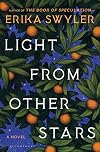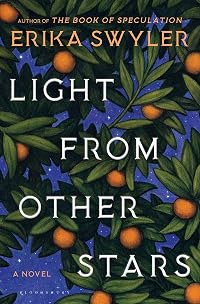
Light from Other Stars
by Erika Swyler
On This Page
Description
Decades after her grieving father, a laid-off NASA scientist, triggers chaotic changes in his pursuit of life-extending technology, an astronaut confronts dangerous family secrets to stop a world-threatening crisis. "From the author of national bestseller The Book of Speculation, a poignant, fantastical novel about the electric combination of ambition and wonder that keeps us reaching toward the heavens. Eleven-year-old Nedda Papas is obsessed with becoming an astronaut. In 1986 in Easter, a show more small Florida Space Coast town, her dreams seem almost within reach--if she can just grow up fast enough. Her father, however, wants the opposite. Laid off from his job at NASA and still reeling from the loss of Nedda's newborn brother several years before, Theo devotes himself to extending his living daughter's childhood just a little longer. The result is an invention that alters the fabric of time. Amidst the erupting chaos, Nedda must confront her father and his secrets, the ramifications of which will irrevocably change her life, her community, and the entire world. But she finds an unexpected ally in Betheen, the mother she's never quite understood, who surprises Nedda by seeing her more clearly than anyone else. Decades later, Nedda has achieved her long-held dream, and as she floats in antigravity, far from earth, she and her crewmates face a serious crisis. Nedda may hold the key to the solution, if she can come to terms with her past and the future that awaits her. Light from Other Stars is about fathers and daughters, women and the forces that hold them back, and the cost of meaningful work. It questions how our lives have changed, what progress looks like, and what it really means to sacrifice for the greater good."--Dust jacket. show lessTags
Recommendations








Member Reviews
"Behind every brilliant woman is her doubly brilliant mother."
(Full disclosure: I received a free e-ARC for review through NetGalley. Trigger warning for child abuse.)
She knew them by their light, the gentle differences—Amit’s warm, yellowish brown, Evgeni who glowed like a pearl, Louisa who was brighter than all of them. Nedda would know them anywhere; if she lost their shapes, she’d recognize their light.
They would likely die. It was why they were childless, unwed. Freedom of sacrifice. It was a shame that only three people would ever again be in the same room as Evgeni when he sang. Only three people would know that Singh ate with his pinkie out. That Marcanta pulled hairs from her eyebrows when frustrated. Children would know show more their names, and drive on roads named Sokolov or Papas. Children would know their ship, Chawla, and who she’d hauled. A little girl somewhere would rattle off everything she’d read about them, and with it everything she knew about space and time, about light.
###
"I got a boat too. It’s not real big, just enough to take a few people out, that’s all.”
“What’d you name it?”
“Flux Capacitor.”
“Doc Brown’s a better name.”
“Yeah, but boats are women.”
“Everything’s a woman. Cars, boats, houses. Anywhere that’s safe or takes you somewhere better is a woman,” she said.
“So, Chawla is a woman?”
“Obviously.” She opened her eye to find him staring.
###
Her father’s machine was as much hope and wish as it was metal and glass.
###
In the present day - her present, our future - Nedda Papas has achieved everything she's dreamed of. As one quarter of the crew of Chawla, Nedda is humanity's last best chance. Climate change has wrought havoc on earth: rising sea levels have disappeared entire islands and shrunk continents, hunger fueled by drought is the new normal, and wildfires plague what little land is left. The planet is beyond saving; now flight is the only long-term option.
Sent to colonize another planet in a galaxy far, far away, Nedda will never again set foot on earth. And she's okay with that - it's for the greater good, after all, and doesn't she owe her species at least that much, anyway? But when cost-cutting and politicking threatens Chawla's success, Nedda must revisit her past in order to salvage our future.
It was 1986 when Nedda's world imploded: first, with the Space Shuttle Challenger disaster; and again with Theo Pappas's magnum opus, the Crucible.
Light from Other Stars unfolds in two parallel narratives: aboard the Chawla, and in January/February 1986, when Nedda is eleven years old.
Middle-schooler Nedda lives Easter, Florida, in the shadow of Kennedy Space Center. She and her professor father Theo - newly laid off from NASA after the latest round of budget cuts - are inseparable, whether devising and executing experiments or trying to spot Halley's Comet shoot across the night sky. Her relationship with mother Betheen is a little frostier, but not necessarily for lack of mutual interests: Beth is a chemist. But her (women's) work is undervalued, because of course it is. It also doesn't help that Betheen has been drowning in grief for most of young Nedda's life. But spoilers!
Theo has suffered from psoriatic arthritis since childhood, and the joint pain and inflammation makes his work difficult (as does the markedly inferior resources at Haverstone College). Ostensibly, this is the impetus behind his crowning achievement, the Crucible, a machine that can slow down, stop, or even reverse time (and thus heal all manner of physical injuries) by manipulating entropy. (Swyler includes a fair amount of background on the science, only a fraction of which I can claim to understand, and I have no idea how sound it is. But I didn't find these bits boring or excessive, fwiw.)
Theo's machine is a success, in a manner of speaking, but things go sideways, because of course they do. When Crucible threatens to devour all of Easter (including Nedda's best friend Denny), it's up to Nedda and Betheen to save the day.
Judy Resnik, Sally Ride, Gus Grissom, Roger Chaffee, Ed White - Nedda's heroes have always been astronauts. WWJD - What would Judy do?
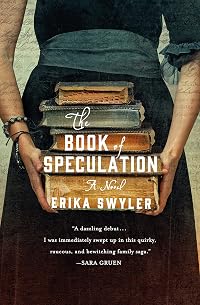
As much as I loved Swyler's previous novel, The Book of Speculation, I think she managed to outdo herself with Light from Other Stars. It is beautiful and magical and excruciating in the best way. I am writing this review weeks after turning the last page, tears coursing down my face anew. (Okay, that makes my ugly crying sound a lot prettier than it is. A spectacle, I am making one.)
A big part of this are the passages on death and dying and the afterlife. I'm an atheist, and don't generally envy people their religious beliefs ... that is, unless it's the comfort that the grieving can find in stories about heaven (or reincarnation, or what have you). Some days I'd give anything to believe that I'll be reunited with my deceased love ones, eventually. But I can't make myself believe in something I don't, even when it's convenient, and so I go scavenging for secular comfort wherever I can find it, like a sad, lonely little heathen magpie.
I find it in all sorts of places (but mostly books, to no one's surprise): Aaron Freeman's essay, "You want a physicist to speak at your funeral." The passages in The Subtle Knife where Lyra and Will lead the ghosts out of the world of the dead. The entire science-based religion created by Lauren Olamina in Octavia Butler's Parables duology. Add to that Theo Pappas's ideas about thoughts, memories, and electrical impulses; heat and light; gas and carbon and star parts. (Carl Sagan's quote about starstuff! I knew I was forgetting something!) There's some truly breathtaking stuff in here. This is a wonderfully godless book; a wonderful book for the godless. I'll hold it close to my heart and cherish it, always.
(I want desperately to include some excerpts here, but spoilers!)
Light from Other Stars is also fiercely feminist, even if the ferocity sometimes comes in a whisper instead of a shout. It's a story about fathers and daughters and fathers and sons ... but also, especially, about mothers and daughters and mothers and sons. Nedda's relationship with Theo is as magnificent as it is tenuous, but her bond with Betheen is all the more wonderful for its complexity, for the way it grows and strengthens and changes - and holds fast even across the vast chasm of space. Nedda's evolving perception of her mother as she discovers what Betheen is capable of is a revelation. I wonder if they ever perfected that champagne cake together?
Last but not least, it's a joy to watch as these two narratives come together, often in unexpected ways (Amadeus, I'm looking at you).
Swyler's writing is exquisite and will pummel you right in the feels. I really hope Netflix picks this one up for a screenplay or miniseries. I need to see what time made liquid looks like, stat.
http://www.easyvegan.info/2019/05/10/light-from-other-stars-by-erika-swyler/ show less
(Full disclosure: I received a free e-ARC for review through NetGalley. Trigger warning for child abuse.)
She knew them by their light, the gentle differences—Amit’s warm, yellowish brown, Evgeni who glowed like a pearl, Louisa who was brighter than all of them. Nedda would know them anywhere; if she lost their shapes, she’d recognize their light.
They would likely die. It was why they were childless, unwed. Freedom of sacrifice. It was a shame that only three people would ever again be in the same room as Evgeni when he sang. Only three people would know that Singh ate with his pinkie out. That Marcanta pulled hairs from her eyebrows when frustrated. Children would know show more their names, and drive on roads named Sokolov or Papas. Children would know their ship, Chawla, and who she’d hauled. A little girl somewhere would rattle off everything she’d read about them, and with it everything she knew about space and time, about light.
###
"I got a boat too. It’s not real big, just enough to take a few people out, that’s all.”
“What’d you name it?”
“Flux Capacitor.”
“Doc Brown’s a better name.”
“Yeah, but boats are women.”
“Everything’s a woman. Cars, boats, houses. Anywhere that’s safe or takes you somewhere better is a woman,” she said.
“So, Chawla is a woman?”
“Obviously.” She opened her eye to find him staring.
###
Her father’s machine was as much hope and wish as it was metal and glass.
###
In the present day - her present, our future - Nedda Papas has achieved everything she's dreamed of. As one quarter of the crew of Chawla, Nedda is humanity's last best chance. Climate change has wrought havoc on earth: rising sea levels have disappeared entire islands and shrunk continents, hunger fueled by drought is the new normal, and wildfires plague what little land is left. The planet is beyond saving; now flight is the only long-term option.
Sent to colonize another planet in a galaxy far, far away, Nedda will never again set foot on earth. And she's okay with that - it's for the greater good, after all, and doesn't she owe her species at least that much, anyway? But when cost-cutting and politicking threatens Chawla's success, Nedda must revisit her past in order to salvage our future.
It was 1986 when Nedda's world imploded: first, with the Space Shuttle Challenger disaster; and again with Theo Pappas's magnum opus, the Crucible.
Light from Other Stars unfolds in two parallel narratives: aboard the Chawla, and in January/February 1986, when Nedda is eleven years old.
Middle-schooler Nedda lives Easter, Florida, in the shadow of Kennedy Space Center. She and her professor father Theo - newly laid off from NASA after the latest round of budget cuts - are inseparable, whether devising and executing experiments or trying to spot Halley's Comet shoot across the night sky. Her relationship with mother Betheen is a little frostier, but not necessarily for lack of mutual interests: Beth is a chemist. But her (women's) work is undervalued, because of course it is. It also doesn't help that Betheen has been drowning in grief for most of young Nedda's life. But spoilers!
Theo has suffered from psoriatic arthritis since childhood, and the joint pain and inflammation makes his work difficult (as does the markedly inferior resources at Haverstone College). Ostensibly, this is the impetus behind his crowning achievement, the Crucible, a machine that can slow down, stop, or even reverse time (and thus heal all manner of physical injuries) by manipulating entropy. (Swyler includes a fair amount of background on the science, only a fraction of which I can claim to understand, and I have no idea how sound it is. But I didn't find these bits boring or excessive, fwiw.)
Theo's machine is a success, in a manner of speaking, but things go sideways, because of course they do. When Crucible threatens to devour all of Easter (including Nedda's best friend Denny), it's up to Nedda and Betheen to save the day.
Judy Resnik, Sally Ride, Gus Grissom, Roger Chaffee, Ed White - Nedda's heroes have always been astronauts. WWJD - What would Judy do?
As much as I loved Swyler's previous novel, The Book of Speculation, I think she managed to outdo herself with Light from Other Stars. It is beautiful and magical and excruciating in the best way. I am writing this review weeks after turning the last page, tears coursing down my face anew. (Okay, that makes my ugly crying sound a lot prettier than it is. A spectacle, I am making one.)
A big part of this are the passages on death and dying and the afterlife. I'm an atheist, and don't generally envy people their religious beliefs ... that is, unless it's the comfort that the grieving can find in stories about heaven (or reincarnation, or what have you). Some days I'd give anything to believe that I'll be reunited with my deceased love ones, eventually. But I can't make myself believe in something I don't, even when it's convenient, and so I go scavenging for secular comfort wherever I can find it, like a sad, lonely little heathen magpie.
I find it in all sorts of places (but mostly books, to no one's surprise): Aaron Freeman's essay, "You want a physicist to speak at your funeral." The passages in The Subtle Knife where Lyra and Will lead the ghosts out of the world of the dead. The entire science-based religion created by Lauren Olamina in Octavia Butler's Parables duology. Add to that Theo Pappas's ideas about thoughts, memories, and electrical impulses; heat and light; gas and carbon and star parts. (Carl Sagan's quote about starstuff! I knew I was forgetting something!) There's some truly breathtaking stuff in here. This is a wonderfully godless book; a wonderful book for the godless. I'll hold it close to my heart and cherish it, always.
(I want desperately to include some excerpts here, but spoilers!)
Light from Other Stars is also fiercely feminist, even if the ferocity sometimes comes in a whisper instead of a shout. It's a story about fathers and daughters and fathers and sons ... but also, especially, about mothers and daughters and mothers and sons. Nedda's relationship with Theo is as magnificent as it is tenuous, but her bond with Betheen is all the more wonderful for its complexity, for the way it grows and strengthens and changes - and holds fast even across the vast chasm of space. Nedda's evolving perception of her mother as she discovers what Betheen is capable of is a revelation. I wonder if they ever perfected that champagne cake together?
Last but not least, it's a joy to watch as these two narratives come together, often in unexpected ways (Amadeus, I'm looking at you).
Swyler's writing is exquisite and will pummel you right in the feels. I really hope Netflix picks this one up for a screenplay or miniseries. I need to see what time made liquid looks like, stat.
http://www.easyvegan.info/2019/05/10/light-from-other-stars-by-erika-swyler/ show less
I'm not going to claim that this review is unbiased because it isn't. I've admired Erika on the internet in various mediums for a long time. I've been an immense fan of her writing for as long as I've known her- whether it be essays or the Book of Speculation or just notes about her bunny and applying coffee to any given situation Erika's words are ardent and honest and they hit me in a place that I forget about often until she comes along and pokes at it. It often aches in a way I can't describe and makes me long for a certain type of kinship I can't quite put my finger on.
The Book of Speculation broke me out of a years long reading slump and reignited a passion within me. It reminded me of my love of mythology and mystery and family show more and fear and desire. Light from Other Stars ignited a new passion within me that, truthfully, I was doubtful I was capable of when I first saw scribblings of this novel floating around. I was worried I wouldn't be able to appreciate this for its broader scope- I'm a relatively young woman, I've been taught all my life to hate science and go towards the arts. I've never read a science fiction book in my life- would I love this as much as I wanted to? Would I be able to relate to a young girl who loved space and her father in a way I had never been able to? Of course I did. Because the love and fear and passion that Erika pours into her every word shows and kicks me in the chest.
I'm not going to lie and say this wasn't a difficult book. I tried to understand the science and I managed as well as someone in the arts can I think. The emotions underlying this novel were also difficult. The family dynamics, the friendship with Denny, Nedda's obsession with NASA. It was hard to read at times. I was fearful of everything breaking apart- and sometimes it did but it all stitched back together. Which is maybe the biggest takeaway from this story. You have to do the scary thing anyway. And it will hurt, but it won't be forever.
There was a little bit of magic in this book and I am so grateful to be allowed in its orbit. show less
The Book of Speculation broke me out of a years long reading slump and reignited a passion within me. It reminded me of my love of mythology and mystery and family show more and fear and desire. Light from Other Stars ignited a new passion within me that, truthfully, I was doubtful I was capable of when I first saw scribblings of this novel floating around. I was worried I wouldn't be able to appreciate this for its broader scope- I'm a relatively young woman, I've been taught all my life to hate science and go towards the arts. I've never read a science fiction book in my life- would I love this as much as I wanted to? Would I be able to relate to a young girl who loved space and her father in a way I had never been able to? Of course I did. Because the love and fear and passion that Erika pours into her every word shows and kicks me in the chest.
I'm not going to lie and say this wasn't a difficult book. I tried to understand the science and I managed as well as someone in the arts can I think. The emotions underlying this novel were also difficult. The family dynamics, the friendship with Denny, Nedda's obsession with NASA. It was hard to read at times. I was fearful of everything breaking apart- and sometimes it did but it all stitched back together. Which is maybe the biggest takeaway from this story. You have to do the scary thing anyway. And it will hurt, but it won't be forever.
There was a little bit of magic in this book and I am so grateful to be allowed in its orbit. show less
Two stories unfold. In one, Nedda is aboard the Chawla, an interstellar vessel, with three other terraformers headed to a new home, to prepare the way for the thousands that will follow. In the other, Nedda is an eleven year old girl in the town of Easter, Florida, in 1986. In the latter story we gradually learn how it came to be that the Nedda there could also be the Nedda on board the space vessel so many years later. In both stories, Nedda holds our attention and our concern as she faces increasingly difficult technical challenges, which, curiously, have a common cause.
Apart from the science of this fiction, the core story is about familial bonds, aspiration, and grief. Nedda’s family — scientist father, former scientist now show more conceptual baker mother — are surrounded in a bubble of grief of which Nedda is unaware. It both locks them together and keeps them separate, unable to fully bond. Unwitting bubbles, temporal bubbles in this case, also begin to envelope the town of Easter due to unanticipated effects of an experiment that Nedda’s father is conducting at the local college. The consequences will be both far-reaching and particular. And a very similar unanticipated outcome will threaten the success of Nedda’s interstellar mission.
It’s a challenging mixture, especially holding our interest across the two storylines. But Erika Swyler has succeeded in making Nedda’s story whole. Admirable writing indeed.
Recommended. show less
Apart from the science of this fiction, the core story is about familial bonds, aspiration, and grief. Nedda’s family — scientist father, former scientist now show more conceptual baker mother — are surrounded in a bubble of grief of which Nedda is unaware. It both locks them together and keeps them separate, unable to fully bond. Unwitting bubbles, temporal bubbles in this case, also begin to envelope the town of Easter due to unanticipated effects of an experiment that Nedda’s father is conducting at the local college. The consequences will be both far-reaching and particular. And a very similar unanticipated outcome will threaten the success of Nedda’s interstellar mission.
It’s a challenging mixture, especially holding our interest across the two storylines. But Erika Swyler has succeeded in making Nedda’s story whole. Admirable writing indeed.
Recommended. show less
Sometimes you go into a story with a certain expectation. I approached Light from Other Stars this way. Somewhere I'd gotten the impression that this was novel was going be the mind-bending what-the-hell-just-happened I found in James Renner's The Man from Primrose Lane (if you want your mind blown, read that novel.) Light from Other Stars isn't what I expected, but it's still intriguing, intelligent, and sometimes a little fun.
Light from Other Stars takes place largely in Florida in the days after the space shuttle Challenger explosion. Eleven-year-old Nedda's father is a scientist working on an entropy experiment at the time of the accident. Enter science. Science was never one of my stronger subjects in school, so consider my show more ignorance when I say that for me this was big-s Science fiction. The narrative occasionally switches to a space craft in the future, but I'll just leave that part a mystery.
Even though Light from Other Stars is heavy on the science, it's also a very effective in showing the human condition. Love, grief, birth, mortality, individuality, and family are all explored in quite some depth. The characters and the plot both show expert craftsmanship, but they probably do get a bit lost in the technical jargon. That said, Swyler is not an author who talks down to her readers. The explanations for the more scientific elements of the story are done in a largely organic way.
The one thing that I think would've made this book stand out more is if the big reveal (don't worry, no spoilers here) had been less obvious earlier in the novel. Now we're dipping into questions of Authorial Intention versus Reader's Interpretation. Perhaps Swyler was not seeking a big reveal. Maybe she wanted it to be obvious from page one. That's a possibility, but she also never comes right out and says it, so it gives the impression that she's trying to hide something. This results in high expectations for what will be a letdown for many.
Light from Other Stars is certainly one of the more imaginative Literary novels I've read in recent times. I would've gladly embraced some more surprise in these pages, but the exploration of time and the human heart made for an excellent journey. show less
Light from Other Stars takes place largely in Florida in the days after the space shuttle Challenger explosion. Eleven-year-old Nedda's father is a scientist working on an entropy experiment at the time of the accident. Enter science. Science was never one of my stronger subjects in school, so consider my show more ignorance when I say that for me this was big-s Science fiction. The narrative occasionally switches to a space craft in the future, but I'll just leave that part a mystery.
Even though Light from Other Stars is heavy on the science, it's also a very effective in showing the human condition. Love, grief, birth, mortality, individuality, and family are all explored in quite some depth. The characters and the plot both show expert craftsmanship, but they probably do get a bit lost in the technical jargon. That said, Swyler is not an author who talks down to her readers. The explanations for the more scientific elements of the story are done in a largely organic way.
The one thing that I think would've made this book stand out more is if the big reveal (don't worry, no spoilers here) had been less obvious earlier in the novel. Now we're dipping into questions of Authorial Intention versus Reader's Interpretation. Perhaps Swyler was not seeking a big reveal. Maybe she wanted it to be obvious from page one. That's a possibility, but she also never comes right out and says it, so it gives the impression that she's trying to hide something. This results in high expectations for what will be a letdown for many.
Light from Other Stars is certainly one of the more imaginative Literary novels I've read in recent times. I would've gladly embraced some more surprise in these pages, but the exploration of time and the human heart made for an excellent journey. show less
This book is absolutely beautiful. The narrative is split between present day, when Nedda is an astronaut, and 1986, when she's growing up in a small Florida town with a scientist father who used to work for NASA. It's a work of speculative fiction, sure--but also a poignant reflection on relationships, family, death, and time.
Light from Other Stars by Erika Swyler is a highly recommended coming-of-age science fiction story.
The dual narrative follows two different stories set in two different time periods. In 1986, eleven-year-old Nedda Papas is living in Easter Florida, a Space Coast town, where she can't wait to grow up and become an astronaut. Theo, her father is a physicist, a college professor who was laid off from NASA, but he has an ongoing project, Crucible, that manipulates time by controlling entropy in an effort to extend Nedda's childhood. Betheen, her distant mother, is a baker and a chemist. Both of her parents, unknown to Nedda, are still mourning the loss of her brother, Michael, several years earlier. On the day after the Challenger disaster, show more another disaster befalls the town of Easter, which also affects Nedda's best friend Denny and her father. Nedda turns to Betheen to find a solution.
In the future Nedda is an astronaut aboard the Chawla, a four-person spacecraft en route to colonize a faraway planet to save humanity. Nedda and her crew mates are facing several trials, but now are doomed if they can't find a solution to a crisis that is threatening all of their lives and the mission. Nedda's past may actually hold the answer for a way to solve their current crisis.
The narrative alternates between the two time periods and the two stories, with Nedda (and by association Betheen) being the connection between the two vastly different narratives. For me, the young Nedda was the better developed character and the earlier timeline/story was much more compelling. I admittedly read the future chapters a bit faster to get back to the coming-of-age story and the disaster befalling her friend Denny and her dad Theo. It also allows the closeness of Betheen and Nedda now make more sense, and truly highlight the sacrifices that women often make for the good of everyone.
The writing is very good and the two plots are compelling for their own reasons. As a long-time reader of hard science fiction, I didn't find the science intimidating, but it would be easy to breeze over it and get on with the story for those who want to do so. The greater story is the examination of progress, finding meaning in your work, sacrifices, passions, determination, and the relationships between people in various contexts - parents, children, friends.
Disclosure: My review copy was courtesy of Bloomsbury.
http://www.shetreadssoftly.com/2019/05/light-from-other-stars.html show less
The dual narrative follows two different stories set in two different time periods. In 1986, eleven-year-old Nedda Papas is living in Easter Florida, a Space Coast town, where she can't wait to grow up and become an astronaut. Theo, her father is a physicist, a college professor who was laid off from NASA, but he has an ongoing project, Crucible, that manipulates time by controlling entropy in an effort to extend Nedda's childhood. Betheen, her distant mother, is a baker and a chemist. Both of her parents, unknown to Nedda, are still mourning the loss of her brother, Michael, several years earlier. On the day after the Challenger disaster, show more another disaster befalls the town of Easter, which also affects Nedda's best friend Denny and her father. Nedda turns to Betheen to find a solution.
In the future Nedda is an astronaut aboard the Chawla, a four-person spacecraft en route to colonize a faraway planet to save humanity. Nedda and her crew mates are facing several trials, but now are doomed if they can't find a solution to a crisis that is threatening all of their lives and the mission. Nedda's past may actually hold the answer for a way to solve their current crisis.
The narrative alternates between the two time periods and the two stories, with Nedda (and by association Betheen) being the connection between the two vastly different narratives. For me, the young Nedda was the better developed character and the earlier timeline/story was much more compelling. I admittedly read the future chapters a bit faster to get back to the coming-of-age story and the disaster befalling her friend Denny and her dad Theo. It also allows the closeness of Betheen and Nedda now make more sense, and truly highlight the sacrifices that women often make for the good of everyone.
The writing is very good and the two plots are compelling for their own reasons. As a long-time reader of hard science fiction, I didn't find the science intimidating, but it would be easy to breeze over it and get on with the story for those who want to do so. The greater story is the examination of progress, finding meaning in your work, sacrifices, passions, determination, and the relationships between people in various contexts - parents, children, friends.
Disclosure: My review copy was courtesy of Bloomsbury.
http://www.shetreadssoftly.com/2019/05/light-from-other-stars.html show less
I really enjoyed this book and surprisingly not for the sci-fi elements. While this book had sci-fi elements, in my opinion it was in no way the focus of the book. The book (in my opinion) was more about family relationships (particularly between parents and children), sacrifice, and the processing of grief.
Members
- Recently Added By
Lists

2020 Hugo Eligible Novels
71 works; 12 members

Kirkus Starred Fiction Reviews of Books Published in 2019
411 works; 12 members
Talk Discussions
Past Discussions
Found: SciFi Book With Female Protagonist and Space and Time Travel in Name that Book (August 2024)
Author Information

5+ Works 2,998 Members
Awards and Honors
Awards
Common Knowledge
- Alternate titles
- German: "Der Tag, an dem mein Vater die Zeit anhielt" (The Day My Father Stopped Time) (The Day My Father Stopped Time)
- Original publication date
- 2019-05-07
- Epigraph
- Oh! I have slipped the surly bonds of Earth
And danced the skies on laughter-silvered wings;
Sunward I've climbed, and joined the tumbling mirth
Of sun-split clouds, -- and done a hundred things
Yo... (show all)u have not dreamed of--wheeled and soared and swung
High in the sunlit silence. Hov'ring there,
I've chased the shouting wind along, and flung
My eager craft through footless halls of air...
Up, up the long, delirious burning blue
I've topped the wind-swept heights with easy grace
Where never lark, or ever eagle flew--
And, while with silent, lifting mind I've trod
The high untrespassed sanctity of space,
Put out my hand, and touched the face of God.
-- John Gillespie Magee Jr., "High Flight" - Dedication
- This book is dedicated to the Hubble Space Telescope, which opened the universe to me. It is also dedicated to the teachers who did not believe a fifth-grade girl could speak knowledgeably about the Hubble Space Telescope. Yo... (show all)u remain embarrassingly wrong.
- First words
- Nedda Papas rose to birdsong, the sharp, rasping call of a dusky seaside sparrow against a backdrop of waves - a reminder of home and things she'd never see again.
- Quotations
- Amit Singh clapped a hand on her shoulder. Nedda liked the shape of his fingernails: perfect pink-brown ovals. As good a reason as any to like a person.
- Last words
- (Click to show. Warning: May contain spoilers.)She touched the face of God.
- Blurbers
- Stradal, J. Ryan; Celt, Adrienne; Shepherd, Peng; Ohanesian, Aline
Classifications
Statistics
- Members
- 353
- Popularity
- 89,409
- Reviews
- 16
- Rating
- (3.93)
- Languages
- English
- Media
- Paper, Audiobook, Ebook
- ISBNs
- 5
- ASINs
- 2