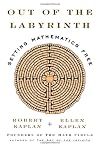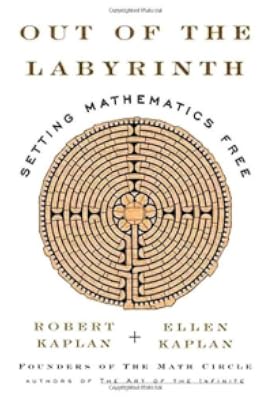
Out of the Labyrinth: Setting Mathematics Free
by Robert Kaplan
On This Page
Description
Who hasn't feared the math Minotaur in its labyrinth of abstractions? Now, in Out of the Labyrinth, Robert and Ellen Kaplan--the founders of The Math Circle, the popular learning program begun at Harvard in 1994--reveal the secrets behind their highly successful approach, leading readers out of the labyrinth and into the joyous embrace of mathematics. Written with the same wit and clarity that made Robert Kaplan's The Nothing That Is an international best seller, Out of the Labyrinth offers show more an engaging and practical guide for parents and educators, and is a delight for anyone interested in sharing the pleasures of mathematics. The Kaplans argue that math should be taught as the highest form of intellectual play, an endeavor to be explored and enjoyed by children (or adults) of any age. In their revolutionary view, talent is a myth: students relish accessible mysteries and their understanding blossoms in pursuing them. Out of the Labyrinth will let students, parents, teachers--anyone--wrestle with the angles of math and delight in the revelations. show lessTags
Recommendations





Member Reviews
This book intends to make math more accessible, which I understand to be the point of the Math Circle program created by the authors. Unfortunately, that accessibility is obscured by a cumbersome narrative. The authors seem to have taken a cue from the "Never utilize a diminutive utterance when a polysyllabic synonym will suffice" mantra. Incongruously, in this book, when they are presented, simple concepts are inflated and more challenging concepts are oversimplified. They aren't presented all that much though.
The authors say in the first chapter that the book describes (among other things) how they removed the barriers to enjoying mathematics...but I don't think they succeeded. The illustrative problems are well done, but the show more trappings are the majority of the book and are unwieldy. The attempts to remove barriers to enjoying mathematics unfortunately include barriers to enjoying reading about the removal of barriers. show less
The authors say in the first chapter that the book describes (among other things) how they removed the barriers to enjoying mathematics...but I don't think they succeeded. The illustrative problems are well done, but the show more trappings are the majority of the book and are unwieldy. The attempts to remove barriers to enjoying mathematics unfortunately include barriers to enjoying reading about the removal of barriers. show less
I'm all in favor of the basic premise of this book: that teaching kids how to discover math on their own is more likely to make math interesting and is a better way to teach them to think. I also enjoyed the examples from the classes and the ways they got students to get into certain ideas, even though many of the ideas were over my head. It's the long, middle section of the book that I found less compelling. The authors found the need to explain their theory of how the brain works and their idea that everyone has an "architectural instinct." I found myself saying, "Let's just stick to math and leave psychology and other fields to experts in those fields." Still, it's an interesting book; I'd just skim the central chapters.
Approached this as a skim after seeing it on the shelves at Powells (math and science store, that is) and getting it from the library instead. Nice overview of the history of math circles as a way to bring pure mathematics to laypersons -- it gave me a broader understanding of what the fine folks at Seattle's Math For Love are all about in the grand scheme of mathematics education and outreach. I only wish there were more circles in Seattle for mathematically precocious young kids.
A quite deep, extended essay on the nature of mathematical thinking and the need for children to learn it by self discovery in small classes with "sherpa" teachers.
Ratings
Members
- Recently Added By
Author Information

5 Works 1,788 Members
Robert Kaplan has taught mathematics to people from six to sixty, most recently at Harvard University. In 1994, with his wife Ellen, he founded The Math Circle, a program, open to the public, for the enjoyment of pure mathematics. He has also taught Philosophy, Greek, German, Sanskrit, and Inspired Guessing. Robert Kaplan lives in Cambridge, MA.
Classifications
Statistics
- Members
- 105
- Popularity
- 308,242
- Reviews
- 4
- Rating
- (3.25)
- Languages
- English
- Media
- Paper, Ebook
- ISBNs
- 6
- ASINs
- 1