On This Page
Description
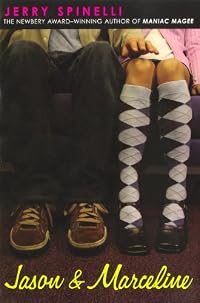
The further adventures of Jason Herkimer as he tries to cope with three important things in his life: his relationship with Marceline McAllister, his peer group, and his burgeoning sexuality. Sequel to "Space Station Seventh Grade."Tags
Recommendations








Member Reviews
Already this has me laughing out loud (I'm on chapter 3) and it's completely inappropriate for middle school kids in such a way that I highly recommend it to them.
Update: The rest of the book was okay--not so inappropriate after all, either. Not as good as Space Station Seventh Grade (no more laugh-out-loud moments). The great thing about this book is that Jason seems pretty normal, obsessing about boobs and "doing it" and getting hickeys, but Marceline is this kick-butt, real, unique character who never gives in to hickeys or "doing it." She plays her trombone in public, loves being smart, won't wear an ankle bracelet because she'd feel like a slave to Jason if she did, etc. The girls in the novel who are "doing it" are portrayed as show more shallow bimbos or, more importantly, normal girls who have a reputation for doing things they never even did. So parents can rest-assured that the message in this book is to take things slow and not be raunchy, be yourself (and hickeys are just dumb) but the kids get enough raunchiness to not realize 'til the end that the book does have a good message. Does this make sense? I'm having a hard time articulating here.
It's a good, subtle anti-conformity novel that is more entertaining to young readers, more realistic,and not as "deep" as others. I think middle school kids will relate to Jason way more than, say, Jonas of The Giver, and is more effective on the topic of non-conformity, even though this book would be considered smut compared to The Giver. show less
Update: The rest of the book was okay--not so inappropriate after all, either. Not as good as Space Station Seventh Grade (no more laugh-out-loud moments). The great thing about this book is that Jason seems pretty normal, obsessing about boobs and "doing it" and getting hickeys, but Marceline is this kick-butt, real, unique character who never gives in to hickeys or "doing it." She plays her trombone in public, loves being smart, won't wear an ankle bracelet because she'd feel like a slave to Jason if she did, etc. The girls in the novel who are "doing it" are portrayed as show more shallow bimbos or, more importantly, normal girls who have a reputation for doing things they never even did. So parents can rest-assured that the message in this book is to take things slow and not be raunchy, be yourself (and hickeys are just dumb) but the kids get enough raunchiness to not realize 'til the end that the book does have a good message. Does this make sense? I'm having a hard time articulating here.
It's a good, subtle anti-conformity novel that is more entertaining to young readers, more realistic,and not as "deep" as others. I think middle school kids will relate to Jason way more than, say, Jonas of The Giver, and is more effective on the topic of non-conformity, even though this book would be considered smut compared to The Giver. show less
I am a big fan of Jerry Spinelli's young, bumbling, true to life characters; however, this book seemed a little crude and sometimes overtly sexual. Is it true to life? Probably, but I felt that the overly sexual nature of the content distracted me from the "Spinelli-esque" characterization I usually enjoy.
Pershing only?!
A sweet story of first love, from the boy's perspective.
Ratings
Members
- Recently Added By
Author Information

66+ Works 60,702 Members
Jerry Spinelli was born in Norristown, Pennsylvania on February 1, 1941. He received a bachelor's degree from Gettysburg College and a master's degree from Johns Hopkins University. He worked as an editor with Chilton from 1966 to 1989. He launched his career in children's literature with Space Station 7th Grade in 1982. He has written over 30 show more books including The Bathwater Gang, Picklemania, Stargirl, Milkweed, and Mama Seeton's Whistle. In 1991, he won the Newbery Award for Maniac Magee. In 1998, Wringer was named a Newbery Honor book. (Bowker Author Biography) show less
Series

Common Knowledge
- Original publication date
- 1986
- Canonical DDC/MDS
- 813.54
Classifications
- Genres
- Kids, Fiction and Literature, Tween
- DDC/MDS
- 813.54 — Literature & rhetoric American literature in English American fiction in English 1900-1999 1945-1999
- LCC
- PZ7 .S75663 .J — Language and Literature Fiction and juvenile belles lettres Fiction and juvenile belles lettres Juvenile belles lettres
- BISAC
Statistics
- Members
- 149
- Popularity
- 219,044
- Reviews
- 4
- Rating
- (3.46)
- Languages
- English
- Media
- Paper, Ebook
- ISBNs
- 10
- ASINs
- 3