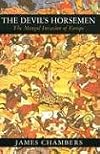
The Devil's Horsemen: The Mongol Invasion of Europe
by James Chambers
On This Page
Description
On Christmas Day 1241 the armies of Batu Khan, founder of the Golden Horde, crossed the Danube while the disunited kingdoms of the West lay at their mercy. The Mongol invasion of Europe was entering its final phase, and it seemed as if all of Christendom was about to be destroyed by the soldiers from Hell. The Devil's Horsemen, based on a wealth of contemporary sources, describes the tactics and training of the finest army the world had ever seen, and tells the story of Subedei Bahadur, the show more illiterate military genius who brought 20th century warfare to medieval Europe. Remembered today only as savage barbarians, the author shows how the Mongols were in fact formidable soldiers who invented strategies and tactics later adopted to devastating effect by Rommel and Patton. Had the last of the great Khans lived only a few years longer, the largest empire ever known would have stretched not just to the Carpathians and the Euphrates, but as far as the Atlantic Ocean itself. show lessTags
Recommendations


























Member Reviews
This is a VERY good book with some minor shortcomings. The most glaring is the mention of many Mongol characters without an introduction as to who they were (and there is not a listing of major characters in the Appendix). But that is a minor quibble.
Chambers provides a fascinating summary of the ways of both the Mongol empire and way of war. He does this by interspersing with chapters about the events that led up to the invasion of Europe and ends with the crushing of the Mongols by the Mamluks at the battle of Ain Jalut. As Chambers notes, the Mongols didn’t leave a legacy behind (like Rome or Greece) and therefore their direct (or should I say, credited) imprint on history is not as obvious as something like the Roman legal system. show more However, this was one incredible empire. The sheer amount of land mass that they conquered is amazing and makes the Roman Empire look comparatively small.
Their civilizational commitment to preparing themselves for military conquest is rivaled by no one (except maybe Sparta). They were extremely brutal, and their episodes of mass slaughter and rape of nuns (for example) create quite the mental image. They are certainly not the only civilization to practice barbarity, but the scale on which they did is probably unmatched.
This book was written in 1979. While Chambers does not say this directly, I wonder if the events of the Iranian Revolution were on his mind as he neared completion of his work. In two places he mentions just how close Islam came to its extermination. Of course, the Mongols almost brought about the end of Christianity as well. However, several Mongol Khans were sympathetic to Christianity. Regarding the Mongol conquest of Syria, and the subsequent prostrating of local Muslims to the Christian cross (the Christians had aided in the conquest), Chambers writes: “It was a poignant image of a Christian world that so nearly might have been.” Had St. Louis and other Christian leaders made some different judgments what happened in Syria might have happened everywhere else in the Muslim world.
Instead they were beaten back and the legacies they left were nothing in comparison to Rome or Greece. Rather, many of their territories suffered for centuries and were left ripe for even worse atrocities to come. Namely Communism. show less
Chambers provides a fascinating summary of the ways of both the Mongol empire and way of war. He does this by interspersing with chapters about the events that led up to the invasion of Europe and ends with the crushing of the Mongols by the Mamluks at the battle of Ain Jalut. As Chambers notes, the Mongols didn’t leave a legacy behind (like Rome or Greece) and therefore their direct (or should I say, credited) imprint on history is not as obvious as something like the Roman legal system. show more However, this was one incredible empire. The sheer amount of land mass that they conquered is amazing and makes the Roman Empire look comparatively small.
Their civilizational commitment to preparing themselves for military conquest is rivaled by no one (except maybe Sparta). They were extremely brutal, and their episodes of mass slaughter and rape of nuns (for example) create quite the mental image. They are certainly not the only civilization to practice barbarity, but the scale on which they did is probably unmatched.
This book was written in 1979. While Chambers does not say this directly, I wonder if the events of the Iranian Revolution were on his mind as he neared completion of his work. In two places he mentions just how close Islam came to its extermination. Of course, the Mongols almost brought about the end of Christianity as well. However, several Mongol Khans were sympathetic to Christianity. Regarding the Mongol conquest of Syria, and the subsequent prostrating of local Muslims to the Christian cross (the Christians had aided in the conquest), Chambers writes: “It was a poignant image of a Christian world that so nearly might have been.” Had St. Louis and other Christian leaders made some different judgments what happened in Syria might have happened everywhere else in the Muslim world.
Instead they were beaten back and the legacies they left were nothing in comparison to Rome or Greece. Rather, many of their territories suffered for centuries and were left ripe for even worse atrocities to come. Namely Communism. show less
Excellent history of the invasion of Europe by the Mongols, giving the campaign of Subedei and Batu as the focus, but also referring to what had come immediately prior to this (the first European campaign of Subedei in 1223) and the aftermath.
I'm baffled by the review below. If you are a student of or merely interested in this period of history, then this is an essential volume for you.
I'm baffled by the review below. If you are a student of or merely interested in this period of history, then this is an essential volume for you.
Detailed and excellent examination of the 13th century Mongol invasion of Central Asia and campaigns in Europe. Explores Mongol motivation, stratey and tactics and response of attacked areas. Esp strong on invasion of Khwarizm and initial Mongol campaigns.
Chambers’ book really brings the Mongol empire to life, giving them their proper place in world history, as the pre-eminent empire and military force of their time...[return]http://icantstopreading.wordpress.com/2008/05/30/the-devils-horsemen-by-james-cambers/
Chambers’ book really brings the Mongol empire to life, giving them their proper place in world history, as the pre-eminent empire and military force of their time...
http://icantstopreading.wordpress.com/2008/05/30/the-devils-horsemen-by-james-ca...
http://icantstopreading.wordpress.com/2008/05/30/the-devils-horsemen-by-james-ca...
the only book you will need about the mongol westward conquest.
Ratings
Members
- Recently Added By
Lists

Shaykh Hamza's Book Recommendations
439 works; 3 members
Author Information

Common Knowledge
- Original publication date
- 1979
- People/Characters
- Subedei Bahadur
- Important places
- Eastern Europe
- Important events
- Mongol Invasion of Europe
- Dedication
- To Josephine
- First words
- In the late winter of 1220, Ala al-Din boarded the only remaining fishing boat in the village of Astara on the shores of the Caspian Sea and sailed out towards the island of Abaskun.
- Last words
- (Click to show. Warning: May contain spoilers.)If Ogedei and Mangku had not died when they did, the largest empire that the world had ever known would have been bounded in the west not by the Carpathians and the Euphrates, but by the Atlantic Ocean.
Classifications
Statistics
- Members
- 513
- Popularity
- 58,821
- Reviews
- 6
- Rating
- (4.01)
- Languages
- English, French
- Media
- Paper
- ISBNs
- 9
- ASINs
- 8