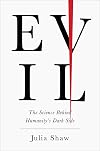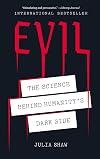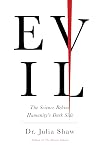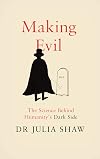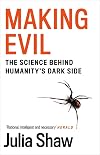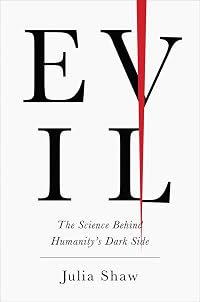
Evil: The Science Behind Humanity's Dark Side
by Julia Shaw
On This Page
Description
"What is it about evil that we find so compelling? From our obsession with serial killers to violence in pop culture, we seem inescapably drawn to the stories of monstrous acts and the aberrant people who commit them. But evil, Dr. Julia Shaw argues, is largely subjective. What one may consider normal, like sex before marriage, eating meat, or working on Wall Street, others find abhorrent. And if evil is only in the eye of the beholder, can it be said to exist at all? In [this book], Shaw show more uses an engrossing mix of science, popular culture, and real-life examples to break down timely and provocative issues. How similar is your brain to a psychopath's? How many people have murder fantasies? Can artificial intelligence be evil? Do your sexual proclivities make you a bad person? Who becomes a terrorist? If you could travel back in time, would you kill baby Hitler? In asking these questions, Shaw urges readers to discover empathy and to rethink and reshape what it means to be bad. [This book] is a wide-ranging exploration into a fascinating, darkly compelling subject from a wickedly smart and talented writer."--Dust jacket. Dr. Julia Shaw, a criminal psychologist, uses the latest scientific research to offer a more enlightened and nuanced explanation for why people behave so badly and how we can prevent evil acts by understanding more profoundly how such acts come about - and what truly makes us evil. show lessTags
Recommendations












Member Reviews
Dr. Julia Shaw explores the definition of evil in her book Evil: The Science Behind Humanity’s Dark Side. Her hypothesis states that there is no such thing as evil as a measurable character trait, for which she provides a compelling argument. Dr. Shaw goes about methodically presenting her case, looking first at people labeled as evil by history and then moving on to actions people typically describe as evil. Throughout each page, she maintains her compassion and neutrality, neither condemning nor condoning any socially unacceptable behavior. It all makes for a fascinating read.
Dr. Shaw devotes the first few chapters to physiology, highlighting studies that examined the brains of sociopaths and serial killers to prove her point that show more there is no physiological smoking gun when it comes to determining whether one can consider a person evil. There are some differences in the brain for sociopaths, but, as she is careful to mention, being a sociopath does not mean that one will commit a crime or act in a deviant manner. Her collection of findings makes you pause as you realize the implications of what Dr. Shaw is saying – in essence, there is no such thing as an evil person. It means that men like Hitler, Stalin, and Pol Pot are not evil per se. Their ideas may be despicable, and their actions were deplorable, but they themselves were not inherently evil.
Before you get a chance to process that idea, Dr. Shaw moves on to what society deems as evil behavior, which includes everything from serial murder, pedophilia, rape, animal love, and more. In each example, Dr. Shaw is careful to reiterate her hypothesis that there is no such thing as an evil person no matter what the crime. She argues that it is a person’s mental state which determines the deviancy of the behavior. A pedophile is not evil but mentally unhealthy and in desperate need of coping mechanisms and psychological help to overcome his or her urges. Someone who loves animals – in both spiritual and physical ways – is someone who needs help establishing healthy relationships with humans. Rape is about control, as is murder to some extent. In both cases, the person committing the crime needs help learning to control his or her emotions and finding healthy outlets for the rage. Dr. Shaw pushes all buttons in this section, tackling the most taboo of behaviors and not pointing blame at anything other than society’s inability to provide the help mentally disturbed people need.
She closes her argument with the idea that if we can look beyond the offensive behavior and look to the person behind the action, only then can we, as a society, help these people get the help they need. Evil doesn’t exist, but people who are mentally ill do, and it is when we can look to the person where we can change how we treat such behaviors and best help society. Again, it is a premise that requires a lot of contemplation to consider in its entirety, but the studies Dr. Shaw cites provides evidence that is difficult to ignore.
Evil is not an easy book to read. The behaviors Dr. Shaw explores are behaviors most people would never consider, and learning about them is a disconcerting, out-of-body experience as you grapple to understand how people can think and act in such a fashion. That reaction, though, is Dr. Shaw’s point. She wants us to think about this; she wants to challenge our social norms so that we can see that a pedophile typically recognizes their emotions and reactions towards children are not how one should feel. She wants us to understand what it means when a person would rather fall in love with an animal than a human. She wants us to recognize that incarceration for such crimes does not help anyone – it does not benefit society, and it most certainly does not support the perpetrator. In the end, she realizes that she might not be able to convince everyone of her hypothesis, and she accepts that. It is my belief, however, that everyone who reads Evil finishes the novel with a greater awareness that she may have a point so that the next time someone mentions that there may be a sexual predator living in your neighborhood, you will remember what she said and pause your condemnation. If Dr. Shaw is right, then that pause may be the start of a dialogue that could change everything. Or not. show less
Dr. Shaw devotes the first few chapters to physiology, highlighting studies that examined the brains of sociopaths and serial killers to prove her point that show more there is no physiological smoking gun when it comes to determining whether one can consider a person evil. There are some differences in the brain for sociopaths, but, as she is careful to mention, being a sociopath does not mean that one will commit a crime or act in a deviant manner. Her collection of findings makes you pause as you realize the implications of what Dr. Shaw is saying – in essence, there is no such thing as an evil person. It means that men like Hitler, Stalin, and Pol Pot are not evil per se. Their ideas may be despicable, and their actions were deplorable, but they themselves were not inherently evil.
Before you get a chance to process that idea, Dr. Shaw moves on to what society deems as evil behavior, which includes everything from serial murder, pedophilia, rape, animal love, and more. In each example, Dr. Shaw is careful to reiterate her hypothesis that there is no such thing as an evil person no matter what the crime. She argues that it is a person’s mental state which determines the deviancy of the behavior. A pedophile is not evil but mentally unhealthy and in desperate need of coping mechanisms and psychological help to overcome his or her urges. Someone who loves animals – in both spiritual and physical ways – is someone who needs help establishing healthy relationships with humans. Rape is about control, as is murder to some extent. In both cases, the person committing the crime needs help learning to control his or her emotions and finding healthy outlets for the rage. Dr. Shaw pushes all buttons in this section, tackling the most taboo of behaviors and not pointing blame at anything other than society’s inability to provide the help mentally disturbed people need.
She closes her argument with the idea that if we can look beyond the offensive behavior and look to the person behind the action, only then can we, as a society, help these people get the help they need. Evil doesn’t exist, but people who are mentally ill do, and it is when we can look to the person where we can change how we treat such behaviors and best help society. Again, it is a premise that requires a lot of contemplation to consider in its entirety, but the studies Dr. Shaw cites provides evidence that is difficult to ignore.
Evil is not an easy book to read. The behaviors Dr. Shaw explores are behaviors most people would never consider, and learning about them is a disconcerting, out-of-body experience as you grapple to understand how people can think and act in such a fashion. That reaction, though, is Dr. Shaw’s point. She wants us to think about this; she wants to challenge our social norms so that we can see that a pedophile typically recognizes their emotions and reactions towards children are not how one should feel. She wants us to understand what it means when a person would rather fall in love with an animal than a human. She wants us to recognize that incarceration for such crimes does not help anyone – it does not benefit society, and it most certainly does not support the perpetrator. In the end, she realizes that she might not be able to convince everyone of her hypothesis, and she accepts that. It is my belief, however, that everyone who reads Evil finishes the novel with a greater awareness that she may have a point so that the next time someone mentions that there may be a sexual predator living in your neighborhood, you will remember what she said and pause your condemnation. If Dr. Shaw is right, then that pause may be the start of a dialogue that could change everything. Or not. show less
I truly enjoy when a book makes me look at something from an entirely different angle. I may still not agree with the point, but I'll always appreciate the view.
This book does that.
I know another reviewer took exception to the fact that the author tries to humanize pedophiles. Trust me, I'm the first one to get angry at anyone that preys on children, but I feel the reviewer got lost in their own feelings and didn't completely catch the point the author made. And no, she's not sympathetic toward pedophiles any more than she's sympathetic to rapists and murderers. Not at all.
And that's what I mean...the author just takes you down a different path of understanding, to determine what, exactly, is evil.
And I, for one, appreciated it. Great, show more thought-provoking, discussion-provoking book. show less
This book does that.
I know another reviewer took exception to the fact that the author tries to humanize pedophiles. Trust me, I'm the first one to get angry at anyone that preys on children, but I feel the reviewer got lost in their own feelings and didn't completely catch the point the author made. And no, she's not sympathetic toward pedophiles any more than she's sympathetic to rapists and murderers. Not at all.
And that's what I mean...the author just takes you down a different path of understanding, to determine what, exactly, is evil.
And I, for one, appreciated it. Great, show more thought-provoking, discussion-provoking book. show less
What is evil? What makes certain choices and actions evil? Does evil exist independently? Or does it need an opposite...good...to manifest? Is evil subjective....or universal?
Dr. Julia Shaw takes a close in-depth look at evil in her new book. But this isn't the sort of book that most might expect. It isn't a bloody dissection of evil behavior in detail, or a discussion of pros and cons about punishment or treatment for those who commit serious acts of violence or crime. Dr. Shaw instead looks at the science behind human behavior. She points out in her introduction that her book is NOT about philosophy, morality, religious views or about punishment/consequences for aberrant behavior....it's about WHY human beings do the things they do, show more what in the makeup of human beings allows violent or evil choices, and what behaviors seem to be present in a person to make them capable of evil. Dr. Shaw breaks down the wide concept of "Evil'' into smaller pieces, using science to explain human behavior.
I read my way through this tome about the nature of evil slowly and thoughtfully. I wanted to give my brain time to formulate its opinions on Dr. Shaw's theories. For me, the idea that any human being can be capable of evil in certain situations is chilling and disturbing. I'm not saying that it isn't true....I'm saying that it is a rough revelation. We all want to see ourselves as the "good'' separated from those we see as "evil'' -- murderers, rapists, criminals, pedophiles, etc. But are we really separate? Interesting theories. Very interesting facts and explanations. Definitely thought provoking, but also disturbing. I had a hard time getting through the entire book. Not because I didn't like it or believe it...but because there is a lot of hard truth and a lot to digest/think over.
This book has definitely started some interesting discussions in our household....my husband and I are still debating what we think about the nature of evil and what situations might lead us to make an "evil'' choice. We had a long discussion this morning about how we perceive those who commit evil acts...do we see them as a person who committed an evil act...or do we judge them as an intrinsically evil person. Are there levels of evil? Are there really "evil'' people...and can "evil'' people have portions of themselves that are good? I think this book is going to be spurring debate in my household for some time to come. Healthy debate is a good thing!
Evil: The Science Behind Humanity's Dark Side hits on some rough subjects -- sadism, murder, deviance, group violence, terrorism, effects of technology/the internet and others.
I have respect for Dr. Shaw's education and her theories. I did my best to understand her points, although my educational background is not in psychology. But I think at times she goes a step or so too far....maybe tries to make things a bit too clinical? I haven't thought over it enough to know if I think that way because she actually does go too far, or if her straight forward opinions about our tendencies to be judgmental make me uncomfortable. Food for thought...and discussion...
All in all, I liked this book because it really made me think. I don't necessarily agree with all of Dr. Shaw's points, but I'm at least willing to seriously think it over and try to wrap my mind around it.
**I voluntarily read an advanced readers copy of this book from Abrams Press via NetGalley. All opinions expressed are entirely my own.** show less
Dr. Julia Shaw takes a close in-depth look at evil in her new book. But this isn't the sort of book that most might expect. It isn't a bloody dissection of evil behavior in detail, or a discussion of pros and cons about punishment or treatment for those who commit serious acts of violence or crime. Dr. Shaw instead looks at the science behind human behavior. She points out in her introduction that her book is NOT about philosophy, morality, religious views or about punishment/consequences for aberrant behavior....it's about WHY human beings do the things they do, show more what in the makeup of human beings allows violent or evil choices, and what behaviors seem to be present in a person to make them capable of evil. Dr. Shaw breaks down the wide concept of "Evil'' into smaller pieces, using science to explain human behavior.
I read my way through this tome about the nature of evil slowly and thoughtfully. I wanted to give my brain time to formulate its opinions on Dr. Shaw's theories. For me, the idea that any human being can be capable of evil in certain situations is chilling and disturbing. I'm not saying that it isn't true....I'm saying that it is a rough revelation. We all want to see ourselves as the "good'' separated from those we see as "evil'' -- murderers, rapists, criminals, pedophiles, etc. But are we really separate? Interesting theories. Very interesting facts and explanations. Definitely thought provoking, but also disturbing. I had a hard time getting through the entire book. Not because I didn't like it or believe it...but because there is a lot of hard truth and a lot to digest/think over.
This book has definitely started some interesting discussions in our household....my husband and I are still debating what we think about the nature of evil and what situations might lead us to make an "evil'' choice. We had a long discussion this morning about how we perceive those who commit evil acts...do we see them as a person who committed an evil act...or do we judge them as an intrinsically evil person. Are there levels of evil? Are there really "evil'' people...and can "evil'' people have portions of themselves that are good? I think this book is going to be spurring debate in my household for some time to come. Healthy debate is a good thing!
Evil: The Science Behind Humanity's Dark Side hits on some rough subjects -- sadism, murder, deviance, group violence, terrorism, effects of technology/the internet and others.
I have respect for Dr. Shaw's education and her theories. I did my best to understand her points, although my educational background is not in psychology. But I think at times she goes a step or so too far....maybe tries to make things a bit too clinical? I haven't thought over it enough to know if I think that way because she actually does go too far, or if her straight forward opinions about our tendencies to be judgmental make me uncomfortable. Food for thought...and discussion...
All in all, I liked this book because it really made me think. I don't necessarily agree with all of Dr. Shaw's points, but I'm at least willing to seriously think it over and try to wrap my mind around it.
**I voluntarily read an advanced readers copy of this book from Abrams Press via NetGalley. All opinions expressed are entirely my own.** show less
As noted by the subtitle, this is generally a scientific look—rather than a philosophical look—at what we call evil. Shaw, a criminal psychologist, has chosen to discuss the topic through the lens of issues we deal with in contemporary society. She has broken the discussion down by chapter into subtopics which include: the “neuroscience of evil,” murder, “deconstructing creepiness”, sexual deviance, predators, “two-faced technology,” groupthink, money and complicity. At the end of the book, the author offers a list of “Ten Things Everyone Needs to Know about Evil” based on what we have just read. I reproduce it here because it gives some hints at the complexities the topic discussions offer:
1. Calling people evil is show more lazy.
2. All brains are a bit sadistic.
3. We are all capable of murder.
4. Our creepiness radars suck.
5. Technology can amplify dangerousness.
6. Sexual deviance is pretty common.
7. All monsters are human.
8. Money distracts from harm.
9. Culture cannot excuse cruelty.
10. We must speak of the unspeakable.
This is an extremely thought-provoking book. I took copious notes, dog-eared pages, and re-read. I also sometimes skipped sections because I thought I was not up to what I imagined to be the horror of a specific topic, but as I moved further into the book I went back and read those sections, too. And it’s no accident that the most powerful topic,in my opinion, that of complicity, is discussed last. Shaw’s intent is to educate, inform, and correct misinformation so that we can work to address the underlying problems (so we as a society can avoid suffering the full effects), and so we can speak up and take action, as necessary.
This would be a great book for a book group (it’s less than 300 pages), even if only certain topics/chapters were discussed. show less
1. Calling people evil is show more lazy.
2. All brains are a bit sadistic.
3. We are all capable of murder.
4. Our creepiness radars suck.
5. Technology can amplify dangerousness.
6. Sexual deviance is pretty common.
7. All monsters are human.
8. Money distracts from harm.
9. Culture cannot excuse cruelty.
10. We must speak of the unspeakable.
This is an extremely thought-provoking book. I took copious notes, dog-eared pages, and re-read. I also sometimes skipped sections because I thought I was not up to what I imagined to be the horror of a specific topic, but as I moved further into the book I went back and read those sections, too. And it’s no accident that the most powerful topic,in my opinion, that of complicity, is discussed last. Shaw’s intent is to educate, inform, and correct misinformation so that we can work to address the underlying problems (so we as a society can avoid suffering the full effects), and so we can speak up and take action, as necessary.
This would be a great book for a book group (it’s less than 300 pages), even if only certain topics/chapters were discussed. show less
Very interesting and accesible work, asking the question "What is Evil"? The author confronts our comfortable conviction trhat only Other People can be evil - and looks at the ease with which we, too, excuse our own actions.
From people "ignoring" someone in distress; "just following orders" (to commit atrocities with a clean conscience)...or swayed by money or desire into unconscionable actions. How Groupthink can cause a kind of mass psychosis Dehumanising people allows us to mistreat them as lesser beings.. How we ward off scary thoughts by blaming the victim ("she only got raped because of her behavior- it wouldnt happen to someone like me!". Internet trolls; paedophiles; "creepy" types (what even IS "creepy"?)...
She concludes that show more we should "top calling people or behaviors or events "evil". It ignores the important nuances of the underlying behaviors."
Well written. show less
From people "ignoring" someone in distress; "just following orders" (to commit atrocities with a clean conscience)...or swayed by money or desire into unconscionable actions. How Groupthink can cause a kind of mass psychosis Dehumanising people allows us to mistreat them as lesser beings.. How we ward off scary thoughts by blaming the victim ("she only got raped because of her behavior- it wouldnt happen to someone like me!". Internet trolls; paedophiles; "creepy" types (what even IS "creepy"?)...
She concludes that show more we should "top calling people or behaviors or events "evil". It ignores the important nuances of the underlying behaviors."
Well written. show less
There is an old illusion. It is called good and evil.
Fredrick Nietzsche
Evil: The Science Behind Humanity's Dark Side by Julia Shaw is a study of evil and an attempt to define evil. Shaw is a German-Canadian psychologist and popular science writer who specializes in false memories. She started a BSc in psychology at the Simon Fraser University. She went on to complete a Masters in Psychology and Law at Maastricht University in the Netherlands. In 2009, she returned to Canada and was awarded a Ph.D. at the University of British Columbia entitled "Constructing Rich False Memories of Committing Crime."
Shaw opens with Hitler, someone that nearly everyone considers as evil; the question is why. There was no trauma in his childhood. He did not show more torture small animals. Even to the last, he was kind to his dog. Yet, he is responsible for the deaths of millions. Others seem to fit this mold like Charles Manson, or Josef Stalin. They have little in redeeming qualities.
What is evil? Is there a definition that can be applied -- a tipping point for actions. Shaw does punctuate the chapters of the book with Nietzsche quotes that tend to imply that the answer is no. The Trolley Experiment is an excellent example of the sliding scale of right and wrong, and that experiment can be played on many different levels and settings. These experiments have no right answer many times. If letting a child die to save a person wrong, what about if ten people were saved, or one hundred? Where is the line drawn? Is someone who kills a person by accident or negligence deserving of the title of "murderer" the same as a serial killer? We all have a dark secret of some kind or something we are not proud of in our past. Should that label be made public and remain with us for our entire lives?
Shaw does take some twists that are unexpected such as with Jeffery Dahmer and those who commit murder. Recidivism rates for murder are extremely low, and most murders are between people who are close. Someone who kills is doubtful to kill again. Her search for why sometimes clouds the actions. However, some crimes are of necessity. Would anyone considers Jean Valjean to be evil?
Evil has changed over time. Homosexuality was considered a crime or a mental illness. Some people thought it was contagious. Some aspects of sexuality today were considered crimes in the recent past. Others remain on the taboo list. Shaw also likes using lists that make the reader feel increasingly uncomfortable to the point that each reader comes upon an action they consider evil. We all do not stop at the same point. We oppose slavery in the modern world but where is the line drawn. Paying someone a non-living wage is permissible, but slavery is evil. Killing puppies or kittens is considered evil, but the industrial slaughter of cows, pigs, and chickens is allowable.
Nietzsche said, "There is no such thing as moral phenomena, but only a moral interpretation of phenomena." Although many of us can agree that evil exists at one edge of the spectrum, how far does it extend to the center? Shaw gives examples and situations to show how large the grey area is between good and evil. Time moves the marker. Differences in our own thinking and experiences create different tipping points for each of us. We all agree are that there is evil, but what is evil varies between people. show less
Fredrick Nietzsche
Evil: The Science Behind Humanity's Dark Side by Julia Shaw is a study of evil and an attempt to define evil. Shaw is a German-Canadian psychologist and popular science writer who specializes in false memories. She started a BSc in psychology at the Simon Fraser University. She went on to complete a Masters in Psychology and Law at Maastricht University in the Netherlands. In 2009, she returned to Canada and was awarded a Ph.D. at the University of British Columbia entitled "Constructing Rich False Memories of Committing Crime."
Shaw opens with Hitler, someone that nearly everyone considers as evil; the question is why. There was no trauma in his childhood. He did not show more torture small animals. Even to the last, he was kind to his dog. Yet, he is responsible for the deaths of millions. Others seem to fit this mold like Charles Manson, or Josef Stalin. They have little in redeeming qualities.
What is evil? Is there a definition that can be applied -- a tipping point for actions. Shaw does punctuate the chapters of the book with Nietzsche quotes that tend to imply that the answer is no. The Trolley Experiment is an excellent example of the sliding scale of right and wrong, and that experiment can be played on many different levels and settings. These experiments have no right answer many times. If letting a child die to save a person wrong, what about if ten people were saved, or one hundred? Where is the line drawn? Is someone who kills a person by accident or negligence deserving of the title of "murderer" the same as a serial killer? We all have a dark secret of some kind or something we are not proud of in our past. Should that label be made public and remain with us for our entire lives?
Shaw does take some twists that are unexpected such as with Jeffery Dahmer and those who commit murder. Recidivism rates for murder are extremely low, and most murders are between people who are close. Someone who kills is doubtful to kill again. Her search for why sometimes clouds the actions. However, some crimes are of necessity. Would anyone considers Jean Valjean to be evil?
Evil has changed over time. Homosexuality was considered a crime or a mental illness. Some people thought it was contagious. Some aspects of sexuality today were considered crimes in the recent past. Others remain on the taboo list. Shaw also likes using lists that make the reader feel increasingly uncomfortable to the point that each reader comes upon an action they consider evil. We all do not stop at the same point. We oppose slavery in the modern world but where is the line drawn. Paying someone a non-living wage is permissible, but slavery is evil. Killing puppies or kittens is considered evil, but the industrial slaughter of cows, pigs, and chickens is allowable.
Nietzsche said, "There is no such thing as moral phenomena, but only a moral interpretation of phenomena." Although many of us can agree that evil exists at one edge of the spectrum, how far does it extend to the center? Shaw gives examples and situations to show how large the grey area is between good and evil. Time moves the marker. Differences in our own thinking and experiences create different tipping points for each of us. We all agree are that there is evil, but what is evil varies between people. show less
An interesting look at what evil is. I like the way Dr. Shaw broke down the subject and made the reader evaluate the way they view what evil truly is.
Members
- Recently Added By
Lists

Club Read's Recommended Nonfiction Written by Women
618 works; 30 members

Biggest Disappointments
606 works; 163 members

Books Read in 2025
4,091 works; 97 members
Author Information

5 Works 730 Members
Some Editions
Common Knowledge
- Canonical title
- Evil: The Science Behind Humanity's Dark Side
- Original title
- Evil: The Science Behind Humanity's Dark Side
- Original publication date
- 2019
- Epigraph
- 'He who fights with monsters should look to it
that he himself does not become a monster.'
Friedrich Nietzsche,
Beyond Good and Evil - Dedication
- To the insatiably curious
- First words
- When we talk about evil, we tend to turn our attention to Hitler.
The famous nineteenth-century German philosopher Friedrich Nietzsche wrote in 1881: 'Bose denken heisst bose machen' - thinking evil means making evil. (Introduction)
'Disaster Tourism' is a term used to describe people who travel to so-called 'traumascapes', areas that have been affected by horrific historical events. (Conclusion) - Last words
- (Click to show. Warning: May contain spoilers.)It's time to rethink Evil. (Conclusion)
(Click to show. Warning: May contain spoilers.)Let me help you find your evil empathy. (Introduction)
(Click to show. Warning: May contain spoilers.)Now the discussion about evil can really begin. - Blurbers
- Zimbardo, Philip
- Original language
- English
Classifications
Statistics
- Members
- 262
- Popularity
- 123,628
- Reviews
- 10
- Rating
- (3.52)
- Languages
- 6 — Czech, Dutch, English, German, Russian, Spanish
- Media
- Paper, Audiobook, Ebook
- ISBNs
- 24
- ASINs
- 7