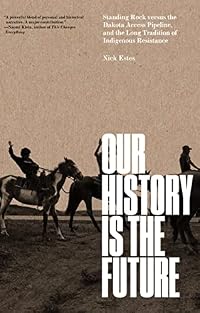
Our History Is the Future: Standing Rock Versus the Dakota Access Pipeline, and the Long Tradition of Indigenous Resistance
by Nick Estes
On This Page
Description
How two centuries of Indigenous resistance created the movement proclaiming "Water is life" In 2016, a small protest encampment at the Standing Rock Reservation in North Dakota, initially established to block construction of the Dakota Access oil pipeline, grew to be the largest Indigenous protest movement in the twenty-first century. Water Protectors knew this battle for native sovereignty had already been fought many times before, and that, even after the encampment was gone, their show more anticolonial struggle would continue. In Our History Is the Future, Nick Estes traces traditions of Indigenous resistance that led to the #NoDAPL movement. Our History Is the Future is at once a work of history, a manifesto, and an intergenerational story of resistance. show lessTags
Recommendations




Member Reviews
In Our History is the Future, Nick Estes, member of the Lower Brule Sioux tribe, journalist and professor of history at the University of Minnesota connects the 2016 Standing Rock NoDAPLE struggle against the Dakota pipeline with the longer history of Indigenous struggles against colonialism. In doing so, he shows clearly that Indigenous struggles are and always have been a battle between very different views of our relationship to the earth, to the land and water, and the importance of and need to protect them if we are to survive. He discusses many different actions, strategies, whether direct or through the courts, as well as solidarity and work with other movements including BLM as well as internationally.
Our History is the Future show more is a well-written, well-researched, and informative book. But Estes’ passion for and deep understanding of the urgency of the subject shines through. An important book and one that anyone concerned about issues like climate change and/or the effects of colonialism should read.
Thanks to Edelweiss+ and Haymarkey Books for the opportunity to read this book in exchange for an honest review show less
Our History is the Future show more is a well-written, well-researched, and informative book. But Estes’ passion for and deep understanding of the urgency of the subject shines through. An important book and one that anyone concerned about issues like climate change and/or the effects of colonialism should read.
Thanks to Edelweiss+ and Haymarkey Books for the opportunity to read this book in exchange for an honest review show less
Our History is the Future: Standing Rock Versus the Dakota Access Pipeline, and the Long Tradition of Indigenous Resistance by Nick Estes is a well-written, engaging but stark reminder that denying or ignoring history doesn't change what actually happened. Estes examines many of the ways the United States has whitewashed history in terms of its treatment of Indigenous peoples ever since Europeans discovered the North and South American continents. Estes offers a glimpse into the lives of the Indigenous people and how they resisted colonization and their own erasure. Our History is the Future investigates the various treaties with the Indigenous tribes broken by the United States government over centuries. Estes ties together struggles show more by Indigenous peoples around the world. In one particular example, Estes demonstrates how Palestinians and the Indigenous Peoples in the United States have supported each other as they have faced similar challenges. Explaining the #NoDAPL movement in context of the greater resistance to having land stolen, culture erased, and starvation provides a deeper understanding of the moment as part of a greater movement. Highlighting coalitions and efforts to work together also shines a light on the misinterpretation of the settlers to Indigenous processes of decision making and tribal relations. Our History is the Future is a hopeful look at the resistance of Indigenous peoples told through the lens of the Indigenous peoples of the United States that challenges us to see all of history so we can actually learn from it to create a better future. show less
A fascinating, well-written history of resistance particularly of Lakota, Dakota, and Nakota people and those who share land claims with them, though the book also stretches outside of those nations as those peoples interact with other nations. Estes does a great job of challenging the historiography where it fails, and keeping the history coming from within community where possible (and it's way more possible than most histories have acknowledged.)
I'm like very behind the times, but the chapter on indigenous internationalisms had me like shaking the book and demanding more. I'm really looking forward to digging into those citations, but I think it's a totally accessible intro to that and I really think could be super effective in a show more classroom. I certainly wish I had access to it sooner! That tipped it over for me, though I recommend the whole book regardless, for its specificity and accessibility. show less
I'm like very behind the times, but the chapter on indigenous internationalisms had me like shaking the book and demanding more. I'm really looking forward to digging into those citations, but I think it's a totally accessible intro to that and I really think could be super effective in a show more classroom. I certainly wish I had access to it sooner! That tipped it over for me, though I recommend the whole book regardless, for its specificity and accessibility. show less
My brief IG review: https://www.instagram.com/p/ByNi0r7AGeq/
***who sucked me in***
Brain of Bookish on YouTube.
Brain of Bookish on YouTube.
«Eskerrak Emateko Eguna: horra hor kolonoen nazioak bere buruari kontatzen dion sorrera-istorio arketipikoa. Istorio horren arabera, natiboek eta kolonoek, indioilarra eta batata erreak janez, ‘bakea’ erdietsi zuten Massachusetts estatuko Plymouth hirian, non, 1620an, kolonia bat ezarri baitzuten Mayflower itsasontzian iritsi ziren erromesek. 1637an, ostera, pekuota herriko 700 bat lagunen sarraski zentzugabea burutzeko, zera esan zuen Massachusetts Badiako Koloniako gobernari William Bradford-ek: Eskerrak Emateko Eguna ospatu beharra zela ‘garaipen odoltsuaren omenez, eta Jainkoari eskerrak emanez borrokan gailentzeagatik’. Bakea, lapurtutako lurretan, genozidioz blai dago».
Jan 7, 2021Spanish
Ratings
Members
- Recently Added By
Lists

Indigenous America Reader
145 works; 12 members

Book Riot Read Harder 2026
80 works; 1 member

Books cited in Progress by Samuel McDonald
160 works; 1 member
Author Information

4+ Works 523 Members
Awards and Honors
Awards
Distinctions
Notable Lists
Common Knowledge
- Canonical title*
- Gure historia da etorkizuna : Standing Rock vs Dakota Access oliobidea, eta indigenen erresistentziaren tradizio luzea
- Original title
- Our history is the future : Standing Rock versus the Dakota Access Pipeline, and the long tradition of indigenous resistance
- Original publication date
- 2019
- Important places
- USA
- Important events
- Dakota Access Pipeline protests
- Original language
- English
*Some information comes from Common Knowledge in other languages. Click "Edit" for more information.
Classifications
- Genres
- History, Nonfiction, General Nonfiction, Science & Nature, Politics and Government
- DDC/MDS
- 978.004 — History & geography History of North America Western United States Ethnic And National Groups
- LCC
- E99 .D1 .E87 — History of the United States America Indians of North America Indian tribes and cultures
- BISAC
Statistics
- Members
- 399
- Popularity
- 77,584
- Reviews
- 6
- Rating
- (4.22)
- Languages
- Basque, English
- Media
- Paper, Audiobook, Ebook
- ISBNs
- 11
- ASINs
- 4