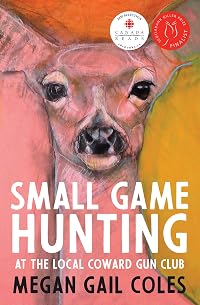
Small Game Hunting at the Local Coward Gun Club
by Megan Gail Coles
On This Page
Description
"February in Newfoundland is the longest month of the year. Another blizzard is threatening to tear a strip off downtown St. John's, while inside The Hazel restaurant a storm of sex, betrayal, addiction, and hurt is breaking. Iris, a young hostess from 'round the bay, is forced to pull a double despite resolving to avoid the charming chef and his wealthy restaurateur wife. Just tables over, Damian, a hungover and self-loathing server, is trying to navigate a potential punch-up with a pair of show more lit customers who remain oblivious to the rising temperature in the dining room. Olive, a young Indigenous woman far from home, watches it all unfurl from the fast and frozen street. It is through Olive, largely unnoticed by the others, that we glimpse the truth behind the scathing lies and unrelenting abuse, and it is her resilience that proves most enduring in the dead of this winter's tale. By turns biting, funny, poetic, and heartbreaking, Megan Coles' debut novel rips into the inner lives of a wicked cast of characters, building towards a climax that will shred perceptions and force a reckoning. This is blistering Newfoundland Gothic for the twenty-first century, a wholly original, bracing, and timely portrait of a place in the throes of enormous change, where two women confront the traumas of their past in an attempt to overcome the present and pick up the future."-- show lessTags
Recommendations


























Member Reviews
The worst and longest Valentine's Day ever takes place in St. John's, Newfoundland, and in this incredible novel. Olive and Iris are two half Indigenous women from the poverty-stricken interior of the province who come to the city for better lives and meet with disaster via their connection to a self-centered foodie chef, his wealthy wife, and to violent and cowardly men from their hometown. Although told from many points of view, the center is Iris and her boss John's destructive affair, which brings out the worst in them, and as the evening winds up in a ferocious blizzard, all the lives that touch theirs, even those trying to prevent disaster, are on the verge of complete ruin. There is no way to abandon ship until you learn all show more there is to know about their pasts and futures. Winner of many literary awards in Canada, it is compelling and significant.
Quotes: "What doesn't kill her now will kill her later."
"Iris is nightly running internal damage-control analysis. She lies awake mapping out ways to stop lying awake."
"He doesn't mind gay people now, he just wishes they didn't all look so fit."
"There is nothing so tragic as a woman aware a man is filling her full of toxins while remaining powerless to stop it. It is a grotesque poisoning."
"Honesty would get everyone out of some lot of scrapes."
"There are nice couples in St. John's. There are men and women who love each other in Newfoundland. There is warmth and happiness, in the clear and understood. Some people still make love around here." show less
Quotes: "What doesn't kill her now will kill her later."
"Iris is nightly running internal damage-control analysis. She lies awake mapping out ways to stop lying awake."
"He doesn't mind gay people now, he just wishes they didn't all look so fit."
"There is nothing so tragic as a woman aware a man is filling her full of toxins while remaining powerless to stop it. It is a grotesque poisoning."
"Honesty would get everyone out of some lot of scrapes."
"There are nice couples in St. John's. There are men and women who love each other in Newfoundland. There is warmth and happiness, in the clear and understood. Some people still make love around here." show less
The main action of Megan Gail Coles’ debut novel takes place in St. John’s, NFLD, on a single day—February 14, Valentine’s Day—as a blizzard threatens the city. The setting is a fashionable downtown restaurant called the Hazel, which caters to a varied clientele: politicians, snobbish business types, couples willing to splurge on a special-occasion dinner. The characters are restaurant staff and patrons, their relatives, friends and acquaintances. The setting may seem commonplace, even familiar, and the characters—rich, poor and in between—ordinary, but there is nothing ordinary about Small Game Hunting at the Local Coward Gun Club or the anguished tale it tells. The multi-faceted story revolves around a love triangle. show more Georgina (George) is owner of the Hazel, her husband John the talented and charmingly manipulative chef, and Iris the browbeaten, emotionally vulnerable hostess. Iris and John are lovers. Other major characters are Damien, a server (who also works the front desk of a nearby hotel), who is nursing a hangover, and who witnesses things but because of his subservient position is nearly invisible. And Olive, a young woman, a friend of Iris, who has been subject to a harrowing act of sexual violence and as a result has withdrawn from those, like Iris, who care for her, and who observes what occurs from her position as an outsider. The affair between John and Iris drives much of the action, but by the time we meet these people, the web of lies and deceit has spread its pernicious influence so far and wide that everyone is caught up in it to varying degrees. Coles narrates her novel from multiple perspectives, allowing each character space to provide their own backstory and describe his or her own version of events leading up to a somewhat chaotic and near-tragic denouement. To say that Small Game Hunting at the Local Coward Gun Club is not an easy read is a laughable understatement. In each section, the reader is submerged within a single character’s consciousness, seeing the city, the surroundings, other people, and feeling the confusion and pain of being alive, from that person’s perspective. Playing a lead role in the sordid goings on is the power dynamic between men and women. John’s is the most prominent male perspective in the novel, and it is a simple one: concerned with little else besides satisfying his own appetites, justifying his actions to himself, and keeping his affairs secret. John is an archetypal villian of the Me Too era. Charismatic and calculating, he uses a position of authority, physical allure, and the magnetism of his personality to exploit women and get what he wants from them. Because of his narcissism he is unable to see his cruelty toward Iris for what it is because he has either convinced himself, or actually believes, that he is bestowing upon her a precious gift: the opportunity to give him pleasure. He is oblivious to the damage he causes and the suffering he leaves in his wake. Make no mistake, this is a powerful novel: uninhibited and uncompromising. It is without a doubt the product of a fierce and probing intelligence. Its morality is righteous and the truths it reveals unambiguous and unflattering to a society that protects the privileged and throws the vulnerable under the bus. It is dazzling in its complexity and formidable in its craft. What’s more, the story that Coles has fashioned is emotionally authentic and often heart-rending. The pain depicted in these pages is real. We feel it in our gut. However, the book is also dense and relentless; its tone of moral outrage hardly varies throughout. In the end, it presents a daunting challenge to the reader. The only way to experience what this book has to offer is total immersion: dive in and resist every temptation to come up for air until the last page. show less
This is a difficult book to read because of its brutality -- people are mistreated and not valued because they are women, non-white, or gay. But it's worth it.
The author's ability to get into the hearts and minds of her characters, especially the two main female characters (Iris and Olive) is phenomenal. The story takes place in Newfoundland during a February snow storm. The sense of place, the flavour of local expressions and characters take you right into the setting, just as the exceptional character development makes you feel these are people you know well.
This is story-telling at it's best.
The author's ability to get into the hearts and minds of her characters, especially the two main female characters (Iris and Olive) is phenomenal. The story takes place in Newfoundland during a February snow storm. The sense of place, the flavour of local expressions and characters take you right into the setting, just as the exceptional character development makes you feel these are people you know well.
This is story-telling at it's best.
The Dedication of the book includes a warning: “This might hurt a little.” That is an understatement! By the time I reached the end of the book, I was emotionally exhausted. But to call this book, with its examination of wounded people and shattered lives, less than brilliant would also be an understatement.
The setting is St. John’s, Newfoundland, on Valentine’s Day; most events take place in an upscale restaurant called The Hazel. The first section, entitled “Prep”, introduces a number of characters: Iris, the hostess at the restaurant, wants to end the destructive affair she has been having with John, the married, predatory chef of the restaurant; Olive, Iris’ friend, is the product of a tragic past and the foster care show more system and has an equally tragic present; Georgina, John’s wife and the owner of the restaurant, craves power and prestige; Calv, an acquaintance of Olive, cannot escape a toxic friendship; and Damian, a server in the restaurant, is a self-loathing gay man. The pace of this first part is slow; the focus is on developing the backgrounds and emotional lives of these characters. Initially, keeping the characters straight is difficult but readers should persevere.
In the second part, entitled “Lunch”, relationships among characters are further clarified and the storylines of the various characters are brought together. Tension grows as more and more people arrive at The Hazel. Just as a winter storm develops outdoors, more than one confrontation is inevitable indoors. Indeed, the third and final section (“Dinner”) is the most intense and dramatic.
The lives of women receive special attention, Iris and Olive more than other characters. They have experienced poverty, violence, abandonment, and misogyny. Women are in fact the small game mentioned in the title, often the victims of physical, psychological, and sexual abuse. The author calls out the men who abuse and also those who do nothing to stop the abuse. She also rails against women who defend an offender: “He is loved because we love him and therefore he is good and not bad.” She attacks women who act as enablers by attacking women who choose to speak up against their abusers.
There is such depth to the characters that readers come to completely understand why someone does what he/she does. A character may make a bad decision, but the author reveals a character’s motivations and rationalizations in such detail that a reader cannot but accept that decision as logical given the circumstances and past experiences and emotional state of the character.
The writer has a distinctive style. The metaphors, for instance, are drawn from ordinary (often specifically Newfoundland) life. A man has the certainty of “a toothless bay grannie’s level of certainty, the kind that takes twenty years of card games in the church basement to curate.” John makes Iris “feel less concentrated than a tin of off-brand soup stock you only use up when you’ve cleaned the cupboards before holidays. Something to be eaten on moving day. The last bit of sustenance in the house.” A woman too depressed to eat properly speaks of every day in her life being a “storm chip day.”
Sometimes the writer veers away from narrative prose to the language of a rant. For instance, when outlining the arguments given in defense of predatory men, she rages against “the cliché trotted out the most because it’s the best/worst one of all, uttered at every girl before any training bra – ready, set, go: boys will be boys. But really, rightly, that statement should be disputed every time it is used to dismiss the very genuine and deserved complaint from girls just trying to survive as girls in spaces where even mothers are used against them. Mothers must stop competing with their daughters. Daughters do not make men mistreat them. It is not right or fair to punish daughters further out of envy. Keeping the dangerous path dangerous will not make them better women but hurt them still in the same sad ways.”
This book is not always an easy read. Some readers may be frustrated by some elements (e.g. the slow pace at the beginning; the large cast of characters, the unpunctuated dialogue in long conversations where speakers are not clearly identified). And because of its subject matter, the book is not a comfortable read. It is not for those who want just to be entertained. This book is for those willing to engage with a powerful piece of interpretive literature.
Note: Please check out my reader's blog (https://schatjesshelves.blogspot.com/) and follow me on Twitter (@DCYakabuski). show less
The setting is St. John’s, Newfoundland, on Valentine’s Day; most events take place in an upscale restaurant called The Hazel. The first section, entitled “Prep”, introduces a number of characters: Iris, the hostess at the restaurant, wants to end the destructive affair she has been having with John, the married, predatory chef of the restaurant; Olive, Iris’ friend, is the product of a tragic past and the foster care show more system and has an equally tragic present; Georgina, John’s wife and the owner of the restaurant, craves power and prestige; Calv, an acquaintance of Olive, cannot escape a toxic friendship; and Damian, a server in the restaurant, is a self-loathing gay man. The pace of this first part is slow; the focus is on developing the backgrounds and emotional lives of these characters. Initially, keeping the characters straight is difficult but readers should persevere.
In the second part, entitled “Lunch”, relationships among characters are further clarified and the storylines of the various characters are brought together. Tension grows as more and more people arrive at The Hazel. Just as a winter storm develops outdoors, more than one confrontation is inevitable indoors. Indeed, the third and final section (“Dinner”) is the most intense and dramatic.
The lives of women receive special attention, Iris and Olive more than other characters. They have experienced poverty, violence, abandonment, and misogyny. Women are in fact the small game mentioned in the title, often the victims of physical, psychological, and sexual abuse. The author calls out the men who abuse and also those who do nothing to stop the abuse. She also rails against women who defend an offender: “He is loved because we love him and therefore he is good and not bad.” She attacks women who act as enablers by attacking women who choose to speak up against their abusers.
There is such depth to the characters that readers come to completely understand why someone does what he/she does. A character may make a bad decision, but the author reveals a character’s motivations and rationalizations in such detail that a reader cannot but accept that decision as logical given the circumstances and past experiences and emotional state of the character.
The writer has a distinctive style. The metaphors, for instance, are drawn from ordinary (often specifically Newfoundland) life. A man has the certainty of “a toothless bay grannie’s level of certainty, the kind that takes twenty years of card games in the church basement to curate.” John makes Iris “feel less concentrated than a tin of off-brand soup stock you only use up when you’ve cleaned the cupboards before holidays. Something to be eaten on moving day. The last bit of sustenance in the house.” A woman too depressed to eat properly speaks of every day in her life being a “storm chip day.”
Sometimes the writer veers away from narrative prose to the language of a rant. For instance, when outlining the arguments given in defense of predatory men, she rages against “the cliché trotted out the most because it’s the best/worst one of all, uttered at every girl before any training bra – ready, set, go: boys will be boys. But really, rightly, that statement should be disputed every time it is used to dismiss the very genuine and deserved complaint from girls just trying to survive as girls in spaces where even mothers are used against them. Mothers must stop competing with their daughters. Daughters do not make men mistreat them. It is not right or fair to punish daughters further out of envy. Keeping the dangerous path dangerous will not make them better women but hurt them still in the same sad ways.”
This book is not always an easy read. Some readers may be frustrated by some elements (e.g. the slow pace at the beginning; the large cast of characters, the unpunctuated dialogue in long conversations where speakers are not clearly identified). And because of its subject matter, the book is not a comfortable read. It is not for those who want just to be entertained. This book is for those willing to engage with a powerful piece of interpretive literature.
Note: Please check out my reader's blog (https://schatjesshelves.blogspot.com/) and follow me on Twitter (@DCYakabuski). show less
**Canada Reads 2020 #1**
A devastating, character-driven story that spends a lot of pages trying to get deep into the mind of a handful of very misogynistic characters. I can't speak to the verisimilitude there, for obvious reasons, but I can say the passages from the minds and perspectives of the women in their lives felt deeply true.
Some passages were absolutely heartbreaking, to the point of physical nausea.
This novel is, in large part, a #metoo novel (as the author states in the acknowledgements); she spends a lot more time on misogyny than on racism, for example, though racism is definitely present and acknowledged. But more than that, it felt like an exploration of whose lives were worthwhile, and whose lives could be entirely show more sacrificed for the comfort and happiness of others. In that way, the ending made perfect sense, thought it was heartbreaking. show less
A devastating, character-driven story that spends a lot of pages trying to get deep into the mind of a handful of very misogynistic characters. I can't speak to the verisimilitude there, for obvious reasons, but I can say the passages from the minds and perspectives of the women in their lives felt deeply true.
Some passages were absolutely heartbreaking, to the point of physical nausea.
This novel is, in large part, a #metoo novel (as the author states in the acknowledgements); she spends a lot more time on misogyny than on racism, for example, though racism is definitely present and acknowledged. But more than that, it felt like an exploration of whose lives were worthwhile, and whose lives could be entirely show more sacrificed for the comfort and happiness of others. In that way, the ending made perfect sense, thought it was heartbreaking. show less
This was a really hard book to read. I persevered though and I'm glad I did. In fact, I am rooting for this book to win the 2020 Canada Reads contest and I haven't even read three of the books. I just can't imagine a book that has more relevance than this one which addresses the issue of violence against women.
It's the middle of February (in fact Valentine's Day) in St. John's, the capital of the province of Newfoundland and Labrador. As usual the weather is frightful with lots of snow already on the ground and a blizzard brewing. Yet, the restaurant known as The Hazel is planning to open for lunch and dinner and all staff are required. Iris, the hostess, was scheduled to have the day off but when she comes in to pick up her paycheque show more she has to get it from her boss/lover, John, who abandoned her late the previous night to pick up his wife, George, at the airport. John plays with her emotions some more and then has sex with Iris which has to end abruptly when his wife enters the restaurant. John was warned just in time by Olive who hangs around the restaurant bumming smokes and food and who happens to be Iris's neighbour. George, daughter of a local tycoon, controls the financing for the restaurant but she does not know (as all the staff know) that John and Iris are having an affair. George insists that Iris work a double this day and is happy to stick around herself causing maximum stress to all concerned. Iris knows that John is not good for her but she finds it impossible to break off their relationship. Meanwhile Olive is still recovering from the trauma of being gang-raped just before Christmas but her methods of coping consist of drinking and/or drugging to excess which of course doesn't result in any recovery. She did not report the rape nor did Damian, a waiter at the restaurant but who was the night clerk at the hotel where the rape took place.
It is the greatest of ironies that all these emotionally damaged people are supposed to be facilitating a romantic setting for other couples. The storm raging outside will eventually wear itself out but the emotional storm will endure. I felt the most empathy for Olive who has had a lifetime of tough breaks but Iris and even George deserve much better than they have been given. I was impatient with Iris in the beginning because she kept allowing John to dictate the terms of their relationship. She even lost her best friend as a result because the friend could see so clearly how awful John was but Iris just wouldn't listen to her. She even had Iris do a quiz about sociopaths which showed John fit the profile but Iris continued to deny the evidence. There are thousands of toxic relationships like this going on every day in this country. That's why I think this book should be read widely. show less
It's the middle of February (in fact Valentine's Day) in St. John's, the capital of the province of Newfoundland and Labrador. As usual the weather is frightful with lots of snow already on the ground and a blizzard brewing. Yet, the restaurant known as The Hazel is planning to open for lunch and dinner and all staff are required. Iris, the hostess, was scheduled to have the day off but when she comes in to pick up her paycheque show more she has to get it from her boss/lover, John, who abandoned her late the previous night to pick up his wife, George, at the airport. John plays with her emotions some more and then has sex with Iris which has to end abruptly when his wife enters the restaurant. John was warned just in time by Olive who hangs around the restaurant bumming smokes and food and who happens to be Iris's neighbour. George, daughter of a local tycoon, controls the financing for the restaurant but she does not know (as all the staff know) that John and Iris are having an affair. George insists that Iris work a double this day and is happy to stick around herself causing maximum stress to all concerned. Iris knows that John is not good for her but she finds it impossible to break off their relationship. Meanwhile Olive is still recovering from the trauma of being gang-raped just before Christmas but her methods of coping consist of drinking and/or drugging to excess which of course doesn't result in any recovery. She did not report the rape nor did Damian, a waiter at the restaurant but who was the night clerk at the hotel where the rape took place.
It is the greatest of ironies that all these emotionally damaged people are supposed to be facilitating a romantic setting for other couples. The storm raging outside will eventually wear itself out but the emotional storm will endure. I felt the most empathy for Olive who has had a lifetime of tough breaks but Iris and even George deserve much better than they have been given. I was impatient with Iris in the beginning because she kept allowing John to dictate the terms of their relationship. She even lost her best friend as a result because the friend could see so clearly how awful John was but Iris just wouldn't listen to her. She even had Iris do a quiz about sociopaths which showed John fit the profile but Iris continued to deny the evidence. There are thousands of toxic relationships like this going on every day in this country. That's why I think this book should be read widely. show less
Members
- Recently Added By
Lists

Top Five Books of 2020
982 works; 348 members

Canada Reads Winners and Nominees
129 works; 9 members
Author Information

3 Works 223 Members
Some Editions
Awards and Honors
Common Knowledge
- Canonical title
- Small Game Hunting at the Local Coward Gun Club
- People/Characters
- Iris; Olive Noseworthy; Calv; Roger; Damian; George (show all 7); John Fisher
- Important places
- St. John's, Newfoundland, Canada
- Epigraph
- This might hurt a little. Be brave.
- Dedication
- I wrote this for myself. And the beautiful vicious island that makes and unmakes us.
- First words
- Olive waits below the sad mural painted in memory of some long ago drowned boy.
- Quotations
- No one says it is okay to feel hurt. No one says anything. Everyone just goes on living. We all go on living until we lose more of each other. And then we are made lesser.
- Last words
- (Click to show. Warning: May contain spoilers.)Olive stays.
- Blurbers
- De Mariaffi, Elisabeth; Hynes, Joel Thomas; Elliott, Alicia
Classifications
Statistics
- Members
- 204
- Popularity
- 160,357
- Reviews
- 7
- Rating
- (3.47)
- Languages
- English, French
- Media
- Paper, Audiobook, Ebook
- ISBNs
- 4
- ASINs
- 1