On This Page
Description
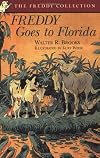
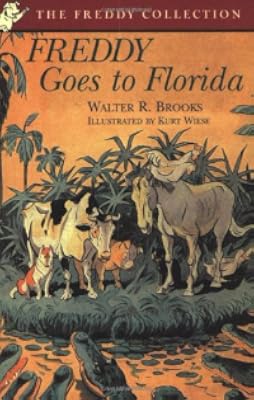
First published between 1927 and 1958, the 26 classic books about Freddy the Pig have delighted five generations of children and are now going on to delight a sixth. Walter R. Brooks introduced Freddy the Pig in Freddy Goes to Florida. Freddy and his friends from Bean Farm migrate south for the winter, with every mile of the way a terrific adventure complete with bumbling robbers and a nasty bunch of alligators. This is vintage Freddy and the whole ensemble cast at their charming best.Tags
Recommendations








Member Reviews
A group of farm animals decide to go south for the winter. I prefer the original title 'To and Again' as Freddy the pig is probably the most underused of any of the animals in this.
It took me a while to get into. It didn't feel much like a kids story, i kept having flashbacks to 'Animal Farm' which didn't help ;) .
One of the problems is that there arn't really any child characters. All of the animals except for the pig have the personalities of grownups which is why it felt a bit too grounded and the humour seemed aimed a bit older. Thats probably why the pig ends up as the centerpiece of the franchise as he's the only possible child-avatar available.
For a while things plodded along and i wondered how the author would reconcile the show more human world with these hyper-intelligent animals. Things came to a head in Washington DC in what seemed like pure satire but the author was now stuck with that strange turn of events and the book was the better for it.
Not much time is actually spent in florida and while my knowledge of the U.S.A isn't great i suspect there are some geographical errors here :) .
I also have to say that a couple of events towards the end would definitely have proven fatal (and smoke doesn't wake people up!) so if reading to a child make sure to point out how homicidal these animals are :P .
Overall a bit drab but there were wacky incidents that improved it as it went along. show less
It took me a while to get into. It didn't feel much like a kids story, i kept having flashbacks to 'Animal Farm' which didn't help ;) .
One of the problems is that there arn't really any child characters. All of the animals except for the pig have the personalities of grownups which is why it felt a bit too grounded and the humour seemed aimed a bit older. Thats probably why the pig ends up as the centerpiece of the franchise as he's the only possible child-avatar available.
For a while things plodded along and i wondered how the author would reconcile the show more human world with these hyper-intelligent animals. Things came to a head in Washington DC in what seemed like pure satire but the author was now stuck with that strange turn of events and the book was the better for it.
Not much time is actually spent in florida and while my knowledge of the U.S.A isn't great i suspect there are some geographical errors here :) .
I also have to say that a couple of events towards the end would definitely have proven fatal (and smoke doesn't wake people up!) so if reading to a child make sure to point out how homicidal these animals are :P .
Overall a bit drab but there were wacky incidents that improved it as it went along. show less
This was a more entertaining book than similar titles from the era it was written. It even had a few jokes for the grownups.
Finally I get a chance to read the first. The second was the only avl. to me when I was a child but I've been reading them all as I get a chance. There was much development after the first, both of the characters and the world-building. Freddy is just another character in this, and the ducks' uncle is not present, for two examples.
Still, it's a funny and exciting 'rollicking' adventure and well worth reading.
Some bits are a tiny bit dated (after all, this is almost a century old). In particular, Brooks describes "swallows" when he really means chimney swifts. And he describes them as hanging from hooks on their wings to perch, which is just plain not true. So do read with a bit of care, and forgive trivial lapses like that. When show more something doesn't seem right, google it: you might learn something new! show less
Still, it's a funny and exciting 'rollicking' adventure and well worth reading.
Some bits are a tiny bit dated (after all, this is almost a century old). In particular, Brooks describes "swallows" when he really means chimney swifts. And he describes them as hanging from hooks on their wings to perch, which is just plain not true. So do read with a bit of care, and forgive trivial lapses like that. When show more something doesn't seem right, google it: you might learn something new! show less
Walter R. Brooks introduced Freddy the Pig in Freddy Goes to Florida. Freddy and his friends from Bean Farm migrate south for the winter, with every mile of the way a terrific adventure complete with bumbling robbers and a nasty bunch of alligato
An assortment of farm animals on Mr. Bean's farm decide to migrate to Florida for the winter. The episodic chapters tell of their adventures on the way, while there, and on the way back. The animals are mostly perfect models of courtesy, honesty, respect and kindness. While most of those they meet on their journey are decent sorts as well, they do run into a few ne'er-do-wells.
This first book in the 26-volume Freddy the Pig series doesn't feature Freddy any more prominently than the other animals.
Old fashioned in some ways, but timeless in others. Elementary age kids would love to have it read to them, or to read it themselves. (And this adult enjoyed reading himself as well.)
This first book in the 26-volume Freddy the Pig series doesn't feature Freddy any more prominently than the other animals.
Old fashioned in some ways, but timeless in others. Elementary age kids would love to have it read to them, or to read it themselves. (And this adult enjoyed reading himself as well.)
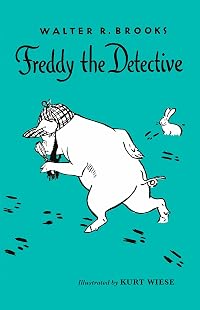
Freddy Goes to Florida by Walter R Brooks (born January 9, 1886, died August 17, 1958) is the first of the Freddy the Pig books. It was originally published as To and Again (like a precursor to The Hobbit, aka There and Back Again, but with barn animals). After the success of the third book, Freddy the Detective, the first two books were re-named to have Freddy in the title.
Freddy is a pig who lives with a variety of other barn animals on Mr. Bean's farm (no, not that Mr. Bean). The dynamics between Freddy and the other animals reminds me of Babe (the movie, not the book by Dick King-Smith). Frankly it wouldn't surprise me one bit if the makers of Babe took some inspiration from the Freddy books to fill out the ensemble cast.
Freddy show more while talking to a barn swallow decides he's had enough of winter on the farm. Migrating to Florida sounds like a grand idea. When he decides to walk to the Sunshine state, the other animals on the farm (including a pair of spiders) decide to follow along. The book chronicles their trip down and back, including some episodic adventures on the way.
Freddy and his friends are completely ignorant on what it will take to get to Florida or what to expect along the way. The fun, though, is in the journey itself. They see new things, meet new people and animals, don disguises, duel with alligators, thwart robbers and save the day.
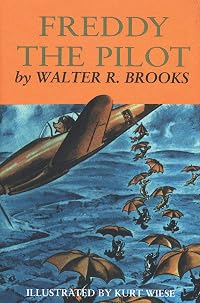
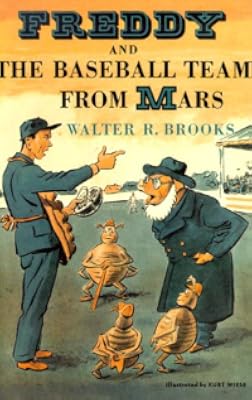
To go with the silly text, are equally delightful pen and ink illustrations by Kurt Wiese. show less
Freddy is a pig who lives with a variety of other barn animals on Mr. Bean's farm (no, not that Mr. Bean). The dynamics between Freddy and the other animals reminds me of Babe (the movie, not the book by Dick King-Smith). Frankly it wouldn't surprise me one bit if the makers of Babe took some inspiration from the Freddy books to fill out the ensemble cast.
Freddy show more while talking to a barn swallow decides he's had enough of winter on the farm. Migrating to Florida sounds like a grand idea. When he decides to walk to the Sunshine state, the other animals on the farm (including a pair of spiders) decide to follow along. The book chronicles their trip down and back, including some episodic adventures on the way.
Freddy and his friends are completely ignorant on what it will take to get to Florida or what to expect along the way. The fun, though, is in the journey itself. They see new things, meet new people and animals, don disguises, duel with alligators, thwart robbers and save the day.
To go with the silly text, are equally delightful pen and ink illustrations by Kurt Wiese. show less
A sweet children's book about a group of farm animals who decide to migrate to Florida for the winter. First published in 1927, the animals' adventures are delightfully innocent by contemporary standards. The bad people are rough-looking men, most people are kind to the animals (at times the tale reminds one of 1941's Make Way for Ducklings), there are few cars, and one subplot requires a phaeton. A number of passages reminded me of The Hobbit, particularly because Freddy the Pig makes up little songs about the group's adventures. In addition, a fight among some robbers evokes the fight between Tolkien's trolls. A fast read for an adult, and probably fun to read aloud with a child.
Members
- Recently Added By
Lists

Favorite Childhood Books
1,651 works; 519 members

Childhood Favorites
427 works; 24 members

Best Children's Books You've Read
197 works; 74 members

4th Grade Books
312 works; 5 members

Favourite Books
1,820 works; 308 members

the dog was the hero
31 works; 5 members
Put a Bird On It
75 works; 12 members
Children's Literature 1900 - 1950 in order
413 works; 8 members
Author Information

64+ Works 4,812 Members
Walter R. Brooks was born on January 9, 1886 in Rome, New York. He attended the Mohegan Lake Military Academy from 1902 to 1904 and the University of Rochester from 1904 to 1906. In 1906 he went to New York City to study homeopathic medicine at the Homeopathic Medical College and Flower Hospital. He dropped out of medical school at the end of show more 1908. He found employment with an advertising agency, and then temporarily retired in 1911 after receiving a considerable inheritance. In 1917, he went to work for the American Red Cross and later did editorial work for several magazines, including The New Yorker. In 1915, his first work, a sonnet titled Haunted, was published in the Century magazine. He is best remembered for his short stories and children's books. His first short story for adults, Harden's Chance, appeared in the Forum magazine for December 1915. Altogether he published more than 180 stories. His short story, Ed Signs the Pledge, about a talking horse was the basis for the 1960s television comedy series Mister Ed. He published one novel for adults, Ernestine Takes Over and a guidebook, New York: An Intimate Guide. The first Freddy the Pig book, To and Again, was published in 1927. He wrote 25 more books wrote about Freddy the Pig and his friends. He died on August 17, 1958. (Bowker Author Biography) show less
Some Editions
Series

Work Relationships
Is contained in
Common Knowledge
- Original title
- To and Again
- Original publication date
- 1927
- People/Characters
- Freddy (Pig); Jinx (Cat); Mrs. Wiggins (Cow); Mr. Bean (New York State Farmer); Mr. Webb (Spider); Mrs. Webb (Spider) (show all 8); Emma (Duck); Charles (Rooster)
- Important places
- Centerboro, New York, USA; Florida, USA
Classifications
- Genres
- Children's Books, Fiction and Literature, Kids
- DDC/MDS
- 813.54 — Literature & rhetoric American literature in English American fiction in English 1900-1999 1945-1999
- LCC
- PZ7 .B7994 .F — Language and Literature Fiction and juvenile belles lettres Fiction and juvenile belles lettres Juvenile belles lettres
- BISAC
Statistics
- Members
- 495
- Popularity
- 61,285
- Reviews
- 13
- Rating
- (3.92)
- Languages
- English
- Media
- Paper, Audiobook, Ebook
- ISBNs
- 23
- ASINs
- 13