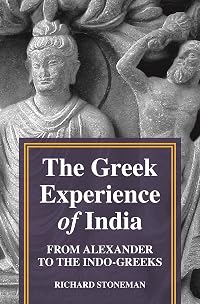
The Greek Experience of India: From Alexander to the Indo-Greeks
by Richard Stoneman
48 Members (3.50)
On This Page
Description
An exploration of how the Greeks reacted to and interacted with India from the third to first centuries BCE0When the Greeks and Macedonians in Alexander's army reached India in 326 BCE, they entered a new and strange world. They knew a few legends and travelers' tales, but their categories of thought were inadequate to encompass what they witnessed. The plants were unrecognizable, their properties unknown. The customs of the people were various and puzzling. While Alexander's conquest was show more brief, ending with his death in 323 BCE, the Greeks would settle in the Indian region for the next two centuries, forging an era of productive interactions between the two cultures. The Greek Experience of India explores the various ways that the Greeks reacted to and constructed life in India during this fruitful period. From observations about botany and mythology to social customs, Richard Stoneman examines the surviving evidence of those who traveled to India. Most particularly, he offers a full and valuable look at Megasthenes, ambassador of the Seleucid king Seleucus to Chandragupta Maurya, and provides a detailed discussion of Megasthenes's now-fragmentary book Indica. Stoneman considers the art, literature, and philosophy of the Indo-Greek kingdom and how cultural influences crossed in both directions, with the Greeks introducing their writing, coinage, and sculptural and architectural forms, while Greek craftsmen learned to work with new materials such as ivory and stucco and to probe the ideas of Buddhists and other ascetics. show lessTags
Recommendations












Member Reviews
Members
- Recently Added By
Published Reviews
This book represents a continuation and an extension of Stoneman’s previous researches into the Greek experience of India. It aims to recover the observations of Alexander’s studious companions and ‘to test them against what we can know from an Indian point of view, as well as to identify the patterns in the curtains that prevented them too from seeing India clearly’ (7). It is also show more about ‘the encounter of two incommensurable civilizations that came face to face for two pregnant centuries’ (2). These two centuries are between Alexander’s Indian campaign and Menander’s death. The chronological span under consideration, therefore, is limited to the period 326 – ca. 135 BC, but for the purposes of his study Stoneman often goes beyond those dates. Geographically, the focus is on the area of Northern India (between the Indus and Ganges) and largely ignores the rest of the subcontinent and Taprobane. show less
added by cinaedus
Lists

Kindle Non-Fiction
221 works; 1 member
Author Information

29+ Works 738 Members
Richard Stoneman is an honorary visiting professor in the Department of Classics and Ancient History at the University of Exeter. His many books include Alexander the Great: A Life in Legend and Xerxes: A Persian Life.
Classifications
Statistics
- Members
- 48
- Popularity
- 625,244
- Rating
- (3.50)
- Languages
- English
- Media
- Paper, Ebook
- ISBNs
- 3
- ASINs
- 1