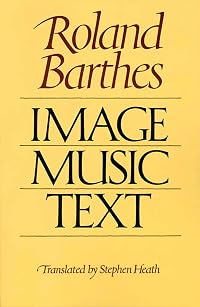
Image, Music, Text
by Roland Barthes
On This Page
Description
The photographic message.-- Rhetoric of the image.-- The third meaning.-- Diderot, Brecht, Eisenstein.-- Introduction to the structural analysis of narratives.-- The struggle with the angel.-- The death of the author.-- Musica practica.-- From work to text -- Change the object itself -- Lesson in writing -- The grain of the voice -- Writers, intellectuals, teachers.Tags
Recommendations





Member Reviews
A provocative and exhilarating collection of essays, at once offering insights into structuralist semiotics and rushing in a paradoxical call for alternative ways of assessing signs, of displacing meaning. A gateway into the experimental potential of the essay, and "non-fiction" in general. Enjoyed the way in which Barthes constantly refutes and contradicts himself, sometimes in the same essay, to dilute the mythical authority of the intellectual figure and to reinforce in the reader a critical sensitivity. Definitely a challenging read, even more so with the references to Marxism and especially (mainly Lacanian) psychoanalysis. Really want to say that this is a life-changing book, as that is how I feel right now. I guess we'll see.
contains the excellent Writers, Intellectuals, Teachers and the seminal Death of the Author and, as such, is worth reading for those reasons alone. Structural Analysis of Narratives was a bit technical for me not coming from an academic-linguistic background. Walked away from it with the same feeling I get from most of Barthes's writing: a compendium of great ideas, none developed to any satisfactory level of depth. I often get the sense Barthes intended these essays to be provocations and preliminary writing than self-contained or holistic theories.
A collection of short essays on the use of word and image together. Some really strong ones, some that lag a little, but typically brilliant observations by Barthes.
very good for reading about literature theories
Likewise, for visual culture students (or anyone else interested in postmodern theory for that matter), 'The Death of the Author' (pp.142-148) is pretty important too.
6861350
374521360
Members
- Recently Added By
Lists

Art of Reading
188 works; 5 members

culture
320 works; 1 member
Author Information

191+ Works 22,339 Members
Roland Barthes (1915-1980), a French critic and intellectual, was a seminal figure in late twentieth-century literary criticism. Barthes's primary theory is that language is not simply words, but a series of indicators of a given society's assumptions. He derived his critical method from structuralism, which studies the rules behind language, and show more semiotics, which analyzes culture through signs and holds that meaning results from social conventions. Barthes believed that such techniques permit the reader to participate in the work of art under study, rather than merely react to it. Barthes's first books, Writing Degree Zero (1953), and Mythologies (1957), introduced his ideas to a European audience. During the 1960s his work began to appear in the United States in translation and became a strong influence on a generation of American literary critics and theorists. Other important works by Barthes are Elements of Semiology (1968), Critical Essays (1972), The Pleasure of the Text (1973), and The Empire of Signs (1982). The Barthes Reader (1983), edited by Susan Sontag, contains a wide selection of the critic's work in English translation. (Bowker Author Biography) show less
All Editions
Common Knowledge
- Canonical title
- Image, Music, Text
- Original title
- Image-Music-Text
- Original publication date
- 1977
- Blurbers
- Sturrock, John
- Original language
- French
Classifications
Statistics
- Members
- 1,247
- Popularity
- 19,758
- Reviews
- 8
- Rating
- (3.88)
- Languages
- English, Greek
- Media
- Paper
- ISBNs
- 7
- ASINs
- 3