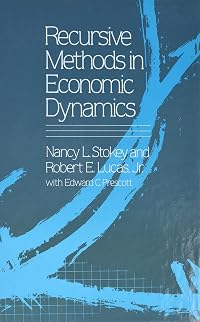
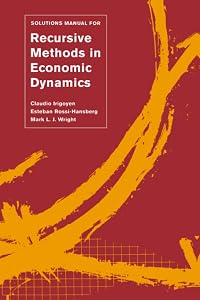
Recursive Methods in Economic Dynamics
by Nancy L. Stokey, Robert E. Lucas, Jr., Edward C. Prescott (Author)
On This Page
Description
Three eminent economists provide in this book a rigorous, self-contained treatment of modern economic dynamics. Nancy L. Stokey, Robert E. Lucas, Jr., and Edward C. Prescott develop the basic methods of recursive analysis and emphasize the many areas where they can usefully be applied.After presenting an overview of the recursive approach, the authors develop economic applications for deterministic dynamic programming and the stability theory of first-order difference equations. They then show more treat stochastic dynamic programming and the convergence theory of discrete-time Markov processes, illustrating each with additional economic applications. They also derive a strong law of large numbers for Markov processes. Finally, they present the two fundamental theorems of welfare economics and show how to apply the methods developed earlier to general equilibrium systems.The authors go on to apply their methods to many areas of economics. Models of firm and industry investment, household consumption behavior, long-run growth, capital accumulation, job search, job matching, inventory behavior, asset pricing, and money demand are among those they use to show how predictions can be made about individual and social behavior. Researchers and graduate students in many areas of economics, both theoretical and applied, will find this book essential. show lessTags
Recommendations





Member Reviews
Not that I've plowed through the whole thing - anything but - but it seems well carried out by three very capable researchers in Macro.
But there is something about this book that puzzles me: Whenever you mention this book among economists, people say, "Yup, that (i.e., the kind of recursive modelling treated in this book) is the way the field's moving." The only thing is, I don't actually see that. Have the people who say such things been reading the Macro journals lately?! I can't even remember the last time I saw a dynamic programming problem in a published paper! Now maybe this is just because my interests are learning and expectations, where we don't use these techniques. Where are people using this stuff? In growth theory? In show more simulations of DSGE models? Not at all? I'm just curious. If any economists read this and know the answer, drop me a line. show less
But there is something about this book that puzzles me: Whenever you mention this book among economists, people say, "Yup, that (i.e., the kind of recursive modelling treated in this book) is the way the field's moving." The only thing is, I don't actually see that. Have the people who say such things been reading the Macro journals lately?! I can't even remember the last time I saw a dynamic programming problem in a published paper! Now maybe this is just because my interests are learning and expectations, where we don't use these techniques. Where are people using this stuff? In growth theory? In show more simulations of DSGE models? Not at all? I'm just curious. If any economists read this and know the answer, drop me a line. show less
Ratings
Members
- Recently Added By
Author Information

2+ Works 93 Members
1 Work 84 Members
Classifications
- Genres
- Economics, Nonfiction, General Nonfiction, Business
- DDC/MDS
- 330.0151 — Society, government, & culture Economics Jobs & Careers > Philosophy And Psychology Mathematics
- LCC
- HB135 .S7455 — Social sciences Economic theory. Demography Economic theory. Demography Methodology Mathematical economics. Quantitative methods
- BISAC
Statistics
- Members
- 85
- Popularity
- 375,326
- Reviews
- 1
- Rating
- (4.00)
- Languages
- English
- Media
- Paper, Ebook
- ISBNs
- 2