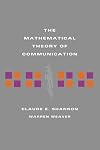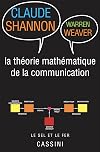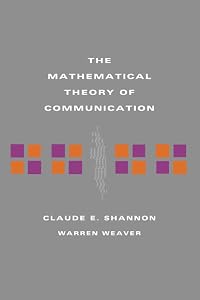
The Mathematical Theory of Communication
by Claude E Shannon, Warren Weaver
On This Page
Description
Scientific knowledge grows at a phenomenal pace--but few books have had as lasting an impact or played as important a role in our modern world as The Mathematical Theory of Communication , published originally as a paper on communication theory more than fifty years ago. Republished in book form shortly thereafter, it has since gone through four hardcover and sixteen paperback printings. It is a revolutionary work, astounding in its foresight and contemporaneity. The University of
show more Illinois Press is pleased and honored to issue this commemorative reprinting of a classic. Tags
Recommendations



















Member Reviews
I've read this book a long time ago, primarily to understand better complex adaptive systems in light of social interaction information processing. The models contained herein may be applied sufficiently in theories on how information is reaching "liminal crititical thresholds" in a cognitive setting, depending on how the message is distributed. It is useful also in media studies, cognitive science, neural networks, general semantics, NLP and day-to-day "raw" communication, to see how the signal loaded with a message interacts with a given audience and what is the probability that a given piece of information will influence a given group or individual, or the message will be "voided" either by cognitive resilience, critical inspection, show more detachment, flood of other messages, conflicting info (cognitive dissonance), information deflation (as in information treated as a tool of "small-talk" interaction with no rhetorical influence whatsoever, as in modern day social networking sites). Excellent read. show less
L'inizio della teoria dell'informazione
Sono pochi i testi che possono definirsi seminali. Sicuramente quello di Shannon sulla teoria dell'informazione (o "della comunicazione", come la chiama lui) è uno di questi: la teoria nasce praticamente completa, e lascia solo (si fa per dire...) da cercare di metterla in pratica. La parte sui segnali continui rimane più datata, forse anche perché ormai usiamo quasi sempre canali digitali; in compenso quella sui segnali discreti si può direttamente usare ancora oggi. In questo libro viene lasciata come introduzione il testo che Weaver scrisse per mostrare al grande pubblico l'importanza della teoria. Un'utile complemento, insomma.
Sono pochi i testi che possono definirsi seminali. Sicuramente quello di Shannon sulla teoria dell'informazione (o "della comunicazione", come la chiama lui) è uno di questi: la teoria nasce praticamente completa, e lascia solo (si fa per dire...) da cercare di metterla in pratica. La parte sui segnali continui rimane più datata, forse anche perché ormai usiamo quasi sempre canali digitali; in compenso quella sui segnali discreti si può direttamente usare ancora oggi. In questo libro viene lasciata come introduzione il testo che Weaver scrisse per mostrare al grande pubblico l'importanza della teoria. Un'utile complemento, insomma.
I've read this book a long time ago, primarily to understand better complex adaptive systems in light of social interaction information processing. The models contained herein may be applied sufficiently in theories on how information is reaching "liminal crititical thresholds" in a cognitive setting, depending on how the message is distributed. It is useful also in media studies, cognitive science, neural networks, general semantics, NLP and day-to-day "raw" communication, to see how the signal loaded with a message interacts with a given audience and what is the probability that a given piece of information will influence a given group or individual, or the message will be "voided" either by cognitive resilience, critical inspection, show more detachment, flood of other messages, conflicting info (cognitive dissonance), information deflation (as in information treated as a tool of "small-talk" interaction with no rhetorical influence whatsoever, as in modern day social networking sites). Excellent read. show less
This small publication was responsible for the beginnings of the world as most of you know it. Everything, from information theory, entropy, started here. Claude Shannon was one of the rare human beings that I was (and am) in awe of. The cruel end of his life (complications of Alzheimer's) cannot take away from his incredible accomplishments.
The other reviews spell it out in detail. No need for me to add to it. I am now on an official hunt for the other work published in that same year (1949), by him, concerning how to create a chess-playing program.
The other reviews spell it out in detail. No need for me to add to it. I am now on an official hunt for the other work published in that same year (1949), by him, concerning how to create a chess-playing program.
As another reviewer pointed out, this is arguably the most influential scientific work of the 20th century. As the human experience becomes more (obviously) about information with the measurability that digital information affords, I think there's a decent chance that history will come to view Shannon in a similar light as the Einstein's and other great physical scientists.
The experience of reading this book is incredible - it's one truly deep, fundamental insight after another, all expressed in perfectly efficient mathematical formalism. It's just so elegant.
The experience of reading this book is incredible - it's one truly deep, fundamental insight after another, all expressed in perfectly efficient mathematical formalism. It's just so elegant.
This is the seminal work that may be said to include the basic concepts, definitions and theorems of information and communication theory. This book does not need any praise because anybody who had even an introductory education in computer science or electronics of communication will have met the name of Shannon (if you haven't yet, please rush to Google and read his achievements).
The beauty of this edition is twofold. It includes two main parts. First part is by Weaver, and you don't need anything more than high school logic and algebra to understand the very clearly explained concepts. The second part by Shannon is 'the real thing' and for the mathematically educated reader, you need a fine grasp of probability theory, calculus, and show more a little bit of calculus of variations if you want to absorb all of the material.
To sum it up, if you want to really understand what entropy means in terms of information theory, then this is THE book for it. You'll also find very entertaining examples about the redundancy and entropy of the English language and how this relates to creating crossword puzzles in 2 dimension or 3 dimension.
You owe it to yourself to read this short book if you are a computer scientist, computer engineer or electronics engineer. show less
The beauty of this edition is twofold. It includes two main parts. First part is by Weaver, and you don't need anything more than high school logic and algebra to understand the very clearly explained concepts. The second part by Shannon is 'the real thing' and for the mathematically educated reader, you need a fine grasp of probability theory, calculus, and show more a little bit of calculus of variations if you want to absorb all of the material.
To sum it up, if you want to really understand what entropy means in terms of information theory, then this is THE book for it. You'll also find very entertaining examples about the redundancy and entropy of the English language and how this relates to creating crossword puzzles in 2 dimension or 3 dimension.
You owe it to yourself to read this short book if you are a computer scientist, computer engineer or electronics engineer. show less
I did pretty well on the discrete signal part, but was not up to speed for the continuous signal part. I give it high marks though for being mostly readable with a good descriptions of the fundamental ideas.
Members
- Recently Added By
Author Information

9+ Works 660 Members

14+ Works 881 Members
Series
Belongs to Publisher Series
Work Relationships
Is abridged in
Common Knowledge
- Original publication date
- 1948
Classifications
- Genres
- Nonfiction, Science & Nature, General Nonfiction
- DDC/MDS
- 621.381 — Applied science & technology Engineering Applied physics Electronics & Computers Electronics, communications engineering Electronics
- LCC
- TK5101 .S45 — Technology Electrical engineering. Electronics. Nuclear engineering Electrical engineering. Electronics. Nuclear Telecommunication
- BISAC
Statistics
- Members
- 587
- Popularity
- 50,290
- Reviews
- 14
- Rating
- (4.53)
- Languages
- 7 — English, French, German, Hungarian, Italian, Japanese, Spanish
- Media
- Paper, Ebook
- ISBNs
- 8
- ASINs
- 3