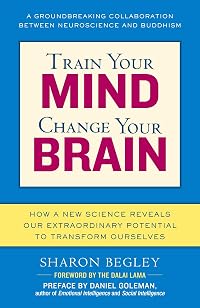
Train Your Mind, Change Your Brain: How a New Science Reveals Our Extraordinary Potential to Transform Ourselves
by Sharon Begley
On This Page
Description
Is change possible? Everyone who has tried and failed, wished they could be happier, or has been told they were too old to learn something, has wondered why we just seem to be stuck with ourselves. But this amazing and hopeful audiobook shows us that it is not only possible for us to control our brains but also for us to rewire them.In late 2004, the Mind and Life Institute brought Western Scientists together with the Dalai Lama and other distinguished Buddhist masters to discuss the show more cutting edge research being conducted in neuroplasticity, which examines whether neurons can be changed and even grown.
The findings are as astonishing as they are helpful. Flying in the face of previous assumptions, the current research shows that not only is it possible for us to change the physical brain, but it is within reach of every single one of us.
Through research into neuroplasticity, it has been shown that we can:
- Heal from depression, even major episodes
- Learn new skills even in old age
- Learn—and even teach—compassion, a critical finding for personal happiness and a more peaceful world Surprising, encouraging, and full of good news that we all want to hear, Sharon Begley's Train Your Mind, Change Your Brain will help us not only change our brains but also the way we approach our lives—for the better.
Tags
Recommendations
















Member Reviews
This is a report on the 2004 Mind and Life Conference which took place in Dharamsala, at the residence of the Dalai Lama.
The topic was "Neuroplasticity" (from the Western perspective) and, though not explicitly stated, was "Lojong" or Mind Training from the Eastern perspective.
A question asked by the Dalai Lama perhaps 2 decades ago: Does Mind Training (Lojong) have an influence on the brain that can be measured by Western science. He received a dismissive "No" as reply when he first asked the question. Updated answer: "Why, yes it does".
This volume is quite different than past reports on the Mind and Life Conferences (see my tag "Mind & Life"). Past volumes have all been edited by conference participants, and report the proceedings show more with equal attention given to both scientific and Buddhist contributions.
This volume was written by the science reporter for the Wall Street Journal, and uses the 2004 Mind and Life Conference as a starting point for a wider discussion of neuroplasticity. Buddhism is used more for flavor than substance, but the conclusions do strongly support the Buddhist meditative practices of Lojong (Mind Training): Dharma practice does indeed change the structure and function of the brain in most beneficial ways. show less
The topic was "Neuroplasticity" (from the Western perspective) and, though not explicitly stated, was "Lojong" or Mind Training from the Eastern perspective.
A question asked by the Dalai Lama perhaps 2 decades ago: Does Mind Training (Lojong) have an influence on the brain that can be measured by Western science. He received a dismissive "No" as reply when he first asked the question. Updated answer: "Why, yes it does".
This volume is quite different than past reports on the Mind and Life Conferences (see my tag "Mind & Life"). Past volumes have all been edited by conference participants, and report the proceedings show more with equal attention given to both scientific and Buddhist contributions.
This volume was written by the science reporter for the Wall Street Journal, and uses the 2004 Mind and Life Conference as a starting point for a wider discussion of neuroplasticity. Buddhism is used more for flavor than substance, but the conclusions do strongly support the Buddhist meditative practices of Lojong (Mind Training): Dharma practice does indeed change the structure and function of the brain in most beneficial ways. show less
Convincing set of scientific evidence for neuroplasticity. Even though it ties in with meditation, it's not a how-to or self-help guide. Makes the case that meditation is a consistent method to affect the brain, but does not answer whether it is the only way, or whether there are differences between meditation schools.
Written in an engaging style that is both easily understood and enjoyable, this book describes the Dali Lama's involvement with science, and, in this case, particularly western neuroscience.
The book centers around a Mind and Life Institute event that the Dali Lama hosted, but is explores a much larger history of the neuroscience of brain plasticity, the Dali Lama's lifelong interest in science, and how his interest was piqued and he became involved when some neuroscientists requested his and fellow monk's help in exploring how the mind might (and does) change the brain.
This book does NOT explain how to train one's brain, nor how to meditate; such information can be found elsewhere (Ricard's "Happiness", Kabat-Zinn's many books, show more Wallace's books, and so forth). However it suggests WHY these techniques work and how neuroscience is discovering the mechanisms behind what Buddhists have been practicing for a millennium. show less
The book centers around a Mind and Life Institute event that the Dali Lama hosted, but is explores a much larger history of the neuroscience of brain plasticity, the Dali Lama's lifelong interest in science, and how his interest was piqued and he became involved when some neuroscientists requested his and fellow monk's help in exploring how the mind might (and does) change the brain.
This book does NOT explain how to train one's brain, nor how to meditate; such information can be found elsewhere (Ricard's "Happiness", Kabat-Zinn's many books, show more Wallace's books, and so forth). However it suggests WHY these techniques work and how neuroscience is discovering the mechanisms behind what Buddhists have been practicing for a millennium. show less
I found this to be a very fascinating account of the progression of the field of neuroscience, from a long-held view that the adult brain is "fixed" and "immutable" (as described by the Spanish neuroanatomist Santiago Romon y Cajal in 1913) to the discovery that the brain is in fact quite plastic and malleable, long into adulthood and old age.
The author leads us through a narrative, describing the unfolding of these discoveries through studies starting in the1960s through the last 4 decades, with many of the key finding occurring in only the last 10 years. Having just read the book, "Your Brain, the Missing Manual" published in 2008, it was interesting to see how long held misconceptions of neuroscience still persist today. For example show more "the Missing Manual" describes an individual's "happiness set point" to be basically unchangeable attribute, and get used to it! When in fact, as put forth by "Train Your Mind", studies have shown this is completely changeable through training our mind.
While this book is not an introduction to Buddhism or a guide to methods for training your mind, it presents a clear, easy to understand synopsis of the scientific research that shows through changing our thinking, training our mind, we are capable of physically changing the structure of our brain, increasing our happiness, and improving the quality of life. show less
The author leads us through a narrative, describing the unfolding of these discoveries through studies starting in the1960s through the last 4 decades, with many of the key finding occurring in only the last 10 years. Having just read the book, "Your Brain, the Missing Manual" published in 2008, it was interesting to see how long held misconceptions of neuroscience still persist today. For example show more "the Missing Manual" describes an individual's "happiness set point" to be basically unchangeable attribute, and get used to it! When in fact, as put forth by "Train Your Mind", studies have shown this is completely changeable through training our mind.
While this book is not an introduction to Buddhism or a guide to methods for training your mind, it presents a clear, easy to understand synopsis of the scientific research that shows through changing our thinking, training our mind, we are capable of physically changing the structure of our brain, increasing our happiness, and improving the quality of life. show less
Fascinating subject, great research is covered. I give it 5 stars, yet have 2 complaints. The author sets up a false dichotemy of Brain versus Mind, but never discusses how one might measure & test these differences. She acts as if she is building up a case, but then dismisses the dichotomy, correctly stating that you cannot test this distinction - so why bother with extended posing? Then later she resumes the distinction between mind and brain, conveniently forgetting the inability to make a distinction.
She also fails to explain the placebo effect to her audience. Most people do Not realize that the placebo effect causes measurable differences in the brain, and that certain chemicals can block the placebo effect. Lastly, she builds up show more a case for meditation over medication, yet by comparing Meditation to "treatment as usual" by Not detailing what is included in "treatment as usual" is it medication, is it psycho-therapy, you can't really draw real conclusions. Nonetheless, fascinating research, on a fascinating topic.
Lastly, she overstates show less
She also fails to explain the placebo effect to her audience. Most people do Not realize that the placebo effect causes measurable differences in the brain, and that certain chemicals can block the placebo effect. Lastly, she builds up show more a case for meditation over medication, yet by comparing Meditation to "treatment as usual" by Not detailing what is included in "treatment as usual" is it medication, is it psycho-therapy, you can't really draw real conclusions. Nonetheless, fascinating research, on a fascinating topic.
Lastly, she overstates show less
What a wonderful book! An interesting mix of hard science and the effects of Buddhist meditation on the mind. I devour books on topics such as neuroplasticity and this was a refreshing look at the topic. It's comforting to know that not only has science and medicine uncovered the truth that we can guide who and what we become for far longer than ever believed, but that a spiritual approach is completely compatible with this pursuit. Though many of the reviews that follow seem to indicate otherwise, I thought Sharon Begleys prose style as "elegant and lucid" as promised on the back cover review.
Interesting book, but highly (and unnecessarily) repetitive. It grounds the theories of mental change in hard science. The main problem I had with it was its oversimplification and idealization of the Dalai Lama.
Members
- Recently Added By
Author Information

5+ Works 1,857 Members
Sharon Begley is the senior science writer at STAT, the life sciences publication of the Boston Globe. The author of the New York Times bestseller Train Your Mind, Change Your Brain, she has received numerous awards for her writings about science.
All Editions
Common Knowledge
- Canonical title*
- La tua mente può cambiare
*Some information comes from Common Knowledge in other languages. Click "Edit" for more information.
Classifications
Statistics
- Members
- 613
- Popularity
- 47,821
- Reviews
- 17
- Rating
- (3.68)
- Languages
- 6 — English, French, German, Italian, Portuguese, Spanish
- Media
- Paper, Audiobook, Ebook
- ISBNs
- 17
- ASINs
- 8