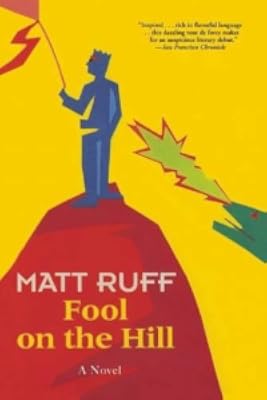
Fool on the Hill
by Matt Ruff
On This Page
Description
It is a literary event when a genuinely new fictional voice comes along. When that voice achieves its newness not through a certain formal facility but through the freshness of its vision, there is truly something to celebrate. Matt Ruff was only twenty-two when Fool on the Hill was first published, but with his novel he gave us a story that won over readers of every persuasion. Not your usual first effort, Fool on the Hill is a full-blown epic of life and death, good and evil, magic and show more love. Think of the imaginative daring of Mark Helprin's Winter's Tale. The zany popism of Tom Robbins's Another Roadside Attraction. The gnomish fantasies of J.R. Tolkien. Think of these and you begin to get some idea of one of the most remarkable first novels to come along in years. In the world of Fool on the Hill dogs and cats can talk, a subculture of sprites lives in the shadows and underfoot (if you're the sensitive type, or drunk enough, you might see them cavorting across the lawn), and the Bohemians, a group of Harley- and horseback-riding students dedicated to all things unconventional, hold all-night revels for the glory of their cause. Then there is Stephen Titus George, the novel's youthful hero, who somehow finds himself the main player in a story that began well over a century ago. George is a mild-mannered flier of kites, a sometimes writer of bestselling fiction, and would-be knight looking for a maiden. George will find his girl and the century-old story will provide the proverbial dragon whose slaying will sanctify their love. But it will not be a sword that fells the foe but the transforming power of the imagination. show lessTags
Recommendations





Member Reviews
Summary: The story behind Fool on the Hill, as far as I know it, goes as follows: Matt Ruff was an undergraduate English major at Cornell University in upstate New York. When it came time to submit his honors thesis, instead of turning in fifty pages on the use of shoelaces in E.B. White's oeuvre and their relation to the major themes of Norse mythology, or whatever English majors usually write honors theses about, he walks into his advisor's office and plunks down a several-hundred-page draft manuscript of what would eventually become Fool on the Hill.
As to the story within Fool on the Hill, that's a lot harder to summarize. The ostensible main character, Stephen T. George, is a young author living in Ithaca, who spends his time show more writing, falling in and out of love, and flying kites. However, the story focuses equally as much on Luther, a mongrel dog, and Blackjack, a Manx cat, who follow the scent of Heaven all the way to Ithaca; a group of modern knights and erstwhile college students known as the Bohemians; Calliope, a Muse, and the most beautiful woman in the world; Aurora Borealis Smith, student and daughter of a would-be revolutionary; a group of invisible Shakespearean sprites that live throughout campus and help maintain the University; Ragnarok, the motorcycle-riding and mace-wielding Black Knight; and many others. All of them are caught up in a Story being told by Mr. Sunshine, a Greek God who entertains himself by creating "true fictions" with the lives of mortals. And they are all faced with a common enemy from deep history: Rasferret the Grub, whose magical powers of Animation are matched only by his malice. Everyone will have a part to play, but it will ultimately be up to Stephen to learn the art of Writing Without Paper if he's going to save the day, the university, and those he loves when a Dragon Day celebration goes horribly awry.
Review: While I love Fool on the Hill, and would go so far as to say it's one of my favorite books, and particularly one of my favorite books that I *didn't* first read in childhood, I will admit up front that I am rather biased. My predisposition towards this book comes from the fact that it takes place at my alma mater, so I'm intimately familiar with the places, institutions, and even the types of people that populate this book. Plus, there's a bit of a thrill to be had from reading a scene where a car chase (okay, a motorcycle-and-Animated-driverless-truck-full-of-pigs chase) goes zipping right past my junior year apartment.
You might scoff at me saying that reading a book that is so thoroughly grounded in a location helps to make it more real, when that reality involves sprites and magic and a canine university and a flying ice bird and armies of cross-bow-shooting rats. But the truth is that Ithaca, and Cornell, feel like places where magic could happen. When Luther says that Ithaca smells like Heaven, like "green and rain and hills", I can't dispute that in the least. It doesn't hurt that just about every location and tradition in this book is real: The Boneyard is real, Dragon Day is real, Risley the arts dorm is real (and while they didn't have a lot of horses in my day, a swordfight on the lawn would not have been out of place.) About the only place that's not real is Tolkien House, the fraternity that holds its parties in the underground grove of Lothlorien, reached by crossing the bridge of Khazad-Dum - and for all I know, Tolkien House *is* real, and I just never got invited to any parties there. Wouldn't surprise me in the slightest.
So, while Fool on the Hill is certainly going to appeal most to Cornellians, I really do think that it's a wonderful novel regardless of where you went to school. It's about three parts fairy tale, two parts urban fantasy (as urban as you can be in Ithaca, anyways), two parts mythology, one part zany screwball comedy, one part tragedy, and liberal doses of horror, action-adventure, and romance. It's also jam-packed with more literary references than you can shake a B.A. in English at, drawing heavily on Shakespeare, Tolkien, and Greek mythology, but also throwing in glancing allusions to everyone from Ray Bradbury to A. A. Milne to Samuel Beckett.
Jam-packed is a good way to describe the book in general, but Ruff does his usual excellent job of balancing a huge host of characters and a bunch of storylines. The pacing's not perfect - the main bad guy doesn't even show up until about halfway through - and some of the minor characters aren't much more than caricatures, but all of the main characters are so sympathetic and all of the storylines so interesting that I never really minded just reading about what they were up to, even if it didn't directly bear on the central plot. The short chapters keep things ticking along quickly until eventually all of the disparate pieces come together like clockwork in the final chapters. It's a big, sprawling jumble of a novel, but I mean that in the best way possible - tons of characters, tons of action, tons of laughter and sweetness and tears and charm, all added up to a thoroughly enjoyable novel that's got something for every fantasy fan. 5 out of 5 stars.
Recommendation: I love this book, and while I'm admittedly biased, I really do think that even non-Cornellian fantasy and fairy-tale fans, as well as those who have enjoyed Ruff's later work, or who like Christopher Moore's books, will find something here to love as well. show less
As to the story within Fool on the Hill, that's a lot harder to summarize. The ostensible main character, Stephen T. George, is a young author living in Ithaca, who spends his time show more writing, falling in and out of love, and flying kites. However, the story focuses equally as much on Luther, a mongrel dog, and Blackjack, a Manx cat, who follow the scent of Heaven all the way to Ithaca; a group of modern knights and erstwhile college students known as the Bohemians; Calliope, a Muse, and the most beautiful woman in the world; Aurora Borealis Smith, student and daughter of a would-be revolutionary; a group of invisible Shakespearean sprites that live throughout campus and help maintain the University; Ragnarok, the motorcycle-riding and mace-wielding Black Knight; and many others. All of them are caught up in a Story being told by Mr. Sunshine, a Greek God who entertains himself by creating "true fictions" with the lives of mortals. And they are all faced with a common enemy from deep history: Rasferret the Grub, whose magical powers of Animation are matched only by his malice. Everyone will have a part to play, but it will ultimately be up to Stephen to learn the art of Writing Without Paper if he's going to save the day, the university, and those he loves when a Dragon Day celebration goes horribly awry.
Review: While I love Fool on the Hill, and would go so far as to say it's one of my favorite books, and particularly one of my favorite books that I *didn't* first read in childhood, I will admit up front that I am rather biased. My predisposition towards this book comes from the fact that it takes place at my alma mater, so I'm intimately familiar with the places, institutions, and even the types of people that populate this book. Plus, there's a bit of a thrill to be had from reading a scene where a car chase (okay, a motorcycle-and-Animated-driverless-truck-full-of-pigs chase) goes zipping right past my junior year apartment.
You might scoff at me saying that reading a book that is so thoroughly grounded in a location helps to make it more real, when that reality involves sprites and magic and a canine university and a flying ice bird and armies of cross-bow-shooting rats. But the truth is that Ithaca, and Cornell, feel like places where magic could happen. When Luther says that Ithaca smells like Heaven, like "green and rain and hills", I can't dispute that in the least. It doesn't hurt that just about every location and tradition in this book is real: The Boneyard is real, Dragon Day is real, Risley the arts dorm is real (and while they didn't have a lot of horses in my day, a swordfight on the lawn would not have been out of place.) About the only place that's not real is Tolkien House, the fraternity that holds its parties in the underground grove of Lothlorien, reached by crossing the bridge of Khazad-Dum - and for all I know, Tolkien House *is* real, and I just never got invited to any parties there. Wouldn't surprise me in the slightest.
So, while Fool on the Hill is certainly going to appeal most to Cornellians, I really do think that it's a wonderful novel regardless of where you went to school. It's about three parts fairy tale, two parts urban fantasy (as urban as you can be in Ithaca, anyways), two parts mythology, one part zany screwball comedy, one part tragedy, and liberal doses of horror, action-adventure, and romance. It's also jam-packed with more literary references than you can shake a B.A. in English at, drawing heavily on Shakespeare, Tolkien, and Greek mythology, but also throwing in glancing allusions to everyone from Ray Bradbury to A. A. Milne to Samuel Beckett.
Jam-packed is a good way to describe the book in general, but Ruff does his usual excellent job of balancing a huge host of characters and a bunch of storylines. The pacing's not perfect - the main bad guy doesn't even show up until about halfway through - and some of the minor characters aren't much more than caricatures, but all of the main characters are so sympathetic and all of the storylines so interesting that I never really minded just reading about what they were up to, even if it didn't directly bear on the central plot. The short chapters keep things ticking along quickly until eventually all of the disparate pieces come together like clockwork in the final chapters. It's a big, sprawling jumble of a novel, but I mean that in the best way possible - tons of characters, tons of action, tons of laughter and sweetness and tears and charm, all added up to a thoroughly enjoyable novel that's got something for every fantasy fan. 5 out of 5 stars.
Recommendation: I love this book, and while I'm admittedly biased, I really do think that even non-Cornellian fantasy and fairy-tale fans, as well as those who have enjoyed Ruff's later work, or who like Christopher Moore's books, will find something here to love as well. show less
This is a fantasy novel set at Cornell University (or a slightly more fantastic version thereof). It features, among many others, a dog searching for heaven, a storyteller searching for love, a colony of sprites who are mostly invisible to humans, a couple of meddling Greek deities, and an old evil lying dormant in a graveyard. Also a dragon. Sort of.
It's a fun, offbeat story, full of literary references to everything from Shakespeare to Winnie the Pooh, with a pleasantly ridiculous plot and some surprisingly well-developed characters. Indeed, if I have one complaint about it, it's that so many of the characters whose stories are interlaced together here feel like they really need a novel of their own, uninterrupted by other people's show more stories, to fully do them justice.
Also, it really made me wish I'd gone to Cornell. I suspect people with an actual connection to the place are likely to enjoy it even more. show less
It's a fun, offbeat story, full of literary references to everything from Shakespeare to Winnie the Pooh, with a pleasantly ridiculous plot and some surprisingly well-developed characters. Indeed, if I have one complaint about it, it's that so many of the characters whose stories are interlaced together here feel like they really need a novel of their own, uninterrupted by other people's show more stories, to fully do them justice.
Also, it really made me wish I'd gone to Cornell. I suspect people with an actual connection to the place are likely to enjoy it even more. show less
To be honest, I'm surprised this book has so many positive reviews. It's definitely a first novel. Chaotic, brimming with literary references, and somewhat pretentious, I found myself skimming most of the book. The basic premise is that life is a play directed by God to amuse himself, and you're hit on the head with this over and over (yes, we've all considered that idea ourselves before without any help, thank-you-very-much).
Part of the reason I may have found it harder to read than most folks is that I'm recent Cornell graduate, and a Risleyite (once a Risleyite, always a Risleyite... it's rather like being a Queen of Narnia). I found all the familiar things distracting. It also made me notice a certain immaturity in the plot of this show more novel (definitely reflected in Risley culture even today), which is the belief that Risleyites are superior and frats are evil. It's this sort of clique-ishness- the idea of "us" vs. "them"- that the novel spends so much time tearing down in other areas (black vs. white, purebred dog vs. mongrel). The inconsistency, I think, definitely reveals a young author.
Well, at least now I know where the rumor that dogs are allowed to roam free on the arts quad came from. show less
Part of the reason I may have found it harder to read than most folks is that I'm recent Cornell graduate, and a Risleyite (once a Risleyite, always a Risleyite... it's rather like being a Queen of Narnia). I found all the familiar things distracting. It also made me notice a certain immaturity in the plot of this show more novel (definitely reflected in Risley culture even today), which is the belief that Risleyites are superior and frats are evil. It's this sort of clique-ishness- the idea of "us" vs. "them"- that the novel spends so much time tearing down in other areas (black vs. white, purebred dog vs. mongrel). The inconsistency, I think, definitely reveals a young author.
Well, at least now I know where the rumor that dogs are allowed to roam free on the arts quad came from. show less
Kind of a fairy tale with a twist. Crazy compelling characters, a plot that was out of this world, literally (unless you believe in sprites).The only problem I had with it was there was too much death -- human, sprite and canine, but the most major of the characters did survive for a happy ending. Definitely a very different, inventive fantasy. I definitely enjoyed it.
Arguably my all-time favorite book, but best enjoyed by those familiar with Ithaca, NY. One of the most legitimately pleasurable reads out there. For fantasy dorks, romantics, Cornellians, anyone.
This was a sometimes strange, but always magical book about storytelling and how it feels to discover that you're part of someone else's story. My favorite characters included George, Aurora, Luther the dog, Blackjack the cat, and the sprites Puck and Zephyr.
What a ride! This was definitely different.
It could maybe have been a bit shorter just before the conclusion - right then everything seemed clear, what are the "weird" parts and so on - but it kept going and going.
It could maybe have been a bit shorter just before the conclusion - right then everything seemed clear, what are the "weird" parts and so on - but it kept going and going.
Members
- Recently Added By
Lists

Best Science Fiction Novels
816 works; 426 members

Top Five Books of 2020
982 works; 348 members

Books Read in 2015
3,299 works; 129 members

Books Read in 2020
4,379 works; 124 members

Myth (Reuse and Retelling)
188 works; 24 members

Favorite Romance Fiction
247 works; 115 members

Books Read in 2024
4,727 works; 128 members

Books We Love to Reread
695 works; 298 members

Top Five Books of 2024
795 works; 264 members
Our Favorite Comfort Reads
334 works; 200 members
Author Information

9+ Works 8,776 Members
Some Editions
Awards and Honors
Awards
Notable Lists
Common Knowledge
- Canonical title
- Fool on the Hill
- Original title
- Fool on the Hill
- Original publication date
- 1988
- People/Characters
- Stephen T. George; Mr. Sunshine (Apollo); Ezra Cornell; Ragnarok; Aurora Borealis Smith; Luther (dog) (show all 9); Blackjack (cat); Puck (sprite); Zephyr (sprite)
- Important places
- Ithaca, New York, USA; Cornell University, Ithaca, New York, USA
- Important events
- Dragon Day; The Ides of March
- Dedication
- to the Bohemians, with gratitude,
to the Grey Ladies, with affection,
and to Lady Chance,
with deepest love - First words
- Mr. Sunshine first enters the city near dusk of a spring day in 1866, after heavy showers have turned its dirt roads and streets to mud soup.
- Last words
- (Click to show. Warning: May contain spoilers.)The wind blew strong all summer.
- Blurbers
- Lurie, Alison
- Original language*
- Englisch
*Some information comes from Common Knowledge in other languages. Click "Edit" for more information.
Classifications
Statistics
- Members
- 1,099
- Popularity
- 23,283
- Reviews
- 15
- Rating
- (4.15)
- Languages
- English, German, Polish
- Media
- Paper, Ebook
- ISBNs
- 14
- ASINs
- 7