On This Page
Description
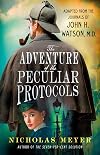
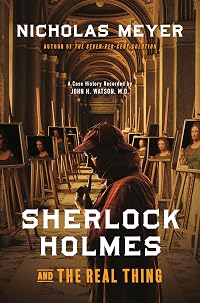
"With the international bestseller The Seven-Per-Cent Solution, Nicholas Meyer brought to light a previously unpublished case of Sherlock Holmes, as recorded by Dr. John H. Watson. Now Meyer returns with a shocking discovery-an unknown case drawn from a recently unearthed Watson journal. January 1905: Holmes and Watson are summoned by Holmes' brother Mycroft to undertake a clandestine investigation. An agent of the British Secret Service has been found floating in the Thames, carrying a show more manuscript smuggled into England at the cost of her life. The pages purport to be the minutes of a meeting of a secret group intent on nothing less than taking over the world. Based on real events, the adventure takes the famed duo-in the company of a bewitching woman-aboard the Orient Express from Paris into the heart of Tsarist Russia, where Holmes and Watson attempt to trace the origins of this explosive document. On their heels are desperate men of unknown allegiance, determined to prevent them from achieving their task. And what they uncover is a conspiracy so vast as to challenge Sherlock Holmes as never before"-- show lessTags
Recommendations






Member Reviews
I'm still mostly enjoying these books, though I do find with each successive installment in the series, I seem to be getting less out of each one.
Yes, I know Meyer isn't Arthur Conan Doyle, nor will he ever be. As such, the stories are paced differently, yet still they're done quite well. However, there's still that thing that kind of bugs me, and I really was at a lost as to why.
So, as I went through this one, I tried to determine why that is, and I think it comes down to two things.
Meyer's obviously a Hollywood guy. He's worked on a lot of movies and shows. I think the two things that get to me are the two things Meyer either can't help doing, or feels he must do.
The first is all the damn cameos. Every single one of his adventures has show more cameos. Freud. Oscar Wilde. Gilbert and Sullivan. And on and on and on. The odd drop in would be fine, a fun little Easter egg. But Meyer packs them in as though he's being paid by the appearance, and it does begin to wear after a bit.
The second Hollywood thing that Meyer likes to do is take Sherlock completely out of his element. That could be physically, emotionally, or mentally, depending on which book you're reading. I think this may be a safety thing for Meyer, so if he has Holmes do something uncharacteristically (such as the gun trick in this one), he can blame it on the stress of being out of his element.
Again, if this is the exception to the rule, then it's a fun experiment, however when it's in every single Meyer pastiche, it quickly begins to lose its appeal.
Overall, this is not a bad story, despite the liberties Meyer takes with Holmes. And it talks to a real world issue that, unfortunately comes up again and again and again.
But overall, these particular Holmes stories are beginning to wear. I know there's a new one to be published this year, but for now, I have one more to go. We'll see how I feel about that one before deciding if I read any future installments. show less
Yes, I know Meyer isn't Arthur Conan Doyle, nor will he ever be. As such, the stories are paced differently, yet still they're done quite well. However, there's still that thing that kind of bugs me, and I really was at a lost as to why.
So, as I went through this one, I tried to determine why that is, and I think it comes down to two things.
Meyer's obviously a Hollywood guy. He's worked on a lot of movies and shows. I think the two things that get to me are the two things Meyer either can't help doing, or feels he must do.
The first is all the damn cameos. Every single one of his adventures has show more cameos. Freud. Oscar Wilde. Gilbert and Sullivan. And on and on and on. The odd drop in would be fine, a fun little Easter egg. But Meyer packs them in as though he's being paid by the appearance, and it does begin to wear after a bit.
The second Hollywood thing that Meyer likes to do is take Sherlock completely out of his element. That could be physically, emotionally, or mentally, depending on which book you're reading. I think this may be a safety thing for Meyer, so if he has Holmes do something uncharacteristically (such as the gun trick in this one), he can blame it on the stress of being out of his element.
Again, if this is the exception to the rule, then it's a fun experiment, however when it's in every single Meyer pastiche, it quickly begins to lose its appeal.
Overall, this is not a bad story, despite the liberties Meyer takes with Holmes. And it talks to a real world issue that, unfortunately comes up again and again and again.
But overall, these particular Holmes stories are beginning to wear. I know there's a new one to be published this year, but for now, I have one more to go. We'll see how I feel about that one before deciding if I read any future installments. show less
Nicholas Meyer skillfully blends fact and fiction in "The Adventure of the Peculiar Protocols," a riveting tale that takes place in 1905. Dr. John Watson has a thriving medical practice and, for the past two years, has been happily married to his second wife, Juliet. Fifty-year-old Sherlock Holmes, Watson's friend and occasional partner, is a bit bored, since he has no compelling investigations pending. Suddenly, Mycroft Holmes, Sherlock’s brother, asks Holmes to embark on a clandestine mission on behalf of His Majesty’s government. His assignment is to track down the source of a manuscript that purports to expose a Jewish plot to take over the world. This is the long-since debunked Protocols of the Elders of Zion, a fabricated show more document that has been used by bigots for many years to stir up hatred and encourage anti-Semitic attacks.
At Mycroft's suggestion, Holmes meets Chaim Weitzmann—who in 1949 would be named the first president of Israel. Dr. Weitzmann, a chemist and professor, fills Holmes in on what occurred at various Zionist conferences, where such notable attendees as Theodor Herzl debated the prospect of establishing a Jewish homeland. Subsequently, the stunningly beautiful Mrs. Anna Strunsky Walling, a Jewish-American socialist, pacifist, and human rights activist, joins Holmes and, of course, Watson, on their long journey through Europe. The author colorfully and entertainingly depicts life in Europe and Russia at the start of the twentieth century, when electric lights were replacing gas lamps; telephones were increasingly appearing in private homes; suffragettes sought the right to vote; Tsar Nicholas's troops brutally suppressed a revolt that threatened his rule; and Russians attacked Jewish men, women, and children in brutal pogroms sanctioned by the authorities.
Holmes is, as usual, cryptic and maddeningly vague at times, while the agreeable Watson does his best to offer whatever assistance he can provide. Furthermore, the doctor keeps a journal of their experiences, as he has done so often during his collaboration with the brilliant master of detection. This relatively brief, well-researched, and fast-paced book is lively, humorous at times, but ultimately tragic. It powerfully foreshadows the bitter enmity, divisiveness, and conflagrations that would, in the not too distant future, tear the world apart and cost millions of innocent lives. The most wrenching scenes are in Kishinev, "a village in Bessarabia, lately a province of Russia," where Holmes, Watson, and Mrs. Walling meet a catatonic thirteen-year-old girl, Rivka Nussbaum, who was traumatized when ruffians physically abused her and slaughtered her mother. The trio later confronts a newspaper editor, Pavel Krushenev, who uses the power of the press to spread poisonous lies concerning the Jews. "The Adventures of the Peculiar Protocols" has a hint of illicit romance, violent encounters with ruthless adversaries, and a disheartening conclusion that reminds us how little we have progressed in fostering harmony among nations, ethnic groups, and religious factions. show less
At Mycroft's suggestion, Holmes meets Chaim Weitzmann—who in 1949 would be named the first president of Israel. Dr. Weitzmann, a chemist and professor, fills Holmes in on what occurred at various Zionist conferences, where such notable attendees as Theodor Herzl debated the prospect of establishing a Jewish homeland. Subsequently, the stunningly beautiful Mrs. Anna Strunsky Walling, a Jewish-American socialist, pacifist, and human rights activist, joins Holmes and, of course, Watson, on their long journey through Europe. The author colorfully and entertainingly depicts life in Europe and Russia at the start of the twentieth century, when electric lights were replacing gas lamps; telephones were increasingly appearing in private homes; suffragettes sought the right to vote; Tsar Nicholas's troops brutally suppressed a revolt that threatened his rule; and Russians attacked Jewish men, women, and children in brutal pogroms sanctioned by the authorities.
Holmes is, as usual, cryptic and maddeningly vague at times, while the agreeable Watson does his best to offer whatever assistance he can provide. Furthermore, the doctor keeps a journal of their experiences, as he has done so often during his collaboration with the brilliant master of detection. This relatively brief, well-researched, and fast-paced book is lively, humorous at times, but ultimately tragic. It powerfully foreshadows the bitter enmity, divisiveness, and conflagrations that would, in the not too distant future, tear the world apart and cost millions of innocent lives. The most wrenching scenes are in Kishinev, "a village in Bessarabia, lately a province of Russia," where Holmes, Watson, and Mrs. Walling meet a catatonic thirteen-year-old girl, Rivka Nussbaum, who was traumatized when ruffians physically abused her and slaughtered her mother. The trio later confronts a newspaper editor, Pavel Krushenev, who uses the power of the press to spread poisonous lies concerning the Jews. "The Adventures of the Peculiar Protocols" has a hint of illicit romance, violent encounters with ruthless adversaries, and a disheartening conclusion that reminds us how little we have progressed in fostering harmony among nations, ethnic groups, and religious factions. show less
I read a ton of "new" Holmes fiction, and this is the best piece I've read in ages. Why?
• The "mystery" at the center of the story really matters—both in its moment and for what it can help us examine in the present day
• The author's version of Watson's voice is believable and engaging.
• The trope of presenting the story as a "found" document and the addition of notes by the author/finder are delightful, giving the book an additional level of entertainment.
• The reader sees development of both the Holmes and Watson characters that is appropriate to their identities as Conan Doyle created them.
• There's some very nice exploration of the tensions in the relationship between Sherlock and Mycroft Holmes.
This is definitely a show more title work seeking out. show less
• The "mystery" at the center of the story really matters—both in its moment and for what it can help us examine in the present day
• The author's version of Watson's voice is believable and engaging.
• The trope of presenting the story as a "found" document and the addition of notes by the author/finder are delightful, giving the book an additional level of entertainment.
• The reader sees development of both the Holmes and Watson characters that is appropriate to their identities as Conan Doyle created them.
• There's some very nice exploration of the tensions in the relationship between Sherlock and Mycroft Holmes.
This is definitely a show more title work seeking out. show less
Nicholas Meyer presents us with another 'newly discovered' Sherlock Holmes case from Dr. Watson's diaries in The Adventure of the Peculiar Protocols. Mycroft Holmes summons his brother Sherlock Holmes to investigate a murder and a document being circulated that warns that a secret group is bent on taking over the world. The document appears to be part of a conspiracy to foment and spur trouble.
My husband and I both read The Seven-Per-Cent Solution by Nicholas Meyer when it came out in 1974. He offered a new view of the perpetually popular Sherlock Holmes. Later my brother shared his copy of Meyer's third Holmes mystery, The West End Horror. I thought this would be a fun read.
Soon after I got into the book I discovered this story is show more more than entertainment. The story of a secret group is 'fake news' being used for political purposes.
Now, where have we heard that story before?
It is 1905 and Watson is married to a suffragette and has build a practice. Holmes notes that crimes are getting bigger. Electric lights are replacing gas. There is an uprising in Russia and Czar Nicholas is struggling to maintain control. The Jews are looking for a homeland, perhaps in Uganda.
Holmes, of course, needs Watson's assistance; they are not so sure about the help of a female radical socialist, Anna Strunsky. Her beauty alone is problematic for the married Watson. Watson's wife made him pledge to end to his risky adventures with Holmes. Will his marriage survive--or his practice? But this is no regular murder investigation; behind the murder is a plot that will set Europe careening into mass hysteria and death.
The three make a journey on the Orient Express to Odessa, Russia. Proving the document a fake is essential. Thousands of lives hang in the balance. Or is it already too late? Once fake news is in the world, it tends to stay there.
People love to place blame on something concrete, some 'other' as the source of their problems.
This is a fun read, filled with historical references and events, political intrigue, a kidnapping, and an expansion of the classic characters of Watson and Holmes. But the underlying message is serious, chilling, and sadly, timeless.
I was granted access to a free egalley by the publisher through NetGalley in exchange for a fair and unbiased review. show less
My husband and I both read The Seven-Per-Cent Solution by Nicholas Meyer when it came out in 1974. He offered a new view of the perpetually popular Sherlock Holmes. Later my brother shared his copy of Meyer's third Holmes mystery, The West End Horror. I thought this would be a fun read.
Soon after I got into the book I discovered this story is show more more than entertainment. The story of a secret group is 'fake news' being used for political purposes.
Now, where have we heard that story before?
It is 1905 and Watson is married to a suffragette and has build a practice. Holmes notes that crimes are getting bigger. Electric lights are replacing gas. There is an uprising in Russia and Czar Nicholas is struggling to maintain control. The Jews are looking for a homeland, perhaps in Uganda.
Holmes, of course, needs Watson's assistance; they are not so sure about the help of a female radical socialist, Anna Strunsky. Her beauty alone is problematic for the married Watson. Watson's wife made him pledge to end to his risky adventures with Holmes. Will his marriage survive--or his practice? But this is no regular murder investigation; behind the murder is a plot that will set Europe careening into mass hysteria and death.
The three make a journey on the Orient Express to Odessa, Russia. Proving the document a fake is essential. Thousands of lives hang in the balance. Or is it already too late? Once fake news is in the world, it tends to stay there.
People love to place blame on something concrete, some 'other' as the source of their problems.
This is a fun read, filled with historical references and events, political intrigue, a kidnapping, and an expansion of the classic characters of Watson and Holmes. But the underlying message is serious, chilling, and sadly, timeless.
I was granted access to a free egalley by the publisher through NetGalley in exchange for a fair and unbiased review. show less
The Adventure of the Peculiar Protocols: Adapted from the Journals of John H. Watson, M.D. was my first encounter with Mr. Meyer and his excellent rendering of a heretofore unknown Holmes case. The style is true to Conan-Doyle and sure to delight any Holmes fan.
The masterful blending of fact and fiction, approaching the "recently discovered journal" and it's "translation" as reality, combined with historic events and peoples brought Holmes and Watson to vivid life as they interacted with these well known personages and participated in historical events.
I have to confess to having to shift gears, so to speak, when starting the book. The style is so markedly different from my recent reads and brought home to me just how much change show more there's been. Reading this "old" style was such a joy...the sentence structure, word choices, all a true delight.
The Adventure of the Peculiar Protocols: Adapted from the Journals of John H. Watson, M.D. was surprising (and scary in a way) in it's relevance to current events; proving in many ways, how the more things change the more they stay the same.
The Adventure of the Peculiar Protocols: Adapted from the Journals of John H. Watson, M.D. was pure reading pleasure on every level. Mr. Meyer has a new fan & I'll be acquiring and reveling in his backlist posthaste.
I received an ARC from the publisher. My thoughts are my own. show less
The masterful blending of fact and fiction, approaching the "recently discovered journal" and it's "translation" as reality, combined with historic events and peoples brought Holmes and Watson to vivid life as they interacted with these well known personages and participated in historical events.
I have to confess to having to shift gears, so to speak, when starting the book. The style is so markedly different from my recent reads and brought home to me just how much change show more there's been. Reading this "old" style was such a joy...the sentence structure, word choices, all a true delight.
The Adventure of the Peculiar Protocols: Adapted from the Journals of John H. Watson, M.D. was surprising (and scary in a way) in it's relevance to current events; proving in many ways, how the more things change the more they stay the same.
The Adventure of the Peculiar Protocols: Adapted from the Journals of John H. Watson, M.D. was pure reading pleasure on every level. Mr. Meyer has a new fan & I'll be acquiring and reveling in his backlist posthaste.
I received an ARC from the publisher. My thoughts are my own. show less
Let me preface this by saying that I like Meyer's interpretation of Sherlock Holmes and I am looking forward to reading more of them, but this one was not, in my opinion, his best effort. He has Holmes and Watson and does a good job of honoring Conan Doyle's writing style and the ancillary characters in this one were good. But it was slow developing and the plot was cumberson at best introducing too many side plots and at times left me wondering exactly what was happening. It was not a page turner by any means. The plot was timely and well developed but wasn't as engaging as his other books. Still it is a worth addition to the Holmes canon. And I lookf orward to the next effort.
The Adventure of the Peculiar Protocols is interesting in a historical sense that being a forgery/fraud that has taken on a life of its own. It is also interesting in story sense in how Sherlock Holmes and Dr. Watson solve to find out the writer of the fraudulent document. A lot of research and thought went into the writing of this story. It has suspense and very believable characters and situations. Four stars were awarded to this book.
Members
- Recently Added By
Published Reviews
ThingScore 100
“Invigoratingly engaging from start to finish, Nicholas Meyer has yet again created a fresh take on an old genre.”
added by andrewv128
Lists

Acclaimed Fanfiction
23 works; 2 members
Author Information

39+ Works 6,189 Members
Awards and Honors
Awards
Series

Common Knowledge
- Canonical title
- The Adventure of the Peculiar Protocols
- Original title
- The Adventure of the Peculiar Protocols
- Alternate titles
- The Adventure of the Peculiar Protocols: Adapted from the Journals of John H. Watson, M.D.
- People/Characters
- Sherlock Holmes; John H. Watson; Mycroft Holmes; Chaim Weizmann; Anna Walling; Pyotr Ivanovich Rachkovsky (show all 7); Constance Garnett
- Important places
- London, England, UK; Odessa, Russian Empire; Varna, Bulgaria; Kishinev, Russia
- Important events
- Publication of "The Protocols of the Learned Elders of Zion" (1905)
- Dedication
- For Leslie, bringer of life
- First words
- "My dear Watson, you astonish me," proclaimed a smiling Sherlock Holmes, sitting to my right on a crimson banquette in the newly refurbished Grill Room of the Café Royal.
- Last words
- (Click to show. Warning: May contain spoilers.)THIS IS WHERE WATSON'S NOTEBOOK ENDS.
- Blurbers
- Chabon, Michael; Lescroart, John; Gold, Glen David; Palumbo, Dennis; Klinger, Leslie S.
Classifications
Statistics
- Members
- 230
- Popularity
- 141,938
- Reviews
- 15
- Rating
- (3.47)
- Languages
- English, French, Italian
- Media
- Paper, Audiobook, Ebook
- ISBNs
- 9
- ASINs
- 4