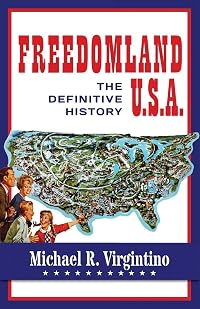
Freedomland U.S.A.: The Definitive History
by Michael R. Virgintino
On This Page
Description
The Story of America's Park After being fired by Walt Disney, the flamboyant C.V. Wood brought his hard-won experience as the self-titled "master builder of Disneyland" east, to a marsh in the Bronx, where in 1960 he unveiled his greatest project, a doomed theme park to tell the history of America: Freedomland. Wood's efforts to build his "Disneyland of the East," a themed collection of lands that presented epic moments in American history as thrill rides, shows, and live action, were show more plagued from the start by politics, cost overruns, and financial chicanery. Despite these obstacles, the park prospered-until its big-money backers (as they had planned from the start) pulled the plug and cleared the land for lucrative urban development. Through a well-researched narrative, personal and newspaper accounts, interviews, and exclusive photos, journalist and author Michael R. Virgintino presents the definitive history of Freedomland, from the people behind its creation, and the executives, en... show lessTags
Recommendations
Member Recommendations
Member Reviews
It sounds make believe, but for five seasons from 1960 to 1964, a theme park that legitimately claimed to be bigger and better than Disneyland operated in the northeast corner of the Bronx. n fact, the park was designed by the firm of C.V. Wood, who had worked on Disneyland before having a falling out with Walt. Many Disneyland veterans worked for Wood's company as well.The park was shaped like a map of the lower 48 states and was divided into seven themed lands:
This book includes detailed description of the lands, attractions, restaurants, and memories of park-goers and employees. A lot of the book is written in list format rather in narrative that makes it less fun to read, but the material is fascinating nonetheless.
A lot of reasons are given why Freedomland failed. The biggest is that unlike Southern California, the climate of New York meant the park could only operate seasonally. Although Virginitino notes that proposals to open Freedomland for special holiday events for Halloween and Christmas were never followed-up on (the same types of things that regional parks in the northern climes do today for added revenue). Another reason for the failure, one that the park's owners harped on, is that Freedomland could not compete with the New York World's Fair (and its Disney-built attractions) which opened in 1964. Virginitino notes that in reality, Freedomland was planned with the knowledge of the World's Fair coming and the hope to piggyback on the fair's success. By 1964, Freedomland had already downsized considerably and sold off some of its most ambitious attractions, so that probably affected attendance more than the fair.
Virgintino also puts forward the idea that the property owners (real estate developers separate from the management of the park) had always intended for Freedomland to be temporary. Plans for Co-Op City, which was eventually built on the site, were put forward in the 1950s. The author's evidence suggests that the the Freedomland structures built on the marshy landfill served the purpose of convincing the government to allow the variances to build the more profitable
Regardless, it's hard to imagine Freedomland being able to persevere through the Bronx's really bad times of the 1970s and 1980s. Also the the superpatriotic theming of the park would've been a hard sell as early as the counterculture era of the late 1960s. Nevertheless, I wish Freedomland had survived. My mother, who grew up in the Bronx, has fond memories of visiting Freedomland in her teen years, and I wish I could've gone there with her when I was young.
Oddly, little bits of Freedomland have showed up in my life without me even knowing it. A sternwheeler that sailed at Freedomland was renamed the Mark Twain and was docked for many years by the Steamboat Hotel in Greenwich, Connecticut. Two of the Freedomland trains were loaned by Edaville Railroad in South Carver, Massachusetts. And a 20 foot cutout figure of Paul Bunyan later stood outside of United House Wrecking in Stamford, Connecticut during my childhood.
Favorite Passages:
- LIttle Old New York - an entry land in a late 19th-century style
- Old Chicago - which included regular reenactments of the Great Fire of 1871
- The Great Plains - which featured a replica army stockade and a stagecoach ride
- San Francisco - home to an earthquake dark ride and the
- Northwest Fur Trapper boat ride (Freedomland's answer to the Jungle Cruise)
- The Old Southwest - where the park's train ride was often boarded by masked robbers
- New Orleans/Mardi Gras - opened before Disneyland's New Orleans Square and had a pirate-themed ride called Buccaneer. Also home to a Civil War reenactment.
- Satellite City – The Future - where visitors could visit a recreation of a Cape Canaveral control room and watch a simulated space mission
This book includes detailed description of the lands, attractions, restaurants, and memories of park-goers and employees. A lot of the book is written in list format rather in narrative that makes it less fun to read, but the material is fascinating nonetheless.
A lot of reasons are given why Freedomland failed. The biggest is that unlike Southern California, the climate of New York meant the park could only operate seasonally. Although Virginitino notes that proposals to open Freedomland for special holiday events for Halloween and Christmas were never followed-up on (the same types of things that regional parks in the northern climes do today for added revenue). Another reason for the failure, one that the park's owners harped on, is that Freedomland could not compete with the New York World's Fair (and its Disney-built attractions) which opened in 1964. Virginitino notes that in reality, Freedomland was planned with the knowledge of the World's Fair coming and the hope to piggyback on the fair's success. By 1964, Freedomland had already downsized considerably and sold off some of its most ambitious attractions, so that probably affected attendance more than the fair.
Virgintino also puts forward the idea that the property owners (real estate developers separate from the management of the park) had always intended for Freedomland to be temporary. Plans for Co-Op City, which was eventually built on the site, were put forward in the 1950s. The author's evidence suggests that the the Freedomland structures built on the marshy landfill served the purpose of convincing the government to allow the variances to build the more profitable
Regardless, it's hard to imagine Freedomland being able to persevere through the Bronx's really bad times of the 1970s and 1980s. Also the the superpatriotic theming of the park would've been a hard sell as early as the counterculture era of the late 1960s. Nevertheless, I wish Freedomland had survived. My mother, who grew up in the Bronx, has fond memories of visiting Freedomland in her teen years, and I wish I could've gone there with her when I was young.
Oddly, little bits of Freedomland have showed up in my life without me even knowing it. A sternwheeler that sailed at Freedomland was renamed the Mark Twain and was docked for many years by the Steamboat Hotel in Greenwich, Connecticut. Two of the Freedomland trains were loaned by Edaville Railroad in South Carver, Massachusetts. And a 20 foot cutout figure of Paul Bunyan later stood outside of United House Wrecking in Stamford, Connecticut during my childhood.
Favorite Passages:
Freedomland’s employees were slotted within 54 categories, some of which were not listed by big city employment agencies at the time. Many employees were required to possess unique skills, including buffalo wrangler, carrousel horse jeweler, totem pole carver, and stage coach harness-maker.
Other odd occupations at the park included pretzel bending, seal keeping, doughnut rolling, can-can dancing, glassblowing, and space tracking. The park also employed a skin diver who regularly inspected the Great Lakes for purity and maintenance
A new attraction was five new-born burros appropriately named Bronx, Brooklyn, Queens, Manhattan, and Staten Island.show less
Members
- Recently Added By
Author Information
1 Work 15 Members
Classifications
- Genre
- Nonfiction
Statistics
- Members
- 15
- Popularity
- 1,594,415
- Reviews
- 1
- Rating
- (3.00)
- Languages
- English
- Media
- Paper
- ISBNs
- 1