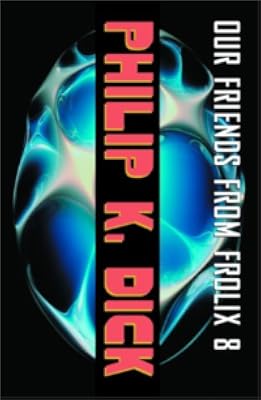
Our Friends from Frolix 8
by Philip K. Dick
On This Page
Description
"This satirical adventure from Philip K. Dick deals with issues of power, class, and politics, set in a world ruled by big-brained elites. In Our Friends from Frolix 8, the world is run by an elite few. And what determines whether one is part of the elite isn't wealth or privilege, but brains. As children, every citizen of Earth is tested; some are found to be super-smart New Men and some are Unusuals, with various psychic powers. The vast majority are Undermen, performing menial jobs in an show more overpopulated world. Nick Appleton is an Underman, content to go with the flow and eke out an existence as a tire regroover. But after his son is classified as an Underman, Appleton begins to question the hierarchy. Strengthening his resolve, and energizing the resistance movement, is news that the great resistance leader Thors Provoni is returning from a trip to the furthest reaches of space. And he's brought help: a giant, indestructible alien"-- show lessTags
Recommendations












Member Reviews
3 if you're a Dick fan, 2.5 if you're not. This is mid-level PKD. It has most of his favorite themes, which to me doesn't mean "what is real," but rather who can you trust, broken marriages, depression, drug cocktails, an imminent all-powerful alien intrusion, and, of course, tire re-grooving. Tire re-grooving was his most excellent choice of the worst possible job in the world in his 1959 non-SF Confessions of a Crap Artist. Since that book wasn't publishable at the time, he brought it back for this novel. The setting is reminiscent Minority Report, except here the world is being run by two competing groups: the telepathic Unusual Men and the intellectually superior New Men. Old Men, i.e., the rest of us, get along as best we can, and show more one of the recurring discussions in the book is how personal security and maybe love is all that really matters to most people, not the global or galactic politics. The imminent intrusion is one human who went to the stars and is coming back with the eponymous friend from Frolix 8, with the power to change to all, and perhaps only good intentions. PKD's plots are shakey at best. This one moves along OK. Unlike much SF of the period, PKD usually knew how to finish his books. I feel the last 6 pages of the book make the rest the novel worth reading. show less
I have really mixed feelings about this one. The main character is a bit of a scumbag. But you're seeing everything through his eyes, so you wind up feeling kind of dirty, like you're not supposed to think he's a scumbag. If you can keep those feelings at bay and maybe care still care what happens to the guy anyway, then this is a great story.
In classic PKD fashion, this one sets up a situation that's very clearly unjust, infuriatingly so. Then he proceeds to pick at the complexities of the situation, and then when it's resolved, you're left with a lot to think about. You can see your initial gut reaction to the situation was naively simplistic. And the whole thing ends on a note of compassion and empathy, which is good.
As in most PKD show more novels, a lot of crazy stuff happens, and nobody's ever 100% sure what's going on and why. The far-out sci-fi premises do a good job of making you feel like you're finding your way in an indecipherable universe, gradually making your way up that Mercerian hill. This is what regular, day-to-day life feels like to me, so it's nice to find somebody who gets it. show less
In classic PKD fashion, this one sets up a situation that's very clearly unjust, infuriatingly so. Then he proceeds to pick at the complexities of the situation, and then when it's resolved, you're left with a lot to think about. You can see your initial gut reaction to the situation was naively simplistic. And the whole thing ends on a note of compassion and empathy, which is good.
As in most PKD show more novels, a lot of crazy stuff happens, and nobody's ever 100% sure what's going on and why. The far-out sci-fi premises do a good job of making you feel like you're finding your way in an indecipherable universe, gradually making your way up that Mercerian hill. This is what regular, day-to-day life feels like to me, so it's nice to find somebody who gets it. show less
If you were wondering what Phil’s writing was like when living through what eventually became the source material for A Scanner Darkly, this book is your answer. This book is an amphetamine driven mess. He must have had a drop dead deadline and popped insane amounts of speed to get it written. There are many speed freak conversations in A Scanner Darkly. That paranoid gibberish is supposed to be what's chronicled in that book. This is not a chronicle or commentary on amphetamine thought -it is amephetamine thought. This kind of pace and thinking can give you a rush in other PKD books, but not at this point. I was afraid after finishing it I might come away with a permanent eye twitch.
To back track, I had just read The Broken Bubble show more which was supposed to be written in 56, at least a decade previous to this. There's a young bohemian couple in that novel and they are back, more in focus in this novel, and more street wise and savage. Even the fancy hot rod, -"The Horch"has returned, this time as a "squib"-named the "Purple Sea Cow". So the hot rod that the real life kids owned, who are the inspiration for these characters, apparently impressed the shit out of Phil.
PKD’s probs with women reach a head in this methamphetamine hydrochloride (named checked in the book) soaked ramble. The absolute worst I’ve seen yet -they are all shrews, harpies and robots. I had pulled out all the PKD I haven’t read yet, and was going to do a run, but I think the run has ended prematurely. Of everything I've read so far, this could be his lowest point as an established writer, both intellectually and spriritually. I'm not in a hurry to find out there's a step below this.
To quote Thors Provoni -the savior in this book, thinking about what he's going to do when he gets back to earth:
"I'll sit there at a drugbar, he said to himself, and have one capsule, pellet, tablet and spansule after another. I'll frost myself into invisibility. I'll fly like a raven, like a crow; I'll cackle and chirp my way across the fields of greenhouses, into the sunlight and out of it..." show less
To back track, I had just read The Broken Bubble show more which was supposed to be written in 56, at least a decade previous to this. There's a young bohemian couple in that novel and they are back, more in focus in this novel, and more street wise and savage. Even the fancy hot rod, -"The Horch"has returned, this time as a "squib"-named the "Purple Sea Cow". So the hot rod that the real life kids owned, who are the inspiration for these characters, apparently impressed the shit out of Phil.
PKD’s probs with women reach a head in this methamphetamine hydrochloride (named checked in the book) soaked ramble. The absolute worst I’ve seen yet -they are all shrews, harpies and robots. I had pulled out all the PKD I haven’t read yet, and was going to do a run, but I think the run has ended prematurely. Of everything I've read so far, this could be his lowest point as an established writer, both intellectually and spriritually. I'm not in a hurry to find out there's a step below this.
To quote Thors Provoni -the savior in this book, thinking about what he's going to do when he gets back to earth:
"I'll sit there at a drugbar, he said to himself, and have one capsule, pellet, tablet and spansule after another. I'll frost myself into invisibility. I'll fly like a raven, like a crow; I'll cackle and chirp my way across the fields of greenhouses, into the sunlight and out of it..." show less
This is not Philip K. Dick's best book, but I enjoyed it.
None of the characters are particularly likeable, except maybe the girl, which is typical for Dick, but the action and the ideas were plenty interesting enough to keep me reading. Given it was written in 1970, the surveillance society depicted in it -- flying cameras, rooms of computers gathering data, politicans assessing the effect of their policies on the 'average man' -- seemed uncannily topical. And the Council Leader Willis Gram, with his inability to separate the personal from the public, didn't half remind me of Trump. I felt the New Men/Unusuals must represent the two-party system in some way, but not being American I'm not familiar enough with the Democrats and show more Republicans to infer much from that. And what that makes the Old Men, I'm not sure.
But that's the beauty of Dick's writing: it gets you thinking about deeper meanings.
However, the plot is pretty simple and the alien was perhaps a tad too all-powerful to be believed. But then, given the title I'm not sure this book was meant to be taken entirely seriously. show less
None of the characters are particularly likeable, except maybe the girl, which is typical for Dick, but the action and the ideas were plenty interesting enough to keep me reading. Given it was written in 1970, the surveillance society depicted in it -- flying cameras, rooms of computers gathering data, politicans assessing the effect of their policies on the 'average man' -- seemed uncannily topical. And the Council Leader Willis Gram, with his inability to separate the personal from the public, didn't half remind me of Trump. I felt the New Men/Unusuals must represent the two-party system in some way, but not being American I'm not familiar enough with the Democrats and show more Republicans to infer much from that. And what that makes the Old Men, I'm not sure.
But that's the beauty of Dick's writing: it gets you thinking about deeper meanings.
However, the plot is pretty simple and the alien was perhaps a tad too all-powerful to be believed. But then, given the title I'm not sure this book was meant to be taken entirely seriously. show less
I began reading this book just as the "Operation Varsity Blues" college admissions scandal story broke, and in confirmation of the unspoken rule that "all politics is in Philip K Dick somewhere", the very first chapter involves the main character's son having his score on an admissions test invalidated so that the rule of the elite can continue unabated. Fittingly, this is one of his more political novels, and yet one of the few with a happy ending. I liked it, but with the caveats appropriate to its minor-tier status.
The basic setup of the novel involves a future Earth with 3 types of people: the Old Men, who are normal humans; the New Men, who have much higher IQ; and the Unusuals, who have mutations like telepathy. The latter two show more groups, though vastly outnumbered by ten thousand to several billion, rule society via a combination of natural superiority and outright fraud, such as changing test scores to lock even promising Old Men out of the upper echelons of power. Protagonist Nick Appleton, a more-or-less typical PKD stand-in, is an Old Man with the almost Onion-esque crap job of "tire regroover"; when the tires of flying cars get low on tread, he etches new grooves on them, which also cuts them dangerously thin. Life sucks in this class-stratified society with omnipresent government surveillance where both alcohol and subversive literature are banned, but there is hope - one dual New Man/Unusual, Thors Provoni, stole a prototype FTL spaceship 10 years ago and is rumored to be returning to Earth in the company of an alien power who will upend the corrupt social order.
I hadn't read any PKD in a while, so it was striking to see the relative absence of reality-questioning and simultaneous increase in politics here, especially against such a relevant backdrop as the college scam stuff. Anti-government themes are to PKD as murders are to Agatha Christie, of course, but there's an uneasy model of politics here, as developed in the plot: both an alien and a renegade Unusual/New Man were required to break up the oligarchic tyranny of the New Men and the Unusuals (who are so entitled that one government official spends an inordinate amount of time trying to steal the protagonist's side chick), but the alien itself, the titular Friend from Frolix 8, is a pure MacGuffin, a sideshow who doesn't even show up until the second half of the book, and vanishes almost immediately after landing on Earth and shifting the balance of power by psychically removing the powers of the elites (excepting Provoni?). The book ends with the Old Men establishing rehabilitation camps for the newly depowered and infantilized Unusuals and New Men, but it's not a very satisfying ending, since we don't see what the new future is actually like. Is the alien going to swallow up all independent life on Earth or not? Childhood's End this isn't. I won't torture the novel to produce allegories for the real world, but I was struck by the helplessness of the majority to change anything about their world, and subsequent reliance on the mutant and the alien.
Also notable for me were PKD's trademark issues with pacing (major life decisions are made almost instantly for odd and seemingly implausible reasons, meanwhile important backstory is delivered in expository chapters while nothing is happening) and his equally signature idiosyncrasies with women. There's an uninentionally revealing internal monologue late in the book delivered by Police Commissioner Gram, the aforementioned official trying to steal Nick's side chick Charlotte, who Nick suddenly abandoned his wife Kleo and several children for after having known her for several minutes:
"You brought Charlotte to your apartment, made up a lie as to how you got involved with her, and then Kleo found the Cordonite tract, and blam, that was it. Because it gave her what a wife likes best: a situation in which her husband has to choose between two evils, between two choices neither of which is palatable to him. Wives love that. When you're in court, divorcing one, you get presented with a choice between going back to her or losing all your possessions, your property, stuff you've hung onto since high school. Yeah, wives really like that."
And a few chapters later, Gram reflects further on his sudden lust for this young woman, who like Nick he has known for essentially no time at all:
"That's the trouble with being that age, he reflected. You idealize the whole woman, her self, her personality… but at my age it's simply how good a lay they'd make and that's that. I'll enjoy her, use her up, teach her a few things she probably doesn't know about sexual relations – even though she's 'been around' – that she hasn't dreamed up. She can be my little fish, for example. And once she learns them, does them, she'll remember them the rest of her life. They'll haunt her, the memory of them… but on some level she'll be yearning for them again: they were so nice. Let's see what Nick Appleton, or Denny Strong, or whoever gets her after me, will do to gratify that. And she won't be able to force herself to tell him what it is that's the matter."
Hmm. Somewhat redeeming all this is the presence of perhaps the best awful sex scene in all of PKD's oeuvre a few chapters later. Immediately after the police have murdered her ex-boyfriend Denny Strong, Charlotte takes Nick to Central Park in Denny's car and flatly tells him they're going to have sex. She starts removing his clothes at the verbal equivalent of gunpoint, he tells her she has small breasts, and he starts babbling about Yeats, statutory rape, and Denny while trying to put his clothes back on. Didn't he just abandon his entire family for her, and hasn't he been fighting the equivalent of the head of secret police for the entire planet over this girl? Clearly PKD was working through some of his own marriage issues via Charlotte (the very year after this book was published his wife left him), but it's distractingly unsubtle to read. Additionally, the focus on police reminded me of the far superior treatment he would provide 5 years later in Flow My Tears, the Policeman Said; this is essentially the last of the amphetamine-fueled pulp novels that he cranked out at unhealthy velocity.
And yet throughout you're reminded constantly why you're reading PKD, who can transform even the roughest pacing, plotting, and characterization into a memorable science-fiction vision of desperate politics and thought-provoking prognostication. The book's recurring conceit that in the future alcohol will be all but outlawed yet pharmaceutical cocktails are eaten like candy and opium is universally consumed is funny, and there's an interesting throwaway reference to J.W. Dunne's An Experiment With Time, a 1927 discussion of precognitive dreams which obviously had a large influence on PKD's own work as well as several other famous sci-fi authors. The horror of the power of the alien is delivered with a nearly Stephen King intensity, yet as the potential of the alien power to transform human society into an equitable, open, and loving world are delightful passages that show his gift for the right imagery at the right time:
"Your race is xenophobic. And I am the ultimate foreigner. I love you, Mr. Provoni; I love your people… insofar as I know them through your mind. I will not do what I can do, but I will make them know what I can do. In your mind's memory-section there is a Zen story about the greatest swordsman in Japan. Two men challenge him. They agree to row out to a small island and fight there. The greatest swordsman in Japan, being a student of Zen, sees to it that he is last to leave the boat. The moment the others have leaped out onto the shore of the island he pushes off, rows away, leaving them and their swords there. Thus he proves his claim for what he is: indeed he is the finest swordsman in Japan. Do you see the application to my situation? I can outfight your establishment, but I will do so by not-fighting... if you follow my thought. It will be in fact be my refusal to fight – yet showing my strength – which will frighten them the most, because they cannot imagine such power held but not used."
A hopeful vision of power like that is all too rare in PKD's novels, and so while this is neither his most technically accomplished nor intellectually adventurous novel, it is a worthy entry all the same. show less
The basic setup of the novel involves a future Earth with 3 types of people: the Old Men, who are normal humans; the New Men, who have much higher IQ; and the Unusuals, who have mutations like telepathy. The latter two show more groups, though vastly outnumbered by ten thousand to several billion, rule society via a combination of natural superiority and outright fraud, such as changing test scores to lock even promising Old Men out of the upper echelons of power. Protagonist Nick Appleton, a more-or-less typical PKD stand-in, is an Old Man with the almost Onion-esque crap job of "tire regroover"; when the tires of flying cars get low on tread, he etches new grooves on them, which also cuts them dangerously thin. Life sucks in this class-stratified society with omnipresent government surveillance where both alcohol and subversive literature are banned, but there is hope - one dual New Man/Unusual, Thors Provoni, stole a prototype FTL spaceship 10 years ago and is rumored to be returning to Earth in the company of an alien power who will upend the corrupt social order.
I hadn't read any PKD in a while, so it was striking to see the relative absence of reality-questioning and simultaneous increase in politics here, especially against such a relevant backdrop as the college scam stuff. Anti-government themes are to PKD as murders are to Agatha Christie, of course, but there's an uneasy model of politics here, as developed in the plot: both an alien and a renegade Unusual/New Man were required to break up the oligarchic tyranny of the New Men and the Unusuals (who are so entitled that one government official spends an inordinate amount of time trying to steal the protagonist's side chick), but the alien itself, the titular Friend from Frolix 8, is a pure MacGuffin, a sideshow who doesn't even show up until the second half of the book, and vanishes almost immediately after landing on Earth and shifting the balance of power by psychically removing the powers of the elites (excepting Provoni?). The book ends with the Old Men establishing rehabilitation camps for the newly depowered and infantilized Unusuals and New Men, but it's not a very satisfying ending, since we don't see what the new future is actually like. Is the alien going to swallow up all independent life on Earth or not? Childhood's End this isn't. I won't torture the novel to produce allegories for the real world, but I was struck by the helplessness of the majority to change anything about their world, and subsequent reliance on the mutant and the alien.
Also notable for me were PKD's trademark issues with pacing (major life decisions are made almost instantly for odd and seemingly implausible reasons, meanwhile important backstory is delivered in expository chapters while nothing is happening) and his equally signature idiosyncrasies with women. There's an uninentionally revealing internal monologue late in the book delivered by Police Commissioner Gram, the aforementioned official trying to steal Nick's side chick Charlotte, who Nick suddenly abandoned his wife Kleo and several children for after having known her for several minutes:
"You brought Charlotte to your apartment, made up a lie as to how you got involved with her, and then Kleo found the Cordonite tract, and blam, that was it. Because it gave her what a wife likes best: a situation in which her husband has to choose between two evils, between two choices neither of which is palatable to him. Wives love that. When you're in court, divorcing one, you get presented with a choice between going back to her or losing all your possessions, your property, stuff you've hung onto since high school. Yeah, wives really like that."
And a few chapters later, Gram reflects further on his sudden lust for this young woman, who like Nick he has known for essentially no time at all:
"That's the trouble with being that age, he reflected. You idealize the whole woman, her self, her personality… but at my age it's simply how good a lay they'd make and that's that. I'll enjoy her, use her up, teach her a few things she probably doesn't know about sexual relations – even though she's 'been around' – that she hasn't dreamed up. She can be my little fish, for example. And once she learns them, does them, she'll remember them the rest of her life. They'll haunt her, the memory of them… but on some level she'll be yearning for them again: they were so nice. Let's see what Nick Appleton, or Denny Strong, or whoever gets her after me, will do to gratify that. And she won't be able to force herself to tell him what it is that's the matter."
Hmm. Somewhat redeeming all this is the presence of perhaps the best awful sex scene in all of PKD's oeuvre a few chapters later. Immediately after the police have murdered her ex-boyfriend Denny Strong, Charlotte takes Nick to Central Park in Denny's car and flatly tells him they're going to have sex. She starts removing his clothes at the verbal equivalent of gunpoint, he tells her she has small breasts, and he starts babbling about Yeats, statutory rape, and Denny while trying to put his clothes back on. Didn't he just abandon his entire family for her, and hasn't he been fighting the equivalent of the head of secret police for the entire planet over this girl? Clearly PKD was working through some of his own marriage issues via Charlotte (the very year after this book was published his wife left him), but it's distractingly unsubtle to read. Additionally, the focus on police reminded me of the far superior treatment he would provide 5 years later in Flow My Tears, the Policeman Said; this is essentially the last of the amphetamine-fueled pulp novels that he cranked out at unhealthy velocity.
And yet throughout you're reminded constantly why you're reading PKD, who can transform even the roughest pacing, plotting, and characterization into a memorable science-fiction vision of desperate politics and thought-provoking prognostication. The book's recurring conceit that in the future alcohol will be all but outlawed yet pharmaceutical cocktails are eaten like candy and opium is universally consumed is funny, and there's an interesting throwaway reference to J.W. Dunne's An Experiment With Time, a 1927 discussion of precognitive dreams which obviously had a large influence on PKD's own work as well as several other famous sci-fi authors. The horror of the power of the alien is delivered with a nearly Stephen King intensity, yet as the potential of the alien power to transform human society into an equitable, open, and loving world are delightful passages that show his gift for the right imagery at the right time:
"Your race is xenophobic. And I am the ultimate foreigner. I love you, Mr. Provoni; I love your people… insofar as I know them through your mind. I will not do what I can do, but I will make them know what I can do. In your mind's memory-section there is a Zen story about the greatest swordsman in Japan. Two men challenge him. They agree to row out to a small island and fight there. The greatest swordsman in Japan, being a student of Zen, sees to it that he is last to leave the boat. The moment the others have leaped out onto the shore of the island he pushes off, rows away, leaving them and their swords there. Thus he proves his claim for what he is: indeed he is the finest swordsman in Japan. Do you see the application to my situation? I can outfight your establishment, but I will do so by not-fighting... if you follow my thought. It will be in fact be my refusal to fight – yet showing my strength – which will frighten them the most, because they cannot imagine such power held but not used."
A hopeful vision of power like that is all too rare in PKD's novels, and so while this is neither his most technically accomplished nor intellectually adventurous novel, it is a worthy entry all the same. show less
Our Friends From Frolix 8 is a pretty good story, although far from perfect. Surprisingly, it's a fairly linear sci fi story from Dick, without his alternate worlds and universes he wrote so much about. And this was published in 1970, while Dick was pretty much at his height of alternate worlds.
The plot is about Nick Appleton, a tire "regroover," who lives in a futuristic world (about 200 years from now) governed by large headed New Men (with large IQs) and Unusuals, who possess telepathic abilities. The rest of the seven billion humans are Old Men or Under Men, who are fighting a silent revolution to one day overthrow the system.
Nick takes his son for a mandatory civil service exam, which he thinks his son will pass and which will lead show more him to a better life than Nick has. However, the exam is rigged and his son fails, disillusioning Nick.
Nick finds himself at work conversing with his boss about things. Big things are happening. A revolutionary leader who has been jailed, but who has written numerous illegal pamphlets and booklets is about to be executed. The primary revolutionary, Thors Provino, took off in a space ship 10 years ago, but is apparently headed back to Earth with help, presumably from an alien or aliens. Like I said, big stuff. Nick's boss talks him into sharing an illegal beer with him and discusses the illegal literature, before taking Nick to a dealer of this literature. There Nick meets a 16 year old girl named Charley, the dealer's girlfriend, and he is smitten. I know, I know -- Dick and his adolescent girls. He had problems, what can I say?
The dealer goes crazy and attacks Charley, and Nick and Charley take off for safety. And he takes her home to his wife and son. Crazy, right? Well, his wife is generally okay with things until she finds an illegal pamphlet in Charley's coat and insists she leaves. To her consternation, Nick leaves with her. They take shelter at a big printing place, where the illegal pamphlets are printed. Meanwhile, Council Chairman Willis Gram, the world dictator who lies around in his pajamas all day, is panicking about the thought of Thors returning with an alien to take over. He orders the prison camps to be opened and everyone released as a good will gesture, but at the same time, orders an attack against the printing plant. There, Nick and Charley are captured. Gram falls for Charley (how does she have this hold over men?) and releases Nick, but Charley escapes Gram's clutches and takes off. Gram realizes she's probably going to go back to Nick, so he puts out a warrant for Nick which they find out about at the dealer's apartment when the cops (pissers) show up. The dealer, Denny, is killed and Charley and Nick take off.
What's happening with Thors? Well, he IS returning with an alien, from Frolix 8. He's lived millions of years and is a 90 ton gelatinous slime blob. He encompasses the ship, protecting it from missiles the army is sending up against the space ship. He feeds on things and grows. They announce they're landing in Times Square and Gram ships a huge laser up from Baltimore to incinerate Thors upon landing. They land eight hours early, but the laser is ready and they fire, only to find the alien devouring the beam and growing larger.
At some point, Charley and Nick find themselves in Central Park, where they make love and Nick recites a Yeats poem. Gotta get the statutory rape in there, don'tcha Phil? They take off in their squib, followed closely by two pissers and Charley crashes and dies violently. That seemed unnecessary, but I guess that's the only way Dick knew to close things. The alien starts telepathically lobotomizing the New Men, rendering them useless and Nick confronts Gram, where things basically end. The last few pages are pretty interesting, but I won't go into more detail here -- I've already shared enough.
In this book, there are drug bars, where people can legally get high and in this book, too, everyone is a walking pharmacist. It's bizarre to think that your average person would know so much about drugs. Dick also brings Biblical themes into play, as well as race, divorce, and futuristic gadgets, all themes and things he wrote so much about. This isn't one of his better known works, and there are some textual inconsistencies (with dates especially) and the dialogue is often somewhat clunky, but it's a fun story and it's pretty action packed, so I suspect many Dick fans will like this book, as will many other readers. I can't give it five stars because it's not his best, but it's a solid four star effort and as such, it's recommended. show less
The plot is about Nick Appleton, a tire "regroover," who lives in a futuristic world (about 200 years from now) governed by large headed New Men (with large IQs) and Unusuals, who possess telepathic abilities. The rest of the seven billion humans are Old Men or Under Men, who are fighting a silent revolution to one day overthrow the system.
Nick takes his son for a mandatory civil service exam, which he thinks his son will pass and which will lead show more him to a better life than Nick has. However, the exam is rigged and his son fails, disillusioning Nick.
Nick finds himself at work conversing with his boss about things. Big things are happening. A revolutionary leader who has been jailed, but who has written numerous illegal pamphlets and booklets is about to be executed. The primary revolutionary, Thors Provino, took off in a space ship 10 years ago, but is apparently headed back to Earth with help, presumably from an alien or aliens. Like I said, big stuff. Nick's boss talks him into sharing an illegal beer with him and discusses the illegal literature, before taking Nick to a dealer of this literature. There Nick meets a 16 year old girl named Charley, the dealer's girlfriend, and he is smitten. I know, I know -- Dick and his adolescent girls. He had problems, what can I say?
The dealer goes crazy and attacks Charley, and Nick and Charley take off for safety. And he takes her home to his wife and son. Crazy, right? Well, his wife is generally okay with things until she finds an illegal pamphlet in Charley's coat and insists she leaves. To her consternation, Nick leaves with her. They take shelter at a big printing place, where the illegal pamphlets are printed. Meanwhile, Council Chairman Willis Gram, the world dictator who lies around in his pajamas all day, is panicking about the thought of Thors returning with an alien to take over. He orders the prison camps to be opened and everyone released as a good will gesture, but at the same time, orders an attack against the printing plant. There, Nick and Charley are captured. Gram falls for Charley (how does she have this hold over men?) and releases Nick, but Charley escapes Gram's clutches and takes off. Gram realizes she's probably going to go back to Nick, so he puts out a warrant for Nick which they find out about at the dealer's apartment when the cops (pissers) show up. The dealer, Denny, is killed and Charley and Nick take off.
What's happening with Thors? Well, he IS returning with an alien, from Frolix 8. He's lived millions of years and is a 90 ton gelatinous slime blob. He encompasses the ship, protecting it from missiles the army is sending up against the space ship. He feeds on things and grows. They announce they're landing in Times Square and Gram ships a huge laser up from Baltimore to incinerate Thors upon landing. They land eight hours early, but the laser is ready and they fire, only to find the alien devouring the beam and growing larger.
At some point, Charley and Nick find themselves in Central Park, where they make love and Nick recites a Yeats poem. Gotta get the statutory rape in there, don'tcha Phil? They take off in their squib, followed closely by two pissers and Charley crashes and dies violently. That seemed unnecessary, but I guess that's the only way Dick knew to close things. The alien starts telepathically lobotomizing the New Men, rendering them useless and Nick confronts Gram, where things basically end. The last few pages are pretty interesting, but I won't go into more detail here -- I've already shared enough.
In this book, there are drug bars, where people can legally get high and in this book, too, everyone is a walking pharmacist. It's bizarre to think that your average person would know so much about drugs. Dick also brings Biblical themes into play, as well as race, divorce, and futuristic gadgets, all themes and things he wrote so much about. This isn't one of his better known works, and there are some textual inconsistencies (with dates especially) and the dialogue is often somewhat clunky, but it's a fun story and it's pretty action packed, so I suspect many Dick fans will like this book, as will many other readers. I can't give it five stars because it's not his best, but it's a solid four star effort and as such, it's recommended. show less
This was short and... not so weird. But also not so good (Dick thought so, too). Bit of an abrupt ending. But the themes are interesting and the presence of a dead god: that's a great concept. Recommended when you have read the classics and want more.
Members
- Recently Added By
Lists

Books Read in 2023
5,638 works; 147 members

1970 Club
85 works; 2 members
Author Information

677+ Works 147,132 Members
Phillip Kindred Dick was an American science fiction writer best known for his psychological portrayals of characters trapped in illusory environments. Born in Chicago, Illinois, on December 16, 1928, Dick worked in radio and studied briefly at the University of California at Berkeley before embarking on his writing career. His first novel, Solar show more Lottery, was published in 1955. In 1963, Dick won the Hugo Award for his novel, The Man in the High Castle. He also wrote a series of futuristic tales about artificial creatures on the loose; notable of these was Do Androids Dream of Electric Sheep?, which was later adapted into film as Blade Runner. Dick also published several collections of short stories. He died of a stroke in Santa Ana, California, in 1982. (Bowker Author Biography) show less
Some Editions
Series
Belongs to Publisher Series
Work Relationships
Is contained in
Common Knowledge
- Canonical title
- Our Friends from Frolix 8
- Original title
- Our Friends from Frolix 8
- Original publication date
- 1970-06
- People/Characters
- Thors Provoni; Willis Gram; Nick Appleton; Charley Boyer; Denny Strong; Bobby Appleton (show all 48); Kleo Appleton; Norbert Weiss; Jerome Pikeman; Ed Garley; Rose Arlen; Carole; Darby Shire; Lloyd Barnes; Eric Cordon; Miss Knight; Horace Denfeld; Irma Gram; Alice Noyes; Dr. Radcliff; Amos Ild; Munro Capp; Earl Zeta; Fred; Fred Huff; Morgo Rahn Wilc; Gran Ce Wank; Wade Ellis; Captain Malliard; Tom Rovere; Stanton Finch; Fred Rayner; Duke Bostrich; Patty Platt; General Hefele; General Rayburn; Mary Scourby; Captain Greco; Camelia Grimes; Margaret Plow; Wade Scenera; Sir Herbert London; Dave Christian; Ed Woodman; Elka Woodman; Bob Grizwald; Marshall; Horse Faced Brunwell
- First words
- Bobby said. 'I don't want to take the test.'
- Last words
- (Click to show. Warning: May contain spoilers.)With the vastness of God.
- Original language
- English
Classifications
Statistics
- Members
- 1,238
- Popularity
- 19,948
- Reviews
- 17
- Rating
- (3.36)
- Languages
- 9 — Dutch, English, French, German, Hungarian, Italian, Japanese, Polish, Spanish
- Media
- Paper, Audiobook, Ebook
- ISBNs
- 37
- ASINs
- 28