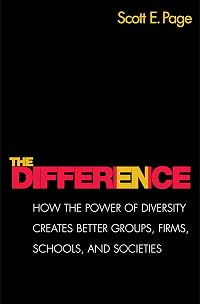
The Difference: How the Power of Diversity Creates Better Groups, Firms, Schools, and Societies
by Scott E. Page
On This Page
Description
In this landmark book, Scott Page redefines the way we understand ourselves in relation to one another. The Difference is about how we think in groups--and how our collective wisdom exceeds the sum of its parts. Why can teams of people find better solutions than brilliant individuals working alone? And why are the best group decisions and predictions those that draw upon the very qualities that make each of us unique? The answers lie in diversity--not what we look like outside, but what we show more look like within, our distinct tools and abilities. The Difference reveals that progress and innovation may depend less on lone thinkers with enormous IQs than on diverse people working together and capitalizing on their individuality. Page shows how groups that display a range of perspectives outperform groups of like-minded experts. Diversity yields superior outcomes, and Page proves it using his own cutting-edge research. Moving beyond the politics that cloud standard debates about diversity, he explains why difference beats out homogeneity, whether you're talking about citizens in a democracy or scientists in the laboratory. He examines practical ways to apply diversity's logic to a host of problems, and along the way offers fascinating and surprising examples, from the redesign of the Chicago "El" to the truth about where we store our ketchup. Page changes the way we understand diversity--how to harness its untapped potential, how to understand and avoid its traps, and how we can leverage our differences for the benefit of all. show lessTags
Recommendations














Member Reviews
One criticism of efforts to increase diversity in the workplace and other contexts suggests that attention should be on individual ability rather than on group differences. Page offers a logical and empirical (as opposed to an ideological) reply. A diverse group outperforms a group of individual experts under four conditions: the problem is hard, the people are smart, the people are diverse, and the group size is bigger than a handful and chosen from a large population. Given these conditions, "a randomly selected collection of problem solvers outperforms a collection of the best individual problem solvers." Importantly, "this theorem is no mere metaphor of cute empirical anecdote that may or may not be true ten years from now. It's a show more logical truth" in the same way that 1+1=2 is a logical truth. The goal of this book is to demonstrate the proof of this truth to a lay audience. Chapters 7-11 may be too theoretical for most readers, but they can be safely skimmed without risk of missing any major points.
Page speaks primarily of cognitive diversity, not cultural or ethnic, but given how easily these correlate to differing perspectives from which his discussion flows, it is not to large a leap to find here a powerful instrumental argument in favor of diversity. Chapters 12 and 13 review this question, and will probably be of most interest to the typical reader. show less
Page speaks primarily of cognitive diversity, not cultural or ethnic, but given how easily these correlate to differing perspectives from which his discussion flows, it is not to large a leap to find here a powerful instrumental argument in favor of diversity. Chapters 12 and 13 review this question, and will probably be of most interest to the typical reader. show less
Generally, I found the book most engaging for understanding perception, heuristics and decision making, although this did not seem to be the primary premise of the book. As for the writing, it was a bit long-winded, using analogies to make points, even though the concepts themselves are readily accessible without elucidation.
As to its purported focus, it provides academic, empirical, and statistical support for diversity, not necessarily racial or ethnic, with the premise being that diversity of viewpoint within groups is powerful, so much so that it trumps individual excellence.
As to its purported focus, it provides academic, empirical, and statistical support for diversity, not necessarily racial or ethnic, with the premise being that diversity of viewpoint within groups is powerful, so much so that it trumps individual excellence.
Referred through a link from Weinberger's Too big to know
Referred through a link from Weinberger's Too big to know
Ratings
Members
- Recently Added By
Lists

Books referenced in David Weinberger's Too Big to Know
65 works; 2 members

List of Removed Books from Nimitz Library
353 works; 1 member
Author Information

8 Works 1,058 Members
Scott E. Page is John Seely Brown Distinguished University Professor of Complexity, Social Science, and Management at the University of Michigan, the Williamson Family Professor of Business Administration at the Stephen M. Ross School of Business, and an external faculty member of the Santa Fe Institute.
Classifications
Statistics
- Members
- 246
- Popularity
- 132,354
- Reviews
- 4
- Rating
- (3.88)
- Languages
- English
- Media
- Paper, Ebook
- ISBNs
- 5
- ASINs
- 2