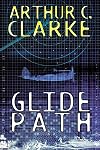
Glide Path
by Arthur C. Clarke
On This Page
Description
A gripping novel of human ingenuity during World War II, based on the visionary author's wartime experiences as a radar control operator.One of the most influential science fiction writers of the twentieth century, Arthur C. Clarke draws upon his own wartime experiences as a radar control operator during World War II to tell a compelling and fascinating story about the development and application of groundbreaking technologies. Clarke's only non-science fiction novel shines with the same show more qualities that made his award-winning space adventures timeless classics: topnotch suspense, up-to-date science, and memorable characters. A hidden gem in Clarke's impressive body of work, Glide Path is an enthralling read for both science fiction fans and history aficionados.
. show less
Tags
Recommendations












Member Reviews
This is often described as Clarke's non-sf novel, but it has a very similar feel to some of his hard sf. There is the same world building and sense of wonder inspired by science -- but the world he brings to life here was real and recent history. For this novel is a fictionalised account of the development of Ground Control Approach radar during the second world war, and Clarke draws upon his own experience of working on the project to safely talk down aircraft by radar.
It might sound dry, but it isn't. Clarke does a fine job on showing both the the technology, and the people who created the technology, with the interplay between different personalities, and the little and large incidents that make up life in a developmental project. show more The main character's not always that likeable a person, but in a way that makes him a believable viewpoint character rather than a stock hero. There's plenty of dramatic tension, and lighter moments as well, with both clearly being drawn at least in part from Clarke's own experiences. Glide Path is well worth a read for both sf readers and WW2 History buffs. show less
It might sound dry, but it isn't. Clarke does a fine job on showing both the the technology, and the people who created the technology, with the interplay between different personalities, and the little and large incidents that make up life in a developmental project. show more The main character's not always that likeable a person, but in a way that makes him a believable viewpoint character rather than a stock hero. There's plenty of dramatic tension, and lighter moments as well, with both clearly being drawn at least in part from Clarke's own experiences. Glide Path is well worth a read for both sf readers and WW2 History buffs. show less
During WWII, Flying Officer Alan Bishop is reassigned from England’s Northern Coastal Defence to a new project involving the development of a new radar-based airplane guidance system called Ground-Controlled Descent (GCD). Its purpose is to guide military craft to safe landings during dense fog or inclement weather. Along with a team of soldiers and scientists, and a trio of Women’s Auxiliary Air Force operators, Bishop leads the testing of the GCD in both staged exercises and actual landings in a small airfield near Land’s End in Cornwall.
Arthur C. Clarke’s only non-SF novel, Glide Path was inspired by his participation in the development of Ground Controlled Approach (GCA) during his wartime service with the Royal Air Force. show more
Such a topic alone does not constitute interesting fodder for fiction, and at times, I was reminded of Clarke’s Prelude to Space, a fictional chronicling of man’s first mission to the moon in the late 1950’s with little in the way of plot or conflict.
Much of the conflict in Glide Path remains in the background and stems from Bishop’s concerns over the declining health of his father, his feelings of inferiority compared to the brilliant scientists and skilled pilots on the team, pressure from skeptical generals, and an adversarial relationship with one particular RAF pilot who becomes competition for the affections of a local harlot. show less
Arthur C. Clarke’s only non-SF novel, Glide Path was inspired by his participation in the development of Ground Controlled Approach (GCA) during his wartime service with the Royal Air Force. show more
Such a topic alone does not constitute interesting fodder for fiction, and at times, I was reminded of Clarke’s Prelude to Space, a fictional chronicling of man’s first mission to the moon in the late 1950’s with little in the way of plot or conflict.
Much of the conflict in Glide Path remains in the background and stems from Bishop’s concerns over the declining health of his father, his feelings of inferiority compared to the brilliant scientists and skilled pilots on the team, pressure from skeptical generals, and an adversarial relationship with one particular RAF pilot who becomes competition for the affections of a local harlot. show less
An interesting read for me as I was intrigued to see Arthur C. Clarke in a non-science fiction genre. Also, I don't mind a good WWII fiction story. This wasn't a great WWII story and it also had what could be seen as a science element to it in that it covers ground directed radar for the RAF in guiding pilots down. I felt that this book is really for those interested in Clarke's work but wouldn't appeal to the general SF or War fiction readers.
Mr. Clarke is a master of explaining technical things to a layman, which explains his enduring popularity. That, and he writes great SF. Glide path is about two things; first, the development of advanced tracking radar to guide WWII planes safely down to the runway, second, it chronicles Alan Bishop's growth from a timid radar technician in the RAF into a Lieutenant in command of an airbase developing a very advanced radar system, of which parts are still in use today. The focus is really on the original Mark I that Bishop worked on and how he was more attached to it than his own family. All in all, a pretty good, and pretty quick read, perfect for those times when you are eagerly anticipating a package of books, one of which is to be show more immediately devoured, and the shipment is late. This was also one of the rare books where chapter 1 actually starts on page 1 and the text ran neatly through to page 200.
Most people know, but I'll throw in here that Clarke was a player in the development of radar, this book is a fictional 'memoir' of sorts. He also came up with the idea of geo-synchronous satellites (in an orbit matching the earth, holding the satellite in exactly the same space in the sky) as a device for an alien civilization to instantly communicate with any point on their planet. These are called Clarke Orbits and the band of satellites up in near space is referred to as the Clarke Belt. He had retired from a life as a prominent scientist to relax in Sri Lanka and write. show less
Most people know, but I'll throw in here that Clarke was a player in the development of radar, this book is a fictional 'memoir' of sorts. He also came up with the idea of geo-synchronous satellites (in an orbit matching the earth, holding the satellite in exactly the same space in the sky) as a device for an alien civilization to instantly communicate with any point on their planet. These are called Clarke Orbits and the band of satellites up in near space is referred to as the Clarke Belt. He had retired from a life as a prominent scientist to relax in Sri Lanka and write. show less
This is a quite good novel about the early days of radar in WWII, concerning the efforts of a group of scientists, flyers and servicemen to perfect a radar talk-down system for planes. Sounds like dry stuff, but Clarke makes it anything but. Moreover, this is an area he knows intimately, and his gift for making scientific intricacies accessible to the layman shines through clearly here.
This book is significant as being the only non-science fiction fiction book that Arthur C. Clarke ever wrote. It was inspired by (and partially, I'm sure) based upon his experience in World War II as a member of the Royal Air Force, using the GCD (Ground Controlled Descent) system to "talk-down" pilots. This is the setting of the story. Though the technology described is not impressive by today's standards (almost 40 years after the book was written, and 60 after the events it fictionalizes), the radar system is gone into in a quite detailed way, and it's obvious that Clarke knows what he's talking about. However, aside from this, there is another reason that this book is significant. Here we actually have Clarke employing a main show more character (Alan Bishop) as a main character, and developing him. Perhaps this was spurned on by his own personal involvement with the setting of the story, but, whatever the reason for it, this is probably actually the most "human" story that Clarke has ever put out. Those who claim that they can't read Clarke because all of his stories are just complex scientific esoteria that nobody understands wrapped up in a science fiction premise with cardboard cutout carichatures of characters who act merely as set pieces must revise, at least partially, this view of the author after reading this book. We see Clarke develop the character of Bishop. This, indeed, is one of his relatively few books (including among them Imperial Earth, The Songs of Distant Earth, and perhaps The Fountains of Paradise), where a human being is actually the star of the show, and not a machine or an idea. This is a bit of a change of pace for the reader of ACC's fiction, and it is a pleasant diversion. While this is most assuredly not one of his major works, it is an enjoyable read, and an interesting contrast. It balances the technological and human elements of the story rather well. A nice, quick read as well. Pick it up if you can find it.
by VoodooLord7 show less
by VoodooLord7 show less
An interesting look into the pioneers of radar talk down systems for night flying bombers during WWII, based somewhat on Clarke's own experiences.
Members
- Recently Added By
Lists

The Novels of Arthur C. Clarke
21 works; 2 members

Lesser known books of well known authors
39 works; 17 members
Author Information

863+ Works 130,359 Members
Arthur C. Clarke was born in Minehead, Somerset, England, on December 16, 1917. During World War II, he served as a radar specialist in the RAF. His first published piece of fiction was Rescue Party and appeared in Astounding Science, May 1946. He graduated from King's College in London with honors in physics and mathematics, and worked in show more scientific research before turning his attention to writing fiction. His first book, Prelude to Space, was published in 1951. He is best known for his book 2001: A Space Odyssey, which was later turned into a highly successful and controversial film under the direction of Stanley Kubrick. His other works include Childhood's End, Rendezvous with Rama, The Garden of Rama, The Snows of Olympus, 2010: A Space Odyssey II, 2062: Odyssey III, and 3001: The Final Odyssey. During his lifetime, he received at least three Hugo Awards and two Nebula Awards. He died of heart failure on March 19, 2008 at the age of 90. (Bowker Author Biography) show less
Some Editions
Common Knowledge
- Canonical title
- Glide Path
- Original publication date
- 1963; 1969 (First UK Publication) (First UK Publication)
- Important events
- World War II (1939 | 1945)
- Dedication
- To Luis Alvarez, George Comstock
Richard Gray, and all who worked on AN/MPN–I XE—
wherever they may be. - First words
- Flying Officer Alan Bishop found it singularly peaceful on this tiny metal platform a hundred feet above the North Sea.
- Last words
- (Click to show. Warning: May contain spoilers.)There was no GCD to guide him past these, no FIDO to clear away the mists that veiled the future. Nor did he need such aids; and in recognizing that fact, he had come at last to the beginnings of wisdom and maturity.
- Original language
- English
Classifications
- Genres
- Fiction and Literature, Science Fiction, Historical Fiction
- DDC/MDS
- 823.914 — Literature & rhetoric English & Old English literatures English fiction 1900- 1901-1999 1945-1999
- LCC
- PZ3 .C551205 — Language and Literature Fiction and juvenile belles lettres Fiction and juvenile belles lettres Fiction in English
- BISAC
Statistics
- Members
- 556
- Popularity
- 53,290
- Reviews
- 7
- Rating
- (3.54)
- Languages
- Czech, English
- Media
- Paper, Ebook
- ISBNs
- 22
- ASINs
- 14