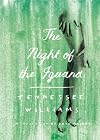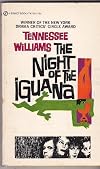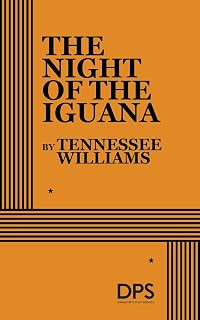
The Night of the Iguana
by Tennessee Williams
On This Page
Description
"Tennessee Williams wrote: "This is a play about love in its purest terms." It is also Williams's robust and persuasive plea for endurance and resistance in the face of human suffering. The earthy widow Maxine Faulk is proprietress of a rundown hotel at the edge of a Mexican cliff overlooking the Pacific Ocean where the defrocked Rev. Shannon, his tour group of ladies from a West Texas women's college, the self-described New England spinster Hannah Jelkes and her ninety-seven-year-old show more grandfather ("the world's oldest living and practicing poet"), a family of grotesque Nazi vacationers, and an iguana tied by its throat to the veranda, all find themselves assembled for a rainy and turbulent night. This is the first trade paperback edition of The Night of the Iguana and comes with an Introduction by playwright Doug Wright, the author's original Foreword, the short story "The Night of the Iguana" which was the germ for the play, plus an essay by noted Tennessee Williams scholar Kenneth Holditch."--Publisher's website. show lessTags
Recommendations




























Member Reviews
John Huston's 1964 adaptation of Tennessee Wiliams's Night of the Iguana is one of my dad's favorite films of all time, so I grew up knowing the characters: Reverend Larry Shannon, battling his demons after being locked out of his Episcopal church for having sex with a young Sunday-school teacher; Maxine Faulk (my hands-down favorite at the time), the crass, sexually omnivorous widow whose at whose hotel Shannon arrives, with twenty angry female Baptists in tow; the otherworldly spinster Hannah Jelkes and her 97-year-old grandfather, the oldest practicing poet in the world.
I grew up knowing them, but, as my dad said when I mentioned that I was reading the play along with my "Non-Structured" blog pals, how much of these characters and show more their interactions can you really understand at the age of fifteen? It is, as he pointed out, an "adult" story, and not just because it involves themes of sexual desperation and sexual contempt—Shannon with his teenage girls; Maxine with her cabana boys—that adults usually keep from children. I think the thing I most failed to identify as a teenager is how worn down all three main characters are, and how that desperate exhaustion imbues their small acts of basic human kindness toward one another with a significance bordering on the heroic. I understood ennui (what teenager doesn't?), but I didn't understand the way that living under emotionally taxing conditions stops being glamorous pretty shortly and starts wearing away at a person's reserves. Luckily, I still can't empathize with the choice between starvation and the kindness of strangers, but I do understand being engaged in a seemingly endless emotional struggle, and how exhausting and panic-inducing that can be.
I also had a much different perspective on the Charlotte/Shannon relationship than I do now. Watching the story unfold as a 15-year-old girl, Shannon's behavior doesn't read as predatory the way it can to an older viewer; my friends, after all, were all for dating "older men." But what I now think is interesting about Williams's portrayal of Shannon is that the Reverend's sexual exploits are not his real crime here—in the playwright's eyes, I think, it's Shannon's cold treatment of these young girls after sleeping with them that exposes the real ugliness in his character. I think, as Williams sees it, Shannon squanders the chance to connect with another human, and that's his sin.
It's interesting that in the 1964 film, Huston chose to remove any discussion of this coldness on Shannon's part, which strikes me as so important in the original play. Perhaps the director felt that a habit of seducing underage women was enough of a barrier for Shannon, as a basically sympathetic character, to overcome.
Another interesting change to Shannon's character in the Huston film is that his theology is completely transformed. In both versions, he objects to the "petulant old man" worshiped by his Virginia congregation. But Huston's Shannon is a sort of nascent hippie environmentalist: as he chases his parishioners out of his church, he speaks of "the God of loving kindness"; and in the scene where he is describing his "researches" to Hannah, he defines "man's inhumanity to God" in terms of polluted rivers and exploited natural resources. These are tropes that a theater audience would immediately understand and relate to. The theology of the original Shannon, on the other hand, is much more complex, and I've always found it difficult to understand. Here, for example, is how he defines his God to Hannah:
Much weirder, no? I can understand why Huston decided to alter Shannon into the more easily-understandable "loving kindness" variety of Christian. But what is he actually saying here? The "stray dogs vivisected" line suggests the idea that God is everywhere, even in the ugly parts of life, and it's wrong of the complacent Virginian congregants not to recognize that. But really, Shannon's recognition of God is no more universal than theirs. If they are only willing to see the divine in anodyne respectability, he only seems willing to recognize it at the most extreme margins of human experience—not in a calm blue sky, but in a dramatic, stormy sunset; not in a pampered house pet, but in a vivisected stray dog. On the other hand, he sees God as "oblivious," unconcerned with the travails of humans. I have always had a hard time wrapping my head around this seeming contradiction: if we're dealing with an unconcerned, "clock-maker" type God, why would he be more manifest in some aspects of life than others? Perhaps Shannon feels that humans are most able to connect with God when they are, themselves, in extremity, and it takes Hannah's calm plea for compassion, for a recognition that all humans have their struggles and their shadows, to balance out his glamorization of the extreme:
Oddly, although I strongly relate to Hannah's philosophy of endurance and human compassion irrespective of God's existence, I find her the least compelling of the three in terms of her actual character, especially on the page. She seems at times just a pretext through which Williams can speak directly to the audience; whereas Shannon and Maxine both talk like real people, Hannah often sounds written to me. Deborah Kerr's performance does a lot to dispel that impression, but Richard Burton and Ava Gardner are still more human-seeming to watch.
There are things in both versions of Night of the Iguana that walk a thin line between bothering and intriguing me: are the depictions of "butch" Judy Fellowes, for example, anti-lesbian misogyny, or an examination of how remaining closeted can cause a person to become cruel and vindictive? (Interestingly, tough-guy Huston actually added material that would favor the second hypothesis. It definitely surprises me that John Huston would be easier on closeted lesbians than Tennessee Williams!) The depictions of Maxine's cabana boys reflect a ridiculous level of casual racism, but it's unusual, especially for 1961, to see a mostly-sympathetic female extract unapologetic sexual enjoyment from men in the way male characters often make sexual use of women. Williams doesn't exactly congratulate Maxine (nor am I arguing that he should), but her employment of Pedro and Pancho is viewed as another desperate attempt at human contact in an alienated world—and Williams, like Hannah Jelkes, respects any attempt at survival that isn't cruel or childish.
In any case, I'm glad to have revisited this old family favorite. I suspect my appreciation of it will continue to grow with time. show less
I grew up knowing them, but, as my dad said when I mentioned that I was reading the play along with my "Non-Structured" blog pals, how much of these characters and show more their interactions can you really understand at the age of fifteen? It is, as he pointed out, an "adult" story, and not just because it involves themes of sexual desperation and sexual contempt—Shannon with his teenage girls; Maxine with her cabana boys—that adults usually keep from children. I think the thing I most failed to identify as a teenager is how worn down all three main characters are, and how that desperate exhaustion imbues their small acts of basic human kindness toward one another with a significance bordering on the heroic. I understood ennui (what teenager doesn't?), but I didn't understand the way that living under emotionally taxing conditions stops being glamorous pretty shortly and starts wearing away at a person's reserves. Luckily, I still can't empathize with the choice between starvation and the kindness of strangers, but I do understand being engaged in a seemingly endless emotional struggle, and how exhausting and panic-inducing that can be.
I also had a much different perspective on the Charlotte/Shannon relationship than I do now. Watching the story unfold as a 15-year-old girl, Shannon's behavior doesn't read as predatory the way it can to an older viewer; my friends, after all, were all for dating "older men." But what I now think is interesting about Williams's portrayal of Shannon is that the Reverend's sexual exploits are not his real crime here—in the playwright's eyes, I think, it's Shannon's cold treatment of these young girls after sleeping with them that exposes the real ugliness in his character. I think, as Williams sees it, Shannon squanders the chance to connect with another human, and that's his sin.
HANNAH: [...:] The episode in the cold, inhuman hotel room, Mr. Shannon, for which you despise the lady almost as much as you despise yourself. Afterward you are so polite to the lady that I'm sure it must chill her to the bone, the scrupulous little attentions that you pay her in return for your little enjoyment of her. The gentleman-of-Virginia act that you put on for her, your noblesse oblige treatment of her...Oh no, Mr. Shannon, don't kid yourself that you ever travel with someone. You have always traveled alone except for your spook, as you call it.
It's interesting that in the 1964 film, Huston chose to remove any discussion of this coldness on Shannon's part, which strikes me as so important in the original play. Perhaps the director felt that a habit of seducing underage women was enough of a barrier for Shannon, as a basically sympathetic character, to overcome.
Another interesting change to Shannon's character in the Huston film is that his theology is completely transformed. In both versions, he objects to the "petulant old man" worshiped by his Virginia congregation. But Huston's Shannon is a sort of nascent hippie environmentalist: as he chases his parishioners out of his church, he speaks of "the God of loving kindness"; and in the scene where he is describing his "researches" to Hannah, he defines "man's inhumanity to God" in terms of polluted rivers and exploited natural resources. These are tropes that a theater audience would immediately understand and relate to. The theology of the original Shannon, on the other hand, is much more complex, and I've always found it difficult to understand. Here, for example, is how he defines his God to Hannah:
SHANNON: It's going to storm tonight—a terrific electrical storm. Then you will see the Reverend T. Lawrence Shannon's conception of God Almighty paying a visit to the world he created. I want to go back to the Church and preach the gospel of God as Lightning and Thunder...and also stray dogs vivisected and...and...and...[He points out suddenly toward the sea.:] That's him! There he is now! [He is pointing out at a blaze, a majestic apocalypse of gold light, shafting the sky as the sun drops into the Pacific.:] His oblivious majesty—and here I am on this...dilapidated verandah of a cheap hotel, out of season, in a country caught and destroyed in its flesh and corrupted in its spirit by its gold-hungry conquistadors that bore the flag of the Inquisition along with the Cross of Christ.
Much weirder, no? I can understand why Huston decided to alter Shannon into the more easily-understandable "loving kindness" variety of Christian. But what is he actually saying here? The "stray dogs vivisected" line suggests the idea that God is everywhere, even in the ugly parts of life, and it's wrong of the complacent Virginian congregants not to recognize that. But really, Shannon's recognition of God is no more universal than theirs. If they are only willing to see the divine in anodyne respectability, he only seems willing to recognize it at the most extreme margins of human experience—not in a calm blue sky, but in a dramatic, stormy sunset; not in a pampered house pet, but in a vivisected stray dog. On the other hand, he sees God as "oblivious," unconcerned with the travails of humans. I have always had a hard time wrapping my head around this seeming contradiction: if we're dealing with an unconcerned, "clock-maker" type God, why would he be more manifest in some aspects of life than others? Perhaps Shannon feels that humans are most able to connect with God when they are, themselves, in extremity, and it takes Hannah's calm plea for compassion, for a recognition that all humans have their struggles and their shadows, to balance out his glamorization of the extreme:
HANNAH: I have a strong feeling you will go back to the Church with this evidence you've been collecting, but when you do and it's a black Sunday morning, look out over the congregation, over the smug, complacent faces for a few old, very old faces, looking up at you, as you begin your sermon, with eyes like a piercing cry for something to still look up to, something to still believe in. And then I think you'll not shout what you say you shouted that black Sunday in Pleasant Valley, Virginia. I think you will throw away the violent, furious sermon, you'll toss it into the chancel, and talk about...no, maybe talk about...nothing...just...
SHANNON: What?
HANNAH: Lead them beside still waters because you know how badly they need the still waters, Mr. Shannon.
Oddly, although I strongly relate to Hannah's philosophy of endurance and human compassion irrespective of God's existence, I find her the least compelling of the three in terms of her actual character, especially on the page. She seems at times just a pretext through which Williams can speak directly to the audience; whereas Shannon and Maxine both talk like real people, Hannah often sounds written to me. Deborah Kerr's performance does a lot to dispel that impression, but Richard Burton and Ava Gardner are still more human-seeming to watch.
There are things in both versions of Night of the Iguana that walk a thin line between bothering and intriguing me: are the depictions of "butch" Judy Fellowes, for example, anti-lesbian misogyny, or an examination of how remaining closeted can cause a person to become cruel and vindictive? (Interestingly, tough-guy Huston actually added material that would favor the second hypothesis. It definitely surprises me that John Huston would be easier on closeted lesbians than Tennessee Williams!) The depictions of Maxine's cabana boys reflect a ridiculous level of casual racism, but it's unusual, especially for 1961, to see a mostly-sympathetic female extract unapologetic sexual enjoyment from men in the way male characters often make sexual use of women. Williams doesn't exactly congratulate Maxine (nor am I arguing that he should), but her employment of Pedro and Pancho is viewed as another desperate attempt at human contact in an alienated world—and Williams, like Hannah Jelkes, respects any attempt at survival that isn't cruel or childish.
In any case, I'm glad to have revisited this old family favorite. I suspect my appreciation of it will continue to grow with time. show less
The Night of the Iguana is set on the veranda of a run-down Mexican hotel in 1940. Reverend Shannon, former Episcopal priest and now tour guide, has brought a busload of schoolteachers from a Baptist Female College to the hotel, where he has connections with the owner, the recently widowed Maxine Faulks. Shannon is in hot water this tour group for taking out 16-year-old Charlotte Goodall; Charlotte’s guardian is ready to turn him in to the tour company.
As Shannon is trying to convince the ladies to stay, a 30-something spinster named Hannah Jelkes arrives looking for lodging for her and her grandfather.
So on this night, these people are stuck together, all of them caught at the end of their ropes, like the iguana the Mexican hotel show more workers catch and tie up during the play.
All of them are trapped with passions and desires and choose to act on them in different ways. Maxine is openly sexual and clear in what—and who—she wants. Shannon was forced out of his church for seducing a minor and for preaching heresy, but it’s never quite clear if he regrets doing it or just regrets getting caught. I suspect the latter. Shannon is filled with anger, but he directs his anger toward those he is wronging. Hannah, on the other hand, is depicted as almost devoid of passion. She has come to respect people who struggle, but for her, it’s not the violence of the struggle but the enduring through it that is important.
It’s interesting that although Hannah seems to have found the healthiest approach to life, she also comes across as the least real of the three main characters. And that makes me wonder how realistic her outlook really is. In choosing endurance and detachment, is she in fact denying her own desires? Has she put them so far from her mind that she doesn’t know what they are? Or has she truly come to a place where fleeting moments of connecting with another soul are sufficient? And are these connections that she prizes really connections?
Williams is a master at creating complex characters with ambiguous motivations. It’s one of the things I’ve loved about all his plays that I’ve read. I can never quite bring myself to like his characters, but I do find them fascinating. The Night of the Iguana was no exception on that score.
See my complete review at Shelf Love. show less
As Shannon is trying to convince the ladies to stay, a 30-something spinster named Hannah Jelkes arrives looking for lodging for her and her grandfather.
So on this night, these people are stuck together, all of them caught at the end of their ropes, like the iguana the Mexican hotel show more workers catch and tie up during the play.
All of them are trapped with passions and desires and choose to act on them in different ways. Maxine is openly sexual and clear in what—and who—she wants. Shannon was forced out of his church for seducing a minor and for preaching heresy, but it’s never quite clear if he regrets doing it or just regrets getting caught. I suspect the latter. Shannon is filled with anger, but he directs his anger toward those he is wronging. Hannah, on the other hand, is depicted as almost devoid of passion. She has come to respect people who struggle, but for her, it’s not the violence of the struggle but the enduring through it that is important.
It’s interesting that although Hannah seems to have found the healthiest approach to life, she also comes across as the least real of the three main characters. And that makes me wonder how realistic her outlook really is. In choosing endurance and detachment, is she in fact denying her own desires? Has she put them so far from her mind that she doesn’t know what they are? Or has she truly come to a place where fleeting moments of connecting with another soul are sufficient? And are these connections that she prizes really connections?
Williams is a master at creating complex characters with ambiguous motivations. It’s one of the things I’ve loved about all his plays that I’ve read. I can never quite bring myself to like his characters, but I do find them fascinating. The Night of the Iguana was no exception on that score.
See my complete review at Shelf Love. show less
This was the first play I've read by Williams. It had so many characters in it I'm really at a loss as to a synopsis. Basically, it is the story of Maxine, who is a widow who owns a hotel in a remote Mexican village. Many different people come to the hotel and they each have a story to tell, many not so nice. The title of the play takes its name from the Iguana tied up under the porch, which Maxine is fattening to kill and cook. Just as the iguana is always trying to get free, many of the hotel guests are also trying to get free from something. 191 pages
Apparently, Tennessee Williams based many of the characters in his plays on not only himself but his family members, all of whom were so dysfunctional that he had no problem coming up with plot and dialogue enough to win four Drama Critic Circle Awards, two Pulitzer Prizes, and the Presidential Medal of Freedom. The Night of the Iguana was written in 1961, and was based on a short story Williams wrote in 1948.
The lead character, Reverend T. Lawrence Shannon, has been accompanying a Baptist women’s group who have contracted for a cheap tour of Mexico run by Blake Tours, the current employer of Reverend Shannon. He is giving tours out of desperation because he was locked out of his church after a mental breakdown.
As the play begins, show more Ms. Fellows, the leader of the Baptist group, is incensed at Shannon for allegedly seducing young Charlotte Goodall, and threatens to call Blake Tours and get him fired. Thus, rather than deliver the ladies to the expected hotel on their way to Puerto Vallarta, Shannon takes them to Costa Verde Hotel (which he mistakenly believes is phoneless) in Mismaloya on the coast. Here he hopes his friends Maxine and Fred Faulk will rescue him. He discovers that Fred had died the previous month however, the hotel now has phone service, and Maxine is in need of rescuing herself. In fact, all of the characters in some way or another are at the end of their rope, like the iguana trapped out in the back of the hotel.
The cause of Shannon's anguish are many: a crisis of faith (reconciling theology with what he sees in the world around him); a crisis of identity (reconciling his own hypocrisy with who he wants to be); desperately wanting to believe in something (but finding the God of the Bible "infantile"); rage against his parents and against God (apparently he's still unhappy over an injunction against masturbation, inter alia); and a deep loneliness that cannot be satisfied by numerous ephemeral sexual encounters. The other characters also reveal inner turmoil: Maxine is bored and frustrated with her job and her love life; Ms. Fellows is a repressed lesbian; Ms. Jelkes has withdrawn from life rather than try to deal with it; and Charlotte is rebelling against her father by throwing herself at any man she can. Whether the characters can escape from the demons driving them to the end of the mental ropes that bind them is the question explored by the play.
Discussion:
Shannon is purportedly an amalgam of the playwright’s maternal grandfather (an Episcopal priest), his father (a hard-drinking traveling salesman), and himself, someone considered sexually deviant with frequent bouts of alcoholism, depression and “crack-ups,” who feared he would go insane. Maxine, the hotel proprietress, is thought to represent Williams’ mother, and indeed, Maxine acts rather motherly toward Shannon, at least if you accept that some mothers also have a Freudian attraction to their sons. Hannah Jelkes, the strange spinster who comes to stay at the same hotel, is supposedly modeled after Williams’ sister Rose, who, diagnosed with schizophrenia, was given a prefrontal lobotomy in 1937. But the Hannah/Rose in this play manages to overcome “the blue devil” of madness, and learns to “endure.”
There are some interesting differences between the movie and the play. While generally hewing pretty close to one another, the movie omits some of the more scandalous religious and sexual statements made by Shannon. Also Shannon is quite cruel to Maxine in the play, and most of those cutting remarks are left out of the movie. I imagine this was in order to ensure Shannon would be a more sympathetic character, or perhaps, because Maxine was, after all, Ava Gardner.
Evaluation: It was rather difficult for me to warm up to these characters or even care very much about any of them. They were all just TOO CRAZY. I did not find the play inordinately dated, although if it were really set in modern times, I believe most of the characters would be taking antidepressants or even lithium, and there wouldn’t have been much of a play.
Rating: How does one rate a “classic” that one wasn’t particularly taken by? I think in this case I’ll eschew the number system, and go for the universally understood “meh.” show less
The lead character, Reverend T. Lawrence Shannon, has been accompanying a Baptist women’s group who have contracted for a cheap tour of Mexico run by Blake Tours, the current employer of Reverend Shannon. He is giving tours out of desperation because he was locked out of his church after a mental breakdown.
As the play begins, show more Ms. Fellows, the leader of the Baptist group, is incensed at Shannon for allegedly seducing young Charlotte Goodall, and threatens to call Blake Tours and get him fired. Thus, rather than deliver the ladies to the expected hotel on their way to Puerto Vallarta, Shannon takes them to Costa Verde Hotel (which he mistakenly believes is phoneless) in Mismaloya on the coast. Here he hopes his friends Maxine and Fred Faulk will rescue him. He discovers that Fred had died the previous month however, the hotel now has phone service, and Maxine is in need of rescuing herself. In fact, all of the characters in some way or another are at the end of their rope, like the iguana trapped out in the back of the hotel.
The cause of Shannon's anguish are many: a crisis of faith (reconciling theology with what he sees in the world around him); a crisis of identity (reconciling his own hypocrisy with who he wants to be); desperately wanting to believe in something (but finding the God of the Bible "infantile"); rage against his parents and against God (apparently he's still unhappy over an injunction against masturbation, inter alia); and a deep loneliness that cannot be satisfied by numerous ephemeral sexual encounters. The other characters also reveal inner turmoil: Maxine is bored and frustrated with her job and her love life; Ms. Fellows is a repressed lesbian; Ms. Jelkes has withdrawn from life rather than try to deal with it; and Charlotte is rebelling against her father by throwing herself at any man she can. Whether the characters can escape from the demons driving them to the end of the mental ropes that bind them is the question explored by the play.
Discussion:
Shannon is purportedly an amalgam of the playwright’s maternal grandfather (an Episcopal priest), his father (a hard-drinking traveling salesman), and himself, someone considered sexually deviant with frequent bouts of alcoholism, depression and “crack-ups,” who feared he would go insane. Maxine, the hotel proprietress, is thought to represent Williams’ mother, and indeed, Maxine acts rather motherly toward Shannon, at least if you accept that some mothers also have a Freudian attraction to their sons. Hannah Jelkes, the strange spinster who comes to stay at the same hotel, is supposedly modeled after Williams’ sister Rose, who, diagnosed with schizophrenia, was given a prefrontal lobotomy in 1937. But the Hannah/Rose in this play manages to overcome “the blue devil” of madness, and learns to “endure.”
There are some interesting differences between the movie and the play. While generally hewing pretty close to one another, the movie omits some of the more scandalous religious and sexual statements made by Shannon. Also Shannon is quite cruel to Maxine in the play, and most of those cutting remarks are left out of the movie. I imagine this was in order to ensure Shannon would be a more sympathetic character, or perhaps, because Maxine was, after all, Ava Gardner.
Evaluation: It was rather difficult for me to warm up to these characters or even care very much about any of them. They were all just TOO CRAZY. I did not find the play inordinately dated, although if it were really set in modern times, I believe most of the characters would be taking antidepressants or even lithium, and there wouldn’t have been much of a play.
Rating: How does one rate a “classic” that one wasn’t particularly taken by? I think in this case I’ll eschew the number system, and go for the universally understood “meh.” show less
By far not my favorite Tennessee Williams play. I did not feel an affinity with any of the characters, which makes it harder to step into their skin and feel their pain. The tender relationship between Hannah and her Grandfather, and the knowledge that even if he survived this night he could not hope to survive many more, made her character both interesting and worthy of sympathy for me. I could not profess to care what happened to either Larry Shannon or Maxine.
The start was slow, but by the third act I would have been unwilling to leave the theater without knowing what happened. I do think, as with all plays, this might appeal more when "seen" vs. "read".
The start was slow, but by the third act I would have been unwilling to leave the theater without knowing what happened. I do think, as with all plays, this might appeal more when "seen" vs. "read".
A noite do iguana é uma das melhores peças do Tennessee Williams, mas talvez não seja tão montada como outras mais famosas do dramaturgo.
O grande John Huston a adaptou para cinema em 1964 num filme excelente, com elenco igualmente fantástico que mantém o humor, a tensão e o tesão da peça.
Enfim, recomendo tanto o texto quanto o filme, especialmente essa edição da New Directions que tem textos de apoio e o conto que Williams escreveu baseado na peça.
O grande John Huston a adaptou para cinema em 1964 num filme excelente, com elenco igualmente fantástico que mantém o humor, a tensão e o tesão da peça.
Enfim, recomendo tanto o texto quanto o filme, especialmente essa edição da New Directions que tem textos de apoio e o conto que Williams escreveu baseado na peça.
An interesting play by Tennessee Williams that brings out some of his themes that are developed, in more detail, in his later plays. Nonetheless, a good read.
Recommended.
Recommended.
Members
- Recently Added By
Lists

1960s, Best books published therein
254 works; 22 members

Pre-1969 LGBTQ Literature
182 works; 69 members

My Play Collection
769 works; 3 members

Next Plays / 2025
352 works; 1 member
Author Information

337+ Works 32,042 Members
After O'Neill, Williams is perhaps the best dramatist the United States has yet produced. Born in his grandfather's rectory in Columbus, Mississippi, Williams and his family later moved to St. Louis. There Williams endured many bad years caused by the abuse of his father and his own anguish over his introverted sister, who was later permanently show more institutionalized. Williams attended the University of Missouri, and, after time out to clerk for a shoe company and for his own mental breakdown, also attended Washington University of St. Louis and the University of Iowa, from which he graduated in 1938. Williams began to write plays in 1935. During 1943 he spent six months as a contract screenwriter for MGM but produced only one script, The Gentleman Caller. When MGM rejected it, Williams turned it into his first major success, The Glass Menagerie (1945). In this intensely autobiographical play, Williams dramatizes the story of Amanda, who dreams of restoring her lost past by finding a gentleman caller for her crippled daughter, and of Amanda's son Tom, who longs to escape from the responsibility of supporting his mother and sister. After The Glass Menagerie,Williams wrote his masterpiece, A Streetcar Named Desire, (1947), along with a steady stream of other plays, among them such major works as Summer and Smoke(1948), Cat on a Hot Tin Roof (1954), and Suddenly Last Summer (1958). His plays celebrate the "fugitive kind," the sensitive outcasts whose outsider status allows them to perceive the horror of the world and who often give additional witness to that horror by becoming its victims. Stephen S. Stanton has summed up Williams's "virtues and strengths" as "a genius for portraiture, particularly of women, a sensitive ear for dialogue and the rhythms of natural speech, a comic talent often manifesting itself in "black comedy,' and a genuine theatrical flair exhibited in telling stage effects attained through lighting, costume, music, and movements." After The Night of the Iguana (1961), Williams continued to write profusely---and constantly to revise his work---but it became more difficult to get productions of his plays and, if they were produced, to win critical or popular acclaim for them. Williams won the Pulitzer Prize for drama for A Streetcar Named Desire and Cat on a Hot Tin Roof. He won the New York Drama Critics Circle Award for these two and for The Glass Menagerie and The Night of the Iguana. (Bowker Author Biography) show less
Awards and Honors
Awards
Series
Belongs to Publisher Series
Penguin Plays (PL56)
Work Relationships
Is contained in
Has the adaptation
Has as a student's study guide
Common Knowledge
- Canonical title
- The Night of the Iguana
- Original title
- The Night of the Iguana
- Original publication date
- 1962-02-28
- Related movies
- The Night of the Iguana (1964 | IMDb)
- Epigraph
- And so, as kinsmen met a night,
We talked between the rooms,
Until the moss had reached our lips.
And covered up our names.
EMILY DICKINSON - First words
- As the curtain rises, there are sounds of a party of excited female tourists arriving by bus on the road down the hill below the Costa Verde hotel.
- Last words
- (Click to show. Warning: May contain spoilers.)It's so quiet here, now.
- Disambiguation notice
- This LT work combines editions of Tennessee Williams' later play, Night of the Iguana (1961). It's distinct from Williams' short stories, including "The Night of the Iguana" (1948). Please don't combine the two; thank ... (show all)you.
Classifications
Statistics
- Members
- 611
- Popularity
- 47,884
- Reviews
- 12
- Rating
- (3.70)
- Languages
- 8 — Catalan, English, French, German, Portuguese, Croatian, Spanish, Swedish
- Media
- Paper, Ebook
- ISBNs
- 21
- ASINs
- 16