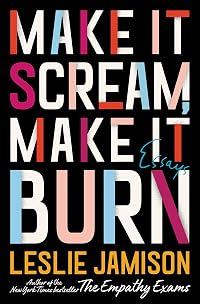
Make It Scream, Make It Burn: Essays
by Leslie Jamison
On This Page
Description
With the virtuosic synthesis of memoir, criticism, and journalism for which she has become known, Jamison offers 14 new essays that are by turns ecstatic, searching, staggering, and wise. With the virtuosic synthesis of memoir, criticism, and journalism for which Leslie Jamison has been so widely acclaimed, the fourteen essays in Make It Scream, Make It Burn explore the oceanic depths of longing and the reverberations of obsession. Among Jamison's subjects are 52 Blue, deemed "the loneliest show more whale in the world"; the eerie past-life memories of children; the devoted citizens of an online world called Second Life; the haunted landscape of the Sri Lankan Civil War; and an entire museum dedicated to the relics of broken relationships. Jamison follows these examinations to more personal reckonings -- with elusive men and ruptured romances, with marriage and maternity -- in essays about eloping in Las Vegas, becoming a stepmother, and giving birth. show lessTags
Recommendations


Member Reviews
"The more important point is that the impulse to escape our lives is universal, and hardly worth vilifying. Inhabiting any life always involves reckoning with the urge to abandon it – through daydreaming; through storytelling; through the ecstasies of art and music, hard drugs, adultery, a smartphone screen. These forms of “leaving” aren’t the opposite of authentic presence. They are simply one of its symptoms – the way love contains conflict, intimacy contains distance, and faith contains doubt."
In this second collection of Leslie Jamison's essays, she writes about a variety of subjects, some very personal and some less so -- although her own perspective and thoughts are always very much part of the story. There's a piece about the virtual environment Second Life, and one about an unusual whale that humans can't resist projecting themselves onto in various ways. There is an essay that's partly about Las Vegas and partly about two very different romantic relationships in Jamison's life. There's one about fairy tales and the experience of being a stepmother. There are a couple that are extended looks at the works of others (James Agee's Let Us Now Praise Famous Men and the photography of Annie Appel, who kept returning to take show more pictures of the same Mexican family for decades), which I didn't find nearly as compelling as Jamison writing about her own experiences, but which were certainly still good. There are essays about pregnancy and eating disorder and Civil War photographs, and a museum in Croatia dedicated to mementos of failed relationships. So it covers rather a lot of ground, although in ways that somehow manage to make it all feel emotionally or thematically connected.
I do think, overall, this didn't wow me quite as much as her earlier collection The Empathy Exams did, although that might simply be because I had a better idea of what to expect from this volume and it took me less by surprise. That's a very high bar to meet, in any case, and no matter what kind of comparisons I might or might not draw, Jamison does very much continue to prove here that she's a damned good writer. I am deeply impressed by her honesty, and by the way she thoughtfully reflects on things and then reflects on her own reflections in ways that, in the hands of a lesser writer, could feel like self-absorbed navel-gazing, but instead feel to me as if they express something deeply profound and recognizable about the experience of being human. Even when I find myself disagreeing with her -- and I definitely wanted to argue some points in the essay she wrote about children who supposedly remember past lives, if nowhere else -- I always felt a very real respect and appreciation for her and her writing. show less
I do think, overall, this didn't wow me quite as much as her earlier collection The Empathy Exams did, although that might simply be because I had a better idea of what to expect from this volume and it took me less by surprise. That's a very high bar to meet, in any case, and no matter what kind of comparisons I might or might not draw, Jamison does very much continue to prove here that she's a damned good writer. I am deeply impressed by her honesty, and by the way she thoughtfully reflects on things and then reflects on her own reflections in ways that, in the hands of a lesser writer, could feel like self-absorbed navel-gazing, but instead feel to me as if they express something deeply profound and recognizable about the experience of being human. Even when I find myself disagreeing with her -- and I definitely wanted to argue some points in the essay she wrote about children who supposedly remember past lives, if nowhere else -- I always felt a very real respect and appreciation for her and her writing. show less
Leslie Jamison has a way of being introspective with a topic, then flipping it inside out so we see it as she does and, maybe, we also see ourselves in the reflection there.
The writing is, simply put, perfection. Jamison's word choices, her phrasing, and the rhythm of her sentences create a lyrical, emotive beauty.
While I didn't connect as strongly with all the essays, I found each one engaging. A large percentage held me captive, and a few had me closing the book afterward in a sort of meditative stupor.
These essays will stay with me for a long time to come.
*Thanks to Little, Brown and Company for the review copy!*
The writing is, simply put, perfection. Jamison's word choices, her phrasing, and the rhythm of her sentences create a lyrical, emotive beauty.
While I didn't connect as strongly with all the essays, I found each one engaging. A large percentage held me captive, and a few had me closing the book afterward in a sort of meditative stupor.
These essays will stay with me for a long time to come.
*Thanks to Little, Brown and Company for the review copy!*
52 Blue - A thoughtful essay about the unique call of the world's so-called loneliest whale that fired the imagination of a legion of people the world over.
We Tell Ourselves Stories in Order to live Again - An essay about death, dying, and returning to life again centered around the sensational story of a young boy who claimed to be the reincarnated spirit of a WWII fighter pilot. It focuses on the investigation of these claims by family members and disinterested outsiders. It asks why people are fascinated with such stories, and what purpose they serve or help they can be to the human psyche as it dies.
Layover Story - A funny and convicting story about an unfortunate layover that requires the author and her entire plane an few hours show more delay. She meets a loud and annoying woman who is full of complaints and petty rudeness but also wants a lot of help because she has an injured knee. The author does a bit of research and learns that this woman has recently been stabbed by a stranger and must be recovering. She then goes on to help the woman complete her journey out of a kind of penance for judging her harshly. Later she learns that the woman actually hurt her leg from dancing too much. At first the author feels robbed, but then she realizes that this is not the point. The point is someone needed help and she did her best. It's a meditative piece about grace, kindness, and the stories we tell ourselves about others.
Sim Life - A contemplative study of the online simulation Second Life. The author researches people who love it. What do they have in common and what entices them about this odd place on the internet. What does this drive to live an alternate, perfectly controlled life teach us about the real one we all cannot escape?
Up in Jaffna - The author recounts the events of a trip taken to Sri Lanka for work. It was a silly trip: completely free but a surprise until 24 hours before hand. In this essays she dwells upon the meaning and purpose of travel, and its effect upon both the place visited and the person visiting. She goes to Sri Lanka.
No Tongue Can Tell - A contemplation of the art of photography, with the focus on how photography was used during the Civil War to communicated grief at the scale and atrocity of it. The author ponders the imagined "reality" of photographs and the scandal that occurred when it became clear that many of these war photographs were staged. Unlike other forms of art, the photograph tricks the viewer into believing it is a literal depiction of truth, rather than a commodity driven by capitalistic industry.
Make it Scream, Make it Burn - An examination of art and artists, especially filmmakers. This one was hard for me to follow because it was examining the work of a person I am completely unfamiliar with.
Maximum Exposure - A detailed essay about a little known photographic artist who has devoted decades of her life to photographing the day-to-day existence of a Mexican family. She travels to them regularly, photographing normal moments alongside tragedies. She helps them, lives with them, and bears witness to their existence. This has, unsurprisingly, brought her very little return in the form of fame or even acknowledgement. The author ponders this extremely intimate study between artist and subject.
Rehearsals - A brief meditation upon weddings and the annoyance and beauty they encompass. The author also examines the complications and drama they can produce, such as when she must attend her father's remarriage after he divorced her mother. Attending hurts her mother, but not attending would have other consequences. Does any of the love from the last marriage still remain? And what of her future relationships? A sad and hopeful essays about love.
The Long Trick - A beautiful, elegiac essay about mortality and family. The love that makes us and the loss that reminds us how dear are those we most take for granted.
The Real Smoke - The author recounts her experiences with dating, love, longing, and eventually marriage and parenthood.
Daughter of a Ghost - The author examines a very personal topic - the cultural tropes and beliefs surrounding the step-mother. Most commonly appearing in fairy tales, this figure typifies the worst sort of parent - an imposter parent. This topic is very close to the author's heart because she is a step-mother, having married a man whose first wife died of leukemia. Although her relationship with her step-daughter is a good one, this figure keeps reappearing, at least in her mind, as a specter.
Museum of Broken Hearts - The author uses a visit to the Museum of Broken Relationships in Croatia as a convenient device to examine the failure of relationships and if the experience can still be meaningful even though it has ended.
The Quickening - The author recounts the story of her pregnancy and her history with eating disorders as a way to discuss her relationship with her body and how that perspective changed with the birth of her daughter.
These essays are beautiful, mournful, intimate, and lyrical. The narrator often sounds like she is reading spoken word poetry. It's lovely and thought provoking. show less
We Tell Ourselves Stories in Order to live Again - An essay about death, dying, and returning to life again centered around the sensational story of a young boy who claimed to be the reincarnated spirit of a WWII fighter pilot. It focuses on the investigation of these claims by family members and disinterested outsiders. It asks why people are fascinated with such stories, and what purpose they serve or help they can be to the human psyche as it dies.
Layover Story - A funny and convicting story about an unfortunate layover that requires the author and her entire plane an few hours show more delay. She meets a loud and annoying woman who is full of complaints and petty rudeness but also wants a lot of help because she has an injured knee. The author does a bit of research and learns that this woman has recently been stabbed by a stranger and must be recovering. She then goes on to help the woman complete her journey out of a kind of penance for judging her harshly. Later she learns that the woman actually hurt her leg from dancing too much. At first the author feels robbed, but then she realizes that this is not the point. The point is someone needed help and she did her best. It's a meditative piece about grace, kindness, and the stories we tell ourselves about others.
Sim Life - A contemplative study of the online simulation Second Life. The author researches people who love it. What do they have in common and what entices them about this odd place on the internet. What does this drive to live an alternate, perfectly controlled life teach us about the real one we all cannot escape?
Up in Jaffna - The author recounts the events of a trip taken to Sri Lanka for work. It was a silly trip: completely free but a surprise until 24 hours before hand. In this essays she dwells upon the meaning and purpose of travel, and its effect upon both the place visited and the person visiting. She goes to Sri Lanka.
No Tongue Can Tell - A contemplation of the art of photography, with the focus on how photography was used during the Civil War to communicated grief at the scale and atrocity of it. The author ponders the imagined "reality" of photographs and the scandal that occurred when it became clear that many of these war photographs were staged. Unlike other forms of art, the photograph tricks the viewer into believing it is a literal depiction of truth, rather than a commodity driven by capitalistic industry.
Make it Scream, Make it Burn - An examination of art and artists, especially filmmakers. This one was hard for me to follow because it was examining the work of a person I am completely unfamiliar with.
Maximum Exposure - A detailed essay about a little known photographic artist who has devoted decades of her life to photographing the day-to-day existence of a Mexican family. She travels to them regularly, photographing normal moments alongside tragedies. She helps them, lives with them, and bears witness to their existence. This has, unsurprisingly, brought her very little return in the form of fame or even acknowledgement. The author ponders this extremely intimate study between artist and subject.
Rehearsals - A brief meditation upon weddings and the annoyance and beauty they encompass. The author also examines the complications and drama they can produce, such as when she must attend her father's remarriage after he divorced her mother. Attending hurts her mother, but not attending would have other consequences. Does any of the love from the last marriage still remain? And what of her future relationships? A sad and hopeful essays about love.
The Long Trick - A beautiful, elegiac essay about mortality and family. The love that makes us and the loss that reminds us how dear are those we most take for granted.
The Real Smoke - The author recounts her experiences with dating, love, longing, and eventually marriage and parenthood.
Daughter of a Ghost - The author examines a very personal topic - the cultural tropes and beliefs surrounding the step-mother. Most commonly appearing in fairy tales, this figure typifies the worst sort of parent - an imposter parent. This topic is very close to the author's heart because she is a step-mother, having married a man whose first wife died of leukemia. Although her relationship with her step-daughter is a good one, this figure keeps reappearing, at least in her mind, as a specter.
Museum of Broken Hearts - The author uses a visit to the Museum of Broken Relationships in Croatia as a convenient device to examine the failure of relationships and if the experience can still be meaningful even though it has ended.
The Quickening - The author recounts the story of her pregnancy and her history with eating disorders as a way to discuss her relationship with her body and how that perspective changed with the birth of her daughter.
These essays are beautiful, mournful, intimate, and lyrical. The narrator often sounds like she is reading spoken word poetry. It's lovely and thought provoking. show less
Make It Scream, Make It Burn is a collection of essays by Leslie Jamison, a journalist with The Atlantic, one of America’s oldest and most respected magazines. She arranged her essays from the outside in, so to speak. The first section of essays is most outside her realm of experience, the final section is autobiographical. Jamison is a chronicler of the odd and misfit, it many ways. I remember the first article by her I ever read, about people with an illness doctors do not believe exists. In that article and in these essays, she displays her extraordinary ability to connect with people, to create an empathetic link to them while recounting their story later.
Full disclosure, Jamison interviewed me for her piece on Second Life, show more included in this book. She did not use my interview but did include people I suggested as good people to interview for greater understanding of Second Life. My friends were shocked at how thorough the fact-checkers were, but were also very unhappy to see Second Life portrayed as an escape. It seemed as her own life was so happy, she could not see a value in a second. They felt misunderstood. Jamison addresses this, too, in her essay on a photographer who felt anger when Jamison wrote about her project.
Make It Scream, Make It Burn is a good collection of essays. Jamison is an essayist exploring life and culture. Journalists often write their stories as though they are no part of the story, as though the observer effect did not exist. But, physicists have shown how even quantum phenomena are changed by passive observation. Jamison, by writing herself into her essays drops the pretense that her words are not mediated by her own perceptions.
Take that Second Life story, it is affected by who she chose to interview and the questions she asks. She could have talked to designers who produced first and Second Life fashions, using SL to expand her ideas of what is possible in fashion, unhampered by gravity, for example. She could have talked to the people at the Sioux sim where tribal history is taught or church services or a transgender support group. Her own idea of SL, a refuge, influenced who she featured and the questions she asked…and by putting herself in the story, she does not pretend omniscience. This makes her essays more compelling.
I received an e-galley of Make It Scream, Make It Burn from the publisher through NetGalley
Make It Scream, Make It Burn at Little, Brown and Company
Leslie Jamison author site
✮✮✮✮
https://tonstantweaderreviews.wordpress.com/2019/10/09/9780316259668/ show less
Full disclosure, Jamison interviewed me for her piece on Second Life, show more included in this book. She did not use my interview but did include people I suggested as good people to interview for greater understanding of Second Life. My friends were shocked at how thorough the fact-checkers were, but were also very unhappy to see Second Life portrayed as an escape. It seemed as her own life was so happy, she could not see a value in a second. They felt misunderstood. Jamison addresses this, too, in her essay on a photographer who felt anger when Jamison wrote about her project.
Make It Scream, Make It Burn is a good collection of essays. Jamison is an essayist exploring life and culture. Journalists often write their stories as though they are no part of the story, as though the observer effect did not exist. But, physicists have shown how even quantum phenomena are changed by passive observation. Jamison, by writing herself into her essays drops the pretense that her words are not mediated by her own perceptions.
Take that Second Life story, it is affected by who she chose to interview and the questions she asks. She could have talked to designers who produced first and Second Life fashions, using SL to expand her ideas of what is possible in fashion, unhampered by gravity, for example. She could have talked to the people at the Sioux sim where tribal history is taught or church services or a transgender support group. Her own idea of SL, a refuge, influenced who she featured and the questions she asked…and by putting herself in the story, she does not pretend omniscience. This makes her essays more compelling.
I received an e-galley of Make It Scream, Make It Burn from the publisher through NetGalley
Make It Scream, Make It Burn at Little, Brown and Company
Leslie Jamison author site
✮✮✮✮
https://tonstantweaderreviews.wordpress.com/2019/10/09/9780316259668/ show less
Kind of bland and inoffensive for me. I liked some of the essays- the story of the California photographer and her relationship with a family she's been photographing for years was fascinating and I liked how Jamison ties her story to the writer's dilemma- and the last essay about the birth of her daughter was incredibly moving. A lot of the rest of it was middle-class-white-New-Yorker concerns which I can relate to but which is not really that interesting to me. If you are from Brooklyn and don't like that other people call you a hipster this is for you.
I wasn’t that into the first two sections of impersonal essays, but I loved the last section of personal essays. Maybe once you’ve written a memoir, it’s hard to detach yourself again from the story? I was also just curious to hear why happened to her. I love her writing, especially the way she describes emotional experiences, and I appreciate how honest she is about her failures, too.
Members
- Recently Added By
Lists

Powell's 50 Books for 50 Years
50 works; 4 members
Author Information

9+ Works 2,533 Members
Leslie Jamison was born in Washington D.C. in 1983. She has worked as a baker, an office temp, an innkeeper, a tutor, and a medical actor. She is the author of The Gin Closet and The Empathy Exams: Essays. She is currently finishing a doctoral dissertation at Yale University about addiction narratives. (Bowker Author Biography)
Awards and Honors
Common Knowledge
- Original publication date
- 2019
- Epigraph
- When do our senses know any thing so utterly as when we lack it?
—Marilynne Robinson, Housekeeping - Dedication
- For my father, Dean Tecumseh Jamison
- Canonical DDC/MDS
- 814.6
- Canonical LCC
- PS3610.A485
Classifications
Statistics
- Members
- 322
- Popularity
- 98,964
- Reviews
- 10
- Rating
- (4.00)
- Languages
- English, French, German, Spanish
- Media
- Paper, Audiobook, Ebook
- ISBNs
- 15
- ASINs
- 3