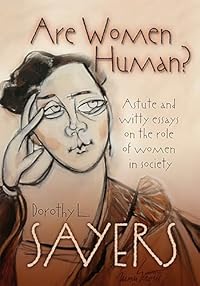
Are Women Human?
by Dorothy L. Sayers
On This Page
Description
Introduction by Mary McDermott Shideler One of the first women to graduate from Oxford University, Dorothy Sayers pursued her goals whether or not what she wanted to do was ordinarily understood to be "feminine." Sayers did not devote a great deal of time to talking or writing about feminism, but she did explicitly address the issue of women's role in society in the two classic essays collected here. Central to Sayers's reflections is the conviction that both men and women are first of all show more human beings and must be regarded as essentially much more alike than different. We are to be true not so much to our sex as to our humanity. The proper role of both men and women, in her view, is to find the work for which they are suited and to do it. Though written several decades ago, these essays still offer in Sayers's piquant style a sensible and conciliatory approach to ongoing gender issues. show lessTags
Recommendations





Member Recommendations

Member Reviews
Are Women Human was an address given by Dorothy L. Sayers to a women’s society in 1938. You would think that, 72 years later, it would seem dated and irrelevant. Not a bit. (Well, okay, a tiny bit. But no more than that.) Sayers’ argument uses some examples that are not directly relevant today, but the thrust of her argument is as fresh now as when it was written: men and women are all human beings, and, while there are some differences between the sexes, to see them as ontologically different is incorrect, unhelpful and unfair.
‘“What,” men have asked distractedly from the beginning of time, “what on earth do women want?” I do not know that women, as women, want anything in particular, but as human beings they want, my show more good man, exactly what you want yourselves: interesting occupation, reasonable freedom for their pleasures, and a sufficient emotional outlet. What form the occupation, the pleasures and the emotion may take, depends entirely upon the individual.’ (p. 44)
The wit, delivery and argument are all superb: I started to mark quotable passages but gave up after the first thirty-eight.
The second essay in this volume, The Human-Not-Quite-Human was presumably written a little later (it refers explicitly to the use of women’s labour in wartime), and is a little angrier in tone. Nevertheless, it, like the first essay, contains a lot of humour and a lot of sense. The book also contains an excellent introduction by Mary McDermott Shideler, which puts Sayers’ essays into the context of her wider work. Don't be put off by the theology tag: Sayers' ideas are informed by her Christian faith, but God only puts in a very brief appearance on the last couple of pages.
I thoroughly recommend this book – to men and women – but for the last word I’m going to let Miss Sayers speak for herself:
‘I am occasionally desired by ... the editors of magazines to say something about the writing of detective fiction “from the woman’s point of view.” To such demands, one can only say, “Go away and don’t be silly. You might as well ask what is the female angle on an equilateral triangle.”’ (p. 41) show less
‘“What,” men have asked distractedly from the beginning of time, “what on earth do women want?” I do not know that women, as women, want anything in particular, but as human beings they want, my show more good man, exactly what you want yourselves: interesting occupation, reasonable freedom for their pleasures, and a sufficient emotional outlet. What form the occupation, the pleasures and the emotion may take, depends entirely upon the individual.’ (p. 44)
The wit, delivery and argument are all superb: I started to mark quotable passages but gave up after the first thirty-eight.
The second essay in this volume, The Human-Not-Quite-Human was presumably written a little later (it refers explicitly to the use of women’s labour in wartime), and is a little angrier in tone. Nevertheless, it, like the first essay, contains a lot of humour and a lot of sense. The book also contains an excellent introduction by Mary McDermott Shideler, which puts Sayers’ essays into the context of her wider work. Don't be put off by the theology tag: Sayers' ideas are informed by her Christian faith, but God only puts in a very brief appearance on the last couple of pages.
I thoroughly recommend this book – to men and women – but for the last word I’m going to let Miss Sayers speak for herself:
‘I am occasionally desired by ... the editors of magazines to say something about the writing of detective fiction “from the woman’s point of view.” To such demands, one can only say, “Go away and don’t be silly. You might as well ask what is the female angle on an equilateral triangle.”’ (p. 41) show less
Sayers gained literary fame for her mysteries, which feature Lord Peter Wimsey, and her translation of Dante’s Inferno. This collection of essays looks at the role women play in society. The title essay was actually a speech Sayers’ gave at an event.
I loved the way she lays out the issue and the simplicity of the answer. She makes it clear that she doesn’t know exactly what every woman wants to do with her life, because women want the same options that men have. They want to be able to decide how to live their own lives, nothing more.
I really enjoyed this collection (esp. the title piece) because Sayers never sounds preachy or condescending. She’s just expressing her opinion and stating that women don’t deserve special show more treatment, but they do deserve equal treatment. This is exactly how I feel. I don’t want different (aka lower) standards for a woman to be able to qualify for a field. If a woman wants to be a firefighter she should have to fulfill the same physical requirements as a man who would want to. It’s not about being “fair” to someone of a smaller size, it’s about being able to lift the equipment and carry someone out of a burning building.
I think Sayers represents this idea well. She thinks, as I do, that any woman should be allowed to be work towards whatever goal or profession she desires, but that doesn’t mean that every woman will want the same thing.
Here are a few good lines…
“What we must not do is to argue that the occasional appearance of a female mechanical genius proves that all women would be mechanical geniuses if they were educated. They would not.”
“Men have asked from the beginning of time, ‘what do women want?’ I do not know that women, as women, want anything in particular, but as human beings they want, my good men, exactly what you want yourselves: interesting occupation, reasonable freedom for their pleasures, and a sufficient emotional outlet. What form the occupation, the pleasures and the emotion may take, depends entirely upon the individual." show less
I loved the way she lays out the issue and the simplicity of the answer. She makes it clear that she doesn’t know exactly what every woman wants to do with her life, because women want the same options that men have. They want to be able to decide how to live their own lives, nothing more.
I really enjoyed this collection (esp. the title piece) because Sayers never sounds preachy or condescending. She’s just expressing her opinion and stating that women don’t deserve special show more treatment, but they do deserve equal treatment. This is exactly how I feel. I don’t want different (aka lower) standards for a woman to be able to qualify for a field. If a woman wants to be a firefighter she should have to fulfill the same physical requirements as a man who would want to. It’s not about being “fair” to someone of a smaller size, it’s about being able to lift the equipment and carry someone out of a burning building.
I think Sayers represents this idea well. She thinks, as I do, that any woman should be allowed to be work towards whatever goal or profession she desires, but that doesn’t mean that every woman will want the same thing.
Here are a few good lines…
“What we must not do is to argue that the occasional appearance of a female mechanical genius proves that all women would be mechanical geniuses if they were educated. They would not.”
“Men have asked from the beginning of time, ‘what do women want?’ I do not know that women, as women, want anything in particular, but as human beings they want, my good men, exactly what you want yourselves: interesting occupation, reasonable freedom for their pleasures, and a sufficient emotional outlet. What form the occupation, the pleasures and the emotion may take, depends entirely upon the individual." show less
Quick and fun read! Only 69 pages, and they are small. This book is comprised of two essays from the author. The premise is that both men and women are first and foremost human, than male and female (although male and female is in no way separate from their humaness). Point being, sometimes we treat things women do as 'womens' issues, when in reality its a matter of things humans do. If that doesn't make sense, or rubs you the wrong way, just pick up the book and challenge yourself :)
Sayers is the champion of common sense, succinct language, and powerful argument. I 100% recommend this short book to one and all—especially to those folks who mistakenly uphold and enforce "public" and "private" spheres for men and women, respectively, in the name of Christianity.
Sayers does not seem to be a militant feminist, but rather a humanist (please ignore the normal connotations of the word). To the question many men post of “what do women want?” Sayers would answer, “Are women not human, that they may all want the same thing?” Take women out of her response and replace it with men, African Americans, homosexuals, Jews, Christians, Asians, Latinos, straight people, children, the elderly, etc. and I think you will find a very workable rule for life. No two humans are exactly alike, so why would anyone assume that two women will be?
Perhaps sadly, Sayers’ remarks seem as applicable now as when she wrote the essays closer to the middle of the 20th century. I think that “Are Women Human?” is show more definitely something worth reading.
For the whole review:
http://www.devourerofbooks.com/2008/07/are-women-human-book-review/ show less
Perhaps sadly, Sayers’ remarks seem as applicable now as when she wrote the essays closer to the middle of the 20th century. I think that “Are Women Human?” is show more definitely something worth reading.
For the whole review:
http://www.devourerofbooks.com/2008/07/are-women-human-book-review/ show less
Great stuff! Dorothy L Sayers claimed not to be a feminist. However, if a feminist is a person who believes that women and men should have equal rights, then Sayers was definitely one. These writings exemplify Sayers: pithy, witty, seriously smart and still relevant 70 years down the track.
Mary McDermott Shideler introduces us to two essays author Dorothy L. Sayers wrote about women and also provides a few remarks she made in an introduction to another book she wrote. Sayers did not consider herself a feminist although she did believe women should be able to choose a vocation suited to them. She believed aggressive feminism more harmful than helpful. This quick and interesting read shows Sayers' familiarity with philosophy and showcases her Christian faith.
Members
- Recently Added By
Author Information

277+ Works 70,710 Members
Dorothy Sayers's impressive reputation as a contemporary master of the classic detective story is eclipsed only by Agatha Christie's. Sayers was born in Oxford and attended Somerville College, where she received a B.A. in 1915 and an M.A. in 1920. During that period, Sayers worked as an instructor of modern languages at Hull High School for Girls show more in Yorkshire and as a reader for a publisher in Oxford. Her early literary work was in poetry; she published several volumes and served as an editor for the journal Oxford Poetry from 1917 to 1919. Sayers also worked as a copywriter for a major advertising firm in London. She was president of the Modern Language Association from 1939 to 1945 and of the Detection Club in the 1950s. Around 1920 Sayers developed the idea for her detective hero Lord Peter Wimsey, and she soon published her first mystery, Whose Body? (1923), in which Lord Peter is introduced. For the next dozen or so years, Sayers wrote prolifically about Wimsey, creating in the process what many critics of the genre consider to be the finest detective novels in the English language. Perhaps her most famous Wimsey mystery was The Nine Tailors (1934). Although Sayers essentially followed the classic form in her detective fiction---a formula in which the plot assumes a greater importance than do the characters---Sayers maintained that a detective hero's greatness depended on how effectively the character was portrayed. All but one of Sayers's mysteries feature Lord Peter Wimsey. By the late 1930s, Sayers had apparently tired of writing detective fiction. She stated in 1947 that she would write no more mysteries, that she wrote detective fiction only when she was young and in need of money. Thus saying, Sayers turned her attention to her early loves, medieval and religious literature, spending her remaining years lecturing on and translating Dante (see Vol. 2). (Bowker Author Biography) show less
Work Relationships
Is contained in
Common Knowledge
- Canonical title
- Are Women Human?
- Original publication date
- 1971
- First words
- [Introduction] Though England, far more than America, is a man's world, Dorothy L. Sayers held her own in it, and more, as scholar, theologian, playwright, lecturer, essayist, and author of detective stories which are also a... (show all)dmirable comedies of manners.
"When I was asked to come and speak to you, your Secretary made the suggestion that she thought I must be interested in the feminist movement. - Last words
- (Click to show. Warning: May contain spoilers.)[Introduction] Most closely related to the subject of women and their work are her Introduction to Dante's 'Purgatory', the essays "Why Work?" and "The Other Six Deadly Sins" in 'Creed or Chaos?', the novels "Gaudy Night" and "Busman's Honeymoon", and her study of creative work, both human and divine, 'The Mind of the Maker."
(Click to show. Warning: May contain spoilers.)Women are not human; nobody shall persuade that they are human; let them say what they like, we will not believe it, though One rose from the dead.
Classifications
- Genres
- Nonfiction, Sexuality and Gender Studies, General Nonfiction, Religion & Spirituality, Philosophy, History
- DDC/MDS
- 305.42 — Society, Government, and Culture Social sciences, sociology & anthropology Social group - Age, Gender, Ethnicity Women Social role and status of women
- LCC
- HQ1154 .S27 — Social sciences The family. Marriage, Women and Sexuality The Family. Marriage. Women Women. Feminism
- BISAC
Statistics
- Members
- 646
- Popularity
- 44,638
- Reviews
- 11
- Rating
- (4.41)
- Languages
- English
- Media
- Paper, Ebook
- ISBNs
- 3
- ASINs
- 4