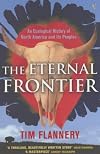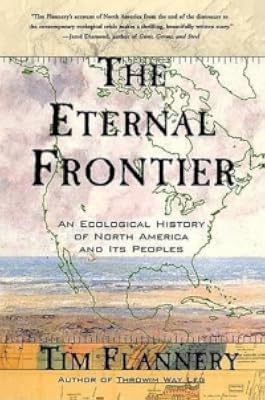
The Eternal Frontier: An Ecological History of North America and Its Peoples
by Tim Flannery
On This Page
Description
A paleontologist offers an ecological tour of North America, from the asteroid strike that killed the dinosaurs sixty-five million years ago to the present.Tags
Recommendations













Member Reviews
If Nature itself has a nature, it's the desire for balance. In a fascinating chronicle of our continent's evolution, Flannery shows, however, that this desire must forever be frustrated. Flannery starts his tale with the asteroid collision that destroyed the dinosaurs, ends with the almost equally cataclysmic arrival of humankind and fills the middle with an engaging survey of invaders from other lands, wild speciation and an ever-changing climate, all of which have kept the ecology of North America in a constant state of flux. We see the rise of horses, camels and dogs (cats are Eurasian), the rapid extinction of mammoths, mastodons and other megafauna at the hands of prehistoric man, and the even quicker extinction of the passenger show more pigeon and other creatures more recently. Flannery also spotlights plenty of scientists at work, most notably one who tries to butcher an elephant as a prehistoric man would have butchered a mastodon, and another who had the intestinal fortitude to check whether meat would keep if a carcass were stored at the bottom of a frigid pond, the earliest of refrigerators. This material might be dense and academic in another's hands, but Flannery displays a light touch, a keen understanding of what will interest general readers and a good sense of structure, which keeps the book moving, manageable and memorable. show less
United States History courses tend to make much out of a little; after all, the United States of America is not even yet 250 years old. But North America is far older.
Tim Flannery provides the ultimate in American history in The Eternal Frontier: An Ecological History of North America and Its Peoples, covering 65 million years from the Chicxulub asteroid impact until the modern day.
As an ecological history, the work focuses on what we have learned about the flora and fauna, especially the fauna, of the North American continent. It is believed said continent has moved a lot, expanded its boundaries, had inland seas come and go, watched a few mountain ranges rise and fall - and of greater consequence, came into contact with Eurasia, show more broke off contact with Eurasia, and connected with South America.
Thus the narrative describes the ascent of mammals after the asteroid impact and plant development; Eurasian migrants to North America, with a couple of key North Americans immigrating to Europe, including the horse; eventual isolation from Eurasia, and eventual contact with South America, and how many more species traveled north from South America than vice versa, including most of our migratory birds.
The big story more recently involved Ice Ages, the development of the American megafauna, and the eventual death of the megafauna, most likely at the hands of early Indigenous people. The author is very committed to the Clovis people as the first Indigenous Americans; one can only wonder what he would make of the most recent evidence suggesting the presence of people well before 13,000 years ago.
According to the author, North America has never really gotten over the end of its megafauna. Sure, Indigenous people persevere for generations afterward, but such explains why the bison became so important as the last remnant of the megafauna. And then the Europeans arrived with all kinds of new exchanges.
The last two centuries in particular have been nothing but a disaster ecologically for North America, well exemplified by the author in terms of the stories of the passenger pigeon and the bison. Resources which developed over long periods of time have been quickly exploited and extracted.
Those who may find the millions of years a difficult prospect to entertain can do well imagining it all happening over a shorter time, or as a heritage imbued in the rock from its creation. What should not be missed is the story we can read from the ecological heritage of North America. The geography of North America means it experiences climate change more sharply and violently than other parts of the world; we should not be surprised if our climate varies more sharply and violently over the next few generations. North America will remain resilient; its present flora and fauna, however, maybe not so much.
This is an interesting read in order to get a fuller picture of the heritage of North America. show less
Tim Flannery provides the ultimate in American history in The Eternal Frontier: An Ecological History of North America and Its Peoples, covering 65 million years from the Chicxulub asteroid impact until the modern day.
As an ecological history, the work focuses on what we have learned about the flora and fauna, especially the fauna, of the North American continent. It is believed said continent has moved a lot, expanded its boundaries, had inland seas come and go, watched a few mountain ranges rise and fall - and of greater consequence, came into contact with Eurasia, show more broke off contact with Eurasia, and connected with South America.
Thus the narrative describes the ascent of mammals after the asteroid impact and plant development; Eurasian migrants to North America, with a couple of key North Americans immigrating to Europe, including the horse; eventual isolation from Eurasia, and eventual contact with South America, and how many more species traveled north from South America than vice versa, including most of our migratory birds.
The big story more recently involved Ice Ages, the development of the American megafauna, and the eventual death of the megafauna, most likely at the hands of early Indigenous people. The author is very committed to the Clovis people as the first Indigenous Americans; one can only wonder what he would make of the most recent evidence suggesting the presence of people well before 13,000 years ago.
According to the author, North America has never really gotten over the end of its megafauna. Sure, Indigenous people persevere for generations afterward, but such explains why the bison became so important as the last remnant of the megafauna. And then the Europeans arrived with all kinds of new exchanges.
The last two centuries in particular have been nothing but a disaster ecologically for North America, well exemplified by the author in terms of the stories of the passenger pigeon and the bison. Resources which developed over long periods of time have been quickly exploited and extracted.
Those who may find the millions of years a difficult prospect to entertain can do well imagining it all happening over a shorter time, or as a heritage imbued in the rock from its creation. What should not be missed is the story we can read from the ecological heritage of North America. The geography of North America means it experiences climate change more sharply and violently than other parts of the world; we should not be surprised if our climate varies more sharply and violently over the next few generations. North America will remain resilient; its present flora and fauna, however, maybe not so much.
This is an interesting read in order to get a fuller picture of the heritage of North America. show less
A history (mostly pre-history) of North America, beginning with the formation of the continent and the extinction of dinosaurs, following waves of life, human and otherwise, populating the frontier, and putting the human story in the context of sixty million years of migration. I found the prehistory more interesting, and the account of humans as relentlessly depressing as I was sure it would be..
This was awesome. One of the best natural history books ever. It's an amazing blend of geological, biological, and social history. It's concise and well-paced. It is an absolutely gripping story as Flannery relates the rise and fall of species and climates with such epic sweep that you feel like God watching it happen. Just great. Nothing like it. Stephen Gould would've been proud. I gave this to my wife to read. If you only read one natural history book in your lifetime - this is the best summary you could choose.
A lively read. Flannery is not good about the very early human history of North America, but the book is sound on either side of that.
Flannery's 80 million year history of North America desperately needs illustrations. Six horned creatures, giant armadillos? For all of that it's a tour de force, but the six part television series is waiting to be made. There's interesting bits to quibble over though, he dismisses the possibility of pre-Clovis settlement for instance in the kind of off hand way that reminds me of tone taken by climate change deniers. Well I can't see the television series ever taking off. The Americans would never accept an Aussie telling them about their own pre-history, and frankly the rest of the world isn't going to be that interested. If only Steve Irwin was still with us....
I have always been fascinated by ecological/climatological history, so I found this book very interesting. For the most part, Flannery does a good job of making the science accessible to those who have some knowledge but perhaps are not experts in a scientific field. A few times the book did get a little cumbersome, but these parts were short lived.
Definitely an interesting look at why North America is different from Europe, Africa, or Asia.
Definitely an interesting look at why North America is different from Europe, Africa, or Asia.
Members
- Recently Added By
Author Information

45+ Works 5,116 Members
Awards and Honors
Common Knowledge
- Original title
- The eternal frontier. An ecological history of North America and its peoples
- Original publication date
- 2001
- Important places
- North America
- Dedication
- To the North Americans:
in admiration of the efforts so many are now making
to win back the natural grandeur, the biodiversity
and ecological balance of their exceptional land. - First words
- There are forces in the lives of people, and animals and plants too, that have made them what they are.
- Last words
- (Click to show. Warning: May contain spoilers.)I wish them well in their struggle to survive in their remarkable land.
- Publisher's editor
- Heyward, Michael; Miller, Andrew
- Original language
- English
Classifications
Statistics
- Members
- 604
- Popularity
- 48,504
- Reviews
- 12
- Rating
- (4.00)
- Languages
- Dutch, English, German
- Media
- Paper, Ebook
- ISBNs
- 13
- ASINs
- 4