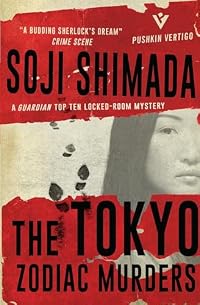
On This Page
Description
Astrologer, fortuneteller, and self-styled detective Kiyoshi Mitarai must in one week solve a macabre murder mystery that has baffled Japan for 40 years. Who murdered the artist Umezawa, raped and killed his daughter, and then chopped up the bodies of six others to create Azoth, the supreme woman? With maps, charts, and other illustrations, this story of magic and illusion, pieced together like a great stage tragedy, challenges the reader to unravel the mystery before the final curtain.Tags
Recommendations







Member Reviews
Rating: 4.5* of five
The Publisher Says: An amateur detective races to solve a decades-old murder mystery in this “bloody and bizarre” Japanese crime novel with a twist hailed as “one of the most original” (Daily Mail).
Astrologer, fortune teller, and self-styled detective Kiyoshi Mitarai must solve a macabre murder mystery that has baffled Japan for 40 years—in just one week.
With the help of his freelance illustrator friend, Kiyoshi sets out to answer the questions that have haunted the country ever since: Who murdered the artist Umezawa, raped and killed his daughter, and then chopped up the bodies of six others to create Azoth, ‘the perfect woman’?
With maps, charts, and other illustrations, this story of magic and show more illusion—pieced together like a great stage tragedy—challenges the reader to unravel the mystery before the final curtain falls.
This quintessential Japanese “logic mystery”—eerie, gory, and intriguing—combines the puzzle-solving of Golden Age Western detective fiction with elements of shocking horror and dark humor.
I RECEIVED A DRC FROM THE PUBLISHER VIA EDELWEISS+. THANK YOU.
My Review: Japanese locked-room mysteries are pretty much exemplars of the genre. Unlike Dame Agatha's versions of the genre, they include a bit more gore...this one feels like it could easily have made itself a mild body-horror story with very little authorial effort...but the focus really is on the puzzle.
That focus is evident from the epistolary outset. The entire first thirty-plus pages is a letter written in 1936. It is the statement of purpose for the rest of the book: A murderer pens is intended crimes in detail, explaining why he intends to do these...vile, violent, violating...things to women.
Now, that right there? The crimes being committed against women for a man's gratification? That will get me to Pearl-Rule a book for good and ever. In this case I did not because I felt the facts presented in this introductory letter-cum-statement-of-purpose put the reader into the mindset of knowing the murderer's sickness. As a result, there was no prurient titillation of discovering the women's bodies to learn what had been done to them. I got in my head the purpose of the story, as it shifted into forensics, into crime-solving, because I knew what the crimes were for. I had already decided how twisted and sick the crimes were.
You should know this going in: Misogyny is on full display in very deeply disturbing ways.
Kiyoshi Mitarai, our sleuth, is in the modern day of the book...early 1980s Japan...solving an unsolved cold case. He's unusual in today's world for being a New-Age practitioner of astrology, a thing that was really prominent in culture at that time. He gets interested because the daughter of the police detective who failed to solve the case, dead now after a blighted career from this case, thinks her dad's soul can rest if the failure is reversed by solving it. Her brother horns in and sets our sleuth a serious time limit of five days to complete the puzzle, or the son will blow up old dirt about Kiyoshi.
As is necessary for a locked-room puzzle to get solved, Kiyoshi has a sidekick to think out loud to, and to do some legwork that the audience doesn't need to see. We'll learn it when mystery book lover, and importantly book illustrator, Kazumi Ishioka delivers the information anyway. (Side note: There is, for each timeline, a dramatis personae...prepare to use it A LOT.) The way the story is presented is largely through these two guys sitting and talking through what they know, how they know it, where they've been, and the like. Direct action? Not a lot. Fun little grace notes of these dudes preening for each other, making friend-jokes, talking about stuff that really does have something to do with the case but does not look like it? I'll read that over a run-around drenched in gore-fest. The world is violent enough.
The story's replete with floorplans and crime-scene illustrations (courtesy of Kizumi) and the details are numerous, hard to track, well-buried meanings abound. It is a delightful time for logic-puzzle reader. It turns meta when, approaching the end, the author directly addresses the reader, asking if we've solved the puzzle yet. Okay, thought I, now I'm aware that I have all the information I need to do it. So I sat me down to think. I flipped to some illustrations. I thought some more. I came up with a perp's identity. I read the rest of the story.
I was wrong. I was sure I was right, and I did not see until it was explained to me what I had missed.
That's a reading experience I really enjoy a lot. Get you one for some #Deathtober fun and games. show less
The Publisher Says: An amateur detective races to solve a decades-old murder mystery in this “bloody and bizarre” Japanese crime novel with a twist hailed as “one of the most original” (Daily Mail).
Astrologer, fortune teller, and self-styled detective Kiyoshi Mitarai must solve a macabre murder mystery that has baffled Japan for 40 years—in just one week.
With the help of his freelance illustrator friend, Kiyoshi sets out to answer the questions that have haunted the country ever since: Who murdered the artist Umezawa, raped and killed his daughter, and then chopped up the bodies of six others to create Azoth, ‘the perfect woman’?
With maps, charts, and other illustrations, this story of magic and show more illusion—pieced together like a great stage tragedy—challenges the reader to unravel the mystery before the final curtain falls.
This quintessential Japanese “logic mystery”—eerie, gory, and intriguing—combines the puzzle-solving of Golden Age Western detective fiction with elements of shocking horror and dark humor.
I RECEIVED A DRC FROM THE PUBLISHER VIA EDELWEISS+. THANK YOU.
My Review: Japanese locked-room mysteries are pretty much exemplars of the genre. Unlike Dame Agatha's versions of the genre, they include a bit more gore...this one feels like it could easily have made itself a mild body-horror story with very little authorial effort...but the focus really is on the puzzle.
That focus is evident from the epistolary outset. The entire first thirty-plus pages is a letter written in 1936. It is the statement of purpose for the rest of the book: A murderer pens is intended crimes in detail, explaining why he intends to do these...vile, violent, violating...things to women.
Now, that right there? The crimes being committed against women for a man's gratification? That will get me to Pearl-Rule a book for good and ever. In this case I did not because I felt the facts presented in this introductory letter-cum-statement-of-purpose put the reader into the mindset of knowing the murderer's sickness. As a result, there was no prurient titillation of discovering the women's bodies to learn what had been done to them. I got in my head the purpose of the story, as it shifted into forensics, into crime-solving, because I knew what the crimes were for. I had already decided how twisted and sick the crimes were.
You should know this going in: Misogyny is on full display in very deeply disturbing ways.
Kiyoshi Mitarai, our sleuth, is in the modern day of the book...early 1980s Japan...solving an unsolved cold case. He's unusual in today's world for being a New-Age practitioner of astrology, a thing that was really prominent in culture at that time. He gets interested because the daughter of the police detective who failed to solve the case, dead now after a blighted career from this case, thinks her dad's soul can rest if the failure is reversed by solving it. Her brother horns in and sets our sleuth a serious time limit of five days to complete the puzzle, or the son will blow up old dirt about Kiyoshi.
As is necessary for a locked-room puzzle to get solved, Kiyoshi has a sidekick to think out loud to, and to do some legwork that the audience doesn't need to see. We'll learn it when mystery book lover, and importantly book illustrator, Kazumi Ishioka delivers the information anyway. (Side note: There is, for each timeline, a dramatis personae...prepare to use it A LOT.) The way the story is presented is largely through these two guys sitting and talking through what they know, how they know it, where they've been, and the like. Direct action? Not a lot. Fun little grace notes of these dudes preening for each other, making friend-jokes, talking about stuff that really does have something to do with the case but does not look like it? I'll read that over a run-around drenched in gore-fest. The world is violent enough.
The story's replete with floorplans and crime-scene illustrations (courtesy of Kizumi) and the details are numerous, hard to track, well-buried meanings abound. It is a delightful time for logic-puzzle reader. It turns meta when, approaching the end, the author directly addresses the reader, asking if we've solved the puzzle yet. Okay, thought I, now I'm aware that I have all the information I need to do it. So I sat me down to think. I flipped to some illustrations. I thought some more. I came up with a perp's identity. I read the rest of the story.
I was wrong. I was sure I was right, and I did not see until it was explained to me what I had missed.
That's a reading experience I really enjoy a lot. Get you one for some #Deathtober fun and games. show less
I don’t know if contemporary Japanese author Sōji Shimada is a member of the Detection Club, but he deserves to be — both because of his excellent novel and due to Shimada’s strictly maintaining the club’s promise to play fair with readers in their novels. (Founded in 1930, the Detection Club was originally all British. The great G.K. Chesterton was its first president, and it continues to this day.)
Shimada promises more than once that he gives you every clue you need to solve the crime, and he’s true to his word. Even so, I never guessed the culprit, and I suspect that most readers won’t. I was utterly delighted that this was the first of a series featuring slacker astrologer Kiyoshi Mitarai and his Watson, illustrator show more Kazumi Ishioka. It’s hard not to dislike Kiyoshi, just as it’s impossible not to love the eager beaver Kazumi; however, Kiyoshi could play Sherlock Holmes like no other. I’m so glad there are sequels. Highly recommended. show less
Shimada promises more than once that he gives you every clue you need to solve the crime, and he’s true to his word. Even so, I never guessed the culprit, and I suspect that most readers won’t. I was utterly delighted that this was the first of a series featuring slacker astrologer Kiyoshi Mitarai and his Watson, illustrator show more Kazumi Ishioka. It’s hard not to dislike Kiyoshi, just as it’s impossible not to love the eager beaver Kazumi; however, Kiyoshi could play Sherlock Holmes like no other. I’m so glad there are sequels. Highly recommended. show less
The Tokyo Zodiac Murders starts off with a “last will and testament” written by Heikichi Umezawa in 1936. In this document, he detailed his belief that he is possessed and how he came to the realization that killing six of his daughters and nieces would solve his problems. Using their zodiac signs as a guide, he’d take one body part from each young woman and construct Azoth, the perfect woman.
The story then fast forwards to about 40 years later. Kazumi, a mystery fan, is describing the facts of the Tokyo Zodiac Murders to his friend Kiyoshi, an astrologer and occasional detective. The six young women were, in fact, killed and mutilated in the manner described in Heikichi’s will, but Heikichi couldn’t possibly have done it: show more he’d been dead for several days prior to the murders. In addition to Heikichi’s murder and the Azoth murders, one of Heikichi’s other stepdaughters was also killed. No one is sure whether that murder was related to the others or not.
After Kiyoshi takes on a client with a distant but potentially embarrassing connection to the case, Kiyoshi and Kazumi end up with a one-week deadline to solve a mystery that no one else has managed to solve in 40 years. Diagrams included throughout the text invite readers to solve the mystery along with them.
If you like trying to solve mysteries before a book’s fictional detective does, you really need to give this a try. It’s an excellent puzzle, and the author even interjects a couple times in order to let readers know when enough information has been included to allow them to solve the mystery. Of course, he interjects late enough that readers have more information than they need, muddying the water a bit, but that’s part of the fun.
The first part, with Heikichi’s will, was particularly strong. Heikichi casually describing why he needed to kill his daughters and nieces was incredibly creepy. I promise, though, that that’s as creepy as the book gets. Although the description of how the murders were actually accomplished was horrifying, the book’s overall tone didn’t have much of a feeling of creepiness, horror, or even urgency to it. Yes, Kiyoshi only had a week to solve the mystery, but the only things at stake, really, were his ego and reputation. Most of the people directly affected by the Tokyo Zodiac Murders were long dead.
There were a few times when I started to lose interest as the book became a little too “two guys talking about the facts of the case,” but for the most part those facts were really interesting. I had all kinds of theories about who might have killed Heikichi and how Kazue, Heikichi’s eldest stepdaughter, was involved, and who had killed the other women. None of my theories fit all of the facts of the case, and all my theories were torpedoed after Shimada included one particular document.
Kazumi, who was basically Kiyoshi’s Watson, had some ideas of his own that sounded promising, but I was fairly certain that he’d miss the key detail that would bring everything together. By the time Kiyoshi finally announced that he’d solved the murders, both Kazumi and I were thoroughly lost. It got to the point where I felt like Shimada was practically shoving the finished puzzle under my nose and I still couldn’t solve it. It was frustrating and fun at the same time. If it hadn’t been for work and sleep, I’d probably have read the last part of the book, where everything was finally revealed, all in one go. I can confidently say that I’d never have figured everything out on my own. There were aspects that stretched my suspension of disbelief, but, even so, the solution was really good.
All in all, this was a very enjoyable mystery that kept me guessing until the final revelation. It was very deliberately structured like a puzzle that readers were invited to solve along with Kiyoshi and Kazumi, but, despite the author’s two interjections, it still didn’t feel quite as detached as a couple similar mysteries I can think of. Kiyoshi and Kazumi had some life to them and didn’t just feel like pieces on the author’s gameboard. I particularly enjoyed their conversation about Sherlock Holmes and well-known mystery authors, and Kazumi's enjoyment of various locations in Japan made me wish I could visit them myself.
(Original review posted on A Library Girl's Familiar Diversions.) show less
The story then fast forwards to about 40 years later. Kazumi, a mystery fan, is describing the facts of the Tokyo Zodiac Murders to his friend Kiyoshi, an astrologer and occasional detective. The six young women were, in fact, killed and mutilated in the manner described in Heikichi’s will, but Heikichi couldn’t possibly have done it: show more he’d been dead for several days prior to the murders. In addition to Heikichi’s murder and the Azoth murders, one of Heikichi’s other stepdaughters was also killed. No one is sure whether that murder was related to the others or not.
After Kiyoshi takes on a client with a distant but potentially embarrassing connection to the case, Kiyoshi and Kazumi end up with a one-week deadline to solve a mystery that no one else has managed to solve in 40 years. Diagrams included throughout the text invite readers to solve the mystery along with them.
If you like trying to solve mysteries before a book’s fictional detective does, you really need to give this a try. It’s an excellent puzzle, and the author even interjects a couple times in order to let readers know when enough information has been included to allow them to solve the mystery. Of course, he interjects late enough that readers have more information than they need, muddying the water a bit, but that’s part of the fun.
The first part, with Heikichi’s will, was particularly strong. Heikichi casually describing why he needed to kill his daughters and nieces was incredibly creepy. I promise, though, that that’s as creepy as the book gets. Although the description of how the murders were actually accomplished was horrifying, the book’s overall tone didn’t have much of a feeling of creepiness, horror, or even urgency to it. Yes, Kiyoshi only had a week to solve the mystery, but the only things at stake, really, were his ego and reputation. Most of the people directly affected by the Tokyo Zodiac Murders were long dead.
There were a few times when I started to lose interest as the book became a little too “two guys talking about the facts of the case,” but for the most part those facts were really interesting. I had all kinds of theories about who might have killed Heikichi and how Kazue, Heikichi’s eldest stepdaughter, was involved, and who had killed the other women. None of my theories fit all of the facts of the case, and all my theories were torpedoed after Shimada included one particular document.
Kazumi, who was basically Kiyoshi’s Watson, had some ideas of his own that sounded promising, but I was fairly certain that he’d miss the key detail that would bring everything together. By the time Kiyoshi finally announced that he’d solved the murders, both Kazumi and I were thoroughly lost. It got to the point where I felt like Shimada was practically shoving the finished puzzle under my nose and I still couldn’t solve it. It was frustrating and fun at the same time. If it hadn’t been for work and sleep, I’d probably have read the last part of the book, where everything was finally revealed, all in one go. I can confidently say that I’d never have figured everything out on my own. There were aspects that stretched my suspension of disbelief, but, even so, the solution was really good.
All in all, this was a very enjoyable mystery that kept me guessing until the final revelation. It was very deliberately structured like a puzzle that readers were invited to solve along with Kiyoshi and Kazumi, but, despite the author’s two interjections, it still didn’t feel quite as detached as a couple similar mysteries I can think of. Kiyoshi and Kazumi had some life to them and didn’t just feel like pieces on the author’s gameboard. I particularly enjoyed their conversation about Sherlock Holmes and well-known mystery authors, and Kazumi's enjoyment of various locations in Japan made me wish I could visit them myself.
(Original review posted on A Library Girl's Familiar Diversions.) show less
This review first appeared on Sci Fi and Scary
‘The Tokyo Zodiac Murders’ is (as the title kind of suggests) a weird, Japanese horror/crime novel. It’s part head scratching mystery, part gruesome serial killer chiller and a lot of fun from first page to last. Written in the early 80s, it was the first novel by popular author Soji Shimada who went on to write dozens of other books. Sadly, not many of them have been translated into English, but I’ll certainly be checking out the ones that have been.
The novel follows two friends, one the narrator, the other a brilliant amateur detective. The pair are investigating three related crimes against members of the same family. One a classic locked room killing, one a brutal rape/murder and show more the last the serial slaughter of six sisters.
The investigating duo set-up is one that will be familiar to anyone who has read Sherlock Holmes and it works well here. Shimada goes so far as to acknowledge the debt he owes Conan Doyle in a hilarious scene where sleuth Kiyoshi Mitarai details his many problems with the Holmes mysteries. Shimada also borrows Conan Doyle’s tendency to make the mysterious seem supernatural, with the murders of the six sisters related to the construction of an astrological effigy, Azoth. This book is far grislier than most mysteries, with a level of violence and graphic detail that moves it firmly into horror genre. The denouement in particular is absolutely horrific.
More than anything though, this is a book for mystery lovers. Shimada is clearly one himself and delights in littering the story with clues. Much of the fun of the book comes from sleuthing along with the detectives, trying to piece the many parts of the puzzle together. Shimada includes diagrams and Agatha Christie style summaries of the facts of the case to help armchair detectives. Deliciously, he also throws in a couple of “have you figured it out yet” interludes where he addresses the reader directly.
If that appeals and you fancy something that will keep you scratching your head whilst it thrills and horrifies, ‘The Tokyo Zodiac Murders’ is definitely worth a try. show less
‘The Tokyo Zodiac Murders’ is (as the title kind of suggests) a weird, Japanese horror/crime novel. It’s part head scratching mystery, part gruesome serial killer chiller and a lot of fun from first page to last. Written in the early 80s, it was the first novel by popular author Soji Shimada who went on to write dozens of other books. Sadly, not many of them have been translated into English, but I’ll certainly be checking out the ones that have been.
The novel follows two friends, one the narrator, the other a brilliant amateur detective. The pair are investigating three related crimes against members of the same family. One a classic locked room killing, one a brutal rape/murder and show more the last the serial slaughter of six sisters.
The investigating duo set-up is one that will be familiar to anyone who has read Sherlock Holmes and it works well here. Shimada goes so far as to acknowledge the debt he owes Conan Doyle in a hilarious scene where sleuth Kiyoshi Mitarai details his many problems with the Holmes mysteries. Shimada also borrows Conan Doyle’s tendency to make the mysterious seem supernatural, with the murders of the six sisters related to the construction of an astrological effigy, Azoth. This book is far grislier than most mysteries, with a level of violence and graphic detail that moves it firmly into horror genre. The denouement in particular is absolutely horrific.
More than anything though, this is a book for mystery lovers. Shimada is clearly one himself and delights in littering the story with clues. Much of the fun of the book comes from sleuthing along with the detectives, trying to piece the many parts of the puzzle together. Shimada includes diagrams and Agatha Christie style summaries of the facts of the case to help armchair detectives. Deliciously, he also throws in a couple of “have you figured it out yet” interludes where he addresses the reader directly.
If that appeals and you fancy something that will keep you scratching your head whilst it thrills and horrifies, ‘The Tokyo Zodiac Murders’ is definitely worth a try. show less
(19) Another of this sub-genre of Japanese "locked-room" or golden age mysteries where the authors follow a set of rules and even reach out to the reader at times. All the clues to solve the murders are in the narrative - there is no deus-ex-machina or last minute revelations. The reader is however, subject to whatever extraneous info the amateur detectives come across as well - so red herrings abound. My son and I have read now 3 such books - this one I fear had a bit more sex and violence in it than the others and he read it before I could censor it; but what can you do? An eccentric artist conceives of a plan to build the perfect woman from various perfect body parts of other women - each must have certain astrological qualifications show more and be killed in buried in a certain way for the "Azoth" to come to life and save Japan from itself. (This took place between the two World Wars - 1936) In his suicide note he admits his devious plan and that the girls are his 6 daughters/step-daughters, nieces, but ... he is found dead in his locked studio and it is only a month after his confirmed death that the girls disappear and die; their bodies found each without a certain body part.... So who committed these heinous crimes? Was the initial murder staged and an imposter actually killed? Did the same criminal commit them all? To make matters more mysterious - an older divorced step-daughter of the artist is also found bludgeoned, killed, raped and her house robbed around this time. How could this possibly fit in?
To say this book is weird and intriguing is to put it mildly. It is compulsively readable, though. Despite being turned off by the whole opening with the astrology and the longitudes and attitudes - it quickly kicks in to high gear when the two amateur detectives begin to investigate (40 years later after the trail has gone cold) receiving an additional clue not available to the police and general public. This translation is not nearly as stilted as 'The Decagon Murders' and 'The Moai Island Mystery.' It tended to be a bit maudlin and foreign sounding in parts. Overall, the diction and sentiment didn't sound as silly as the others. Did I guess it? No, not really. Towards the end, I suspected; but more based on hunch. I certainly didn't figure the clever deception that allowed the murderer to get away with it.
A fun sub-genre that maybe feels a bit better to me than reading about true crime. I am enjoying my little trip through the golden age mysteries: Christie; the Japanese writers, and I am finishing a Dorothy Sayers. Right now in my life, I need this type of novel. I am having difficulty making room for classics and introspective modern masterpieces. I will return to "serious" literature when I have the bandwidth to commit. This was a fabulous classic locked-room whodunnit with a Japan twist; cherry-blossoms and all. show less
To say this book is weird and intriguing is to put it mildly. It is compulsively readable, though. Despite being turned off by the whole opening with the astrology and the longitudes and attitudes - it quickly kicks in to high gear when the two amateur detectives begin to investigate (40 years later after the trail has gone cold) receiving an additional clue not available to the police and general public. This translation is not nearly as stilted as 'The Decagon Murders' and 'The Moai Island Mystery.' It tended to be a bit maudlin and foreign sounding in parts. Overall, the diction and sentiment didn't sound as silly as the others. Did I guess it? No, not really. Towards the end, I suspected; but more based on hunch. I certainly didn't figure the clever deception that allowed the murderer to get away with it.
A fun sub-genre that maybe feels a bit better to me than reading about true crime. I am enjoying my little trip through the golden age mysteries: Christie; the Japanese writers, and I am finishing a Dorothy Sayers. Right now in my life, I need this type of novel. I am having difficulty making room for classics and introspective modern masterpieces. I will return to "serious" literature when I have the bandwidth to commit. This was a fabulous classic locked-room whodunnit with a Japan twist; cherry-blossoms and all. show less
Oh my! This is probably the best mystery novel I've read all year -- it is the kind of book that I hope to find every time I pick up a new mystery. I do have to admit to a fondness for Japanese authors, especially mystery writers, and this particular book is an example of why. I have to find other works by this author in translation if they exist. I could NOT put this book down at all once I started.
The story begins some time back in the 1930s, and its focal point is a bizarre case known as the Tokyo Zodiac Murders. In the last will & testament of an artist under the influences of astrology and alchemy, he sets forth his plan to create the perfect woman...by killing off female relatives, including his daughters, to combine the best show more parts of all of them in his creation. The murders occurred, but this happened after the artist was found dead, in his studio, locked from the outside. The clues left little to go on, and solving the horrifying case became an obsession for many over the last decades. One detective, who is also a fortune teller, decides to take it on and solve it where others have failed. With the help of his friend, a fan of detective fiction, he tries to do what so many have attempted and failed over the a 40-year period of time.
An amazing book, one that will totally occupy you as you read. There are a number of possibilities that present themselves as the two friends delve into the past. The characterization is very well done, the writing is excellent, and the mystery itself (not to mention the solution) is nothing like I've ever read before. Hooray for a mystery I could really sink my teeth into.
I think this one will really appeal to people like myself who enjoy the different take on mysteries provided by Japanese mystery authors, and those who enjoy the classic locked-room scenario. It isn't a mystery for cozy readers or readers who want an easy solution -- this requires the reader's participation the entire way. Also, if alchemy and astrology aren't your thing, then you may want to skip it.
An excellent mystery -- I enjoy finding these little gems now and then. Most highly recommended. show less
The story begins some time back in the 1930s, and its focal point is a bizarre case known as the Tokyo Zodiac Murders. In the last will & testament of an artist under the influences of astrology and alchemy, he sets forth his plan to create the perfect woman...by killing off female relatives, including his daughters, to combine the best show more parts of all of them in his creation. The murders occurred, but this happened after the artist was found dead, in his studio, locked from the outside. The clues left little to go on, and solving the horrifying case became an obsession for many over the last decades. One detective, who is also a fortune teller, decides to take it on and solve it where others have failed. With the help of his friend, a fan of detective fiction, he tries to do what so many have attempted and failed over the a 40-year period of time.
An amazing book, one that will totally occupy you as you read. There are a number of possibilities that present themselves as the two friends delve into the past. The characterization is very well done, the writing is excellent, and the mystery itself (not to mention the solution) is nothing like I've ever read before. Hooray for a mystery I could really sink my teeth into.
I think this one will really appeal to people like myself who enjoy the different take on mysteries provided by Japanese mystery authors, and those who enjoy the classic locked-room scenario. It isn't a mystery for cozy readers or readers who want an easy solution -- this requires the reader's participation the entire way. Also, if alchemy and astrology aren't your thing, then you may want to skip it.
An excellent mystery -- I enjoy finding these little gems now and then. Most highly recommended. show less
I don't read a lot of mysteries, so I've been trying to shore up that gap in my library by reading all sorts takes on the genre.
The Tokyo Zodiac Murders was specifically recommended to me due to it kicking off the shin honkaku 'era' of mystery books in Japan. This term refers to more orthodox mysteries which tend to be closer to a puzzle box or game and is far less focused on the social and dramatic elements of a mystery. It's not about spotting inconsistencies in witness testimony or developing a criminal profile, it's more about solving the physical logic behind how a crime happened.
It's a fun idea for approaching a mystery. The problem is this particular book just isn't very fun to read.
The series of murders was fascinating, and I show more wanted so much to get absorbed in the mystery. But the book is more interested in bogging you down with facts and tidbits about the murder. There are pages and pages of names, astrology definitions, latitudes, longitudes, the top speed of a car during a blizzard, and on and on and on.
The reason for all this was not lost on me. A certain type of trick is being played on the reader, and it's an effective one. But it's also tremendously boring and tedious to actually run your eyes over. If you're going to misdirect me then you should at least have fun with it!
I enjoy logic puzzles, and while I haven't read many mysteries I've played plenty of games and visual novels in the genre, many of which were strongly influenced by honkaku. If this truly was game it'd be very poorly reviewed.
Perhaps it's the translation? I recognized many 'stock phrases' and other details throughout the book that suggested it adhered to a very literal translation. Could be that a lot has been lost in translation. It's hard to speculate too much about that.
I'm glad I read it to better understand the history of the genre, but I'd have a hard time recommending it to anyone, and I certainly can't see myself going reading it again. show less
The Tokyo Zodiac Murders was specifically recommended to me due to it kicking off the shin honkaku 'era' of mystery books in Japan. This term refers to more orthodox mysteries which tend to be closer to a puzzle box or game and is far less focused on the social and dramatic elements of a mystery. It's not about spotting inconsistencies in witness testimony or developing a criminal profile, it's more about solving the physical logic behind how a crime happened.
It's a fun idea for approaching a mystery. The problem is this particular book just isn't very fun to read.
The series of murders was fascinating, and I show more wanted so much to get absorbed in the mystery. But the book is more interested in bogging you down with facts and tidbits about the murder. There are pages and pages of names, astrology definitions, latitudes, longitudes, the top speed of a car during a blizzard, and on and on and on.
The reason for all this was not lost on me. A certain type of trick is being played on the reader, and it's an effective one. But it's also tremendously boring and tedious to actually run your eyes over. If you're going to misdirect me then you should at least have fun with it!
I enjoy logic puzzles, and while I haven't read many mysteries I've played plenty of games and visual novels in the genre, many of which were strongly influenced by honkaku. If this truly was game it'd be very poorly reviewed.
Perhaps it's the translation? I recognized many 'stock phrases' and other details throughout the book that suggested it adhered to a very literal translation. Could be that a lot has been lost in translation. It's hard to speculate too much about that.
I'm glad I read it to better understand the history of the genre, but I'd have a hard time recommending it to anyone, and I certainly can't see myself going reading it again. show less
Members
- Recently Added By
Author Information

32+ Works 799 Members
Some Editions
Series

Belongs to Publisher Series
Pushkin Vertigo (4)
Common Knowledge
- Canonical title
- The Tokyo Zodiac Murders
- Original publication date
- 1981
- Original language
- Japanese
Classifications
- Genres
- Fiction and Literature, Mystery
- DDC/MDS
- 895.635 — Literature & rhetoric Asian Literature Literatures of East and Southeast Asia Japanese Japanese fiction 1945–2000
- LCC
- PL861 .H529 .S4513 — Language and Literature Languages and literatures of Eastern Asia, Africa, Oceania Languages of Eastern Asia, Africa, Oceania Japanese language and literature Japanese literature Individual authors and works
- BISAC
Statistics
- Members
- 515
- Popularity
- 57,954
- Reviews
- 22
- Rating
- (3.62)
- Languages
- English, French, Italian, Japanese
- Media
- Paper, Ebook
- ISBNs
- 14
- ASINs
- 4