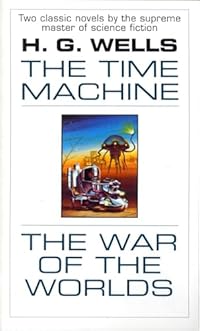
The War of the Worlds / The Time Machine
by H. G. Wells
On This Page
Description
The Time Machine When the Time Traveller courageously stepped out of his machine for the first time, he found himself in the year 802,700—and everything had changed. In this unfamiliar, utopian age creatures seemed to dwell together in perfect harmony. The Time Traveller thought he could study these marvelous beings—unearth their secret and then return to his own time—until he discovered that his invention, his only avenue of escape, had been stolen. H. G. Wells’s famous novel of one show more man’s astonishing journey beyond the conventional limits of the imagination first appeared in 1895. It won him immediate recognition and has been regarded ever since as one of the great masterpieces in the literature of science fiction. The War of the Worlds H. G. Wells’s science fiction classic, the first novel to explore the possibilities of intelligent life from other planets, is still startling and vivid nearly a century after its appearance, and a half century after Orson Welles’s infamous 1938 radio adaptation. This daring portrayal of aliens landing on English soil, with its themes of interplanetary imperialism, technological holocaust, and chaos, is central to the career of H. G. Wells, who died at the dawn of the atomic age. The survival of mankind in the face of “vast and cool and unsympathetic” scientific powers spinning out of control was a crucial theme throughout his work. Visionary, shocking, and chilling, The War of the Worlds has lost none of its impact since its first publication in 1898. show lessTags
Recommendations


















Member Reviews
Among H. G. Wells early science fiction novels this is perhaps the most remarkable. It is a tour de force and remains relevant more than a century after its appearance. It contains an early (perhaps the first) description of mechanized warfare and its impact on urban society. We should remember that Wells wrote this not only before the First World War but even prior to the Boer War. The account of refugees must have amazed readers in the 1890s, but unfortunately is almost a commonplace today. There are other ways that this novel broke new ground, but the description of remote-controlled devices used by the Martians seems uncannily similar to mobile robots and drones used today. And then there is the ultimate weapon used by the Martians. show more This novel needs to be read and reread by each generation of those who admire and appreciate the ability of creative genius to imagine alternative futures. show less
It is still amazing to me how many classic and highly influential science fiction authors and stories I have managed to miss in 30+ years of reading. I never read any Asimov or Clarke until my late twenties and thirties. My exposure to Heinlein and Bradbury are still very limited. And until I picked up this book, I had never read any Wells.
This little volume includes an introduction written by Isaac Asimov, which is quite well done. He discusses the origins of science fiction as a genre, the seminal roles of Jules Verne and H. G. Wells in its establishment, and the general cultural context that inspired their works.
I was vaguely familiar with The Time Machine; I think I've seen fragments of at least one movie version. I hadn't quite show more realized the impact of this story (beyond the exploration of time travel) on pop culture. For example, I knew that the Morlocks of X-Men fame were named for *something*, but until I read this story I did not make the connection. In this story, the scientist who invents his time machine shares his experiences to invited guests at a dinner party, which include the narrator. The intrepid explorer travels to the far distant future (hundreds of thousands of years) and discovers the ultimate fate of mankind--divergence into two distinct species, the Eloi and the Morlocks, and ultimately extinction thousands of years beyond that.
In contrast, The War of the Worlds is quite well known, given my familiarity with the various productions over the decades in radio and on screen. It is the inspiration for endless stories of hostile first contact by marauding aliens: Invasion of the Bodysnatchers, V, Independence Day, etc.
Both stories are quite imaginative and predicated on late-nineteenth century understanding of science in terms of evolution, astrophysics, etc. They are quite well written, with elegant prose and evocative imagery. Wells does not bog down by avoiding either endless exposition or minute descriptions. The writing style is definitely dated to our modern eyes, and may be difficult to digest for some modern readers, but I found it very accessible.
The other interesting aspect of these stories are his social premises, which also reflect the thinking of the day to some extent. His supposed mechanism for the development and coexistence of the Eloi and Morlocks is founded on class differences extrapolated along a distant trajectory and seasoned with some poetic justice. Kind of like what happens when the exact opposite of Marxist model of social dynamics ensues. Likewise, Asimov suggests that Wells consciously drew many parallels with the colonialism of the British Empire for The War of the Worlds. In the latter case, Wells spends a great deal of the story exploring how individuals and society as a whole react to overwhelming and unimaginable crisis. In both cases, Wells does not appear to be optimistic, but he is nowhere near as dark as Philip K. Dick, whose works as a rule appear to be quite pessimistic. Admittedly, I have not read *many* of Dick's works, but they are in a league of their own in terms of the feel of his prognostications on future society.
So end result, I enjoyed both stories and I am glad I finally repaired this gap in my coverage of science fiction. I will doubtless seek out other works by Wells. show less
This little volume includes an introduction written by Isaac Asimov, which is quite well done. He discusses the origins of science fiction as a genre, the seminal roles of Jules Verne and H. G. Wells in its establishment, and the general cultural context that inspired their works.
I was vaguely familiar with The Time Machine; I think I've seen fragments of at least one movie version. I hadn't quite show more realized the impact of this story (beyond the exploration of time travel) on pop culture. For example, I knew that the Morlocks of X-Men fame were named for *something*, but until I read this story I did not make the connection. In this story, the scientist who invents his time machine shares his experiences to invited guests at a dinner party, which include the narrator. The intrepid explorer travels to the far distant future (hundreds of thousands of years) and discovers the ultimate fate of mankind--divergence into two distinct species, the Eloi and the Morlocks, and ultimately extinction thousands of years beyond that.
In contrast, The War of the Worlds is quite well known, given my familiarity with the various productions over the decades in radio and on screen. It is the inspiration for endless stories of hostile first contact by marauding aliens: Invasion of the Bodysnatchers, V, Independence Day, etc.
Both stories are quite imaginative and predicated on late-nineteenth century understanding of science in terms of evolution, astrophysics, etc. They are quite well written, with elegant prose and evocative imagery. Wells does not bog down by avoiding either endless exposition or minute descriptions. The writing style is definitely dated to our modern eyes, and may be difficult to digest for some modern readers, but I found it very accessible.
The other interesting aspect of these stories are his social premises, which also reflect the thinking of the day to some extent. His supposed mechanism for the development and coexistence of the Eloi and Morlocks is founded on class differences extrapolated along a distant trajectory and seasoned with some poetic justice. Kind of like what happens when the exact opposite of Marxist model of social dynamics ensues. Likewise, Asimov suggests that Wells consciously drew many parallels with the colonialism of the British Empire for The War of the Worlds. In the latter case, Wells spends a great deal of the story exploring how individuals and society as a whole react to overwhelming and unimaginable crisis. In both cases, Wells does not appear to be optimistic, but he is nowhere near as dark as Philip K. Dick, whose works as a rule appear to be quite pessimistic. Admittedly, I have not read *many* of Dick's works, but they are in a league of their own in terms of the feel of his prognostications on future society.
So end result, I enjoyed both stories and I am glad I finally repaired this gap in my coverage of science fiction. I will doubtless seek out other works by Wells. show less
H.G. Wells pisses me off.
I know these stories are classic, and I know he was writing in the 1890s, but does the narrator have to spend half of his time talking about how he's better than everyone else, and the other half fretting about humankind becoming less "manly"?
Some of the short stories at the end (the "Connections") are clever, though. (They're also by other people.)
I know these stories are classic, and I know he was writing in the 1890s, but does the narrator have to spend half of his time talking about how he's better than everyone else, and the other half fretting about humankind becoming less "manly"?
Some of the short stories at the end (the "Connections") are clever, though. (They're also by other people.)
Personally, I enjoyed The Time Machine better than The War of the Worlds. I found that often Wells would divert the story onto a tangent more in War of the Worlds. The Time Machine was more straightforward and any tangents were more directly related to the main story. The War of the Worlds took entire chapters away from the main character to focus on a brother whose fate is never revealed.
Deservedly classics. I'd never read either of these before, and it was fascinating to realise how many echoes they've had throughout literature and pop culture ever since. Also interesting to me was the level of scientific knowledge evinced by the author. On top of that, they were really enjoyable stories, and I look forward to reading more of Wells' works.
I wasn't the biggest fan of The Time Machine, I felt like there was only one bit that I enjoyed. The War of the Worlds is what saved this for me, I enjoyed quite a bit more. I think it was the little bit of horror elements in The War of the Worlds that made me like that one.
Brilliant novels packaged with brilliant contextualizing scholarship. Mark Hillegas' essay was particularly enlightening.
Members
- Recently Added By
Lists

SF Masterworks
193 works; 8 members
SF Masterworks
22 works; 3 members

S.F. Masterworks (Complete)
229 works; 15 members
Author Information

1,543+ Works 108,483 Members
H. G. Wells was born in Bromley, England on September 21, 1866. After a limited education, he was apprenticed to a draper, but soon found he wanted something more out of life. He read widely and got a position as a student assistant in a secondary school, eventually winning a scholarship to the Royal College of Science in South Kensington, where show more he studied biology. He graduated from London University in 1888 and became a science teacher. He also wrote for magazines. When his stories began to sell, he left teaching to write full time. He became an author best known for science fiction novels and comic novels. His science fiction novels include The Time Machine, The War of the Worlds, The Wonderful Visit, The Island of Doctor Moreau, The Invisible Man, The First Men in the Moon, and The Food of the Gods. His comic novels include Love and Mr. Lewisham, Kipps: The Story of a Simple Soul, The History of Mr. Polly, and Tono-Bungay. He also wrote several short story collections including The Stolen Bacillus, The Plattner Story, and Tales of Space and Time. He died on August 13, 1946 at the age of 79. (Bowker Author Biography) show less
Series
Belongs to Publisher Series
Work Relationships
Contains
Has the (non-series) sequel
Common Knowledge
- Canonical title
- The War of the Worlds / The Time Machine
- Original title
- The War of the Worlds / The Time Machine
- Original publication date
- 1895 (The Time Machine) (The Time Machine); 1898 (War of the Worlds) (War of the Worlds)
- Important places
- London, England, UK
- Epigraph
- But who shall dwell in these worlds if they be inhabited? .... Are we or they Lords of the World? .... And how are all things made for man? ...
~ Kepler (quoted in The Anatomy of Melancholy) - First words
- War of the Worlds:
No one would have believed in the last years of the nineteenth century that this world was being watched keenly and closely by intelligence greater than man's and yet as mortal as his own; that as men bu... (show all)sied themselves about their various concerns they were scrutinized and studied, perhaps almost as narrowly as a man with a microscope might scrutinize the transient creatures that swarm and multiply in a drop of water. - Last words
- (Click to show. Warning: May contain spoilers.)The Time Machine:
And I have by me, for my comfort, two strange white flowers - shriveled now, and brown and flat and brittle - to witness that even when mind and strength had gone, gratitude and a mutual tenderness still loved on in the heart of man.
Classifications
Statistics
- Members
- 1,442
- Popularity
- 16,194
- Reviews
- 12
- Rating
- (3.93)
- Languages
- English, Finnish, Spanish
- Media
- Paper, Audiobook, Ebook
- ISBNs
- 36
- ASINs
- 40