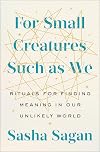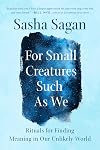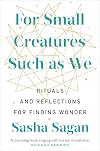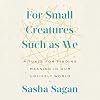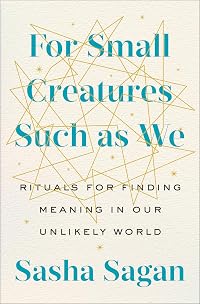
For Small Creatures Such as We: Rituals for Finding Meaning in Our Unlikely World
by Sasha Sagan
On This Page
Description
"Part memoir, part guidebook, and part social history, For Small Creatures Such as We is the first book from the daughter of Carl Sagan and Ann Druyan--a luminous exploration of all Earth's marvels that require no faith in order to be believed"--Tags
Recommendations
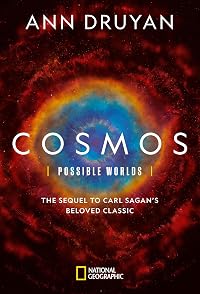



Member Reviews
This is a sweet little book that is mostly about Sasha Sagan's life and gratitude to her parents, Ann Druyan and Carl Sagan. It is clearly inspired by their work: writing clearly and spaciously about how the marvels of science and the rational world can invoke a sense of awe and spirituality and exploring a non-supernatural intention for religion and connection.
It was interesting to me that for a book about atheism, it is also a profoundly Jewish book. When Sasha talks about the atheists that found meaning in awe in the scientific world being people like her father, Einstein and Feynman, it's not a coincidence that these are all Jewish atheists. To riff on a classic Jewish joke: the G-d they don't believe in is specifically the Jewish show more G-d. This is important because so many atheists in America are culturally Christian and talk about atheism in a way that is specifically about rejecting Christianity. For Jews, participation in ritual life is not predicated on belief, and the blending of ritual and spirituality with atheism is simpler. This is clear when Sagan talks about her atheistic approaches to Shabbat, Passover and other Jewish traditions.
A trainee came to my office in tears a few years ago, to ask how to move forward in a world where we are constantly caring for sick and sometimes dying children. The only thing I could tell him was that religion was the technology that humanity had invented and refined over millenia to deal with hardship and that using this technology did not require any belief, just a willingness to trust that feeling part of something larger, finding rituals that take us out of the day-to-day and being in community. Sasha Sagan paints a way to do this in a world where many people have religious trauma, and/or do not hold supernatural beliefs, reverse engineering the technology to include: textures of time that relate to the seasons/days of the week/times of day, moments for rest and recuperation, moments for self-denial and empathy for those with less abundance, moments for joy and grief and awareness of being alive and this being a temporary state.
It is more of a reflective piece than a practical piece, but I enjoyed it and will come back to it. show less
It was interesting to me that for a book about atheism, it is also a profoundly Jewish book. When Sasha talks about the atheists that found meaning in awe in the scientific world being people like her father, Einstein and Feynman, it's not a coincidence that these are all Jewish atheists. To riff on a classic Jewish joke: the G-d they don't believe in is specifically the Jewish show more G-d. This is important because so many atheists in America are culturally Christian and talk about atheism in a way that is specifically about rejecting Christianity. For Jews, participation in ritual life is not predicated on belief, and the blending of ritual and spirituality with atheism is simpler. This is clear when Sagan talks about her atheistic approaches to Shabbat, Passover and other Jewish traditions.
A trainee came to my office in tears a few years ago, to ask how to move forward in a world where we are constantly caring for sick and sometimes dying children. The only thing I could tell him was that religion was the technology that humanity had invented and refined over millenia to deal with hardship and that using this technology did not require any belief, just a willingness to trust that feeling part of something larger, finding rituals that take us out of the day-to-day and being in community. Sasha Sagan paints a way to do this in a world where many people have religious trauma, and/or do not hold supernatural beliefs, reverse engineering the technology to include: textures of time that relate to the seasons/days of the week/times of day, moments for rest and recuperation, moments for self-denial and empathy for those with less abundance, moments for joy and grief and awareness of being alive and this being a temporary state.
It is more of a reflective piece than a practical piece, but I enjoyed it and will come back to it. show less
A largely charming read, but not quite what the subtitle and PR campaigns purport it to be. Coming into this after listening to interviews with the author, I was expecting a lot more in the way of suggestions for secular rituals. Instead, it's part autobiography, part musing about the amazing universe we inhabit. We learn a few of the author's own rituals for various stages of life, of course, but if you're looking for ideas for adopting new rituals of your own, it's not the main point of the book. A better choice for that might be The Book of New Family Traditions: How to Create Great Rituals for Holidays and Every Day.
I had high hopes for this book, but in the end it just didn't do much for me.
The book jacket states, "part memoir, part guidebook, and part social history" and for me, that was part of the problem as I did not think the book flowed, but jumped from one topic to the other in rapid succession. There were a few thought provoking topics, but not enough to make the book engaging for me.
The book jacket states, "part memoir, part guidebook, and part social history" and for me, that was part of the problem as I did not think the book flowed, but jumped from one topic to the other in rapid succession. There were a few thought provoking topics, but not enough to make the book engaging for me.
I downloaded this audiobook on a whim because I needed something to listen to. I'm surprised by how much I enjoyed it. Author Sasha Sagan is Carl Sagan's daughter. Despite their Jewish and Eastern European heritage, Carl Sagan's family was obviously secular, and this nonreligious tradition was passed down to his daughter. Enter this book, which is about the ways that secular nonbelievers should and can partake in traditions, celebrations, and rituals that have brought people together for thousands of years. By drawing on her family's past and her daughter's future, Sasha Sagan argues that rituals bring secular people a sense of wonder and awe, no matter their disbelief.
7 stars: Good
From the back cover: Sasha Sagan was raised by secular parents, the astronomer Carl Sagan and the writer and producer Ann Druyan. They taught her that the natural world and vast cosmos are full of profound beauty, that science reveals truths more wondrous than any myth or fable. When Sagan herself became a mother, she began her own hunt for the natural phenomena behind our most treasured occasions - from births to deaths, holidays to weddings, anniversaries, and more - growing these roots into a new set of rituals that honor the joy and significance of human experience without relying on a religious framework.
Seeing life itself as worth of celebration, "For Small Creatures Such As We" is part memoir, part guidebook, and show more part social history. IN these pages Sagan offers us a luminous exploration of Earth's marvels, which require no faith in order to be believed, and an unforgettable meditation on the power of each to bring us closer to one another.
------------
I enjoyed this book fairly well, but am somewhat surprised that I didn't love it more. Sagan is a good writer, not quite on a level with her parents, but very few of us are. The description above of part memoir, guidebook, and social history, is spot on. I learned a lot. It was both deeply personal and multi cultural in scope. Perhaps its the time in my life, where I have had enough life changes to have a different relationship with rituals, but I found much of it to be something I can't relate to at this time of life. I'm going to pass on to a friend (MR) who recently had a baby and is in a cross cultural marriage. I think it may resonate with her more than it does me.
Some quotes I liked:
"It's dangerous to believe things [God] because you want them to be true." - Carl Sagan
Being alive was presented to me as a profoundly beautiful and staggeringly unlikely, a sacred miracle of random chance. My parents taught me that the universe is enormous and we humans are tiny beings who get to live on an out of the way planet for the blink of an eye. And they taught me that, as they once wrote, "For small creatures such as we, the vastness is bearable only through love."
[Discussing a childhood ritual that Sasha and her mom created]. Usually it was just the two of us, maybe a girlfriend of hers who lived nearby. Gifts were exchanged, but the biggest gift was the idea that celebrations could be invented, that we could choose to honor what was most meaningful to us. [I loved this part of the book, that idea that we can each create rituals and traditions].
I once came to my parents with a question:
"Marugja says when you die you go to heaven and there are angels playing harps and you're with God. And you guys say its like you're asleep forever with no dreams. Who is right?"
My parents, without missing a beat, said in unison "Nobody knows!"
and they didn't just say it. They announced it like good news, joyful, enthusiastic, beaming.
This exchange was revelatory for me. Not because it gave me any clarity on the mystery of death, but because it gave me a window into the nature of life. It taught me that there is no shame in not knowing. Uncertainty is real. It need not be glossed over or buried.
[Talking about her father] How sorry I am I didn't cherish every minute, every tiny detal, conversation, inside joke, and quiet moment. But that's the thing about death - it makes you appreciate life. It's almost impossible to appreciate something without facing its absence. Just as we cannot improve ourselves if we cannot acknowledge where we've floundered and atone.
There is so much that happens before and after each of us is born, we must relish the things that happen while we're here.
Halloween reminds us that there is something powerful and mysterious coming for each of us and that before it does, we must relish the present with glee.
[Discussing fasting rituals]. Maybe by fasting once in awhile, maybe by meditating on the experience of all those who have a knot of hunger in their bellies every day, I can force my own hand and do more for others. I want this realization to fuel me to be more charitable, donate more, volunteer more, and appreciate better what I have. If more Americans understood the biological alarms of hunger, imagine what the response would be.
I've spent a lot of time talking about how great the winter solstice is, how worthy it is of celebration... But there's something I always omit. The winter solstice is also the anniversary of my father's death. He died in the early hours of December 20, when the stars shone the longest.
At my fathers grave ... people from all over the world leave notes, marbles, Lego, mini planets and other space related objects. Seeing this makes me happy. My grief is soothed by knowing other people miss him, remember him, and still love him now.
My parents taught me that even though its not forever -- *because* its not forever -- being alive is porfoundly beautiful thing for which each of us should feel deeply grateful. If we lived forever it would not be so amazing. show less
From the back cover: Sasha Sagan was raised by secular parents, the astronomer Carl Sagan and the writer and producer Ann Druyan. They taught her that the natural world and vast cosmos are full of profound beauty, that science reveals truths more wondrous than any myth or fable. When Sagan herself became a mother, she began her own hunt for the natural phenomena behind our most treasured occasions - from births to deaths, holidays to weddings, anniversaries, and more - growing these roots into a new set of rituals that honor the joy and significance of human experience without relying on a religious framework.
Seeing life itself as worth of celebration, "For Small Creatures Such As We" is part memoir, part guidebook, and show more part social history. IN these pages Sagan offers us a luminous exploration of Earth's marvels, which require no faith in order to be believed, and an unforgettable meditation on the power of each to bring us closer to one another.
------------
I enjoyed this book fairly well, but am somewhat surprised that I didn't love it more. Sagan is a good writer, not quite on a level with her parents, but very few of us are. The description above of part memoir, guidebook, and social history, is spot on. I learned a lot. It was both deeply personal and multi cultural in scope. Perhaps its the time in my life, where I have had enough life changes to have a different relationship with rituals, but I found much of it to be something I can't relate to at this time of life. I'm going to pass on to a friend (MR) who recently had a baby and is in a cross cultural marriage. I think it may resonate with her more than it does me.
Some quotes I liked:
"It's dangerous to believe things [God] because you want them to be true." - Carl Sagan
Being alive was presented to me as a profoundly beautiful and staggeringly unlikely, a sacred miracle of random chance. My parents taught me that the universe is enormous and we humans are tiny beings who get to live on an out of the way planet for the blink of an eye. And they taught me that, as they once wrote, "For small creatures such as we, the vastness is bearable only through love."
[Discussing a childhood ritual that Sasha and her mom created]. Usually it was just the two of us, maybe a girlfriend of hers who lived nearby. Gifts were exchanged, but the biggest gift was the idea that celebrations could be invented, that we could choose to honor what was most meaningful to us. [I loved this part of the book, that idea that we can each create rituals and traditions].
I once came to my parents with a question:
"Marugja says when you die you go to heaven and there are angels playing harps and you're with God. And you guys say its like you're asleep forever with no dreams. Who is right?"
My parents, without missing a beat, said in unison "Nobody knows!"
and they didn't just say it. They announced it like good news, joyful, enthusiastic, beaming.
This exchange was revelatory for me. Not because it gave me any clarity on the mystery of death, but because it gave me a window into the nature of life. It taught me that there is no shame in not knowing. Uncertainty is real. It need not be glossed over or buried.
[Talking about her father] How sorry I am I didn't cherish every minute, every tiny detal, conversation, inside joke, and quiet moment. But that's the thing about death - it makes you appreciate life. It's almost impossible to appreciate something without facing its absence. Just as we cannot improve ourselves if we cannot acknowledge where we've floundered and atone.
There is so much that happens before and after each of us is born, we must relish the things that happen while we're here.
Halloween reminds us that there is something powerful and mysterious coming for each of us and that before it does, we must relish the present with glee.
[Discussing fasting rituals]. Maybe by fasting once in awhile, maybe by meditating on the experience of all those who have a knot of hunger in their bellies every day, I can force my own hand and do more for others. I want this realization to fuel me to be more charitable, donate more, volunteer more, and appreciate better what I have. If more Americans understood the biological alarms of hunger, imagine what the response would be.
I've spent a lot of time talking about how great the winter solstice is, how worthy it is of celebration... But there's something I always omit. The winter solstice is also the anniversary of my father's death. He died in the early hours of December 20, when the stars shone the longest.
At my fathers grave ... people from all over the world leave notes, marbles, Lego, mini planets and other space related objects. Seeing this makes me happy. My grief is soothed by knowing other people miss him, remember him, and still love him now.
My parents taught me that even though its not forever -- *because* its not forever -- being alive is porfoundly beautiful thing for which each of us should feel deeply grateful. If we lived forever it would not be so amazing. show less
Lovely book bringing a sense of humanity and ritual to people who might be more scientifically inclined and also bringing science and rationality to those who might not venture past their traditions and feelings. I think the book is aimed at people younger than me but I was moved in many places.
Kind of a mix of World Religions 101 and personal anecdotes. Too much "All religions are valid because isn't the universe just so mysterious?", too little "Guidebook for the emerging pantheist".
Members
- Recently Added By
Lists

Real Good Religion
32 works; 1 member
Author Information

1 Work 285 Members
Awards and Honors
Notable Lists
Classifications
- Genres
- Nonfiction, Philosophy, General Nonfiction, Biography & Memoir, Science & Nature, Religion & Spirituality
- DDC/MDS
- 390.0973 — Society, government, & culture Customs, etiquette & folklore Customs, etiquette, folklore Customs; Costumes; Folklore Biography; History by Place North America United States
- LCC
- GN473 .S155 — Geography, Anthropology and Recreation Anthropology Anthropology Ethnology. Social and cultural anthropology Cultural traits, customs, and institutions Intellectual life
- BISAC
Statistics
- Members
- 285
- Popularity
- 113,082
- Reviews
- 9
- Rating
- (3.90)
- Languages
- English, Korean
- Media
- Paper, Audiobook, Ebook
- ISBNs
- 11
- ASINs
- 2