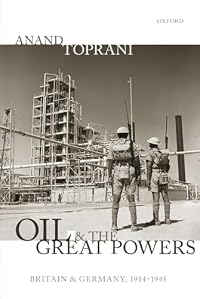
Oil and the Great Powers: Britain and Germany, 1914 to 1945
by Anand Toprani
On This Page
Description
'Oil and the Great Powers' examines how oil shaped British and German grand strategy in the era of the two world wars, arguing that both countries' efforts to become energy-independent led them to pursue policies that compromised security by inducing strategic over-extension, thereby hastening their decline as great powers.Tags
Member Reviews
Although I ultimately found this monograph insightful, the way Toprani structured his analysis, and various running niggling points undermined the experience for me.
However, Toprani's bottom line seems quite convincing, as he wants to make the distinction between "energy independence" and "energy security," two terms that are mistakenly lumped together in his view. The first term relates to strategic autonomy at any cost, whereas the second means access to a secure continuing supply (presuming a viable cooperative relationship). The point being that post-1918, the world's main supplier of oil for decades was the United States, and London and Berlin had problematic relations (of varying degrees of intensity) with Washington, not to show more mention the economic costs, in the 1920s and 1930s. From there, the reader gets the blow by blow of how Britain and Germany tried to work around American predominance, via Middle East oil or synthetic oil respectively. Ultimately, it was all to no avail.
As for my issues, Toprani does seem to get lost in the weeds at times, in terms of the level of detail he provides. Also, having been published in 2019, this book does feel like an artifact of a dying regime of globalism; though Toprani might easily have been able to work his analysis into this reality. Finally, I have to admit that I was really irritated when Toprani consistently refers to the German Army's "Ordinance" Department; the last time I checked, "ordnance" referred to military hardware and an "ordinance" is a piece of paper. show less
However, Toprani's bottom line seems quite convincing, as he wants to make the distinction between "energy independence" and "energy security," two terms that are mistakenly lumped together in his view. The first term relates to strategic autonomy at any cost, whereas the second means access to a secure continuing supply (presuming a viable cooperative relationship). The point being that post-1918, the world's main supplier of oil for decades was the United States, and London and Berlin had problematic relations (of varying degrees of intensity) with Washington, not to show more mention the economic costs, in the 1920s and 1930s. From there, the reader gets the blow by blow of how Britain and Germany tried to work around American predominance, via Middle East oil or synthetic oil respectively. Ultimately, it was all to no avail.
As for my issues, Toprani does seem to get lost in the weeds at times, in terms of the level of detail he provides. Also, having been published in 2019, this book does feel like an artifact of a dying regime of globalism; though Toprani might easily have been able to work his analysis into this reality. Finally, I have to admit that I was really irritated when Toprani consistently refers to the German Army's "Ordinance" Department; the last time I checked, "ordnance" referred to military hardware and an "ordinance" is a piece of paper. show less
Members
- Recently Added By
Lists

Books I Would Like to Acquire
20 works; 1 member
Author Information
2 Works 11 Members
Awards and Honors
Awards
Classifications
- Genres
- Nonfiction, History, Politics and Government
- DDC/MDS
- 327.41009041 — Society, Government, and Culture Political science International Relations: Spies Europe British Isles
- LCC
- DA566.2 .T67 — History of Europe, Asia, Africa and Oceania Great Britain History of Great Britain England History By period Modern, 1485- 20th century
- BISAC
Statistics
- Members
- 8
- Popularity
- 2,495,984
- Reviews
- 1
- Rating
- (3.50)
- Languages
- English
- Media
- Paper
- ISBNs
- 2