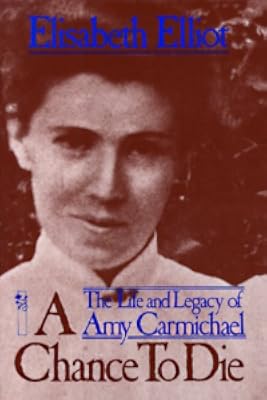
A Chance to Die: The Life and Legacy of Amy Carmichael
by Elisabeth Elliot
On This Page
Description
A Chance to Die is a vibrant portrayal of Amy Carmichael, an Irish missionary and writer who spent fifty-three years in south India without furlough. There she became known as "Amma," or "mother," as she founded the Dohnavur Fellowship, a refuge for underprivileged children. Amy's life of obedience and courage stands as a model for all who claim the name of Christ. She was a woman with desires and dreams, faults and fears, who gave her life unconditionally to serve her Master. Bringing Amma show more to life through inspiring photos and compelling biographical narrative, Elisabeth Elliot urges readers to examine the depths of their own commitment to Christ. Elisabeth Elliot (1926-2015) was a missionary and a critically acclaimed author and speaker. For over half a century, her life of obedience, timeless teachings, and best-selling books have influenced both believers and seekers of the Christian faith. Elisabeth life work was to share these deep things: the trustworthiness of God, the blessings of obedience, the hope of joy in the midst of sorrow, the call to love one's enemy, the priceless treasure of purity, and the true meaning of Biblical womanhood and manhood. Having written over twenty books, some of her most distinguished writings include, Passion and Purity, Let Me Be a Woman, Shadow of the Almighty, Through Gates of Splendor, and The Savage My Kinsman. The latter three chronicle Elliot's missionary work and the life and martyrdom of her husband Jim Elliot. She is survived by her husband Lars Gren, her daughter Valerie Elliot Shepard, and eight grandchildren. Today, her legacy. show lessTags
Recommendations





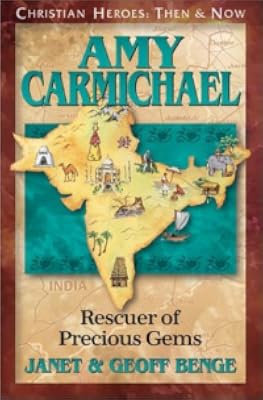

















Member Reviews
“Missionary life is simply a chance to die.”
This eight-word quote, from which Elisabeth Elliot takes the title of this biography, well summarizes Amy Carmichael’s life. Born into an Irish Presbyterian family in 1867, Amy spent eight decades pouring out her life for her beloved Crucified One in service to the least of his little ones. As she put it when urged to moderate her activity for her own health’s sake, “I would rather burn out than rust out.”
Elisabeth Elliot — a gifted writer, speaker, and missionary in her own right — was well-suited to write this biography. Having lost her own husband Jim to Kichwa spears, she understood something of sacrificing everything for the sake of the one who sacrificed himself for us.
I show more suspect Amy may have envied Jim Elliot the chance to die, literally, in the battle for souls. She conceived of Christianity in militant terms. In dozens of beautifully-written books, she wrote often of a spiritual war, of the need for soldiers, of opening fronts against Satan or defending against his attacks.
In part, she was no doubt encouraged in this by the nature of her work. Though she arrived in India as an itinerant preacher, intent on conversion through gospel preaching, her mission grew to include into the salvation of young girls from the temple prostitution she abhorred as satanic slavery.
That said, this was not the wellspring of her militant spirit, as much as she deplored the prospect of girls sold without consent or escape into a lifetime of slaking sacred lust. For Amy, material reality was just the reverse side of a spiritual reality animated by war between God and his unseen adversaries.
This might cause discomfort to Christians who, when it comes to theology, are more interested in the “logy” than the “theo.” Amy can’t be understood apart from the Keswick movement in which her soul was formed, and which blew through picky doctrinal distinctives in favor of an immanent spiritual life.
Like the Christian pietists and mystics she read and admired, Amy believed in prayer, in asking for and receiving signs, and in the power of God to intimate his will through dreams. She even believed that, for a fleeting and unrepeated period of time, she had been granted the gift of healing.
This never devolved into fronting herself as a prophet, or into attempts to call up miracles like Saul summoning the spirit of Samuel. Amy was grounded in Scripture as true revelation, and in the sovereign will of God who moves in his time as he chooses. Ours is but to ask, expect, accept, and act.
This may grate the nerves of some, but no less than they would grate hers. Amy had no patience with a faith satisfied by systematic precision and refined Sunday mornings. God is loving and living and active; so it makes no sense for his people, like the tide pools of her childhood, merely to exist in rock-solid sanctity growing lichens.
Amy died in 1951, but her ministry lives on. On the website of her Dohnavur Fellowship, now in its second century, you can read of the fellowship’s mission to engage in “Child Development, Education, Health care, Community Development & Conservation of Nature” for the purpose of “sharing the love of Jesus Christ with others in need.”
One of Amy’s favorite verses was John 12:24: “Verily, verily, I say unto you, Except a corn of wheat fall into the ground and die, it abideth alone: but if it die, it bringeth forth much fruit.” Three quarters of a century after her death, her spiritual descendants continue to prove the value of a life spent dying. show less
This eight-word quote, from which Elisabeth Elliot takes the title of this biography, well summarizes Amy Carmichael’s life. Born into an Irish Presbyterian family in 1867, Amy spent eight decades pouring out her life for her beloved Crucified One in service to the least of his little ones. As she put it when urged to moderate her activity for her own health’s sake, “I would rather burn out than rust out.”
Elisabeth Elliot — a gifted writer, speaker, and missionary in her own right — was well-suited to write this biography. Having lost her own husband Jim to Kichwa spears, she understood something of sacrificing everything for the sake of the one who sacrificed himself for us.
I show more suspect Amy may have envied Jim Elliot the chance to die, literally, in the battle for souls. She conceived of Christianity in militant terms. In dozens of beautifully-written books, she wrote often of a spiritual war, of the need for soldiers, of opening fronts against Satan or defending against his attacks.
In part, she was no doubt encouraged in this by the nature of her work. Though she arrived in India as an itinerant preacher, intent on conversion through gospel preaching, her mission grew to include into the salvation of young girls from the temple prostitution she abhorred as satanic slavery.
That said, this was not the wellspring of her militant spirit, as much as she deplored the prospect of girls sold without consent or escape into a lifetime of slaking sacred lust. For Amy, material reality was just the reverse side of a spiritual reality animated by war between God and his unseen adversaries.
This might cause discomfort to Christians who, when it comes to theology, are more interested in the “logy” than the “theo.” Amy can’t be understood apart from the Keswick movement in which her soul was formed, and which blew through picky doctrinal distinctives in favor of an immanent spiritual life.
Like the Christian pietists and mystics she read and admired, Amy believed in prayer, in asking for and receiving signs, and in the power of God to intimate his will through dreams. She even believed that, for a fleeting and unrepeated period of time, she had been granted the gift of healing.
This never devolved into fronting herself as a prophet, or into attempts to call up miracles like Saul summoning the spirit of Samuel. Amy was grounded in Scripture as true revelation, and in the sovereign will of God who moves in his time as he chooses. Ours is but to ask, expect, accept, and act.
This may grate the nerves of some, but no less than they would grate hers. Amy had no patience with a faith satisfied by systematic precision and refined Sunday mornings. God is loving and living and active; so it makes no sense for his people, like the tide pools of her childhood, merely to exist in rock-solid sanctity growing lichens.
Amy died in 1951, but her ministry lives on. On the website of her Dohnavur Fellowship, now in its second century, you can read of the fellowship’s mission to engage in “Child Development, Education, Health care, Community Development & Conservation of Nature” for the purpose of “sharing the love of Jesus Christ with others in need.”
One of Amy’s favorite verses was John 12:24: “Verily, verily, I say unto you, Except a corn of wheat fall into the ground and die, it abideth alone: but if it die, it bringeth forth much fruit.” Three quarters of a century after her death, her spiritual descendants continue to prove the value of a life spent dying. show less
This is the first book I have read about the life and work of Amy Carmichael and I have to say that I was surprised by the content. I feel conflicted as to how to review and rate this book as there were so many positive and negative aspects.
Amy believed she was called to China but subsequently ended up in India where she ministered for 55 years--with over a decade spent as a "shut-in" after an accident. Evangelism had been her focus and I found myself admiring her singlemindedness and lack of interest in material things or worldly distractions. She knew from a young age that she would remain single for the Kingdom. However, shortly into her work in India she became horrified by the plight of a number of children who were used for show more unmentionable acts at the various local temples--she set about rescuing them. She effectively created an organisation to house these children but referred to it as a "family." She employed staff to help her--the organisation grew and expanded to form "Dohnavur," which still exists as a Christian charity today.
I appreciated Amy's love for those around her and her determination in her work and ministry. Also her faithfulness in prayer and reliance on the Lord in all matters. She lived by faith financially--refusing to even mention needs until they had been provided for after prayer. There are many examples in this book of incredible provision just at the right time and down to the last penny. God obviously had His hand on her ministry and bore with her failings as He does with all of us.
However, I struggled with a number of aspects in her work. She chose to be single for the Kingdom as she believed that God was leading her to do that but then effectively created a single-parent family due to the needs she saw in India. It comes across in the book as if she remained single partly due to her belief that men were somehow inferior spiritually--she believed that some of the passages in the NT about women in the church don't apply to us today. She didn't appear to value the marriage bond especially highly discouraging her staff from marrying and in some cases allowing/causing separation between husband/wife/children for long periods for the sake of the work. One of her long term male workers became conflicted when his wife was asking him to return to England with her and the children and Amy was telling him he should stay for the sake of the life-long call he had received to the work.
Amy took the role of spiritual leader of this large organisation and local Indian men and foreign workers were therefore in submission to her. She ruled over small details almost as an autocrat at times. She did appoint men to preach and teach for seasons but the lines of authority were blurred. She regularly speaks of "words from the Lord" and is always 100% convinced that the leading she thinks she has received is correct. But she has no accountability and doesn't seem to seek advice from anybody. It's Amy's way or the highway.
The way Dohnavur operated has a "cult-like" feel to it, although clearly it was not as they were following the Bible. But they were cut off from the outside world and insulated/sheltered from any and everything worldly. The Bible makes it clear that we should be in the world but not of it. I think changes were made to this aspect of the ministry in Amy's latter years and she endorsed the changes which can only be a positive thing.
I think Amy would've benefitted from friends who were her spiritual/intellectual equals to keep her independent spirit in check at times. She chose not to allow a husband to lead her in that way and it seems that others wouldn't dare to stand up to her--those that did were listened to but largely ignored. Amy was in my view too reliant on her own spiritual discernment.
Having said these things, I think we can all learn from her life, work and mistakes. It is interesting that I didn't have the same reservations about Gladys Aylward whose life and work had a similar independence--maybe because she stuck to her original calling with evangelism as her main focus rather than rescuing and parenting needy children. That said, Amy's purpose in doing so was to bring the Gospel to them. God did bless Amy's ministry and provided for her--she was sincerely doing what she felt He was calling her to do. The area of India was impacted for the Gospel in a big way and the work continues long after her death.
I would recommend this book. show less
Amy believed she was called to China but subsequently ended up in India where she ministered for 55 years--with over a decade spent as a "shut-in" after an accident. Evangelism had been her focus and I found myself admiring her singlemindedness and lack of interest in material things or worldly distractions. She knew from a young age that she would remain single for the Kingdom. However, shortly into her work in India she became horrified by the plight of a number of children who were used for show more unmentionable acts at the various local temples--she set about rescuing them. She effectively created an organisation to house these children but referred to it as a "family." She employed staff to help her--the organisation grew and expanded to form "Dohnavur," which still exists as a Christian charity today.
I appreciated Amy's love for those around her and her determination in her work and ministry. Also her faithfulness in prayer and reliance on the Lord in all matters. She lived by faith financially--refusing to even mention needs until they had been provided for after prayer. There are many examples in this book of incredible provision just at the right time and down to the last penny. God obviously had His hand on her ministry and bore with her failings as He does with all of us.
However, I struggled with a number of aspects in her work. She chose to be single for the Kingdom as she believed that God was leading her to do that but then effectively created a single-parent family due to the needs she saw in India. It comes across in the book as if she remained single partly due to her belief that men were somehow inferior spiritually--she believed that some of the passages in the NT about women in the church don't apply to us today. She didn't appear to value the marriage bond especially highly discouraging her staff from marrying and in some cases allowing/causing separation between husband/wife/children for long periods for the sake of the work. One of her long term male workers became conflicted when his wife was asking him to return to England with her and the children and Amy was telling him he should stay for the sake of the life-long call he had received to the work.
Amy took the role of spiritual leader of this large organisation and local Indian men and foreign workers were therefore in submission to her. She ruled over small details almost as an autocrat at times. She did appoint men to preach and teach for seasons but the lines of authority were blurred. She regularly speaks of "words from the Lord" and is always 100% convinced that the leading she thinks she has received is correct. But she has no accountability and doesn't seem to seek advice from anybody. It's Amy's way or the highway.
The way Dohnavur operated has a "cult-like" feel to it, although clearly it was not as they were following the Bible. But they were cut off from the outside world and insulated/sheltered from any and everything worldly. The Bible makes it clear that we should be in the world but not of it. I think changes were made to this aspect of the ministry in Amy's latter years and she endorsed the changes which can only be a positive thing.
I think Amy would've benefitted from friends who were her spiritual/intellectual equals to keep her independent spirit in check at times. She chose not to allow a husband to lead her in that way and it seems that others wouldn't dare to stand up to her--those that did were listened to but largely ignored. Amy was in my view too reliant on her own spiritual discernment.
Having said these things, I think we can all learn from her life, work and mistakes. It is interesting that I didn't have the same reservations about Gladys Aylward whose life and work had a similar independence--maybe because she stuck to her original calling with evangelism as her main focus rather than rescuing and parenting needy children. That said, Amy's purpose in doing so was to bring the Gospel to them. God did bless Amy's ministry and provided for her--she was sincerely doing what she felt He was calling her to do. The area of India was impacted for the Gospel in a big way and the work continues long after her death.
I would recommend this book. show less
A Chance to Die is a vibrant portrayal of Amy Carmichael, an Irish missionary and writer who spent fifty-three years in south India without furlough. There she became known as "Amma," or "mother," as she founded the Dohnavur Fellowship, a refuge for underprivileged children.
Amy's life of obedience and courage stands as a model for all who claim the name of Christ. She was a woman with desires and dreams, faults and fears, who gave her life unconditionally to serve her Master.
Bringing Amma to life through inspiring photos and compelling biographical narrative, Elisabeth Elliot urges readers to examine the depths of their own commitment to Christ.
Amy's life of obedience and courage stands as a model for all who claim the name of Christ. She was a woman with desires and dreams, faults and fears, who gave her life unconditionally to serve her Master.
Bringing Amma to life through inspiring photos and compelling biographical narrative, Elisabeth Elliot urges readers to examine the depths of their own commitment to Christ.
Initially I was excited to read this book. I had heard good things about Elizabeth Eliot and wanted to read about missionaries in India. While, I did find Amy Carmichael's journey exciting from the outset, I found her personality and the way inwhich Eliot dealt with her flaws discouraging. I was hoping for an attempt at an honest portrail, but, her flaws were not only glanced over, but her imperialist attitude and any justifications there of lost my respect. Amy was dedicated to prayer, but I found that her growth as a Christian lacked. The book was boring in some parts and became a bit self serving.
A thorough and complete narration of the life of Amy Carmichael that helps put her writings in the context of the struggles and situations she endured. At points in the middle, however, it does get a little tedious and boring - a bit like life. Still, this is the best resource I've encountered yet on the life of a prolific, inspirational and challenging writer who also acted upon her beliefs. It is encouraging that this retelling is brought by the well-appreciated pen of a woman also influenced by Amy's life and writings.
a wonderful, inspiring biography of Amy "Amma" Carmichael, missionary to India. Amma was a thoughtful, deep, loving, Godly woman who saught to exemplify God's love in every situation. She was a truly amazing woman, especially considering the time and culture she lived in. Elliot paints Amy as a Godly, loving writer and mother, even while showing some of her faults. Amy was a woman deeply devoted to prayer and doign God's will, not her own. While her faults are clearly visable, no one can deny her deep love of her Savior and Family. Highly, highly recommended!
Amy Carmichael's life makes my own seem to worthless and insignificant. What an amazing Christian! Wonderfully written and enjoyable to read.
Members
- Recently Added By
Lists

Books Read in 2006
421 works; 8 members
Author Information

131+ Works 25,481 Members
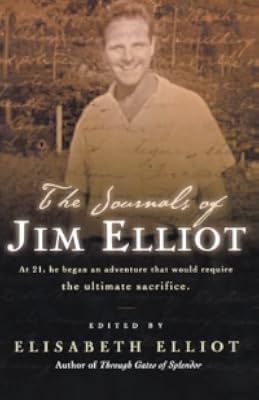
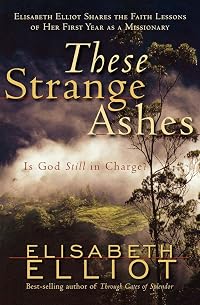
Elisabeth Elliot (1926-2015) was one of the most perceptive and popular Christian writers of the last century. The author of more than twenty books, including Passion and Purity, The Journals of Jim Elliot, and These Strange Ashes, Elliot offered guidance and encouragement to millions of readers worldwide. For more information about Elisabeth's show more books, visit elisabethelliot.org. show less
Common Knowledge
- Original publication date
- 1987
- People/Characters
- Amy Carmichael
- Important places
- India
- Epigraph
- Be earnest, earnest, earnest--
Mad if thou wilt;
Do what thou dost as if the
stake were Heaven,
And that thy last deed before
the Judgment Day.
Charles Kingsley - Dedication
- To all who loved Amma
- First words
- [Preface] To Amy Carmichael I owe what C. S. Lewis said he owed to George MacDonald: as great a debt as one can owe another.
She managed to stuff her two little brothers up through the skylight and then squeezed herself onto the slate roof.
[Epilogue] So she finished her course--Amy Carmichael, one of the tens of thousands of lovers of the Lord who staked everything on His faithfulness. - Last words
- (Click to show. Warning: May contain spoilers.)Beneath it is the date when they laid her there under the tamarind.
Classifications
Statistics
- Members
- 1,904
- Popularity
- 11,235
- Reviews
- 10
- Rating
- (4.23)
- Languages
- English
- Media
- Paper, Audiobook, Ebook
- ISBNs
- 10
- ASINs
- 11