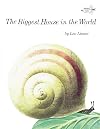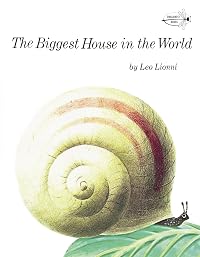
The Biggest House in the World
by Leo Lionni
On This Page
Description
A snail's father advises him to keep his house small and tells him what happened to a snail that grew a large and spectacular shell.Tags
Recommendations


Member Reviews
A young snail dreams of having the biggest house—or shell—in the world. Then one day, his wise father tells him the story of another snail with the same dream. He grew and grew, adding bright colors and beautiful designs, until he found that his house came at a terrible cost. The young snail decides that a small, easy-to-carry shell might be best for a life of adventure and exploration.
I liked this as a kid, but seriously, it also reads as, "If you get above yourself, or try to have really nice things, you'll die and fade to nothing." Oy.
This is sort of a harsh one. Although I agree that we should apply moderation in our life, not give in to vanity or let things get out of hand, I really felt for the little snail as he "faded away". He really put a lot of effort, ingenuity and artistry into building his wonderful house: " ... by squeezing and pushing, and by wishing very hard, he was able to add bright colors and beautiful designs." By simply "wishing" he pulled off all these things, it seems there must have been some purpose to that? And the little snail DID bring some magic to others. Not only the snails, but also the butterflies, the frogs marveled at his accomplishment.
The upside: our snail in the story took this parable to heart, rejoiced in being mobile and show more instead took pleasure in all the marvelous things he saw through his journeys. Yes, sometimes it's better to think ahead and small can be good! show less
The upside: our snail in the story took this parable to heart, rejoiced in being mobile and show more instead took pleasure in all the marvelous things he saw through his journeys. Yes, sometimes it's better to think ahead and small can be good! show less
This is a beautiful picture book with a great life lesson.
* The book is about snails on a cabbage, and one snail tells his father that he wished to have the biggest house in the world, to which his father responds that he also wished that when he was young, and he told his son the story that his father told him. In the story a young snail learns to make his shell bigger, and bigger, and eventual how to make it grow horns, and color. Eventually, his house got so big that he couldn't move. The moral, which the young snail learned, was to appreciate what you have, and that sometimes smaller is better. In this case, his smaller shell/home afforded him extra freedom to roam where he pleased, and he looked at everything with a new-found show more appreciation. show less
* The book is about snails on a cabbage, and one snail tells his father that he wished to have the biggest house in the world, to which his father responds that he also wished that when he was young, and he told his son the story that his father told him. In the story a young snail learns to make his shell bigger, and bigger, and eventual how to make it grow horns, and color. Eventually, his house got so big that he couldn't move. The moral, which the young snail learned, was to appreciate what you have, and that sometimes smaller is better. In this case, his smaller shell/home afforded him extra freedom to roam where he pleased, and he looked at everything with a new-found show more appreciation. show less
Not sure I agree with the universality of the message in this fable. I want fewer possessions & more freedom... but not everybody does! Discuss w/ your students/ children.
In a fable within a fable, a wise snail convinces his son that a small, easy-to-carry shell might be better than the biggest house in the world for a life of adventure and exploration.
This book is about a Papa snail who tells his son a story about a snail whose house was too big. The little snail wished for the largest house in the world (could be an empire? or a comment on unnecessary capital gain). As the house grew in size and amazement other insects and friends admired the beauty of the house (shell). But because the shell was too big, the snail could not move on with his family to find a new food source, and withered away. I probably wouldn't have this in my classroom either, at least not as part of a lesson plan.
Members
- Recently Added By
Lists

CCE 1000 Good Books List
1,033 works; 12 members

Which house?
423 works; 16 members
Author Information

131+ Works 58,657 Members
Leo Lionni was born in Amsterdam on May 5, 1910. He attended the University of Zurich and also earned a doctorate in Economics from the University of Genoa in 1935. He taught himself to draw by visiting museums. After marrying Nora Maffi in 1931, Lionni moved to Milan, Italy, where he became known as a painter. In 1939 he moved to Philadelphia and show more began working in advertising design. Lionni held several positions in the artistic field including artistic director and design director. He also served as president of the American Institute of Graphic Arts. Around 1960 Lionni moved back to Italy. His first of over forty children's books was Little Blue and Little Yellow. Other titles include Inch by Inch, Frederick, Swimmy, and Alexander and the Wind-up Mouse, all of which won a Caldecott Honor. In addition, he received the American Institute of Graphic Arts Gold Medal in 1984. Lionni died on October 11, 1999 at his home in Tuscany, Italy at the age of 89. (Bowker Author Biography) show less
Series
Belongs to Publisher Series
Work Relationships
Common Knowledge
- Canonical title*
- La maison la plus grande du monde
- Original title
- The Biggest House in the World
- Original publication date
- 1968
- People/Characters*
- Caracol
- First words*
- Era uma vez um caracol que vivia numa suculenta couve.
- Original language*
- Inglês
*Some information comes from Common Knowledge in other languages. Click "Edit" for more information.
Classifications
Statistics
- Members
- 847
- Popularity
- 32,349
- Reviews
- 24
- Rating
- (3.79)
- Languages
- 12 — Catalan, Chinese, Dutch, English, French, German, Italian, Japanese, Korean, Portuguese, Spanish, Turkish
- Media
- Paper
- ISBNs
- 29
- UPCs
- 1
- ASINs
- 3