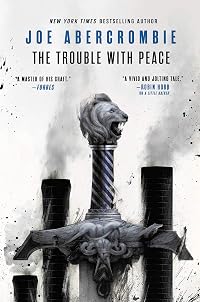
On This Page
Description
"Savine dan Glokta, once Adua's most powerful investor, finds her judgment, fortune, and reputation in tatters. But she still has all her ambitions, and no scruple will be permitted to stand in her way. For heroes like Leo dan Brock and Stour Nightfall, only happy with swords drawn, peace is an ordeal to end as soon as possible. But grievances must be nursed, power seized, and allies gathered first, while Rikke must master the power of the Long Eye... before it kills her. Unrest worms into show more every layer of society. The Breakers still lurk in the shadows, plotting to free the common man from his shackles, while noblemen bicker for their own advantage. Orso struggles to find a safe path through the maze of knives that is politics, only for his enemies, and his debts, to multiply. The old ways are swept aside, and the old leaders with them, but those who would seize the reins of power will find no alliance, no friendship, and no peace lasts forever"--Dust jacket flap. show lessTags
Recommendations


Member Reviews
It's rare that I read a series for this long and am still enraptured. I think this is Abercrombie's best.
The characters are well defined, the action is thrilling, the humor is sharp, and I really found the inner monologues from the characters a delight. Perfectly paced. The final 100 pages or so completely mesmerized me. I don't know if the content is wholly original, but it doesn't really matter. Even if Arch Lektor Glokta isn't in the book very much, Clover and Broad and Orso and Savine are worthy replacements.
Loved the sections where he follows the "Little People" in Grand conflicts. The switch in perspective to random villagers and soldiers was a great break from the usual narrative.
The characters are well defined, the action is thrilling, the humor is sharp, and I really found the inner monologues from the characters a delight. Perfectly paced. The final 100 pages or so completely mesmerized me. I don't know if the content is wholly original, but it doesn't really matter. Even if Arch Lektor Glokta isn't in the book very much, Clover and Broad and Orso and Savine are worthy replacements.
Loved the sections where he follows the "Little People" in Grand conflicts. The switch in perspective to random villagers and soldiers was a great break from the usual narrative.
The author stays true to his Twitter handle 'Lord Grimdark.' The novel is a dark world of betrayal, striving to survive and beyond. I've already bought the third and final book in the Age of Madness trilogy and look forward to reading it later this year.
I received this novel from Orbit Books through NetGalley, in exchange for an honest review: my thanks to both of them for this opportunity.
When I read A Little Hatred, the first volume in Joe Abercrombie’s new saga, I had not yet fulfilled the long-standing promise to myself to read his First Law trilogy, yet still I managed to enjoy the new story very much, despite missing the connection with past events and characters contained in the previous books. Now that I have managed to catch up with that past, I am finally able to appreciate all the subtler nuances of story and characterization that make this world one of the best creations in the genre. And what an amazing journey this was!
As the title suggests, peace is not an enduring show more status in the Circle of the World: the political scene in the Union is still in flux and the newly named king Orso finds himself hemmed in between the rock of social unrest and the hard place of his own advisory council, whose disdain for his ruling abilities is barely concealed. Savine dan Glockta lost much of her prestige after the harrowing experiences of the Breakers’ revolt, and her need to regain the standing she enjoyed compels her to make alliances whose wisdom might not survive the harsh light of day. Leo dan Brock, Lord Governor of Angland - the buffer state between the Union and the “barbaric” North - still pines for triumphs and glorious battles and is far too easily drawn into a dangerous conspiracy by shrewd politicians harnessing his brawn in service of their subtly nefarious brains.
Things are hardly better in the North, where the self-declared king Stour Nightfall is bent on attacking again the Union to expand his territories, meanwhile bolstering his rule through violence and cruelty, not only against opponents but also against those of his own men foolish enough to raise objections. As a first step he sets again his sights on Uffrith, the domain of the Dogman, where Rikke, the old hero’s daughter, is trying to come to terms with her prescient gift - the Long Eye - and is ready to undergo the most harrowing of rituals to harness that power and put it to the service of her people.
This is the bare-bones premise from which The Trouble With Peace takes flight, developing into a tale of convoluted political schemes, social unrest, conspiracies, revolution and, above all, an engrossing examination of the human soul filtered through conflicting desires and shameful or tragic paths. Where the action scenes remain among the most engagingly cinematic I ever encountered - alternatively focusing on heroic feats and very human moments of pure terror and cowardice - Joe Abercrombie’s storytelling shines the brightest when he shapes his characters, be they the main ones or the secondary figures, who get just as much attention and detail as everyone else, contributing to the richness of the narrative canvas. A shining example of this careful design comes from the portrayal of a bloody act of sabotage that is relayed several times from the point of view of a number of different people: the repetition of events helps to create a three-dimensional picture not just of the fact itself, but of the societal medium in which it happens and the way its members figure into it.
What’s most extraordinary in this story is that the moral ambiguity of the characters works both ways, with no clear definition of right or wrong, and the main examples of this grey area are King Orso and Leo dan Brock: while the narrative focus is on either one of them, it’s easy for the reader to sympathize with him, to see his reasons or at least to understand where they come from, but once the point of view shifts to the other one, the same happens, making us realize that truth and righteousness are simply a matter of perspective. Both characters have their merits, narratively speaking, because if on one side Orso seems to grow into his role, finding strength and the foundations of his role through the troubles he has to deal with,
He sometimes could hardly face breakfast, was alarmed by the notion of choosing a shirt, but epic disaster appeared to have finally brought out the best in him.
on the other Leo comes across as an ultimately tragic character, one who is driven by high ideals toward a very dangerous, very uncertain path.
Savine dan Glokta’s journey continues on the controlling and manipulative trail that was her peculiar modus operandi from book 1, but a part of her ruthless self did get lost during the Breakers’ tumults and the traumatic experiences she endured, so it appears here as if she lost both the edge and the keen foresight that once allowed her to be always five moves ahead of her opponents. Despite a constant show of willpower, and a relentless drive that propels her toward any goal, it’s clear that some key element of her personality is now missing, exposing her to fate’s vagaries in an unprecedented way.
Rikke’s character arc, on the other hand, moves in the opposite direction: from the half-savage, tormented girl plagued by unwanted and uncontrollable visions of the future, she grows here into her own woman - and one ready to pay the price necessary to harness her gift and turn it into the tool she needs to lead her people. She became my favorite character in this book, both for the combination of strength and gallows humor that allows Abercrombie’s peculiar narrative style to shine even more, and for the way she transforms into a crafty leader, the perfect embodiment of this world’s survivor, one who knows that shrewd manipulation and back-stabbing politics are the best weapons she can wield.
If the main protagonists do indeed carry the story on their proverbial backs, the secondary figures are just as fascinating, offering complementary points of view and enhancing the sense of full immersion created by the novel: Caul Shivers, Broad, Isern-i-Phail or Vick dan Teufel - just to name a few - enjoy their own share of the limelight, adding depth to the events being carefully built before our own eyes, and the biggest surprise, toward the end of the book, comes exactly from two of those “lesser” players. As the novel seems ready for an epilogue, with the narrative threads brought to what looks like a neat wrap-up that made me wonder if this was not set as a duology, the end is carried by two of those secondary figures - one from the previous trilogy and one from the newest arc - whose actions open the door to what promises to be an amazing, gloriously devastating finale I can hardly wait for.
Thankfully, I still have the stand-alone books in this saga to sustain me while I bide my time… show less
When I read A Little Hatred, the first volume in Joe Abercrombie’s new saga, I had not yet fulfilled the long-standing promise to myself to read his First Law trilogy, yet still I managed to enjoy the new story very much, despite missing the connection with past events and characters contained in the previous books. Now that I have managed to catch up with that past, I am finally able to appreciate all the subtler nuances of story and characterization that make this world one of the best creations in the genre. And what an amazing journey this was!
As the title suggests, peace is not an enduring show more status in the Circle of the World: the political scene in the Union is still in flux and the newly named king Orso finds himself hemmed in between the rock of social unrest and the hard place of his own advisory council, whose disdain for his ruling abilities is barely concealed. Savine dan Glockta lost much of her prestige after the harrowing experiences of the Breakers’ revolt, and her need to regain the standing she enjoyed compels her to make alliances whose wisdom might not survive the harsh light of day. Leo dan Brock, Lord Governor of Angland - the buffer state between the Union and the “barbaric” North - still pines for triumphs and glorious battles and is far too easily drawn into a dangerous conspiracy by shrewd politicians harnessing his brawn in service of their subtly nefarious brains.
Things are hardly better in the North, where the self-declared king Stour Nightfall is bent on attacking again the Union to expand his territories, meanwhile bolstering his rule through violence and cruelty, not only against opponents but also against those of his own men foolish enough to raise objections. As a first step he sets again his sights on Uffrith, the domain of the Dogman, where Rikke, the old hero’s daughter, is trying to come to terms with her prescient gift - the Long Eye - and is ready to undergo the most harrowing of rituals to harness that power and put it to the service of her people.
This is the bare-bones premise from which The Trouble With Peace takes flight, developing into a tale of convoluted political schemes, social unrest, conspiracies, revolution and, above all, an engrossing examination of the human soul filtered through conflicting desires and shameful or tragic paths. Where the action scenes remain among the most engagingly cinematic I ever encountered - alternatively focusing on heroic feats and very human moments of pure terror and cowardice - Joe Abercrombie’s storytelling shines the brightest when he shapes his characters, be they the main ones or the secondary figures, who get just as much attention and detail as everyone else, contributing to the richness of the narrative canvas. A shining example of this careful design comes from the portrayal of a bloody act of sabotage that is relayed several times from the point of view of a number of different people: the repetition of events helps to create a three-dimensional picture not just of the fact itself, but of the societal medium in which it happens and the way its members figure into it.
What’s most extraordinary in this story is that the moral ambiguity of the characters works both ways, with no clear definition of right or wrong, and the main examples of this grey area are King Orso and Leo dan Brock: while the narrative focus is on either one of them, it’s easy for the reader to sympathize with him, to see his reasons or at least to understand where they come from, but once the point of view shifts to the other one, the same happens, making us realize that truth and righteousness are simply a matter of perspective. Both characters have their merits, narratively speaking, because if on one side Orso seems to grow into his role, finding strength and the foundations of his role through the troubles he has to deal with,
He sometimes could hardly face breakfast, was alarmed by the notion of choosing a shirt, but epic disaster appeared to have finally brought out the best in him.
on the other Leo comes across as an ultimately tragic character, one who is driven by high ideals toward a very dangerous, very uncertain path.
Savine dan Glokta’s journey continues on the controlling and manipulative trail that was her peculiar modus operandi from book 1, but a part of her ruthless self did get lost during the Breakers’ tumults and the traumatic experiences she endured, so it appears here as if she lost both the edge and the keen foresight that once allowed her to be always five moves ahead of her opponents. Despite a constant show of willpower, and a relentless drive that propels her toward any goal, it’s clear that some key element of her personality is now missing, exposing her to fate’s vagaries in an unprecedented way.
Rikke’s character arc, on the other hand, moves in the opposite direction: from the half-savage, tormented girl plagued by unwanted and uncontrollable visions of the future, she grows here into her own woman - and one ready to pay the price necessary to harness her gift and turn it into the tool she needs to lead her people. She became my favorite character in this book, both for the combination of strength and gallows humor that allows Abercrombie’s peculiar narrative style to shine even more, and for the way she transforms into a crafty leader, the perfect embodiment of this world’s survivor, one who knows that shrewd manipulation and back-stabbing politics are the best weapons she can wield.
If the main protagonists do indeed carry the story on their proverbial backs, the secondary figures are just as fascinating, offering complementary points of view and enhancing the sense of full immersion created by the novel: Caul Shivers, Broad, Isern-i-Phail or Vick dan Teufel - just to name a few - enjoy their own share of the limelight, adding depth to the events being carefully built before our own eyes, and the biggest surprise, toward the end of the book, comes exactly from two of those “lesser” players. As the novel seems ready for an epilogue, with the narrative threads brought to what looks like a neat wrap-up that made me wonder if this was not set as a duology, the end is carried by two of those secondary figures - one from the previous trilogy and one from the newest arc - whose actions open the door to what promises to be an amazing, gloriously devastating finale I can hardly wait for.
Thankfully, I still have the stand-alone books in this saga to sustain me while I bide my time… show less
To be honest the preoccupation of a lot of fantasy that I found when younger with "Species = Trait = Personality" and homogeneous cultures - dressed often up with evil-begets-evil ideas that you can have an inherently "good" or "evil" race was what put me off fantasy for a good long while. This then mutated, as I see it, into "we're all compromised, selfish people that will lie and kill to get ahead and be actively complicit in all the nastiest excesses of human behaviour, and any good people are in time killed or ground down by society" which isn't much more insightful. Now it strikes me that a lot of the framing of "villains" in genre fiction - perhaps less fantasy but a lot of SF and superhero stuff - is demonising the dispossessed; show more suggesting that the natural response to being hard done by by society is to start killing and causing havoc. That we can now sit and happily watch loads of stories about society's unfairness creating villains out of those it lets down - and the "heroes" are those bringing them to justice - seems very odd to me. Heroes used to stand up for those hard done by by unfairness, not put them back in their place to preserve the status quo. I don't think I need to tell you what Abercrombie is doing with his representation of good vs evil however you wish to look at it and how that currently matches up to our progress in understanding the moral underpinnings in humans. Certainly fantasy's authors have taken that basic yin/yang further and naturally so for different sub-creation exercises involving certain narrative devices as well as people's expertise at 'story-tripping' with their characters, etc. Looking at this pattern one could discern there's a certain epistemic quality to our sense of morality that matches with what modern science can inform to our basic intuitions of that morality and how they can be biased in certain directions. As for “The Trouble with Peace” I think it works perfectly well as a world we can look from outside into. A durable Abercrombie piece, with some memorable moments, lots of kidney-looking character representations, including a particularly prominent one. It’s like going in to the butcher, asking for 1Kg of chicken, going home to weight it and it turns out that you have exactly 1 Kg of chicken (even with the offal thrown in), sometimes a little more, sometimes a little less, and then you taste it and that’s exactly the taste you expected. And that you've known for many years, i.e., the Abercrombie who wrote the world of First Law but with a somewhat more refined prose. That's exactly the taste. When you add what I wrote above to Abercrombie’s second volume of “The Age of Madness” however, some of our inner-world starts seeping into these other worlds and as Morpheus says in “The Matrix”:
"How would you know the difference between the dream world and the real world?" show less
"How would you know the difference between the dream world and the real world?" show less
The Trouble with Peace by Joe Abercrombie is the middle volume in this grimdark fantasy trilogy. The first book, A Little Hatred, set the scene and we are back in the world developed for his other series, The First Law. With a huge range of characters, many of them connected to characters from the first books, there is a lot to following these stories.
Orso, is now King of the Union and although he hates it, he must deal with his newfound power and responsibilities with handling the Union’s politics, and the many people who want his attention. There is a plot afoot to overthrow the throne and the conspirators draw Leo dan Brock, the Young Lion and military hero, in. He becomes their front man and although he just wants to see equality show more and justice , his wife is eager to become queen. Many promises are made as the rebellion make some doubtful allies
and the story comes to head when the long awaited battle us fought. With turncoats, traitors, brave heroes and cowardly deserters, the final chapters of the book are totally captivating.
The best thing about these books are the characters that the author develops. They are flawed, but often likeable and even though the reader follows many different prospectives, it is hard to be definitively for one side or the other. I particularly liked following the thoughts and actions of the reluctant king, Orso. And one of the new leaders of the North, Rikke, daughter of the famous Dogman added greatly to the excitement and humor. Although this book gives us the confrontation between the loyalists and rebels, I need to read the next book soon so I can find out the fate of many of the characters. show less
Orso, is now King of the Union and although he hates it, he must deal with his newfound power and responsibilities with handling the Union’s politics, and the many people who want his attention. There is a plot afoot to overthrow the throne and the conspirators draw Leo dan Brock, the Young Lion and military hero, in. He becomes their front man and although he just wants to see equality show more and justice , his wife is eager to become queen. Many promises are made as the rebellion make some doubtful allies
and the story comes to head when the long awaited battle us fought. With turncoats, traitors, brave heroes and cowardly deserters, the final chapters of the book are totally captivating.
The best thing about these books are the characters that the author develops. They are flawed, but often likeable and even though the reader follows many different prospectives, it is hard to be definitively for one side or the other. I particularly liked following the thoughts and actions of the reluctant king, Orso. And one of the new leaders of the North, Rikke, daughter of the famous Dogman added greatly to the excitement and humor. Although this book gives us the confrontation between the loyalists and rebels, I need to read the next book soon so I can find out the fate of many of the characters. show less
Seguimos avanzando en esta nueva era.
Leer este libro es como ver una locomotora que se ha salido de las vias y lenta pero inexorablemente se acerca a una casa para destruirla.
Esta perfectamente escrito como siempre pero creo había demasiada preparación y aunque el final es increible creo que sufre un poco hasta llegar a el.
Leer este libro es como ver una locomotora que se ha salido de las vias y lenta pero inexorablemente se acerca a una casa para destruirla.
Esta perfectamente escrito como siempre pero creo había demasiada preparación y aunque el final es increible creo que sufre un poco hasta llegar a el.
I loved this book. It was really when the series started to click with me. After what felt like a very abrupt ending to the previous book, this one simultaneously broadens the scope and narrows the focus. We watch conspiracies unfold all over the place and it was all expertly done.
Members
- Recently Added By
Lists

Best Fantasy Novels
821 works; 357 members

Plan to Listen Audiobooks
63 works; 1 member

Books Read in 2020
4,379 works; 123 members

infjsarah's wishlist
408 works; 2 members

Books Read in 2025
4,091 works; 97 members
Author Information

91+ Works 40,728 Members
Joe Abercrombie is a freelance film editor, working mostly on documentaries and live music events. He lives and works in London. The First Law is his debut series. He won a Locus Award 2015 for science-fiction in the Young Adult Book Category with his title Half a King. (Bowker Author Biography)
Awards and Honors
Series


Common Knowledge
- Canonical title
- The Trouble With Peace
- Original title
- The Trouble With Peace
- Original publication date
- 2020-09-15
- Dedication
- For Lou,
With grim, dark
hugs - First words
- "I hope no one minds if we dispense with this for now?"
- Last words
- (Click to show. Warning: May contain spoilers.)"A Great Change."
- Original language*
- Inglés
*Some information comes from Common Knowledge in other languages. Click "Edit" for more information.
Classifications
Statistics
- Members
- 1,126
- Popularity
- 22,443
- Reviews
- 17
- Rating
- (4.35)
- Languages
- 7 — English, French, German, Greek, Italian, Polish, Spanish
- Media
- Paper, Audiobook, Ebook
- ISBNs
- 29
- ASINs
- 10