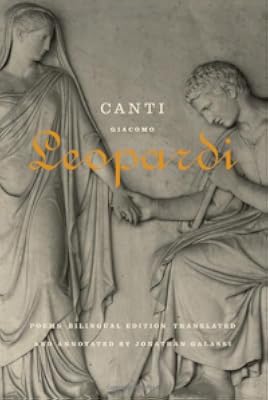
Canti
by Giacomo Leopardi
On This Page
Description
Giacomo Leopardi is Italy's greatest modern poet, the first European writer to portray and examine the self in a way that feels familiar to us today. A great classical scholar and patriot, he explored metaphysical loneliness in entirely original ways. Though he died young, his influence was enormous, and it is no exaggeration to say that all modern poetry, not only in Italian, derives in some way from his work. Galassi, whose translations of Eugenio Montale have been widely acclaimed, has show more produced a strong, fresh, direct version of this great poet that offers English-language readers a new approach to Leopardi. show lessTags
Recommendations























Member Recommendations

Member Reviews
O patria mia, vedo le mura e gli archi
E le colonne e i simulacri e l'erme
Torri degli avi nostri,
Ma la gloria non vedo
I warmed to Leopardi's lamentations on the state of nineteenth-century Italian culture, for all of his cloying pessimism. The great modernist poet proves to be more complex than mere Romantic self-pity. His is a harsh call to the former glory of classical times, which often reminds me of Rimbaud's poem > :
– Ô Vénus, ô Déesse !
Je regrette les temps de l’antique jeunesse
Jonathan Galassi's translation outshines other English renderings. Every word is infused with power that reminds me of the best of Melville ("Give me a condor's quill! Give me Vesuvius' crater for an inkstand!").
It's amazing how unrequited love and show more a childhood lost can turn one's thoughts to such refrains as "Life is forlorn, lightless," while still maintaining the capacity to create beautiful art. show less
E le colonne e i simulacri e l'erme
Torri degli avi nostri,
Ma la gloria non vedo
I warmed to Leopardi's lamentations on the state of nineteenth-century Italian culture, for all of his cloying pessimism. The great modernist poet proves to be more complex than mere Romantic self-pity. His is a harsh call to the former glory of classical times, which often reminds me of Rimbaud's poem > :
– Ô Vénus, ô Déesse !
Je regrette les temps de l’antique jeunesse
Jonathan Galassi's translation outshines other English renderings. Every word is infused with power that reminds me of the best of Melville ("Give me a condor's quill! Give me Vesuvius' crater for an inkstand!").
It's amazing how unrequited love and show more a childhood lost can turn one's thoughts to such refrains as "Life is forlorn, lightless," while still maintaining the capacity to create beautiful art. show less
Leopardi's "La Ricordanza," trans AW Powers
The heart did not tell me that my green age
would be condemned, consumed in that
Native wild town, among a people rustic
boorish and low; whose foreign names, and often
Arguments of laughter at laughing-stocks
were their schools and wisdom; who hated me, fled
Never through envy; because I was nothing
to them; but because such esteen
As tinged my heart would tickle and incense
those I never noticed. Therefore, I
Passed the years abandoned, hidden,
without love, wihout life; I turned
Bitter from the band of illwishers...
At the same time, dear youth, more dear
than fame or the laurel, more than
The pure light of day, or hope: I lost you
without a delight. Unlived, unused in that
Not human trip, among show more those anxieties--
oh the short, sharp life of a petal. show less
The heart did not tell me that my green age
would be condemned, consumed in that
Native wild town, among a people rustic
boorish and low; whose foreign names, and often
Arguments of laughter at laughing-stocks
were their schools and wisdom; who hated me, fled
Never through envy; because I was nothing
to them; but because such esteen
As tinged my heart would tickle and incense
those I never noticed. Therefore, I
Passed the years abandoned, hidden,
without love, wihout life; I turned
Bitter from the band of illwishers...
At the same time, dear youth, more dear
than fame or the laurel, more than
The pure light of day, or hope: I lost you
without a delight. Unlived, unused in that
Not human trip, among show more those anxieties--
oh the short, sharp life of a petal. show less
Leopardi just ain't for me. I got closer to it this time with Galassi's translation, as well as ploughing through the original for a few of the texts, but the Italian nationalism and the philosophical meanderings still bore me almost equally.
Dual language edition!
No sabría decir por qué principalmente me han fascinado estos poemas. A lo mejor por su variedad, que no me esperaba. Variedad métrica, que, naturalmente, se pierde un poco en la traducción. Pero, sobre todo, variedad temática. Hay poemas filosóficos y amorosos, pero también muchos políticos y algunos costumbristas, al menos en parte. Por todas partes encontramos un pesimismo declarado, mezclado con la nostalgia del pasado y esa atracción por la muerte tan romántica. Pero también hay muchas ganas de vivir (esta no tan declarada, supongo que la moda era lo contrario) y rabia porque las cosas no salen como deberían. Yo creo que la vitalidad es lo que me ha enganchado de esta colección de poemas.
Nov 16, 2025Spanish
I canti di Leopardi sono una lettura che rinnova il piacere di leggere; e il rimpianto per i propositi giovanili che con gli anni assumono sempre più il valore di una chimera. La rilettura delle poesie più famose del grande poeta italiano viene introdotta egregiamente da Franco Gavezzani che prepara il campo ad un viaggio al centro dell’uomo. Leopardi non è il poeta del dolore, come da ricordi di scuola da clichè didattici; né del rimpianto, alla continua ricerca dell’effimera e temporanea felicità degli anni dell’attesa, l’adolescenza, un semplice preludio di tempi in cui la vita porterà il suo fardello. Leopardi è il poeta dell’uomo, della sua vita, pregna, e certo di un disagio che gli dona, per l’appunto show more umanità. La complessità letteraria di Leopardi, la ricchezza della prosa, sempre sontuosa, accompagnano il lettore dal primo all’ultimo canto, in una sorta di grande melodia. E così poesia famose, famosissime, A Silvia piuttosto che l’infinito, si alternano a canti di eguale sostanza, per una lettura che, al solito per opere di questo genere, non è semplice, ma ripaga, con interesse usurario, il lettore del tempo dedicato. show less
Jun 30, 2017 (Edited)Italian
GR-1
Nov 30, 2020Catalan
Members
- Recently Added By
Lists

The 100 Best Books of All Time by Norwegian Book Club (World Library)
104 works; 21 members

Italian Literature
556 works; 41 members

Philip Ward's Lifetime Reading Plan
592 works; 22 members

1001 Books You Must Read Before You Die
1,448 works; 1,132 members

The Luca Guadagnino Universe
62 works; 1 member

To read
39 works; 1 member
Author Information

Italian poet Giacomo Leopardi, son of Count Monaldo and Countess Adelaide, was born in Recanati, Italy, on June 29, 1798. Leopardi enjoyed the company of his brother Carlo and sister Paolina, with whom he played such games as dressing up in clerical wear and saying mass, or acting in historical dramas. Encouraged to learn by his parents, Giacomo show more Leopardi was able to read and write Greek by the age of 15. It was his ability at poetry that kept him sane when, at 18, he lost most of his eyesight and developed a severely curved spine. Leopardi fell in love with his married cousin Countess Geltrude Cassi, with whom he had a powerful affair, in 1817. Nine years later, Leopardi fell in love with yet another married countess, Teresa Carniani Malvezzi, whose husband put an end to the affair. Leopardi channeled his anguish over his physical condition and emotionally exhausting romances into his poetry, fueled by the enthusiasm of his mentor, Pietro Giordani, and by the financial aid of such persons as publisher Antonio Stella, who paid Leopardi for his editing of works by classical writers. Although his poetry is usually grim and gloomy, his attention to detail with outdoor scenes is praised by critics, such as in his shortly-before-death poem, "The Broom," about a flower's growth. Giacomo Leopardi died on June 15, 1837, in Naples, Italy. (Bowker Author Biography) show less
Some Editions
Awards and Honors
Awards
Distinctions
Series
Belongs to Publisher Series
Oneworld Classics (33)
A tot vent (756)
Work Relationships
Common Knowledge
- Canonical title*
- Canti
- Original title
- Canti
- Original publication date
- 1845
- Original language
- Italian
*Some information comes from Common Knowledge in other languages. Click "Edit" for more information.
Classifications
Statistics
- Members
- 1,034
- Popularity
- 24,985
- Reviews
- 15
- Rating
- (4.34)
- Languages
- 10 — Catalan, Dutch, English, Finnish, French, German, Italian, Polish, Spanish, Portuguese (Portugal)
- Media
- Paper, Audiobook, Ebook
- ISBNs
- 101
- UPCs
- 1
- ASINs
- 18