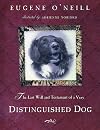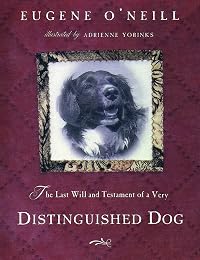
The Last Will and Testament of an Extremely Distinguished Dog
by Eugene O'Neill
On This Page
Description
A beautiful and compassionate rendering of Eugene O'Neill's original poem, The Last Will and Testament of an Extremely Distinguished Dog is the perfect comfort for anyone grieving the loss of their furry friend. Those who have suffered the loss of a long-lived canine companion may take some solace in the classic prose poem by Eugene ONeill, The Last Will and Testament of an Extremely Distinguished Dog. Here, the poem, written from the point of view of ONeill's beloved Dalmatian Blemie, is show more accompanied by Mark Andresen's equally sympathetic illustrations of dogs of various breeds. This illustrated eulogy is a balm for anyone who has recently lost their dog, or a perfect gift for a friend in their time of loss. Andresen's original drawings along with the words of America's only Nobel Prize-winning playwright are a perfect match. show lessTags
Recommendations























Member Reviews
A lovely gem of a book! A Library Thing friend sent this to me, and I am so glad she did! One very special dog, called Blemie, was nearing the end of life. O'Neill writes with depth of feeling for the many years his lovely border collie was loved and quite capable of loving in return.
The illustrations by Adrienne Yorinks are nestled inside a stunning quilt. Each 25 illustration is beautifully rendered.
O'Neill gives a beautiful telling of life with Blemie, and then the stark realization that time with Blemie is growing shorter. It is Blemie's time to be free of pain. And, the pain created by the loss is sincerely heartfelt.
Highly recommended.
Four and 1/2 Stars.
The illustrations by Adrienne Yorinks are nestled inside a stunning quilt. Each 25 illustration is beautifully rendered.
O'Neill gives a beautiful telling of life with Blemie, and then the stark realization that time with Blemie is growing shorter. It is Blemie's time to be free of pain. And, the pain created by the loss is sincerely heartfelt.
Highly recommended.
Four and 1/2 Stars.
En la versió catalana els dibuixos de Joan Tharrats són excepcionals
Aug 27, 2025Catalan
Ratings
Members
- Recently Added By
Author Information

282+ Works 13,247 Members
Eugene O'Neill was born in New York City on October 16, 1888, the son of popular actors James O'Neill and Ellen Quinlan. As a young child, he frequently went on tour with his father and later attended a Catholic boarding school and a private preparatory school. He entered Princeton University but stayed for only a year. He took a variety of jobs, show more including prospecting for gold, shipping out as a merchant sailor, joining his father on the stage, and writing for newspapers. In 1912, he was hospitalized for tuberculosis and emotional exhaustion. While recovering, he read a great deal of dramatic literature and, after his release from the sanitarium, began writing plays. O'Neill got his theatrical start with a group known as the Provincetown Players, a company of actors, writers, and other theatrical newcomers, many of whom went on to achieve commercial and critical success. His first plays were one-act works for this group, works that combined realism with experimental forms. O'Neill's first commercial successes, Beyond the Horizon (1920) and Anna Christie (1921) were traditional realistic plays. Anna Christie is still frequently performed. It is the story of a young woman, Anna, whose hard life has led her to become a prostitute. Anna comes to live with her long-lost father, who is unaware of her past, and she falls in love with a sailor, who is also unaware. When Anna finds the two men fighting over her as though she were property, she is so angry and disgusted that she insists on telling them the truth. The man she loves rejects her at first, but then later returns to marry her. Soon O'Neill began to experiment more, and over the next 12 years used a wide variety of unusual techniques, settings, and dramatic devices. It is no exaggeration to say that, virtually on his own, O'Neill created a tradition of serious American theater. His influence on the playwrights who followed him has been enormous, and much of what is taken today for granted in modern American theater originated with O'Neill. A major legacy has been the nine plays he wrote between 1924 and 1931, tragedies that made heavy use of the new Freudian psychology just coming into fashion. His one comedy, Ah, Wilderness (1933), was the basis for the musical comedy, Oklahoma!, itself a groundbreaking event in American theater. O'Neill later began to write the intense, brooding, and highly autobiographical plays that are now considered to his best work. The Iceman Cometh (1946) is set in a bar in Manhattan's Bowery, or skid-row district. In the course of the play, a group of apparently happy men are forced to recognize the true emptiness of their lives. In A Long Day's Journey into Night (1956), O'Neill examines his own family and their tormented lives, a subject he continues in A Moon for the Misbegotten (1957). O'Neill's work was highly honored. He was awarded the Nobel Prize for literature in 1936 and Pulitzer Prizes for Anna Christie, Beyond the Horizon, Strange Interlude (1928), and A Long Day's Journey Into Night, which also received the New York Drama Critics Circle Award. O'Neill died in Room 401 of the Sheraton Hotel on Bay State Road in Boston, on November 27, 1953, at the age of 65. He was also born in a hotel room in Times Square, NYC. (Bowker Author Biography) show less
Classifications
Statistics
- Members
- 47
- Popularity
- 625,337
- Reviews
- 2
- Rating
- (4.50)
- Languages
- English
- Media
- Paper
- ISBNs
- 4
- ASINs
- 1