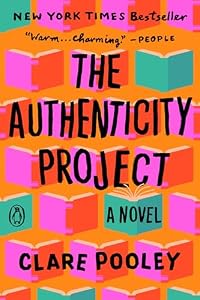
The Authenticity Project
by Clare Pooley
On This Page
Description
"A story about a solitary green notebook that brings together six strangers and leads to unexpected friendship, and even love--think Eleanor Oliphant Is Completely Fine meets Love, Actually "Everybody lies about their lives. What would happen if you shared the truth?" This is the question that Julian Jessop, an eccentric, seventy-nine-year-old artist, poses within a pale green exercise book that he labels The Authenticity Project, before leaving it behind in Monica's Café. When Monica show more discovers Julian's abandoned notebook, not only does she add her own story to the book, she is determined to find a way to help Julian feel less lonely. And so it goes with the others who find the green notebook that will soon contain their deepest selves. It will also knit the group together In Real Life at Monica's Cafe, where they'll discover the thrill and sometime-risk of being completely honest--and, for some, find unexpected love. With a cast of characters who are by turns quirky and funny, heartbreakingly sad and painfully true-to-life, The Authenticity Project is a novel readers will take to their hearts and read with unabashed pleasure"-- show lessTags
Recommendations



Member Reviews
I just knew from the first few pages that I was going to love Clare Pooley's debut fiction novel, The Authenticity Project. Trust me, you will too....
An older, lonely widower/artist who has spent the last fifteen years pretty much by himself in his home is determined to get back out into the world. He comes up with an idea.....he writes his truth in a green notebook and leaves it on a table in a local cafe.....and The Authenticity Project is begun.
"Everyone lies about their lives. What would happen if you shared the truth instead? The one thing that defines you, that makes everything else about you fall into place. Not on the internet, but with those real people around you? Maybe nothing. Or maybe telling that story would change your show more life, or the life of someone you've not met me. That's what I want to find out."
What a great premise eh? I couldn't wait to see what would happen next. Well, the notebook is picked up again and again - and the lives of six strangers intersect.....
I loved Pooley's characters - they're all wonderfully drawn, strengths, foibles and all. (And yes, I'd like to be sitting around the table with them at the back of the cafe.) I was immediately invested in their lives and kept quickly turning pages to see who would next pick up the book. The narrative moves from player to player and again and this only ensured I couldn't put the book down. Those intersections get more and more complicated, changes happen and I certainly didn't see some of them coming. Some I liked, some I didn't, but they were all 'just right' for the book.
Pooley's writing is so easy to read, flows so easily and is utterly addictive. If you're looking for a warm, feel-good, uplifting, unexpected, just be yourself tale, this is one you'll want to read. After I turned the last page, I wondered - what would happen if someone actually did this?
"If we all stopped making each other feel sad and inadequate by pretending to be perfect, and instead opened up about our struggles, we would all be much happier, and feel less alone." Clare Pooley.
This is easily one of my favourite reads for 2020 - and yes, I know we're only in February! show less
An older, lonely widower/artist who has spent the last fifteen years pretty much by himself in his home is determined to get back out into the world. He comes up with an idea.....he writes his truth in a green notebook and leaves it on a table in a local cafe.....and The Authenticity Project is begun.
"Everyone lies about their lives. What would happen if you shared the truth instead? The one thing that defines you, that makes everything else about you fall into place. Not on the internet, but with those real people around you? Maybe nothing. Or maybe telling that story would change your show more life, or the life of someone you've not met me. That's what I want to find out."
What a great premise eh? I couldn't wait to see what would happen next. Well, the notebook is picked up again and again - and the lives of six strangers intersect.....
I loved Pooley's characters - they're all wonderfully drawn, strengths, foibles and all. (And yes, I'd like to be sitting around the table with them at the back of the cafe.) I was immediately invested in their lives and kept quickly turning pages to see who would next pick up the book. The narrative moves from player to player and again and this only ensured I couldn't put the book down. Those intersections get more and more complicated, changes happen and I certainly didn't see some of them coming. Some I liked, some I didn't, but they were all 'just right' for the book.
Pooley's writing is so easy to read, flows so easily and is utterly addictive. If you're looking for a warm, feel-good, uplifting, unexpected, just be yourself tale, this is one you'll want to read. After I turned the last page, I wondered - what would happen if someone actually did this?
"If we all stopped making each other feel sad and inadequate by pretending to be perfect, and instead opened up about our struggles, we would all be much happier, and feel less alone." Clare Pooley.
This is easily one of my favourite reads for 2020 - and yes, I know we're only in February! show less
I disliked this ridiculous feel-good novel, stuffed with clichés and implausible caricatures of people, situations, and dialogue, and presumably sponsored by Apple*. But two friends recommended it as enjoyable, uplifting fun. I fancied something light, and the premise had promise. One of them lent me a copy, so I felt obliged to read the whole thing. I did. But I wish that I hadn’t. This is an honest review of my feelings about the book. I will say less, and be rather gentler when I return it.
The authenticity dilemma
The book’s title is that of Julian’s notebook. He writes that he’s old and lonely, and wants neighbours to know and understand each other. He pens a bit about himself, suggests others do the same, stressing the need show more for unvarnished honesty, and leaves it for someone to find.
“Everyone lies about their lives. What would happen if you shared the truth instead?”
A daisy-chain of stories and lives. Probably sentimental, but potentially interesting. Four more main characters (plus a late-comer) find the book and write in it: sensible Monica, risk-taking Hazard, a stunning Aussie surfer living the life of Riley called… Riley, and a Mummy Instagram influencer with a secret drink problem called Alice. Lesser characters include Mrs Wu, who is an inconsistent (especially in her speech) and uncomfortable caricature of a Chinese matriarch and restaurateur, an old lesbian couple whose peripheral presence in the story makes little sense, and a young gay couple.
Despite the characters’ obvious and admitted flaws, they’re all too kind to be true. As their lives intersect more and more, and they all benefit from helping each other, rather than focusing on their own problems. Nothing they say or do feels authentic, let alone the six-month timescale. A former high-flying city lawyer whose proudest achievement is a five-star hygiene rating for her café and loves nothing better than reading a business plan? A surprise party to mark the fifteenth anniversary of the death of a loved-one is weird, isn’t it? And one person’s disapproval of a character who is accidentally outed is quickly is overcome by a scene that could be from Mickey Mouse!
Image: A cat using a mirror to paint a self-portrait - of a tiger. “Self portrait” by Sarang Bhagat (Source)
Social media proves that many people like to share their lives and inner thoughts, authentic or not. However, it’s either for family and friends, or, with the exception of celebs, shared relatively anonymously. No one would write what these people write and then leave it so near to home, when strangers could identify them.
The inauthenticity could be clever and meta. It came close with Alice, who realises her brand “was all about authenticity”, but knows her posts paint sunny lie after sunny lie. And a couple of other characters question the effect of the notebook. But overall, every paragraph felt utterly inauthentic to me.
Life imitating art?
I feel bad for criticising the believability because at the end, the author says she was a Mummy blogger with a drink problem, in the same part of west London. She’s sober now, and has written and given a TED talk about her experience to help others. Nevertheless, I don’t think the old advice to “write what you know” worked.
*Product placement
iPhones were the worst, with at least six gratuitous and unidiomatic mentions. My phone happens to be an iPhone, but like every Brit I know, I just refer to my “phone” or my “mobile”, regardless of brand (unless specifically making comparisons). Other product placement broke the flow, either because it didn’t ring true (Insta woman and After Eights) or because it was unnecessary (a list of six well-known relationship books, where one or two would make the point).
Mood
I understand the desire for escapism, but for me, it has to be either more believable than this, or be explicitly fantasy or magical realism. I guess this is chick-lit, so I looked at the only other such book I reviewed, nearly 14 years ago, Kinsella’s Can You Keep a Secret? My closing comment applies just as much to this:
I expected a juice bar/coffee shop rather than Heston Blumenthal's molecular gastronomy, but I ended up with soggy fluorescent candyfloss.
Image: Soggy candyfloss (BrE) aka cotton candy (AmE) (Source)
Silver lining
This is the shortest review of a 400-page book I’ve written for more than a decade! show less
The authenticity dilemma
The book’s title is that of Julian’s notebook. He writes that he’s old and lonely, and wants neighbours to know and understand each other. He pens a bit about himself, suggests others do the same, stressing the need show more for unvarnished honesty, and leaves it for someone to find.
“Everyone lies about their lives. What would happen if you shared the truth instead?”
A daisy-chain of stories and lives. Probably sentimental, but potentially interesting. Four more main characters (plus a late-comer) find the book and write in it: sensible Monica, risk-taking Hazard, a stunning Aussie surfer living the life of Riley called… Riley, and a Mummy Instagram influencer with a secret drink problem called Alice. Lesser characters include Mrs Wu, who is an inconsistent (especially in her speech) and uncomfortable caricature of a Chinese matriarch and restaurateur, an old lesbian couple whose peripheral presence in the story makes little sense, and a young gay couple.
Despite the characters’ obvious and admitted flaws, they’re all too kind to be true. As their lives intersect more and more, and they all benefit from helping each other, rather than focusing on their own problems. Nothing they say or do feels authentic, let alone the six-month timescale. A former high-flying city lawyer whose proudest achievement is a five-star hygiene rating for her café and loves nothing better than reading a business plan? A surprise party to mark the fifteenth anniversary of the death of a loved-one is weird, isn’t it? And one person’s disapproval of a character who is accidentally outed is quickly is overcome by a scene that could be from Mickey Mouse!
Image: A cat using a mirror to paint a self-portrait - of a tiger. “Self portrait” by Sarang Bhagat (Source)
Social media proves that many people like to share their lives and inner thoughts, authentic or not. However, it’s either for family and friends, or, with the exception of celebs, shared relatively anonymously. No one would write what these people write and then leave it so near to home, when strangers could identify them.
The inauthenticity could be clever and meta. It came close with Alice, who realises her brand “was all about authenticity”, but knows her posts paint sunny lie after sunny lie. And a couple of other characters question the effect of the notebook. But overall, every paragraph felt utterly inauthentic to me.
Life imitating art?
I feel bad for criticising the believability because at the end, the author says she was a Mummy blogger with a drink problem, in the same part of west London. She’s sober now, and has written and given a TED talk about her experience to help others. Nevertheless, I don’t think the old advice to “write what you know” worked.
*Product placement
iPhones were the worst, with at least six gratuitous and unidiomatic mentions. My phone happens to be an iPhone, but like every Brit I know, I just refer to my “phone” or my “mobile”, regardless of brand (unless specifically making comparisons). Other product placement broke the flow, either because it didn’t ring true (Insta woman and After Eights) or because it was unnecessary (a list of six well-known relationship books, where one or two would make the point).
Mood
I understand the desire for escapism, but for me, it has to be either more believable than this, or be explicitly fantasy or magical realism. I guess this is chick-lit, so I looked at the only other such book I reviewed, nearly 14 years ago, Kinsella’s Can You Keep a Secret? My closing comment applies just as much to this:
I expected a juice bar/coffee shop rather than Heston Blumenthal's molecular gastronomy, but I ended up with soggy fluorescent candyfloss.
Image: Soggy candyfloss (BrE) aka cotton candy (AmE) (Source)
Silver lining
This is the shortest review of a 400-page book I’ve written for more than a decade! show less
The story of a solitary green notebook that brings together six strangers and leads to unexpected friendship, and even love
Julian Jessop, an eccentric, lonely artist and septuagenarian believes that most people aren't really honest with each other. But what if they were? And so he writes--in a plain, green journal--the truth about his own life and leaves it in his local café. It's run by the incredibly tidy and efficient Monica, who furtively adds her own entry and leaves the book in the wine bar across the street. Before long, the others who find the green notebook add the truths about their own deepest selves--and soon find each other in real life at Monica's café.
The Authenticity Project's cast of characters--including Hazard, the show more charming addict who makes a vow to get sober; Alice, the fabulous mommy Instagrammer whose real life is a lot less perfect than it looks online; and their other new friends--is by turns quirky and funny, heartbreakingly sad and painfully true-to-life. It's a story about being brave and putting your real self forward--and finding out that it's not as scary as it seems. In fact, it looks a lot like happiness. show less
Julian Jessop, an eccentric, lonely artist and septuagenarian believes that most people aren't really honest with each other. But what if they were? And so he writes--in a plain, green journal--the truth about his own life and leaves it in his local café. It's run by the incredibly tidy and efficient Monica, who furtively adds her own entry and leaves the book in the wine bar across the street. Before long, the others who find the green notebook add the truths about their own deepest selves--and soon find each other in real life at Monica's café.
The Authenticity Project's cast of characters--including Hazard, the show more charming addict who makes a vow to get sober; Alice, the fabulous mommy Instagrammer whose real life is a lot less perfect than it looks online; and their other new friends--is by turns quirky and funny, heartbreakingly sad and painfully true-to-life. It's a story about being brave and putting your real self forward--and finding out that it's not as scary as it seems. In fact, it looks a lot like happiness. show less
Authenticity isn't so simple, as characters discover in Clare Pooley's rewarding 2020 novel “The Authenticity Project.”
The novel's concept is simple enough. Julian Jessup, a lonely old artist still living in the past when he was at the center of London's swinging art community, confesses his situation in a notebook that he labels "The Authenticity Project" and invites others to do the same before leaving it behind in Monica's Cafe. Monica herself, a woman in her late 30s dreaming of marriage and a family, finds the notebook and tells about herself in it, then leaves it behind in a bar.
And so it goes, those who find the notebook adding their own truths and passing it on, then seeking out those individuals they read about and forming show more a close-knit group of friends with seemingly little in common. In this respect the novel is much like Nick Hornby's “A Long Way Down,” in which four very different people meet on the top of a building on New Year's Eve, each planning to commit suicide, and then begin to care about each other and support each other.
What makes Pooley's book distinctive is that most of the characters aren't really as authentic in their confessions as they pretend to be. Julian, for example, is older than he says and isn't even a widower. Thus the story becomes more complex than it first appears, as the characters discover more about themselves and about each other.
You may be somebody afraid to be caught reading a soppy, feel-good novel in public, but be more authentic and take this one with you on the plane or to the doctor's waiting room. show less
The novel's concept is simple enough. Julian Jessup, a lonely old artist still living in the past when he was at the center of London's swinging art community, confesses his situation in a notebook that he labels "The Authenticity Project" and invites others to do the same before leaving it behind in Monica's Cafe. Monica herself, a woman in her late 30s dreaming of marriage and a family, finds the notebook and tells about herself in it, then leaves it behind in a bar.
And so it goes, those who find the notebook adding their own truths and passing it on, then seeking out those individuals they read about and forming show more a close-knit group of friends with seemingly little in common. In this respect the novel is much like Nick Hornby's “A Long Way Down,” in which four very different people meet on the top of a building on New Year's Eve, each planning to commit suicide, and then begin to care about each other and support each other.
What makes Pooley's book distinctive is that most of the characters aren't really as authentic in their confessions as they pretend to be. Julian, for example, is older than he says and isn't even a widower. Thus the story becomes more complex than it first appears, as the characters discover more about themselves and about each other.
You may be somebody afraid to be caught reading a soppy, feel-good novel in public, but be more authentic and take this one with you on the plane or to the doctor's waiting room. show less
The characters in this novel are all charming: very different from one another, multidimensional for the most part with just enough eccentricity to make them interesting but not too much to make them unbelievable. Too bad that the plot is so flimsy: the notebook that generates so much generosity is highly unlikely, the romances are obvious and not very compelling; everything is really very predictable and not terribly engaging. A lovely holiday read, no more.
So very often we hide parts of ourselves, the unhappy parts, the unsavory parts, the hard, struggling parts. This has probably always been true but seems to be accentuated by our social media society. We only post our highlights reel. If we can get the lighting correct and crop the messes of real life out, our curated life looks enviable and aspirational. But behind the scenes, we're all human with all the attendant ups and downs of real life. So what would happen if we told the truth about our lives? Telling the truth is exactly what happens in Clare Pooley's debut novel, The Authenticity Project.
Monica, owner of Monica's Cafe, finds a plain green journal titled The Authenticiy Project at the recently vacated table of a dapper, elderly show more man. She reads the first page in hopes that she can identify the owner and return it but what she discovers is an honest and open journal entry that almost eighty year old Julian Jessop, a lonely artist whose wife is gone, has written. At the end of his journal entry, he challenges whoever finds the journal to add their own truth to the pages and pass it along if they would like to. So Monica, a control freak for whom the cafe is her entire life, does so, admitting her sorrow at the lack of a husband and child in her life. She leaves the journal at the bar across the street where it is picked up by a deeply unhappy man named Hazard. Hazard surprises himself by not only furthering Monica's plan to engage Julian in life by getting him to teach art classes at the cafe, but also by reading, contributing to the journal, and passing it along to an easy going Australian named Riley, who he's vetted as a friend for Julian and as a potential lover for Monica and is headed to London from the Pacific Island where Hazard has landed to try and beat his addiction and get a handle on his life. These characters, with the addition of Monica's barista Benji, his boyfriend Baz, and Alice, a local, frazzled, mommy Instagrammer whose life is anything but picture perfect all come together through the journal and the art classes as they learn to bare their true selves to others, to chase their own happiness, to offer kindness, and to be authentic in the world.
The novel is definitely a feel good story. It's a story of love and friendship and claiming the life you want. The conceit of the journal passing from hand to hand and connecting disparate people is a sweet one. Each of the characters has quirks and flaws that make them feel real. This also makes them not always terribly likable and sometimes they come across as a bit too stereotypical. The short chapters are centered on different characters, moving the story along as they interact together but also when they are at a far remove but thinking of the others. Of course, the path to happiness isn't smooth. The novel's conflict is a little reminiscent of a romance novel and there is an interesting twist in one character's "authentic" story. The final scene is predictable but still the right ending. This is a big hearted and charming novel, perhaps perfect for the year we've all been having. show less
Monica, owner of Monica's Cafe, finds a plain green journal titled The Authenticiy Project at the recently vacated table of a dapper, elderly show more man. She reads the first page in hopes that she can identify the owner and return it but what she discovers is an honest and open journal entry that almost eighty year old Julian Jessop, a lonely artist whose wife is gone, has written. At the end of his journal entry, he challenges whoever finds the journal to add their own truth to the pages and pass it along if they would like to. So Monica, a control freak for whom the cafe is her entire life, does so, admitting her sorrow at the lack of a husband and child in her life. She leaves the journal at the bar across the street where it is picked up by a deeply unhappy man named Hazard. Hazard surprises himself by not only furthering Monica's plan to engage Julian in life by getting him to teach art classes at the cafe, but also by reading, contributing to the journal, and passing it along to an easy going Australian named Riley, who he's vetted as a friend for Julian and as a potential lover for Monica and is headed to London from the Pacific Island where Hazard has landed to try and beat his addiction and get a handle on his life. These characters, with the addition of Monica's barista Benji, his boyfriend Baz, and Alice, a local, frazzled, mommy Instagrammer whose life is anything but picture perfect all come together through the journal and the art classes as they learn to bare their true selves to others, to chase their own happiness, to offer kindness, and to be authentic in the world.
The novel is definitely a feel good story. It's a story of love and friendship and claiming the life you want. The conceit of the journal passing from hand to hand and connecting disparate people is a sweet one. Each of the characters has quirks and flaws that make them feel real. This also makes them not always terribly likable and sometimes they come across as a bit too stereotypical. The short chapters are centered on different characters, moving the story along as they interact together but also when they are at a far remove but thinking of the others. Of course, the path to happiness isn't smooth. The novel's conflict is a little reminiscent of a romance novel and there is an interesting twist in one character's "authentic" story. The final scene is predictable but still the right ending. This is a big hearted and charming novel, perhaps perfect for the year we've all been having. show less
The Authenticity Project is a charming, and thought-provoking novel from author Clare Pooley, best known for her 2017 memoir, The Sober Diaries.
“Everyone lies about their lives. What would happen if you shared the truth instead? The one thing that defines you, that makes everything else about you fall into place?... .maybe telling that story would change your life, or the life of someone you’ve not yet met.’
Feeling sorry for himself, seventy-nine year old Julian Jessop, a widowed, once famous artist, articulates his regrets and loneliness in an exercise book he titles ‘The Authenticity Project’, and leaves it in a local cafe, inviting whoever finds it to share their truth, and leave it for someone else to find. When Monica, show more the owner of the cafe, reads Julian’s confession, she is inspired not only to add her own, and then leave the book in a local wine bar to be found, but also to concoct a plan to relieve Julian’s loneliness.
Exploring themes of friendship, truth, and forgiveness, connections are forged between the strangers who find the book as Monica invites Julian to host art classes in the cafe, and then Hazard, having read Monica’s heartfelt missive, decides to play matchmaker, placing Riley in her path. Next to find the book is Alice, and then finally Lizzy.
It’s a heartwarming journey as these strangers, who are very different from one another, become friends, and change each other’s lives in ways both small and large. Conflict is inevitable, as honesty is not always easy, and it can be scary to let go of the curated image of ourselves, but the drama is a catalyst for each of them to find a way to live more authentically.
Told with humour and heart, The Authenticity Project is an uplifting story that reminds us of what we have to gain when we are truthful with ourselves. show less
“Everyone lies about their lives. What would happen if you shared the truth instead? The one thing that defines you, that makes everything else about you fall into place?... .maybe telling that story would change your life, or the life of someone you’ve not yet met.’
Feeling sorry for himself, seventy-nine year old Julian Jessop, a widowed, once famous artist, articulates his regrets and loneliness in an exercise book he titles ‘The Authenticity Project’, and leaves it in a local cafe, inviting whoever finds it to share their truth, and leave it for someone else to find. When Monica, show more the owner of the cafe, reads Julian’s confession, she is inspired not only to add her own, and then leave the book in a local wine bar to be found, but also to concoct a plan to relieve Julian’s loneliness.
Exploring themes of friendship, truth, and forgiveness, connections are forged between the strangers who find the book as Monica invites Julian to host art classes in the cafe, and then Hazard, having read Monica’s heartfelt missive, decides to play matchmaker, placing Riley in her path. Next to find the book is Alice, and then finally Lizzy.
It’s a heartwarming journey as these strangers, who are very different from one another, become friends, and change each other’s lives in ways both small and large. Conflict is inevitable, as honesty is not always easy, and it can be scary to let go of the curated image of ourselves, but the drama is a catalyst for each of them to find a way to live more authentically.
Told with humour and heart, The Authenticity Project is an uplifting story that reminds us of what we have to gain when we are truthful with ourselves. show less
Members
- Recently Added By
Lists

Staff Picks
11 works; 1 member

My Library
43 works; 1 member
Author Information

5 Works 2,447 Members
Some Editions
Awards and Honors
Awards
Common Knowledge
- Canonical title
- The Authenticity Project
- Original title
- The Authenticity Project
- Original publication date
- 2020-02-04
- People/Characters
- Julian Jessop
- Epigraph
- "Ring the bells that still can ring / Forget your perfect offering / There is a crack in everything / That's how the light gets in." - Leonard Cohen
- Dedication
- For my father, Peter Pooley, who taught me to love words
- Original language
- English
Classifications
Statistics
- Members
- 1,168
- Popularity
- 21,358
- Reviews
- 67
- Rating
- (3.73)
- Languages
- 10 — Danish, English, Finnish, French, German, Italian, Romanian, Spanish, Swedish, Portuguese (Portugal)
- Media
- Paper, Audiobook, Ebook
- ISBNs
- 37
- ASINs
- 12