The American Aircraft Factory in World War II
by Bill Yenne
On This Page
Description
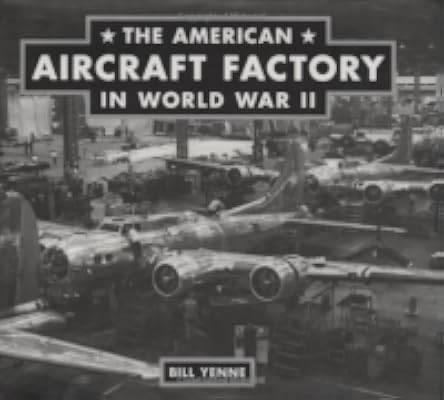
Few industrial phenomena have been as dramatic as the United States' mid-20th-century shift from peacetime to wartime production. The American Aircraft Factory in World War II documents the production of legendary warbirds by companies like Boeing, North American, Curtiss, Consolidated, Douglas, Grumman, and Lockheed. It was a production unmatched by any other country anda crucial part of why the allies won the war. Author Bill Yenne considers the prewar governmental acts that got the plants show more rolling, as well as the gender shift that occurred as women entered the work force like never before. He also describes the construction of megafactories like Willow Run, factory design considerations, and the postwar conversion back to peacetime production. Illustrated with 175 period photographs-including 50 rare color photos never before seen in print. show lessTags
Recommendations



















Member Reviews
That Bill Yenne is an accessible author and passionate researcher has never been more clearly seen than in his book, “The American Aircraft Factory in WWII.” Filled with a plethora of photographs, the text offers readers reams of information regarding U.S. wartime plane production.
Yenne begins by detailing the industry’s beginnings, showing how the ideas of the Wright Brothers – “aeronautical geniuses but not entrepreneurs” – were taken by business people and transformed into an enterprise. But not very quickly: American aviation, Yenne points out, “barely made it into the game (of WWI)” but grew in the 1920’s with the rise of different plane manufacturers, companies about which Yenne provides pages of detailed show more information.
The main thrust of the book, obviously, is plane production during WWII, and Yenne dovetails information regarding the industry with then-current international events. For instance, prior to Pearl Harbor, some within US government wanted a build-up of American air power when they saw that the Luftwaffe (literally, “air weapon,” the name of Nazi Germany’s air force) was the focus and representation of Germany’s military strength. In the chapter entitled, “Backing into WWII,” Yenne explains that FDR requested congressional permission to create 50,000 planes on May 16, 1940, “two days after the Netherlands’ government fled in disarray [and] Hitler’s blitzkrieg was on the move and France teetered on the brink of collapse.”
Yenne obviously loves numbers and when placed within this historical context, they are often quite illuminating. For instance, he mentions that American aircraft factories produced 2,383 planes “in the last pre-Pearl Harbor quarter” but two years later, during the third quarter of 1943, 11,776 aircraft were created by US factories. And as the daughter of a young tail gunner who flew missions in several types of B-26’s rather late in the European theater, I was interested to learn from Yenne’s book that 1,883 B-26B’s were built in Baltimore and 1,210 B-26C’s in Omaha (and I also enjoyed viewing the photographs of partially-finished B-26's included in the book).
Filling the page opposite the book’s introduction, there is an immensely appealing color photograph of a female aviation factory worker leaning on the inside of a partially-finished plane (one presumes), hair net in place, tool in hand, a stunning, red-lipped smile across her face, and a big wink for the camera. The caption mentions that the war’s “Rosie the Riveters” were the most well paid in the aviation sector and Yenne’s book is filled with a plethora of such photographs, many of them staged, some of them obviously not so.
It is photographs like these that provide the book with a general appeal for WWII aficionados but for those with a particular interest in US wartime aviation production, this detailed book is a must-read.
(This review also appears at BookPleasures.com). show less
Yenne begins by detailing the industry’s beginnings, showing how the ideas of the Wright Brothers – “aeronautical geniuses but not entrepreneurs” – were taken by business people and transformed into an enterprise. But not very quickly: American aviation, Yenne points out, “barely made it into the game (of WWI)” but grew in the 1920’s with the rise of different plane manufacturers, companies about which Yenne provides pages of detailed show more information.
The main thrust of the book, obviously, is plane production during WWII, and Yenne dovetails information regarding the industry with then-current international events. For instance, prior to Pearl Harbor, some within US government wanted a build-up of American air power when they saw that the Luftwaffe (literally, “air weapon,” the name of Nazi Germany’s air force) was the focus and representation of Germany’s military strength. In the chapter entitled, “Backing into WWII,” Yenne explains that FDR requested congressional permission to create 50,000 planes on May 16, 1940, “two days after the Netherlands’ government fled in disarray [and] Hitler’s blitzkrieg was on the move and France teetered on the brink of collapse.”
Yenne obviously loves numbers and when placed within this historical context, they are often quite illuminating. For instance, he mentions that American aircraft factories produced 2,383 planes “in the last pre-Pearl Harbor quarter” but two years later, during the third quarter of 1943, 11,776 aircraft were created by US factories. And as the daughter of a young tail gunner who flew missions in several types of B-26’s rather late in the European theater, I was interested to learn from Yenne’s book that 1,883 B-26B’s were built in Baltimore and 1,210 B-26C’s in Omaha (and I also enjoyed viewing the photographs of partially-finished B-26's included in the book).
Filling the page opposite the book’s introduction, there is an immensely appealing color photograph of a female aviation factory worker leaning on the inside of a partially-finished plane (one presumes), hair net in place, tool in hand, a stunning, red-lipped smile across her face, and a big wink for the camera. The caption mentions that the war’s “Rosie the Riveters” were the most well paid in the aviation sector and Yenne’s book is filled with a plethora of such photographs, many of them staged, some of them obviously not so.
It is photographs like these that provide the book with a general appeal for WWII aficionados but for those with a particular interest in US wartime aviation production, this detailed book is a must-read.
(This review also appears at BookPleasures.com). show less
Ratings
Members
- Recently Added By
Author Information

161+ Works 5,131 Members
Bill Yenne is the author of three dozen works of biography and historical nonfiction, including many books on military and aviation history. His previous books about combat aviation include Superfortress: The B-29 and American Airpower in World War II (written with legendary U.S. Air Force commander General Curtis E. LeMay), The Story of the show more Boeing Company, and The American Aircraft Factory in World War II. Most recently, he has written B-52 Stratofortress: The Complete History of the World's Longest Serving and Best Known Bomber. He currently lives in San Francisco, California. www.billyenne.com show less
Common Knowledge
- Important events
- World War II (1939 | 1945); World War II, American Home Front
Classifications
- Genres
- History, Nonfiction, General Nonfiction
- DDC/MDS
- 623.74 — Applied science & technology Engineering Military Vehicles: Land, Air, & Sea Military Aviation; Military Wheeled & Tracked Vehicles; Related Technologies Military Aviation; Military Wheeled & Tracked Vehicles
- LCC
- TL724 .Y46 — Technology Motor vehicles. Aeronautics. Astronautics Motor vehicles. Aeronautics. Astronautics Aeronautics. Aeronautical engineering
- BISAC
Statistics
- Members
- 36
- Popularity
- 800,503
- Reviews
- 1
- Rating
- (3.50)
- Languages
- English
- Media
- Paper, Ebook
- ISBNs
- 3
- UPCs
- 2
- ASINs
- 1