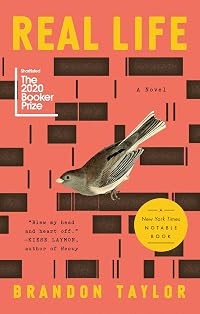
Real Life
by Brandon Taylor
On This Page
Description
"A novel of rare emotional power that excavates the social intricacies of a late-summer weekend -- and a lifetime of buried pain. Almost everything about Wallace, an introverted African-American transplant from Alabama, is at odds with the lakeside Midwestern university town where he is working toward a biochem degree. For reasons of self-preservation, Wallace has enforced a wary distance even within his own circle of friends -- some dating each other, some dating women, some feigning show more straightness. But a series of confrontations with colleagues, and an unexpected encounter with a young straight man, conspire to fracture his defenses, while revealing hidden currents of resentment and desire that threaten the equilibrium of their community"-- show lessTags
Recommendations











Member Reviews
I really liked it. Highly impressive for a debut. The existential ennui of being an overeducated twentysomething plus the grueling realities of graduate school were rendered painfully accurately. I thought that Taylor's portrayal of racism in academia was well done and illuminating. It colors so much of Wallace's experience yet for many of the white people around him there's this plausible deniability as though he isn't a reliable narrator. There's a passage that really struck me about how when you identify something as racist, white people "hold it up to the light" to verify it as though you cannot be trusted and they have to verify it themselves. The metaphor is powerful.
This isn't the easiest read -- it also grapples with topics show more like the long term ramifications of childhood sexual abuse. I liked the contemplation of how childhood relationships and abandonment by parents impact decision paralysis as a young adult.
Anyway, a great read that I might not have discovered other than the Booker list. Check it out. show less
This isn't the easiest read -- it also grapples with topics show more like the long term ramifications of childhood sexual abuse. I liked the contemplation of how childhood relationships and abandonment by parents impact decision paralysis as a young adult.
Anyway, a great read that I might not have discovered other than the Booker list. Check it out. show less
Emma puts her head on Wallace's shoulder, but she won't say anything either, can't bring herself to. No one does. No one ever does. Silence is their way of getting by, because if they are silent long enough, then this moment of minor discomfort will pass for them, will fold down into the landscape of the evening as if it never happened. Only Wallace will remember it.
When Wallace begins his graduate studies in chemistry at a university in the midwest, it feels like a chance to begin again, without baggage. But a few years in and Wallace is still himself and he's still a Black man in an almost entirely white environment. This novel recounts a few days in Wallace's life, as he negotiates his way through a difficult and hostile lab show more environment, his friend group where he feels like an outsider, always, and his own loneliness, based both on his father's recent death and his lack of romantic attachments. Into that comes Miller, another chemistry post-graduate, with whom he has always felt a certain hostility.
This was a difficult novel to read, not because of the writing, which is very, very good, but because the novel is so centered on Wallace and Wallace is seriously depressed. Wallace has lost any resiliency he might once have had and the casual micro-aggressions (and overt hostilities) leave him drained and deeply unhappy. He's damped down his own anger so deeply that he comes across to his friends and co-workers as affectless and unemotional, but that careful veneer is one that is eating away at him and this moment, when the end of the summer weather is beautiful and he can almost see the finishing lines of his PhD, is when he can no longer sustain the effort, even when there's the possibility of love. show less
When Wallace begins his graduate studies in chemistry at a university in the midwest, it feels like a chance to begin again, without baggage. But a few years in and Wallace is still himself and he's still a Black man in an almost entirely white environment. This novel recounts a few days in Wallace's life, as he negotiates his way through a difficult and hostile lab show more environment, his friend group where he feels like an outsider, always, and his own loneliness, based both on his father's recent death and his lack of romantic attachments. Into that comes Miller, another chemistry post-graduate, with whom he has always felt a certain hostility.
This was a difficult novel to read, not because of the writing, which is very, very good, but because the novel is so centered on Wallace and Wallace is seriously depressed. Wallace has lost any resiliency he might once have had and the casual micro-aggressions (and overt hostilities) leave him drained and deeply unhappy. He's damped down his own anger so deeply that he comes across to his friends and co-workers as affectless and unemotional, but that careful veneer is one that is eating away at him and this moment, when the end of the summer weather is beautiful and he can almost see the finishing lines of his PhD, is when he can no longer sustain the effort, even when there's the possibility of love. show less
this book is very good, and very fucking heavy. miserable and frustrating at times, but also, i feel like that's the point. as someone who has indeed been through the grad school machine, and for science too, there were parts of this that really, really hit. the parts of this story that were foreign to me are places not for me to comment, but to listen.
i think the writing is at times extraordinary and captivating, and of course, this book does my favourite thing ever, which is taking place over the space of a very limited timespan. i absolutely devoured it. i think it's one of those things where you feel obliged not to look away - i think, "enjoyed" is not the word for my relationship to this narrative. (except for the moment when show more wallace blew it up at the dinner party, when i was full on howling, though i'm not sure if i was meant to take so much glee in that.) i enjoyed the writing, certainly, i luxuriated in it. and as for the story - as for the discomfort - i sat with it.
i do think everyone should read this. show less
i think the writing is at times extraordinary and captivating, and of course, this book does my favourite thing ever, which is taking place over the space of a very limited timespan. i absolutely devoured it. i think it's one of those things where you feel obliged not to look away - i think, "enjoyed" is not the word for my relationship to this narrative. (except for the moment when show more wallace blew it up at the dinner party, when i was full on howling, though i'm not sure if i was meant to take so much glee in that.) i enjoyed the writing, certainly, i luxuriated in it. and as for the story - as for the discomfort - i sat with it.
i do think everyone should read this. show less
I didn't quite enjoy this, but then again I am not overly fond of clearly autobiographical, "social issue" novels by debut novelists. Still, these are the core concerns of the vast majority of debut novelists, so I can't complain too much. My doubts were more to do with the emptiness of many of the characters and the overall milieu; perhaps I am just becoming too aged and decrepit to care about the easily emotional lives of the youth?
Lest I sound cruel, Taylor's literary style is exacting, beautiful, often poignant, able to conjure up realistic social moments of the zeitgeist as competently as more lyrical emotional passages. I will be keen to read what Taylor does next.
Lest I sound cruel, Taylor's literary style is exacting, beautiful, often poignant, able to conjure up realistic social moments of the zeitgeist as competently as more lyrical emotional passages. I will be keen to read what Taylor does next.
2. Real Life by Brandon Taylor
reader: Kevin R. Free
published: 2020
format: 9:25 audible audiobook (329 pages in hardcover)
acquired: December21
listened: Dec 22 – Jan 6
rating: 4
locations: UW Madison
about the author: from rural Alabama, born 1989
My sixth book on the 2020 Booker longlist, and while I didn't exactly love this book or find it fun, I liked it a lot and particularly enjoyed all the layers happening simultaneously. Wallace, black, gay, from rural Alabama, is a biochemistry grad student in the very very white University of Wisconsin, in very very white Madison, WI (neither the school or city are mentioned by name). He is desperately searching for and wanting some kind of intimate connection, while doing everything conceivably show more possible to avoid or limit this. He's lonely, unexpressive, unwilling to let anyone see any part of what's inside of him, and he presents an outwardly milk toast faux-cheerful calm, an armor of dullness. He's constantly aroused by men around him, and in a constant battle not to feel that, not to feel any emotion. Also, he's a good, but mediocre grad student with that defeated aspect that grad students typically have hanging over him, while surrounded by a bunch of fellow grad students in roughly that same empty mental place. (Being in grad school, and hanging out with grad students is sometimes a weird experience of being surrounded by smart interesting people you more or less admire and hating everything about it. That is vividly captured here.) But Wallace is extra-self-defeating. His contradictions, the racism, the homosexuality and the defeat run through this novel.
Taylor claims he wrote this book in five weeks, which is interesting because of how much he put into it. At five weeks an author doesn't have time to struggle with doubt, or rethink. He must have had all this in mind at the start and carried it out. What I really like is he conveys all this stuff above without talking about it. He just goes through a weekend, and a series of interesting enough things are happening on the surface, but these atmospheres (plural intended) pervade and mix.
In a so far disappointing Booker longlist of monotonous and overly-long texts, this stands out.
2021
https://www.librarything.com/topic/328037#7385936 show less
reader: Kevin R. Free
published: 2020
format: 9:25 audible audiobook (329 pages in hardcover)
acquired: December21
listened: Dec 22 – Jan 6
rating: 4
locations: UW Madison
about the author: from rural Alabama, born 1989
My sixth book on the 2020 Booker longlist, and while I didn't exactly love this book or find it fun, I liked it a lot and particularly enjoyed all the layers happening simultaneously. Wallace, black, gay, from rural Alabama, is a biochemistry grad student in the very very white University of Wisconsin, in very very white Madison, WI (neither the school or city are mentioned by name). He is desperately searching for and wanting some kind of intimate connection, while doing everything conceivably show more possible to avoid or limit this. He's lonely, unexpressive, unwilling to let anyone see any part of what's inside of him, and he presents an outwardly milk toast faux-cheerful calm, an armor of dullness. He's constantly aroused by men around him, and in a constant battle not to feel that, not to feel any emotion. Also, he's a good, but mediocre grad student with that defeated aspect that grad students typically have hanging over him, while surrounded by a bunch of fellow grad students in roughly that same empty mental place. (Being in grad school, and hanging out with grad students is sometimes a weird experience of being surrounded by smart interesting people you more or less admire and hating everything about it. That is vividly captured here.) But Wallace is extra-self-defeating. His contradictions, the racism, the homosexuality and the defeat run through this novel.
Taylor claims he wrote this book in five weeks, which is interesting because of how much he put into it. At five weeks an author doesn't have time to struggle with doubt, or rethink. He must have had all this in mind at the start and carried it out. What I really like is he conveys all this stuff above without talking about it. He just goes through a weekend, and a series of interesting enough things are happening on the surface, but these atmospheres (plural intended) pervade and mix.
In a so far disappointing Booker longlist of monotonous and overly-long texts, this stands out.
2021
https://www.librarything.com/topic/328037#7385936 show less
Wallace is a graduate student in a campus situated in the American midwest. Originally from Alabama, he struggles to work, even exist, in a prejudiced environment rife with unhealthy and unnecessary competition, sabotage, and racist micro(and macro?)-aggressions. Being Black, gay, southern, from a poor background, grief-stricken, and battling traumatic abuse from childhood, Wallace finds little to no solace from his environment. My reactions to the people of this book were simply pity (for Wallace) and rage (for nearly everyone else). Those who are meant to be his friends (mostly white) not only struggle to understand him but also make horrid statements about his race, or are silent and thus complicit to his abuse. The only Black people show more he is familiar with are the cleaning staff who he has no relationship with. Which means he is isolated with no community to help him at all. And to top it all off (I'll resist the obvious puns) the protagonist is having a sexual and abusive relationship with a violent closeted/curious man. I haven't read a book with such a detestable lineup of characters since Luster, which is similar to this book in some ways, and I couldn't wait to quit it. But just like Luster, this book was hard to leave when I started it.
The problem I had with this book was its unending violence, and whether the abuse the protagonist constantly faces was necessary to the story. No doubt pain exists in the world. In many forms, is inevitable, and the individual and systemic reasons for pain are mostly enmeshed. Grief, loss, abuse, violence, war and death exist. So does racism, homophobia, sexism, transphobia, poverty, exploitation of the ruling classes on the masses and marginalized, the quick decay of the planet caused by the insatiable greed of those who already possess too much, the quotidian persecution and violations of rights of others. Yet, I don't see why readers should simply become voyeurs to the suffering of others, even if they're fictional characters. Undoubtedly, art that creates a pristine world completely devoid of all this pain is unrealistic and false, but I no longer understand the use for the opposite; where all kinds of traumatic events are thrown at the protagonist, the kitchen sink, the cabinets, the drain pipes, the tiles, the ceiling, and the concrete all included.
At the same time I have to acknowledge that had I read this book some years ago I would have completely handed myself over to it. It happened with A Little Life, which in hindsight is worse than this book in that sense, and offers even less context for the suffering that occurs. The portrayal of loneliness, pain, self-loathing, and even the self-destructive actions in this book all rang true. So as I read this I wondered, what had changed? Did I simply become prudish over time? The easy answer would have been a change in reading tastes, which happens, but that would be false because this is well written literary fiction which I'd typically go for. But the true answer, and one that was more difficult to understand, is that as I have read and discovered more over the years my opinion on life and its depictions of it have changed. A (real) life, I think, isn't only the sum of the pain and traumas that could be or have been endured.
It's still undeniable that, as I've mentioned earlier, this is a well-written book. It takes some level of skill to create and maintain the tension in this book, especially as its duration is just a weekend. show less
The problem I had with this book was its unending violence, and whether the abuse the protagonist constantly faces was necessary to the story. No doubt pain exists in the world. In many forms, is inevitable, and the individual and systemic reasons for pain are mostly enmeshed. Grief, loss, abuse, violence, war and death exist. So does racism, homophobia, sexism, transphobia, poverty, exploitation of the ruling classes on the masses and marginalized, the quick decay of the planet caused by the insatiable greed of those who already possess too much, the quotidian persecution and violations of rights of others. Yet, I don't see why readers should simply become voyeurs to the suffering of others, even if they're fictional characters. Undoubtedly, art that creates a pristine world completely devoid of all this pain is unrealistic and false, but I no longer understand the use for the opposite; where all kinds of traumatic events are thrown at the protagonist, the kitchen sink, the cabinets, the drain pipes, the tiles, the ceiling, and the concrete all included.
At the same time I have to acknowledge that had I read this book some years ago I would have completely handed myself over to it. It happened with A Little Life, which in hindsight is worse than this book in that sense, and offers even less context for the suffering that occurs. The portrayal of loneliness, pain, self-loathing, and even the self-destructive actions in this book all rang true. So as I read this I wondered, what had changed? Did I simply become prudish over time? The easy answer would have been a change in reading tastes, which happens, but that would be false because this is well written literary fiction which I'd typically go for. But the true answer, and one that was more difficult to understand, is that as I have read and discovered more over the years my opinion on life and its depictions of it have changed. A (real) life, I think, isn't only the sum of the pain and traumas that could be or have been endured.
It's still undeniable that, as I've mentioned earlier, this is a well-written book. It takes some level of skill to create and maintain the tension in this book, especially as its duration is just a weekend. show less
Beautifully written but full of so much pain. The book takes place over only a few days but encompasses lifetimes---how the characters, particularly Wallace, came to this point...and of course, where is he going...where are all of these graduate students going. Taylor writes with a tremendous amount of emotional and physical detail---not only the sex but the individual feelings of sweat, fear. desperation and on and on. A sequel 10 years in the future for these characters?
Members
- Recently Added By
Published Reviews
ThingScore 100
Real Life will undoubtedly unsettle some readers, but it will do the opposite for others, offering relief and validation at finally having their own experiences and truths recognized and reflected in a novel, and artfully so. Taylor’s language is breathtaking in its precision and poetry, and he has a real talent for writing beautifully about ugly, brutal things. The result is a book that can show more only be described as the perfect union of the two—brutiful—and should be considered essential reading for all. show less
added by karenb
Taylor’s book isn’t about overcoming trauma or the perils of academia or even just the experience of inhabiting a black body in a white space, even as Real Life does cover these subjects. Taylor is also tackling loneliness, desire and — more than anything — finding purpose, meaning and happiness in one’s own life. What makes it most special, though, is that Real Life is told from the show more perspective of Wallace, who, like so many other gay black men I know, understands how such a quest is further complicated by racism, poverty and homophobia. Such is often the case with publishing itself, an industry that is only now releasing works from queer black men. How fortunate we are for Real Life, another stunning contribution from a community long deserving of the chance to tell its stories. show less
added by karenb
In Taylor’s stunning debut, “Real Life,” quiet diligence toward one’s goals mutates into a spiral that leaves the mind and body bruised as if survivors of a psychic war zone.
added by karenb
Lists

The Guardian Books of the Year 2020
126 works; 8 members

Phi Beta Kappa reading list
260 works; 8 members

Books Read in 2020
4,379 works; 124 members
Talk Discussions
Past Discussions
2020 Booker Prize Longlist: Real Life by Brandon Taylor in Booker Prize (August 2020)
Author Information

5+ Works 2,000 Members
Some Editions
Awards and Honors
Awards
Distinctions
Common Knowledge
- Canonical title
- Real Life
- Original publication date
- 2020-02-18
- Important places
- Wisconsin, USA
- Canonical DDC/MDS
- 813.6
- Canonical LCC
- PS3620.A93534
Classifications
Statistics
- Members
- 1,210
- Popularity
- 20,516
- Reviews
- 43
- Rating
- (3.73)
- Languages
- English, French, German
- Media
- Paper, Audiobook, Ebook
- ISBNs
- 11
- ASINs
- 4